

The DOI matches its Crossref record; 3 of the 3 references it cites were found in a registry or an index.
Contrasting Effects of Sleep Restriction, Total Sleep Deprivation, and Sleep Timing on Positive and Negative Affect
Abstract
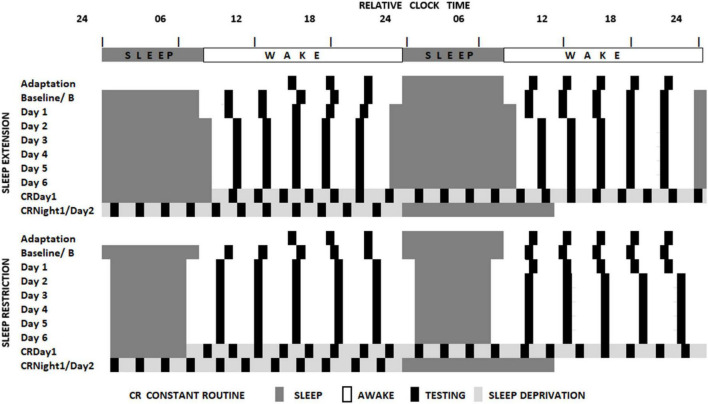
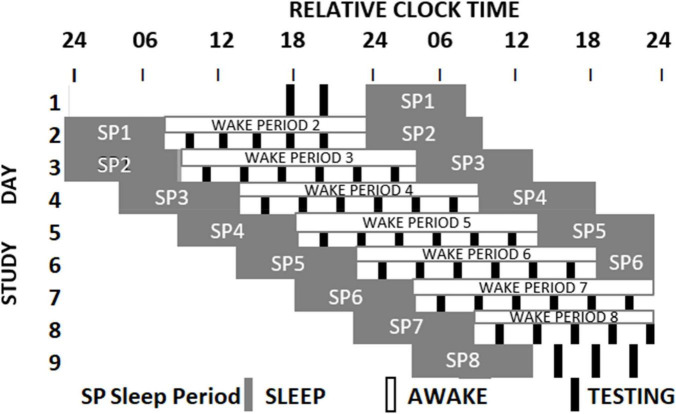
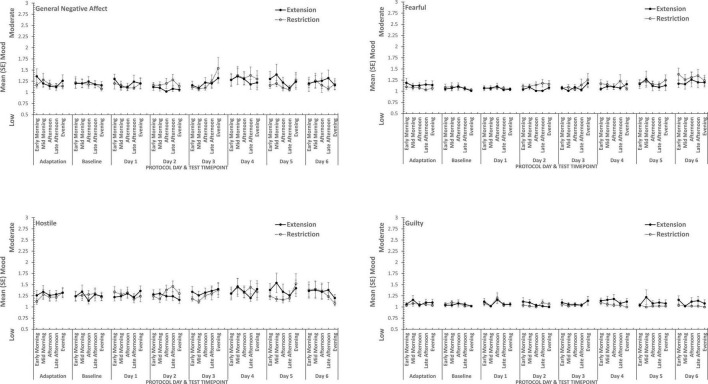
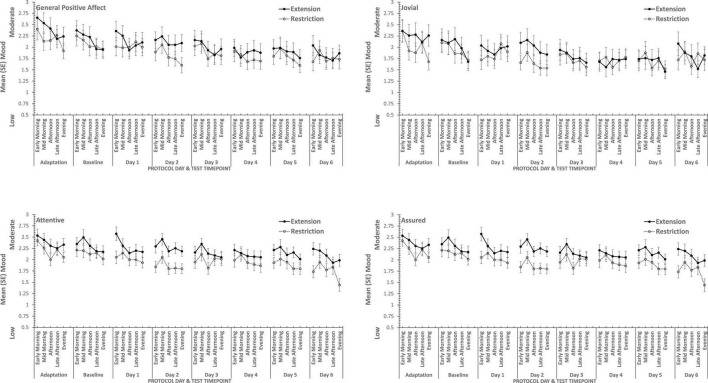
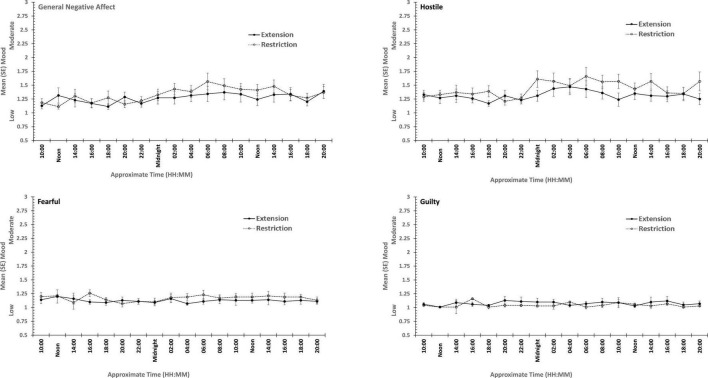
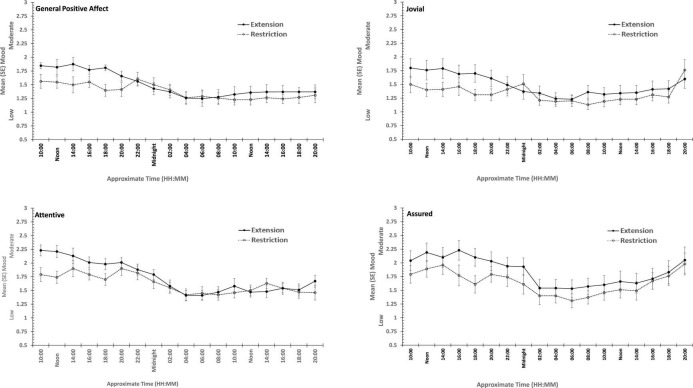
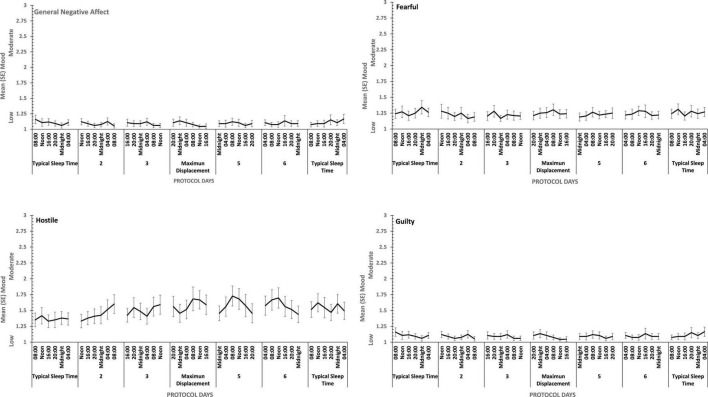
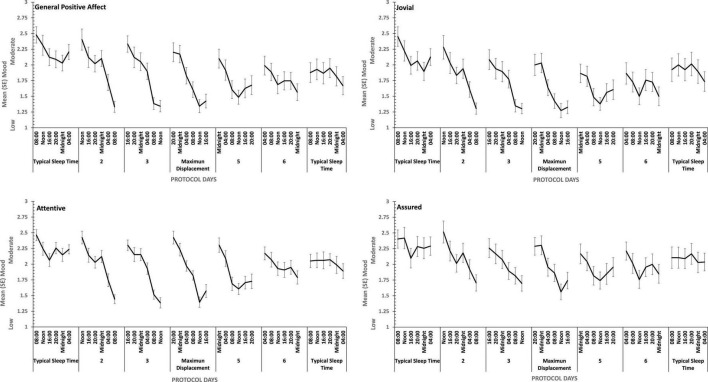
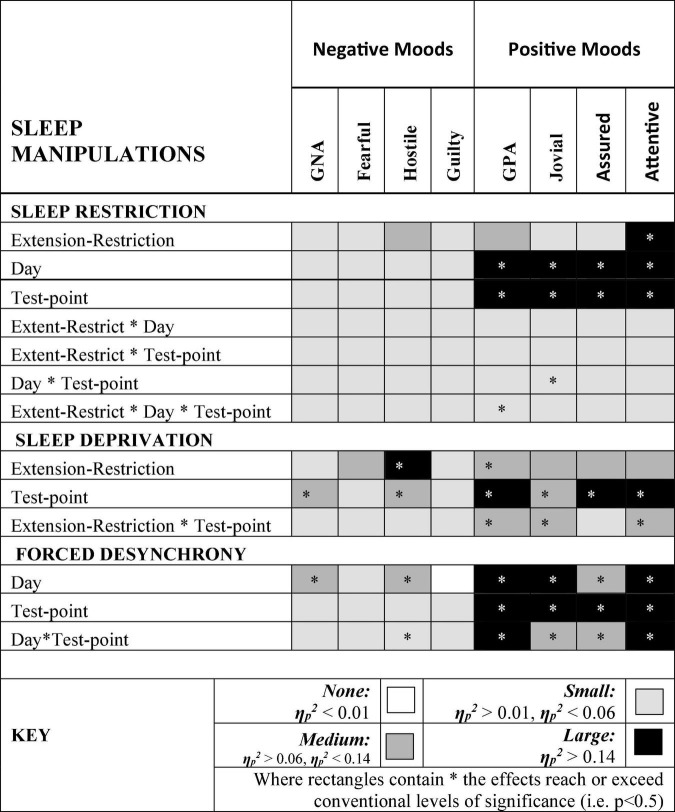
Laboratory-based sleep manipulations show asymmetries between positive and negative affect, but say little about how more specific moods might change. We report extensive analyzes of items from the Positive and Negative Affect Scale (PANAS) during days following nights of chronic sleep restriction (6 h sleep opportunity), during 40 h of acute sleep deprivation under constant routine conditions, and during a week-long forced desynchrony protocol in which participants lived on a 28-h day. Living in the laboratory resulted in medium effects sizes on all positive moods (Attentiveness, General Positive Affect, Joviality, Assuredness), with a general deterioration as the days wore on. These effects were not found with negative moods. Sleep restriction reduced some positive moods, particularly Attentiveness (also General Positive), and increased Hostility. A burden of chronic sleep loss also led to lower positive moods when participants confronted the acute sleep loss challenge, and all positive moods, as well as Fearfulness, General Negative Affect and Hostility were affected. Sleeping at atypical circadian phases resulted in mood changes: all positive moods reduced, Hostility and General Negative Affect increased. Deteriorations increased the further participants slept from their typical nocturnal sleep. In most cases the changes induced by chronic or acute sleep loss or mistimed sleep waxed or waned across the waking day, with linear or various non-linear trends best fitting these time-awake-based changes. While extended laboratory stays do not emulate the fluctuating emotional demands of everyday living, these findings demonstrate that even in controlled settings mood changes systematically as sleep is shortened or mistimed.
Overview
The claims and statistics of this paper haven’t been checked yet.
Run the check — free, no account needed. It reads the open-access text and checks the sources it cites.
Integrity signals
Registry
Cites
Statistics
Figures
Verification
Claims the paper makes
The claims and statistics of this paper haven’t been checked yet.
Run the check — free, no account needed. It reads the open-access text and checks the sources it cites.
Claims other papers make about this one
Each is checked against this paper’s own text: does it say what the citing paper says it does?
In the citing paper
“Attention tended to decline during the first day after SD, but it was to recover the next day (68).”
From Sleep deprivation alters utilization of negative feedback in risky decision-making (2024) · cites this paper as [68]
In the citing paper
“In the present study, the effects on positive moods were greater than those on negative moods, which suggested that the influence of the circadian phase on general negative affect is particularly strong (68).”
From Sleep deprivation alters utilization of negative feedback in risky decision-making (2024) · cites this paper as [68]
Self-check
Percentages, sums and reported differences re-computed from the paper’s own numbers.
The self-check needs the paper’s full text.
Citations
Cites
Mechanisms linking circadian clocks, sleep, and neurodegeneration
Musiek, E. S., & Holtzman, D. M. (2016) · Science · doi:10.1126/science.aah4968 · Cited by 878
Complex Interaction of the Sleep-Wake Cycle and Circadian Phase Modulates Mood in Healthy Subjects
Boivin, D. B. (1997) · Archives of General Psychiatry · doi:10.1001/archpsyc.1997.01830140055010 · Cited by 378
Lo, J. C., Groeger, J. A., Santhi, N., Arbon, E. L., Lazar, A. S., Hasan, S., von Schantz, M., Archer, S. N., & Dijk, D.-J. (2012) · PLoS ONE · doi:10.1371/journal.pone.0045987 · Cited by 342
Self-citation
Research works printed but not linked: 30
- Akerstedt, 2013, The daily variation in sleepiness and its relation to the preceding sleep episode–a prospective study across 42 days of normal living., J. Sleep Res., 22, 258, 10.1111/jsr.12014 · DOI · Paper page
- 2013, Diagnostic and Statistical Manual of Mental Disorders 5 th Edn.
- Barrett, 1999, The structure of current affect: controversies and emerging consensus., Curr. Dir. Psychol. Sci., 8, 10, 10.1088/1478-3975/10/4/040301 · DOI
- Boivin, 2016, Diurnal and circadian variation of sleep and alertness in men vs. naturally cycling women., Proc. Natl. Acad. Sci., 113, 10980, 10.1073/pnas.1524484113 · DOI
- Cohen, 1988, Statistical Power Analysis for the Behavioral Sciences.
- Duffy, 2002, Getting through to circadian oscillators: why use constant routines?, J. Biol. Rhythms, 17, 4, 10.1177/074873002129002294 · DOI · Paper page
- Dijk, 2010, Age-related reduction in daytime sleep propensity and nocturnal slow wave sleep: Implications for insomnia., Sleep, 33, 211, 10.1093/sleep/33.2.211 · DOI
- Dinges, 1997, Cumulative sleepiness, mood disturbance, and psychomotor vigilance performance decrements during a week of sleep restricted to 4-5 hours per night., Sleep., 20, 267
- Groeger, 2014, Dissociating effects of global SWS disruption and healthy aging on waking performance and daytime sleepiness., Sleep, 37, 1127, 10.5665/sleep.3776 · DOI
- Groeger, 2008, Early morning executive functioning during sleep deprivation is compromised by a PERIOD3 polymorphism., Sleep, 31, 1159
- Harous, 2021, Consecutive nights of moderate sleep loss does not affect mood in healthy young males., Clocks Sleep, 3, 442, 10.3390/clockssleep3030031 · DOI
- Hertenstein, 2019, Insomnia as a predictor of mental disorders: a systematic review and meta-analysis., Sleep Med. Rev., 43, 96, 10.1016/j.smrv.2018.10.006 · DOI · Paper page
- 2021, IBM SPSS Statistics for Windows, Version 28.0.0.
- Kaida, 2014, Total sleep deprivation decreases flow experience and mood status., Neuropsychiatr. Dis. Treat., 10, 19, 10.2147/NDT.S53633 · DOI · Paper page
- Kaufmann, 2020, Getting emotional about affect and mood., Aust. N. Z. J. Psychiatry, 54, 850, 10.1177/0004867420943943 · DOI
- Larsen, 1992, Promises and problems with the circumplex model of emotion, Review of personality and social psychology: emotion, 25, 10.1177/0004867420943943 · DOI
- Li, 2021, Relation of decreased functional connectivity between left thalamus and left inferior frontal gyrus to emotion changes following acute sleep deprivation., Front. Neurol., 12, 642411, 10.3389/fneur.2021.642411 · DOI
- McNair, 1971, Manual for the Profile of Mood States.
- Meney, 1988, The effect of one night’s sleep deprivation on temperature, mood, and physical performance in subjects with different amounts of habitual physical activity., Chronobiol. Int., 15, 349, 10.3109/07420529808998695 · DOI
- Russell, 1980, A circumplex model of affect., J. Pers. Soc. Psychol., 39, 1161, 10.1037/h0077714 · DOI · Paper page
- Saksvik-Lehouillier, 2020, Mild to moderate partial sleep deprivation is associated with increased impulsivity and decreased positive affect in young adults., Sleep, 43, zsaa078, 10.1093/sleep/zsaa078 · DOI
- Santhi, 2016, Sex differences in the circadian regulation of sleep and waking cognition in humans., PNAS, 113, E2730, 10.1073/pnas.1521637113 · DOI
- Shen, 2022, Sleep and affect in adolescents: bidirectional daily associations over 28-day ecological momentary assessment., J Sleep Res., 31, e13491, 10.1111/jsr.13491 · DOI
- Thayer, 1989, The Biopsychology of Mood and Activation.
- Vandewalle, 2009, Functional magnetic resonance imaging-assessed brain responses during an executive task depend on interaction of sleep homeostasis, circadian phase, and PER3 genotype., J. Neurosci., 29, 7948, 10.1523/JNEUROSCI.0229-09.2009 · DOI
- Vidafar, 2018, Increased vulnerability to attentional failure during acute sleep deprivation in women depends on menstrual phase., Sleep, 41, zsy098, 10.1093/sleep/zsy098 · DOI · Paper page
- Watson, 1985, Toward a consensual structure of mood., Psychol. Bull., 98, 219, 10.1037//0033-2909.98.2.219 · DOI · Paper page
- Watson, 1988, Development and validation of brief measures of positive and negative affect: The PANAS scales., J. Pers. Soc. Psychol., 54, 1063, 10.1037/0022-3514.54.6.1063 · DOI · Paper page
- Wong, 2021, Day-to-day associations between sleep characteristics and affect in community dwelling adults., J. Sleep Res., 30, e13297, 10.1111/jsr.13297 · DOI
- Wundt, An Introduction to Psychology (R. Pintner, Trans.)., 10.1037/13784-000 · DOI
Cited by
Sorted by citations
Sleep deprivation alters utilization of negative feedback in risky decision-making
Xu, W., Wang, L., Yang, L., Zhu, Y., & Chen, P. (2024) · Frontiers in Psychiatry · doi:10.3389/fpsyt.2024.1307408 · Cited by 2
Metadata
- Authors
- Groeger, J. A., Lo, J. C.-Y., Santhi, N., Lazar, A. S., & Dijk, D.-J.
- Venue
- Frontiers in Behavioral Neuroscience
- Publisher
- Frontiers Media SA
- Published
- 2022-08-17
- Volume
- 16
- ISSN
- 1662-5153
- PMC
- PMC9433122
- Cited by
- 30
- References
- 3
About these checks
Registry, retraction, Cites and statistics results are computed, not judged, with one exception: a printed reference that no index lists is read once by a model before it counts as a citation error. Claims are extracted by a model and kept only when their quote appears verbatim in the text; each cited source is then checked, with a model’s help, for whether it says what the claim relies on. Those verdicts can be wrong — read the claim’s quote and the cited source before relying on one.
Statistics and arithmetic are recomputed, not judged.
Confidence bands are shown only for fields calibrated on our annotated test set. None is calibrated yet, so no band is shown.
What counts as a claim ›How we measure confidence ›How we check this ›
Are you an author, or do you see a problem with this page? Request a review
