

The DOI matches its Crossref record; 233 of the 236 references it cites were found in a registry or an index.
Hypocretin as a Hub for Arousal and Motivation
Open accessAbstract
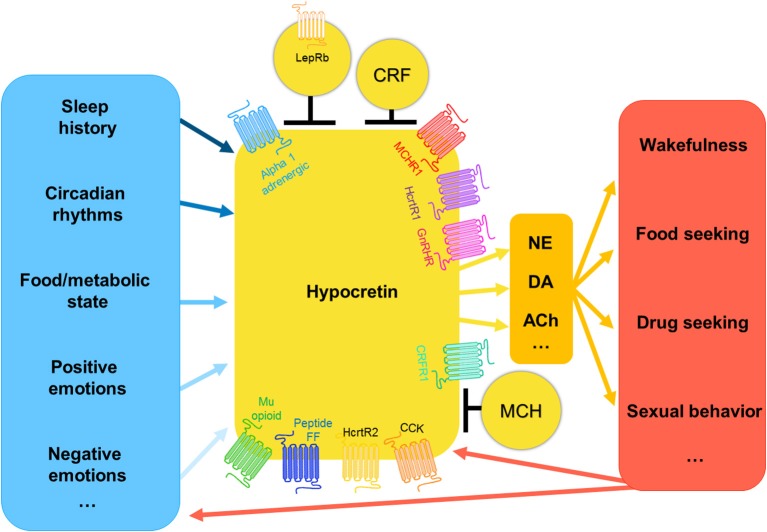
The lateral hypothalamus is comprised of a heterogeneous mix of neurons that serve to integrate and regulate sleep, feeding, stress, energy balance, reward, and motivated behavior. Within these populations, the hypocretin/orexin neurons are among the most well studied. Here, we provide an overview on how these neurons act as a central hub integrating sensory and physiological information to tune arousal and motivated behavior accordingly. We give special attention to their role in sleep-wake states and conditions of hyper-arousal, as is the case with stress-induced anxiety. We further discuss their roles in feeding, drug-seeking, and sexual behavior, which are all dependent on the motivational state of the animal. We further emphasize the application of powerful techniques, such as optogenetics, chemogenetics, and fiber photometry, to delineate the role these neurons play in lateral hypothalamic functions.
Overview
The claims and statistics of this paper haven’t been checked yet.
Run the check — free, no account needed. It reads the open-access text and checks the sources it cites.
Integrity signals
Registry
Cites
Statistics
Figures
Verification
Claims the paper makes
The claims and statistics of this paper haven’t been checked yet.
Run the check — free, no account needed. It reads the open-access text and checks the sources it cites.
Claims other papers make about this one
Each is checked against this paper’s own text: does it say what the citing paper says it does?
The cited source says what the claim attributes to it.
In the citing paper
“orexin maintains wakefulness and arousal, as well as regulates sleep stability.17–21”
From Effects of Traumatic Brain Injury on the Orexin/Hypocretin System (2025) · cites this paper as [20]
Self-check
Percentages, sums and reported differences re-computed from the paper’s own numbers.
The self-check needs the paper’s full text.
Citations
Cites
2 retracted
Wu, X., Gao, J., Yan, J., Owyang, C., & Li, Y. (2004) · Journal of Neurophysiology · doi:10.1152/jn.00791.2003 · Cited by 53
Retractedla Herrán-Arita, A. K. D., Kornum, B. R., Mahlios, J., Jiang, W., Lin, L., Hou, T., Macaubas, C., Einen, M. A., Plazzi, G., Crowe, C., et al. (2014) · Science Translational Medicine · doi:10.1126/scitranslmed.3009995 · Cited by 31
RetractedPositional cloning of the mouse obese gene and its human homologue
Zhang, Y., Proenca, R., Maffei, M., Barone, M., Leopold, L., & Friedman, J. M. (1994) · Nature · doi:10.1038/372425a0 · Cited by 13,419
Sakurai, T., Amemiya, A., Ishii, M., Matsuzaki, I., Chemelli, R. M., Tanaka, H., Williams, S. C., Richardson, J. A., Kozlowski, G. P., Wilson, S., et al. (1998) · Cell · doi:10.1016/s0092-8674(00)80949-6 · Cited by 5,501
Aston-Jones, G., & Cohen, J. D. (2005) · Annual Review of Neuroscience · doi:10.1146/annurev.neuro.28.061604.135709 · Cited by 4,472
Brain stem reticular formation and activation of the EEG
Moruzzi, G., & Magoun, H. W. (1949) · Electroencephalography and Clinical Neurophysiology · doi:10.1016/0013-4694(49)90219-9 · Cited by 4,307
Ghrelin induces adiposity in rodents
Tschöp, M., Smiley, D. L., & Heiman, M. L. (2000) · Nature · doi:10.1038/35038090 · Cited by 3,949
The hypocretins: hypothalamus-specific peptides with neuroexcitatory activity
de Lecea, L., Kilduff, T. S., Peyron, C., Gao, X.-B., Foye, P. E., Danielson, P. E., Fukuhara, C., Battenberg, E. L. F., Gautvik, V. T., Bartlett, F. S., et al. (1998) · Proceedings of the National Academy of Sciences · doi:10.1073/pnas.95.1.322 · Cited by 3,878
Neurons containing hypocretin (orexin) project to multiple neuronal systems
Peyron, C., Tighe, D. K., van den Pol, A. N., de Lecea, L., Heller, H. C., Sutcliffe, J. G., & Kilduff, T. S. (1998) · The Journal of Neuroscience · doi:10.1523/jneurosci.18-23-09996.1998 · Cited by 3,466
A role for ghrelin in the central regulation of feeding
Nakazato, M., Murakami, N., Date, Y., Kojima, M., Matsuo, H., Kangawa, K., & Matsukura, S. (2001) · Nature · doi:10.1038/35051587 · Cited by 3,443
Research works printed but not linked: 1
- Elias, 1998, Chemically defined projections linking the mediobasal hypothalamus and the lateral hypothalamic area, J Comp Neurol., 402, 442, 10.1002/(SICI)1096-9861(19981228)402:4<442::AID-CNE2>3.0.CO;2-R · DOI
Cited by
Sorted by citations
Ross, J. A., & Bockstaele, E. J. V. (2021) · Frontiers in Psychiatry · doi:10.3389/fpsyt.2020.601519 · Cited by 241
To eat or to sleep: That is a lateral hypothalamic question
Arrigoni, E., Chee, M. J. S., & Fuller, P. M. (2018) · Neuropharmacology · doi:10.1016/j.neuropharm.2018.11.017 · Cited by 128
Role of spontaneous and sensory orexin network dynamics in rapid locomotion initiation
Karnani, M., Schöne, C., Bracey, E. F., González, J. A., Viskaitis, P., Li, H., Adamantidis, A., & Burdakov, D. (2020) · Progress in Neurobiology · doi:10.1016/j.pneurobio.2020.101771 · Cited by 89
Effects of orexin receptor antagonism on human sleep architecture: A systematic review
Clark, J. W., Brian, M. L., Drummond, S. P. A., Hoyer, D., & Jacobson, L. H. (2020) · Sleep Medicine Reviews · doi:10.1016/j.smrv.2020.101332 · Cited by 89
Brunes, L. C., Baldi, F. S., Lopes, F. B., Lôbo, R. B., Espigolan, R., Costa, M. F. O. E., Stafuzza, N. B., & Magnabosco, C. D. U. (2020) · Journal of Animal Breeding and Genetics · doi:10.1111/jbg.12496 · Cited by 78
Metadata
- Authors
- Tyree, S. M., Borniger, J. C., & de Lecea, L.
- Affiliations
- Stanford University (US)
- Venue
- Frontiers in Neurology
- Publisher
- Frontiers Media SA
- Published
- 2018-06-06
- Volume
- 9
- Pages
- 413-413
- ISSN
- 1664-2295 (ISSN-L)
- PMC
- PMC5997825
- OpenAlex
- W2806993167
- Cited by
- 83
- References
- 236
- Citations by year
- 2026: 5 · 2025: 5 · 2024: 5 · 2023: 9 · 2022: 15 · 2021: 12 · 2020: 19 · 2019: 10 · 2018: 3
- FWCI
- 1.47
- Type
- journal article
- Language
- en
- Open access
- gold
- doi.org
- Locations
- Frontiers in Neurology (publishedVersion, cc-by)
- Europe PMC (PubMed Central) (publishedVersion, cc-by)
- PubMed Central (publishedVersion, cc-by)
- PubMed (publishedVersion)
- Cold Spring Harbor Laboratory Institutional Repository (Cold Spring Harbor Laboratory) (acceptedVersion)
- DOAJ (DOAJ: Directory of Open Access Journals) (submittedVersion, cc-by-sa)
- Funders
- Neurological Foundation of New Zealand
- Foundation for the National Institutes of Health (F32MH11543, 5R01MH087592, R01MH1026380, 1R01AG047671)
- Boehringer Ingelheim
- Topics
- Life Sciences › Neuroscience › Cognitive Neuroscience › Sleep and Wakefulness Research
- Life Sciences › Neuroscience › Endocrine and Autonomic Systems › Neuroscience of respiration and sleep
- Life Sciences › Neuroscience › Endocrine and Autonomic Systems › Regulation of Appetite and Obesity
- Keywords
- hypocretin/orexin neurons, lateral hypothalamus, arousal, motivation, sleep-wake regulation, hyperarousal, stress-induced anxiety, feeding behavior, drug-seeking behavior, sexual behavior, optogenetics, chemogenetics, fiber photometry
About these checks
Registry, retraction, Cites and statistics results are computed, not judged, with one exception: a printed reference that no index lists is read once by a model before it counts as a citation error. Claims are extracted by a model and kept only when their quote appears verbatim in the text; each cited source is then checked, with a model’s help, for whether it says what the claim relies on. Those verdicts can be wrong — read the claim’s quote and the cited source before relying on one.
Statistics and arithmetic are recomputed, not judged.
Confidence bands are shown only for fields calibrated on our annotated test set. None is calibrated yet, so no band is shown.
What counts as a claim ›How we measure confidence ›How we check this ›
Are you an author, or do you see a problem with this page? Request a review
