

Machine learning models in post-stroke aphasia: a scoping review
Open accessThe DOI matches its Crossref record; 38 of the 38 references it cites were found in a registry or an index; 130 of the 156 sources its claims cite were checked for support.
Abstract
A scoping review of 19 studies evaluating supervised machine learning models (random forests, neural networks, SVM) in post-stroke aphasia for diagnosis, classification, severity estimation, and recovery prediction using multimodal clinical and neuroimaging data.
Overview
CoChat Summary
TL;DR
This scoping review synthesized 19 studies on machine learning models in post-stroke aphasia, finding that supervised algorithms dominate and models are used for diagnosis/classification, severity assessment, rehabilitation outcome prediction, and symptom monitoring. The authors conclude that these models show high applicability but require multi-center, multimodal data and external validation to improve robustness and clinical feasibility.
Key findings
- Of 19 included articles, 18 used supervised machine learning algorithms and 1 used unsupervised learning; common algorithms included support vector machines, random forests, decision trees, logistic regression, and neural networks such as CNNs and RNNs.
- Model functions covered diagnosis/classification of aphasia patients (4 studies), assessment/prediction of aphasia severity (5 studies), prediction of language function and rehabilitation outcome (5 studies), and monitoring/evaluation of symptoms (5 studies).
- Reported performance varied widely: Yourganov et al. reported 93.56% accuracy, Zhong et al. reported AUC 0.92, Billot et al. reported 92.7% accuracy and F1-score 0.94, Močilnik et al. reported 89.4% accuracy, while Landrigan et al. reported 76.9% accuracy, Marte et al. reported 78.3–85% accuracy and F1-score 0.767–0.790, Mahmoud et al. reported 59.17% accuracy, and Wilmskoetter et al. reported AUC 0.62–0.75.
- Data sources were diverse and included general demographic data, clinical indicators, neuroimaging data, and physiological signal data; some studies also used healthy subjects’ speech/behavioral data, public video platforms, or public image databases.
Methods
- Scoping review conducted according to scoping review methodology and reported following PRISMA-ScR; databases searched were Web of Science, PubMed, Cochrane Library, Embase, CINAHL, CNKI, VIP, Wanfang, and China Biology Medicine, from database establishment to November 20, 2025.
- Inclusion criteria followed PCC: participants with post-stroke aphasia, concept of machine learning algorithms, context in medical/health fields, and original research; exclusions were conference abstracts without full text, duplicate publications, and non-Chinese or non-English literature.
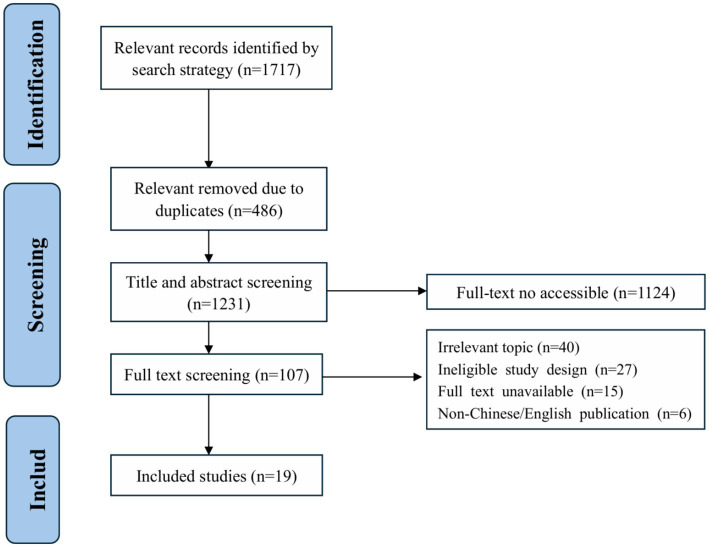
- Two researchers independently screened, extracted, and assessed quality using the JBI quality assessment tool; the initial search yielded 1717 documents, 1231 remained after duplicate removal, 107 underwent full-text review, and 19 documents were included.
Limitations
- The paper states that small sample sizes or single-center designs may limit generalizability; a few studies did not systematically identify or adjust for potential confounding factors; some quasi-experimental studies or randomized controlled trials did not report allocation concealment or blinding; and some outcome measurements were limited in follow-up or multiple measurements.
- The paper also states major gaps: lack of external validation, dominance of single-center and small-sample studies, insufficient integration of multimodal data, and absence of real clinical application and prospective validation.
- Evident from the text: the review was restricted to Chinese- and English-language literature, most included studies were from the United States (12 of 19), and many models completed only internal validation, which further limits generalizability.
Model-written summary. Check it against the paper before relying on it.
Integrity signals
Registry
Cites
Statistics
Figures
Verification
Claims the paper makes
52 Valid · 4 Not valid · 9 Not checked · 57 Own results and interpretations
Some cited sources support this claim and some don’t — read each source’s verdict below.
In the paper
“Seven studies (21, 23, 26, 31, 32, 35, 36) primarily relied on error metrics, such as root mean square error and mean absolute error, combined with indicators, such as the Pearson correlation coefficient and coefficient of determination, to provide a more comprehensive assessment.”
§ Machine learning models in post-stroke aphasia: a scoping review > Results > Evaluation metrics of the machine learning models for post-stroke aphasia
What the sources say
- Supportedcites [21] Hu X Varkanitsa M Kropp E Betke M Ishwar P Kiran S. Aphasia severity prediction using a multi-modal machine learning approach. NeuroImage. (2025) 317: 121300. doi: 10.1016/j.neuroimage.2025.121300, 40554033 PMC12261925 source
The Materials and Methods section (Performance Evaluation and Comparison; page unavailable) says this study evaluated test performance using RMSE, MAE, and the correlation between ground truth and prediction (r), with RMSE as its primary metric. That supports citing it as one example of a study combining error and correlation metrics; the sentence describes the seven studies collectively, rather than requiring each to use every listed indicator. (LLM, conf=0.88)
- Supportedcites [23] Riccardi N Nelakuditi S den Ouden DB Rorden C Fridriksson J Desai RH. Discourse- and lesion-based aphasia quotient estimation using machine learning. Neuroimage Clin. (2024) 42: 103602. doi: 10.1016/j.nicl.2024.103602 38593534 PMC11016805 source
The Machine learning approach section says the study used RMSE, MAE, and Pearson’s correlation to evaluate prediction accuracy. It also reports an R² score during model selection, supporting its inclusion as an example of a study using these metrics. (LLM, conf=0.90)
- Partly supportedcites [26] Hildesheim FE Ophey A Zumbansen A Funck T Schuster T Jamison KW. Predicting language function post-stroke: a model-based structural connectivity approach. Neurorehabil Neural Repair. (2024) 38: 447– 59. doi: 10.1177/15459683241245410, 38602161 PMC11097606 sourceExperimental — accuracy not yet measured
The Methods section (page unavailable) says this study measured prediction error using mean squared error, and the Results section reports R² values. That supports its inclusion as a study using an error metric alongside a coefficient of determination. Our copy does not show this study using root mean square error, mean absolute error, or Pearson correlation, and it cannot establish what the other six studies used. (LLM, conf=0.85)
- Not checked — no full text of the sourcecites [31] Mahmoud SS Kumar A Tang YT Li YC Gu XD Fu JM. An efficient deep learning based method for speech assessment of mandarin-speaking aphasic patients. IEEE J Biomed Health Inform. (2020) 24: 3191– 202. doi: 10.1109/JBHI.2020.3011104, 32750967 source
- Partly supportedcites [32] Kristinsson S Zhang W Rorden C Newman-Norlund R Basilakos A Bonilha L. Machine learning-based multimodal prediction of language outcomes in chronic aphasia. Hum Brain Mapp. (2021) 42: 1682– 98. doi: 10.1002/hbm.25321, 33377592 PMC7978124 sourceExperimental — accuracy not yet measured
In Results (Table 6; page unavailable), the paper reports mean square error alongside Pearson correlation for its prediction models, supporting the claim that it combined an error metric with a correlation indicator. It identifies Pearson correlation—not an error metric—as its measure of accuracy, and does not report root mean square error, mean absolute error, or the coefficient of determination. This paper alone cannot establish what all seven cited studies used. (LLM, conf=0.84)
- Disputedcites [35] Gillespie S Laures-Gore J Moore E Farina M Russell S Haaland B. Identification of affective state change in adults with aphasia using speech acoustics. J Speech Lang Hear Res. (2018) 61: 2906– 16. doi: 10.1044/2018_JSLHR-S-17-0057, 30481797 PMC6440307 sourceExperimental — accuracy not yet measured
The Results (page unavailable) say this study judged model performance using accuracy and the Matthews correlation coefficient, rather than primarily relying on root mean square error or mean absolute error. The Analysis of Correlation of Affective Labels (page unavailable) uses Pearson correlation to compare self-reported scores, not as a model-performance measure; the cited paper therefore does not fit the sentence’s description of the seven studies. (LLM, conf=0.88)
Checked by a reasoning model — may be wrong.
- Supportedcites [36] Pustina D Coslett HB Ungar L Faseyitan OK Medaglia JD Avants B. Enhanced estimations of post-stroke aphasia severity using stacked multimodal predictions. Hum Brain Mapp. (2017) 38: 5603– 15. doi: 10.1002/hbm.23752, 28782862 PMC5765865 source
The Methods (Final STAMP predictions; page unavailable) say the study computed Pearson correlations between predicted and true values. The Results (page unavailable) report prediction accuracy using both r and RMSE. This supports citing the paper as one example among the seven studies; the sentence does not require every listed metric to appear in each study. (LLM, conf=0.91)
plain- Asserted: passes — The authors put it forward as true.
- Checkable: passes — It can be checked against evidence.
- Load-bearing: unclear — It is unclear whether the paper’s conclusions depend on it.
- Based: passes — The paper gives a reason why it holds.
- Supported
Every source the paper cites for this claim was checked and supports it.
In the paper
“One study (30) used unsupervised machine learning algorithms, including clustering.”
§ Machine learning models in post-stroke aphasia: a scoping review > Results > Types of machine learning algorithms applied in machine learning models of post-stroke aphasia
What the sources say
- Supportedcites [30] Landrigan JF Zhang F Mirman D. A data-driven approach to post-stroke aphasia classification and lesion-based prediction. Brain. (2021) 144: 1372– 83. doi: 10.1093/brain/awab010, 34046670 PMC8219353 source
The Introduction says the study used machine-learning techniques and community detection analysis to cluster patients by their language deficits. The Materials and methods section confirms that clustering was applied to the participant datasets. (LLM, conf=0.94)
plain- Asserted: passes — The authors put it forward as true.
- Checkable: passes — It can be checked against evidence.
- Load-bearing: unclear — It is unclear whether the paper’s conclusions depend on it.
- Based: passes — The paper gives a reason why it holds.
- Supported
Every source the paper cites for this claim was checked and supports it.
In the paper
“One model (22) uses speech acoustic features to automatically identify the fluency type of aphasia.”
§ Machine learning models in post-stroke aphasia: a scoping review > Results > Functions and effects of machine learning models for post-stroke aphasia
What the sources say
- Supportedcites [22] Metu J Kotha V Hillis AE. Evaluating fluency in aphasia: fluency scales, trichotomous judgements, or machine learning. Aphasiology. (2023) 38: 168– 80. doi: 10.1080/02687038.2023.2171261, 38425350 PMC10901507 source
The Machine Learning Algorithms section describes a convolutional neural network that detects non-fluent speech versus normal or fluent speech using spectrograms that capture acoustic characteristics such as pauses, slowness, and prosody. The Speech samples section confirms that the model classifies speech from those spectrograms. (LLM, conf=0.90)
plainstates a cause- Asserted: passes — The authors put it forward as true.
- Checkable: passes — It can be checked against evidence.
- Load-bearing: unclear — It is unclear whether the paper’s conclusions depend on it.
- Based: passes — The paper gives a reason why it holds.
- Supported
The cited sources that could be checked couldn’t confirm or dispute this claim.
In the paper
“Yourganov et al. (37) reported an accuracy rate of 93.56%”
§ Machine learning models in post-stroke aphasia: a scoping review > Results > Functions and effects of machine learning models for post-stroke aphasia
What the sources say
- Could not verifycites [37] Yourganov G Smith KG Fridriksson J Rorden C. Predicting aphasia type from brain damage measured with structural MRI. Cortex. (2015) 73: 203– 15. doi: 10.1016/j.cortex.2015.09.005, 26465238 PMC4689665 sourceExperimental — accuracy not yet measured
The Results section describes accuracy by pair of aphasia types and brain atlas, but the passages retrieved from our copy do not report 93.56%. Searches for that figure and for accuracy results did not locate it, so the specific rate cannot be verified from our copy. (LLM, conf=0.70)
plain- Asserted: passes — The authors put it forward as true.
- Checkable: passes — It can be checked against evidence.
- Load-bearing: unclear — It is unclear whether the paper’s conclusions depend on it.
- Based: passes — The paper gives a reason why it holds.
- Could not verify
The sources with a verdict support this claim; the rest weren’t checked yet, have no full text we could read, or their verdicts aren’t rated yet.
In the paper
“Twelve studies (19, 20, 22, 24, 25, 27–30, 33, 34, 37) mainly used accuracy, AUC, F1-score, precision, recall, and other indicators.”
§ Machine learning models in post-stroke aphasia: a scoping review > Results > Evaluation metrics of the machine learning models for post-stroke aphasia
What the sources say
- Not checked yetcites [19] Zhong Y Mahmoud SS Huang L Fang Q. Post-stroke aphasia analysis using topological alterations in brain functional networks. J Neural Eng. (2025) 22: 046027. doi: 10.1088/1741-2552/adef80, 40659033 source
Checked before — its earlier verdict is held back until a new check runs.
- Supportedcites [20] Marte MJ Carpenter E Scimeca M Russell-Meill M Peñaloza C Grasemann U. Machine learning predictions of recovery in bilingual Poststroke aphasia: aligning insights with clinical evidence. Stroke. (2025) 56: 494– 504. doi: 10.1161/STROKEAHA.124.047867, 39744848 PMC11772114 source
The Methods section (Evaluation Metrics) says this study assessed model performance using accuracy, F1 score, precision, and sensitivity (recall), as well as specificity and MCC. The citing sentence lists metrics used across twelve studies; it does not require this study to have used every listed metric. (LLM, conf=0.88)
- Supportedcites [22] Metu J Kotha V Hillis AE. Evaluating fluency in aphasia: fluency scales, trichotomous judgements, or machine learning. Aphasiology. (2023) 38: 168– 80. doi: 10.1080/02687038.2023.2171261, 38425350 PMC10901507 source
The Model results: training set section (page unavailable) reports training and testing accuracy for this study’s machine-learning models. The Abstract (page unavailable) also reports Kappa scores for agreement with clinicians. This supports citing the paper as one of the studies that used performance indicators; the sentence does not require every listed indicator to appear in each study. (LLM, conf=0.90)
- Supportedcites [24] Teghipco A Newman-Norlund R Fridriksson J Rorden C Bonilha L. Distinct brain morphometry patterns revealed by deep learning improve prediction of post-stroke aphasia severity. Commun Med. (2024) 4: 115. doi: 10.1038/s43856-024-00541-8, 38866977 PMC11169346 source
The Methods (Model evaluation) state that this study assessed performance using precision, F1 scores, and class accuracies, and explain how recall relates to severe-class accuracy. The citing sentence lists metrics used across twelve studies; it does not claim that each study used every listed metric. (LLM, conf=0.88)
- Supportedcites [25] Močilnik V Rutar Gorišek V Sajovic J Pretnar Oblak J Drevenšek G Rogelj P. Integrating EEG and machine learning to analyze brain changes during the rehabilitation of Broca’s aphasia. Sensors (Basel). (2024) 24: 329. doi: 10.3390/s24020329, 38257423 PMC10818958 source
Section 3.2 reports that this study evaluated its machine-learning models using accuracy, precision, sensitivity (recall), specificity, the F-measure, and ROC curves. That supports citing it as one of the studies using model-performance indicators; the sentence does not require every listed study to have used every indicator. (LLM, conf=0.88)
- Supportedcites [27] Mahmoud SS Pallaud RF Kumar A Faisal S Wang Y Fang Q. A comparative investigation of automatic speech recognition platforms for aphasia assessment batteries. Sensors (Basel). (2023) 23: 857. doi: 10.3390/s23020857 36679654 PMC9863375 source
The Results section states that this study evaluated its speech-recognition models using accuracy, precision, recall, and F1-score. The citing sentence lists metrics used across twelve studies; it does not attribute every listed metric, including AUC, to this individual paper. (LLM, conf=0.90)
- Supportedcites [28] Jeong S Lee EJ Kim YH Woo JC Ryu OW Kwon M. Deep learning approach using diffusion-weighted imaging to estimate the severity of aphasia in stroke patients. Journal of. Stroke. (2022) 24: 108– 17. doi: 10.5853/jos.2021.02061 PMC8829479 35135064 source
The Results section, “Performance of the machine-learning model,” reports accuracy for categorized aphasia severity and also evaluates performance using Cohen’s weighted kappa and correlation coefficients. This supports citing the paper as one of the studies that used performance indicators; the sentence does not require every listed metric to appear in every study. (LLM, conf=0.90)
- Supportedcites [29] Billot A Lai S Varkanitsa M Braun EJ Rapp B Parrish TB. Multimodal neural and behavioral data predict response to rehabilitation in chronic Poststroke aphasia. Stroke. (2022) 53: 1606– 14. doi: 10.1161/STROKEAHA.121.036749, 35078348 PMC9022691 source
The Methods ('Model development and evaluation') state that this study evaluated prediction performance using accuracy, F1 score, precision, and recall. The citing sentence lists it among twelve studies and gives a collective list of indicators; it does not assert that this particular study used AUC. (LLM, conf=0.91)
- Supportedcites [30] Landrigan JF Zhang F Mirman D. A data-driven approach to post-stroke aphasia classification and lesion-based prediction. Brain. (2021) 144: 1372– 83. doi: 10.1093/brain/awab010, 34046670 PMC8219353 source
The cited paper is one of the studies listed, and its Materials and methods section says its classifiers were assessed using mean accuracy. The citing sentence lists indicators used across twelve studies; it does not attribute every listed indicator to this paper individually. (LLM, conf=0.90)
- Supportedcites [33] Wilmskoetter J Del Gaizo J Phillip L Behroozmand R Gleichgerrcht E Fridriksson J. Predicting naming responses based on pre-articulatory electrical activity in individuals with aphasia. Clin Neurophysiol. (2019) 130: 2153– 63. doi: 10.1016/j.clinph.2019.08.011, 31585339 PMC6935719 source
This citation is one of twelve attached to a collective statement, so this paper need only substantiate its own use of performance indicators. The Results section reports accuracy, AUROC, sensitivity, and specificity; the Discussion also reports positive and negative predictive values. The paper does not establish the total of twelve studies, which is the citing authors’ count. (LLM, conf=0.88)
plain- Asserted: passes — The authors put it forward as true.
- Checkable: passes — It can be checked against evidence.
- Load-bearing: unclear — It is unclear whether the paper’s conclusions depend on it.
- Based: passes — The paper gives a reason why it holds.
- Not checked yet
85 more claims · 41 with their cited sources checked
Create a free account to see all 122 claims and to verify the 14 references still open.
- It may state two separate claims as one. 21
- Probably not a substantial claim. 15
Self-check
Percentages, sums and reported differences re-computed from the paper’s own numbers.
Each contradiction between two passages listed here was confirmed by an independent check.
Rated major: it would touch a result — a value a result rests on, reported and recomputed p-values on opposite sides of the significance level, two passages that conflict with no sign which is right, or a cited work retracted before this paper was published.
In the paper
§ Machine learning models in post-stroke aphasia: a scoping review > Results > Functions and effects of machine learning models for post-stroke aphasia
“only one study (34) conducted external validation in an independent clinical cohort”
§ Machine learning models in post-stroke aphasia: a scoping review > Materials and methods > Literature quality assessment
“| Blom-Smink et al. (2019) (34) | Netherlands | Patients with aphasia after moderate to severe stroke /88 cases | Predicting patients’ communication abilities following inpatient rehabilitation | Internal Validation |”
Citations
Cites
Updated methodological guidance for the conduct of scoping reviews
Peters, M. D. J., Marnie, C., Tricco, A. C., Pollock, D., Munn, Z., Alexander, L., McInerney, P., Godfrey, C. M., & Khalil, H. (2020) · JBI Evidence Synthesis · doi:10.11124/jbies-20-00167 · Cited by 9,046 · cited 1×
“Therefore, guided by the scoping review methodology (16), this study systematically searched relevant databases both domestically and internationally, used the Joanna Briggs Institute (JBI) quality assessment tool to evaluate the methodological quality of the included literature, systematically…”
Feigin, V. L., Stark, B. A., Johnson, C. O., Roth, G. A., Bisignano, C., Abady, G. G., Abbasifard, M., Abbasi-Kangevari, M., Abd-Allah, F., Abedi, V., et al. (2021) · The Lancet Neurology · doi:10.1016/s1474-4422(21)00252-0 · Cited by 7,937
Practical Guidance for Knowledge Synthesis: Scoping Review Methods
Lockwood, C., dos Santos, K. B., & Pap, R. (2019) · Asian Nursing Research · doi:10.1016/j.anr.2019.11.002 · Cited by 373
Mead, G. E., Sposato, L. A., Sampaio Silva, G., Yperzeele, L., Wu, S., Kutlubaev, M., Cheyne, J., Wahab, K., Urrutia, V. C., Sharma, V. K., et al. (2023) · International Journal of Stroke · doi:10.1177/17474930231156753 · Cited by 235
Current Approaches to the Treatment of Post-Stroke Aphasia
Fridriksson, J., & Hillis, A. E. (2021) · Journal of Stroke · doi:10.5853/jos.2020.05015 · Cited by 172 · cited 1×
“…practice of aphasia still faces several challenges, including the long time consumption and insufficient consistency of results of traditional assessment tools (12), as well as the scarcity of treatment resources (13), which complicates the delivery of intensive and personalized rehabilitation.”
Predicting aphasia type from brain damage measured with structural MRI
Yourganov, G., Smith, K. G., Fridriksson, J., & Rorden, C. (2015) · Cortex · doi:10.1016/j.cortex.2015.09.005 · Cited by 132 · cited 8×
“After reading the full texts and tracing the references, 19 documents were included (19–37).”
InfluentialVocal music enhances memory and language recovery after stroke: pooled results from two RCTs
Sihvonen, A. J., Leo, V., Ripollés, P., Lehtovaara, T., Ylönen, A., Rajanaro, P., Laitinen, S., Forsblom, A., Saunavaara, J. P., Autti, T. H., et al. (2020) · Annals of Clinical and Translational Neurology · doi:10.1002/acn3.51217 · Cited by 114 · cited 1×
“Stroke patients often experience multiple functional disorders, including motor, sensory, swallowing, and language issues (2, 3).”
Diagnosis of aphasia in stroke populations: A systematic review of language tests
Rohde, A., Worrall, L., Godecke, E., O’Halloran, R., Farrell, A., & Massey, M. (2018) · PLOS ONE · doi:10.1371/journal.pone.0194143 · Cited by 113 · cited 1×
“…practice of aphasia still faces several challenges, including the long time consumption and insufficient consistency of results of traditional assessment tools (12), as well as the scarcity of treatment resources (13), which complicates the delivery of intensive and personalized rehabilitation.”
Incidence of Aphasia in Ischemic Stroke
Grönberg, A., Henriksson, I., Stenman, M., & Lindgren, A. G. (2022) · Neuroepidemiology · doi:10.1159/000524206 · Cited by 103
Aphasia As a Predictor of Stroke Outcome
Lazar, R. M., & Boehme, A. K. (2017) · Current Neurology and Neuroscience Reports · doi:10.1007/s11910-017-0797-z · Cited by 102
Enhanced estimations of post‐stroke aphasia severity using stacked multimodal predictions
Pustina, D., Coslett, H. B., Ungar, L., Faseyitan, O. K., Medaglia, J. D., Avants, B., & Schwartz, M. F. (2017) · Human Brain Mapping · doi:10.1002/hbm.23752 · Cited by 86 · cited 5×
“Seven studies (21, 23, 26, 31, 32, 35, 36) primarily relied on error metrics, such as root mean square error and mean absolute error, combined with indicators, such as the Pearson correlation coefficient and coefficient of determination, to provide a more comprehensive assessment.”
InfluentialNorise, C., & Hamilton, R. H. (2017) · Frontiers in Human Neuroscience · doi:10.3389/fnhum.2016.00675 · Cited by 80
Depression and Subthreshold Depression in Stroke-Related Aphasia
Ashaie, S. A., Hurwitz, R., & Cherney, L. R. (2019) · Archives of Physical Medicine and Rehabilitation · doi:10.1016/j.apmr.2019.01.024 · Cited by 79
Aphasia outcome: the interactions between initial severity, lesion size and location
Benghanem, S., Rosso, C., Arbizu, C., Moulton, E. J., Dormont, D., Léger, A., Pires, C., & Samson, Y. (2019) · Journal of Neurology · doi:10.1007/s00415-019-09259-3 · Cited by 67
Machine learning‐based multimodal prediction of language outcomes in chronic aphasia
Kristinsson, S., Zhang, W., Rorden, C., Newman‐Norlund, R., Basilakos, A., Bonilha, L., Yourganov, G., Xiao, F., Hillis, A., & Fridriksson, J. (2021) · Human Brain Mapping · doi:10.1002/hbm.25321 · Cited by 64 · cited 7×
“Seven studies (21, 23, 26, 31, 32, 35, 36) primarily relied on error metrics, such as root mean square error and mean absolute error, combined with indicators, such as the Pearson correlation coefficient and coefficient of determination, to provide a more comprehensive assessment.”
InfluentialAn updated systematic review of stroke clinical practice guidelines to inform aphasia management
Burton, B., Isaacs, M. L., Brogan, E., Shrubsole, K., Kilkenny, M. F., Power, E., Godecke, E., Cadilhac, D. A.-M., Copland, D. A., & Wallace, S. J. (2023) · International Journal of Stroke · doi:10.1177/17474930231161454 · Cited by 57
Treatment of post-stroke aphasia: A narrative review for stroke neurologists
Vitti, E., & Hillis, A. E. (2021) · International Journal of Stroke · doi:10.1177/17474930211017807 · Cited by 55 · cited 1×
“Stroke patients often experience multiple functional disorders, including motor, sensory, swallowing, and language issues (2, 3).”
A data-driven approach to post-stroke aphasia classification and lesion-based prediction
Landrigan, J.-F., Zhang, F., & Mirman, D. (2021) · Brain · doi:10.1093/brain/awab010 · Cited by 54 · cited 7×
“The research designs included seven prospective studies (20, 25, 27, 29, 31, 34, 35), 11 retrospective studies (19, 21, 23, 24, 26, 28, 30, 32, 33, 36, 37), and 1 mixed-methods study (22).”
InfluentialAdikari, A., Hernandez, N., Alahakoon, D., Rose, M. L., & Pierce, J. E. (2024) · Disability and Rehabilitation · doi:10.1080/09638288.2023.2199463 · Cited by 54 · cited 1×
“…in aphasia can be deeply mined, and predictive models can be constructed through machine learning to realize automatic assessment and personalized rehabilitation, which provides new possibilities for accurate identification, efficacy prediction, and rehabilitation intervention of aphasia (14, 15).”
Billot, A., Lai, S., Varkanitsa, M., Braun, E. J., Rapp, B., Parrish, T. B., Higgins, J., Kurani, A. S., Caplan, D., Thompson, C. K., et al. (2022) · Stroke · doi:10.1161/strokeaha.121.036749 · Cited by 47 · cited 10×
“The research designs included seven prospective studies (20, 25, 27, 29, 31, 34, 35), 11 retrospective studies (19, 21, 23, 24, 26, 28, 30, 32, 33, 36, 37), and 1 mixed-methods study (22).”
InfluentialMcArthur, A., Cooper, A., Edwards, D., Klugarova, J., Yan, H., Barber, B. V., Gregg, E. E., Weeks, L. E., & Jordan, Z. (2025) · JBI Evidence Synthesis · doi:10.11124/jbies-24-00293 · Cited by 42 · cited 2×
“The quality of the included literature was evaluated using the literature quality assessment items from the JBI Evidence-Based Healthcare Center in Australia (18).”
An Efficient Deep Learning Based Method for Speech Assessment of Mandarin-Speaking Aphasic Patients
Mahmoud, S. S., Kumar, A., Tang, Y., Li, Y., Gu, X., Fu, J., & Fang, Q. (2020) · IEEE Journal of Biomedical and Health Informatics · doi:10.1109/jbhi.2020.3011104 · Cited by 36 · cited 10×
“Seven studies (21, 23, 26, 31, 32, 35, 36) primarily relied on error metrics, such as root mean square error and mean absolute error, combined with indicators, such as the Pearson correlation coefficient and coefficient of determination, to provide a more comprehensive assessment.”
InfluentialMahmoud, S. S., Pallaud, R. F., Kumar, A., Faisal, S., Wang, Y., & Fang, Q. (2023) · Sensors · doi:10.3390/s23020857 · Cited by 25 · cited 7×
“For example, Mahmoud et al. (27) used time-frequency images as the input index of convolutional neural networks and achieved a recognition accuracy of 59.17% in the “health training - aphasia test” scenario, which was better than the commercial speech recognition platform.”
InfluentialAI-assisted assessment and treatment of aphasia: a review
Zhong, X. (2024) · Frontiers in Public Health · doi:10.3389/fpubh.2024.1401240 · Cited by 25 · cited 1×
“…in aphasia can be deeply mined, and predictive models can be constructed through machine learning to realize automatic assessment and personalized rehabilitation, which provides new possibilities for accurate identification, efficacy prediction, and rehabilitation intervention of aphasia (14, 15).”
Identification of affective state change in adults with aphasia using speech acoustics
Gillespie, S., Laures-Gore, J., Moore, E., Farina, M., Russell, S., & Haaland, B. (2018) · Journal of Speech, Language, and Hearing Research · doi:10.1044/2018_jslhr-s-17-0057 · Cited by 20 · cited 6×
“Seven studies (21, 23, 26, 31, 32, 35, 36) primarily relied on error metrics, such as root mean square error and mean absolute error, combined with indicators, such as the Pearson correlation coefficient and coefficient of determination, to provide a more comprehensive assessment.”
InfluentialHamilton, R. H. (2016) · Restorative Neurology and Neuroscience · doi:10.3233/rnn-169002 · Cited by 18
Teghipco, A., Newman-Norlund, R., Fridriksson, J., Rorden, C., & Bonilha, L. (2024) · Communications Medicine · doi:10.1038/s43856-024-00541-8 · Cited by 11 · cited 9×
“Hu et al. (21) and Teghipco et al. (24) recommended the use of support vector regression and a convolutional neural network, respectively.”
InfluentialEvaluating fluency in aphasia: fluency scales, trichotomous judgements, or machine learning
Metu, J., Kotha, V., & Hillis, A. E. (2024) · Aphasiology · doi:10.1080/02687038.2023.2171261 · Cited by 10 · cited 4×
“Four studies (19, 22, 30, 37) constructed diagnostic and classification models of aphasia by evaluating general demographic data, neuro-imaging data, and clinical indicators of patients, but there were .”
InfluentialWilmskoetter, J., Del Gaizo, J., Phillip, L., Behroozmand, R., Gleichgerrcht, E., Fridriksson, J., Riley, E., & Bonilha, L. (2019) · Clinical Neurophysiology · doi:10.1016/j.clinph.2019.08.011 · Cited by 9 · cited 7×
“The other two studies (25, 33) used electroencephalogram indicators to evaluate the neural activity level.”
InfluentialJeong, S., Lee, E.-J., Kim, Y.-H., Woo, J. C., Ryu, O.-W., Kwon, M., Kwon, S. U., Kim, J. S., & Kang, D.-W. (2022) · Journal of Stroke · doi:10.5853/jos.2021.02061 · Cited by 9 · cited 5×
“The research designs included seven prospective studies (20, 25, 27, 29, 31, 34, 35), 11 retrospective studies (19, 21, 23, 24, 26, 28, 30, 32, 33, 36, 37), and 1 mixed-methods study (22).”
InfluentialMarte, M. J., Carpenter, E., Scimeca, M., Russell-Meill, M., Peñaloza, C., Grasemann, U., Miikkulainen, R., & Kiran, S. (2025) · Stroke · doi:10.1161/strokeaha.124.047867 · Cited by 9
Chu, T., Zhang, H., Xu, Y., Teng, X., & Jing, L. (2022) · Frontiers in Public Health · doi:10.3389/fpubh.2022.927874 · Cited by 8 · cited 1×
“Supervised machine learning algorithms can analyze a large amount of existing data and learn the mapping relationship between input and output, so as to build a model capable of predicting or classifying new data (38).”
Močilnik, V., Rutar Gorišek, V., Sajovic, J., Pretnar Oblak, J., Drevenšek, G., & Rogelj, P. (2024) · Sensors · doi:10.3390/s24020329 · Cited by 8 · cited 5×
“The other two studies (25, 33) used electroencephalogram indicators to evaluate the neural activity level.”
InfluentialDiscourse- and lesion-based aphasia quotient estimation using machine learning
Riccardi, N., Nelakuditi, S., den Ouden, D. B., Rorden, C., Fridriksson, J., & Desai, R. H. (2024) · NeuroImage: Clinical · doi:10.1016/j.nicl.2024.103602 · Cited by 8 · cited 6×
“Seven studies (21, 23, 26, 31, 32, 35, 36) primarily relied on error metrics, such as root mean square error and mean absolute error, combined with indicators, such as the Pearson correlation coefficient and coefficient of determination, to provide a more comprehensive assessment.”
InfluentialPredicting language function post-stroke: a model-based structural connectivity approach
Hildesheim, F. E., Ophey, A., Zumbansen, A., Funck, T., Schuster, T., Jamison, K. W., Kuceyeski, A., & Thiel, A. (2024) · Neurorehabilitation and Neural Repair · doi:10.1177/15459683241245410 · Cited by 8 · cited 8×
“Seven studies (21, 23, 26, 31, 32, 35, 36) primarily relied on error metrics, such as root mean square error and mean absolute error, combined with indicators, such as the Pearson correlation coefficient and coefficient of determination, to provide a more comprehensive assessment.”
InfluentialAphasia severity prediction using a multi-modal machine learning approach
Hu, X., Varkanitsa, M., Kropp, E., Betke, M., Ishwar, P., & Kiran, S. (2025) · NeuroImage · doi:10.1016/j.neuroimage.2025.121300 · Cited by 8
Blom-Smink, M. R., van de Sandt-Koenderman, M. W., Lingsma, H. F., Heijenbrok-Kal, M. H., & Ribbers, G. M. (2019) · European Journal of Physical and Rehabilitation Medicine · doi:10.23736/s1973-9087.19.05622-3 · Cited by 4 · cited 6×
“The research designs included seven prospective studies (20, 25, 27, 29, 31, 34, 35), 11 retrospective studies (19, 21, 23, 24, 26, 28, 30, 32, 33, 36, 37), and 1 mixed-methods study (22).”
InfluentialPost-stroke aphasia analysis using topological alterations in brain functional networks
Zhong, Y., Mahmoud, S. S., Huang, L., & Fang, Q. (2025) · Journal of Neural Engineering · doi:10.1088/1741-2552/adef80 · Cited by 3 · cited 10×
“After reading the full texts and tracing the references, 19 documents were included (19–37).”
Influential
Metadata
- Authors
- Li, X., Song, H., Guo, N., Kang, C., Gong, X., Ji, X., & Zheng, J.
- Affiliations
- Shanxi Medical University (CN)
- Corresponding author
- Zheng, Jie
- Venue
- Frontiers in Neurology
- Publisher
- Frontiers Media SA
- Published
- 2026-05-07
- Volume
- 17
- Pages
- 1806856-1806856
- ISSN
- 1664-2295 (ISSN-L)
- PMC
- PMC13189803
- OpenAlex
- W7160520104
- Cited by
- 0
- References
- 38
- FWCI
- 0.00
- Type
- journal article
- Language
- en
- Open access
- gold
- doi.org
- Licence
- Locations
- Frontiers in Neurology (publishedVersion, cc-by)
- PubMed (publishedVersion)
- PubMed Central (publishedVersion, cc-by)
- Topics
- Life Sciences › Neuroscience › Cognitive Neuroscience › Neurobiology of Language and Bilingualism
- Health Sciences › Health Professions › Health Information Management › Artificial Intelligence in Healthcare
- Health Sciences › Medicine › Rehabilitation › Stroke Rehabilitation and Recovery
- Keywords
- post-stroke aphasia, machine learning, aphasia diagnosis, rehabilitation outcome prediction, multimodal data, random forest, artificial neural networks, support vector machine, external validation
About these checks
Registry, retraction, Cites and statistics results are computed, not judged, with one exception: a printed reference that no index lists is read once by a model before it counts as a citation error. Claims are extracted by a model and kept only when their quote appears verbatim in the text; each cited source is then checked, with a model’s help, for whether it says what the claim relies on. Those verdicts can be wrong — read the claim’s quote and the cited source before relying on one.
The claim verdicts this report counts are experimental: their accuracy is not yet measured.
A language model drew the claims from the paper on 2026-10-10, under version 3 of the claim definition (model deepseek-v4.1-flash, prompt extract-v3).
A second model labelled each claim on 2026-10-10 (model jev-1.13-20260917, definition revision gold-guideline-v0.2).
Cited sources are checked with a language model’s help (gpt-6-sol).
Statistics and arithmetic are recomputed, not judged.
Confidence bands are shown only for fields calibrated on our annotated test set. None is calibrated yet, so no band is shown.
What counts as a claim ›How we measure confidence ›How we check this ›
Are you an author, or do you see a problem with this page? Request a review
Data sources
Bibliographic data: Semantic Scholar, OpenAlex, Crossref.
Contains information from the Semantic Scholar Academic Graph Datasets, made available under the ODC Attribution License (ODC-BY 1.0).
Semantic Scholar’s data is described in: Kinney, R., et al. (2023). The Semantic Scholar Open Data Platform. arXiv:2301.10140.
