

The DOI matches its Crossref record; 124 of the 124 references it cites were found in a registry or an index.
Distinct brain morphometry patterns revealed by deep learning improve prediction of post-stroke aphasia severity
Open accessAbstract
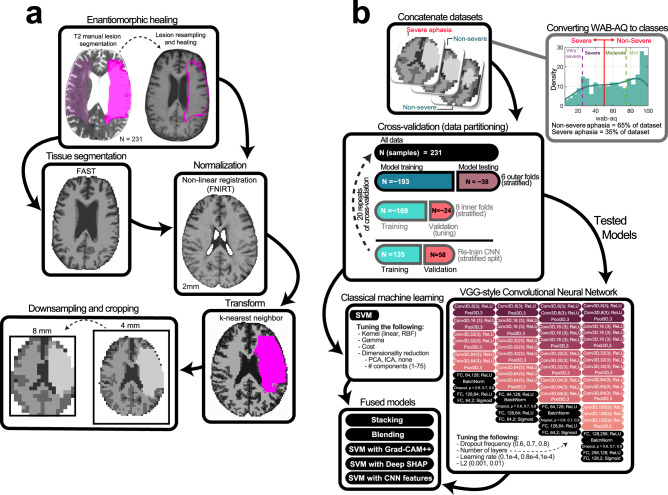
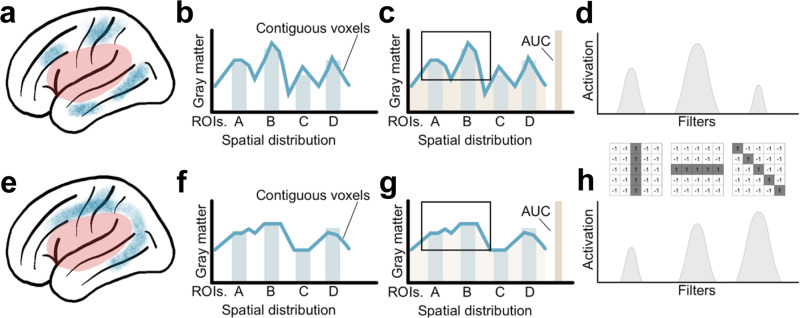
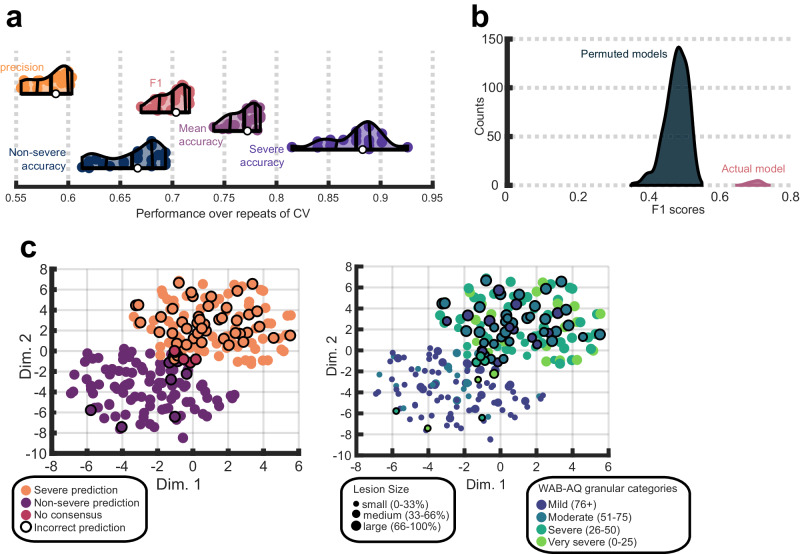
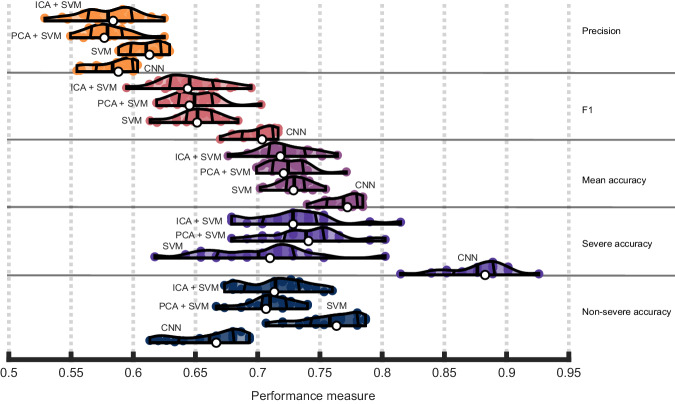
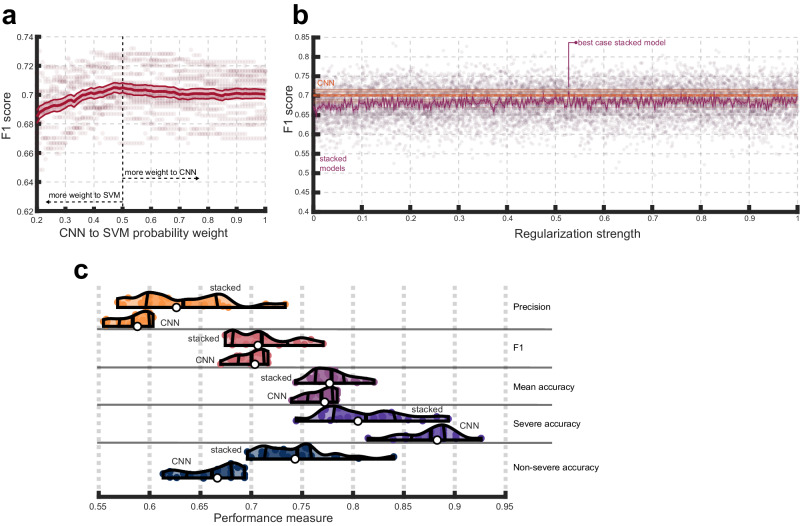
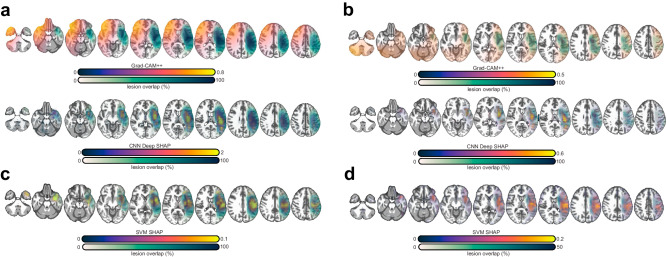
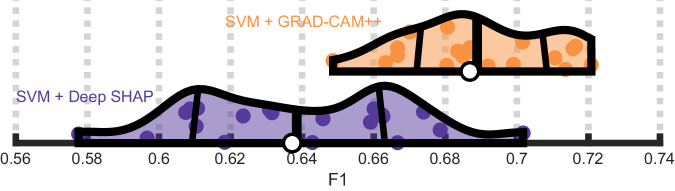
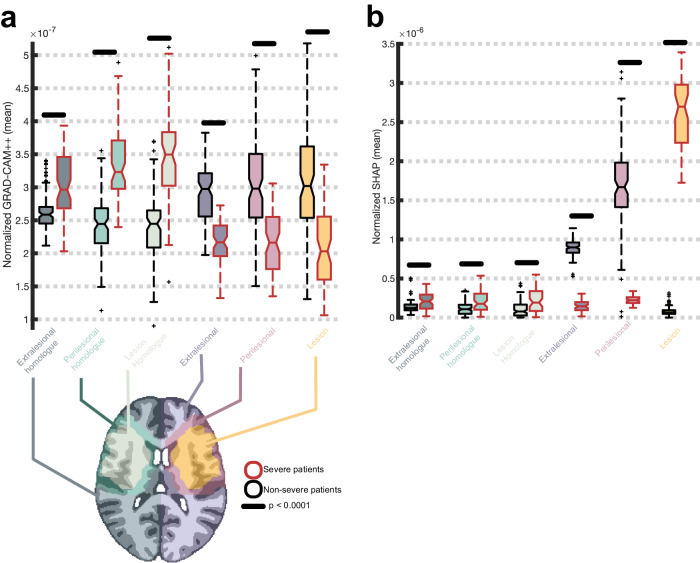
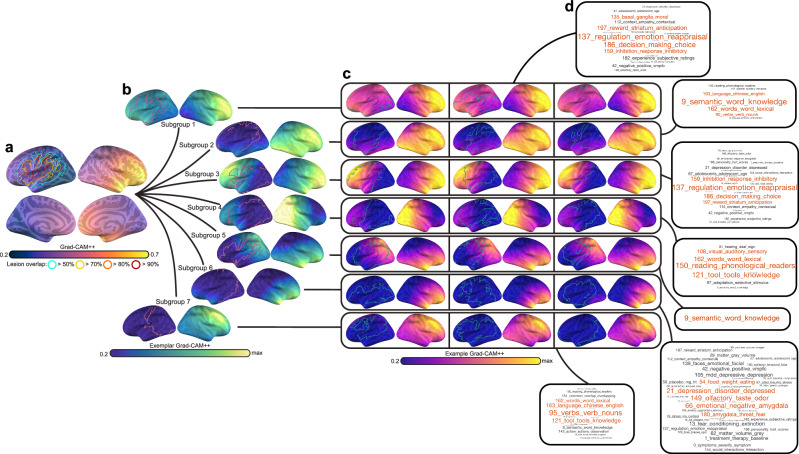
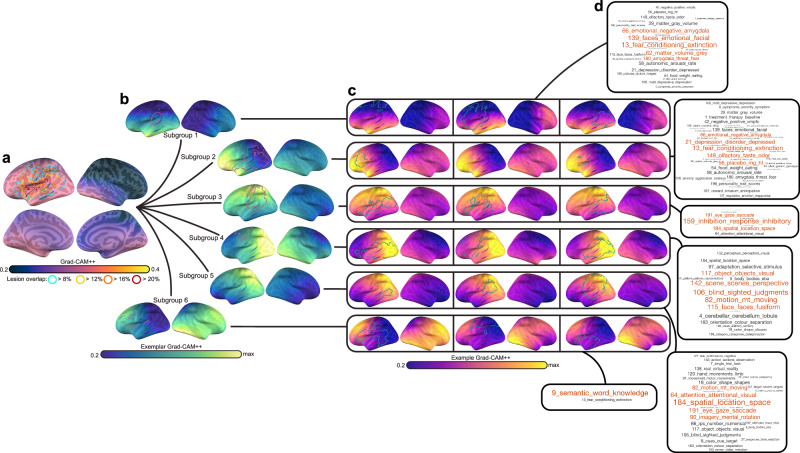
Background: Emerging evidence suggests that post-stroke aphasia severity depends on the integrity of the brain beyond the lesion. While measures of lesion anatomy and brain integrity combine synergistically to explain aphasic symptoms, substantial interindividual variability remains unaccounted. One explanatory factor may be the spatial distribution of morphometry beyond the lesion (e.g., atrophy), including not just specific brain areas, but distinct three-dimensional patterns. Methods: Here, we test whether deep learning with Convolutional Neural Networks (CNNs) on whole brain morphometry (i.e., segmented tissue volumes) and lesion anatomy better predicts chronic stroke individuals with severe aphasia (N = 231) than classical machine learning (Support Vector Machines; SVMs), evaluating whether encoding spatial dependencies identifies uniquely predictive patterns. Results: CNNs achieve higher balanced accuracy and F1 scores, even when SVMs are nonlinear or integrate linear or nonlinear dimensionality reduction. Parity only occurs when SVMs access features learned by CNNs. Saliency maps demonstrate that CNNs leverage distributed morphometry patterns, whereas SVMs focus on the area around the lesion. Ensemble clustering of CNN saliencies reveals distinct morphometry patterns unrelated to lesion size, consistent across individuals, and which implicate unique networks associated with different cognitive processes as measured by the wider neuroimaging literature. Individualized predictions depend on both ipsilateral and contralateral features outside the lesion. Conclusions: Three-dimensional network distributions of morphometry are directly associated with aphasia severity, underscoring the potential for CNNs to improve outcome prognostication from neuroimaging data, and highlighting the prospective benefits of interrogating spatial dependence at different scales in multivariate feature space.
Overview
The claims and statistics of this paper haven’t been checked yet.
Free: it reads the open-access text and checks the first 5 claims that cite a source we can check. Create a free account to check every claim.
Integrity signals
Registry
Cites
Statistics
Figures
Verification
Claims the paper makes
The claims and statistics of this paper haven’t been checked yet.
Free: it reads the open-access text and checks the first 5 claims that cite a source we can check. Create a free account to check every claim.
Claims other papers make about this one
Each is checked against this paper’s own text: does it say what the citing paper says it does?
The source backs part of the claim, not all of it — or backs it for a different population, condition or comparison.
In the citing paper
“The analysis results showed that the machine learning algorithms used in post-stroke aphasia models were mainly supervised methods, including random forests, neural networks, and support vector machines.”
From Machine learning models in post-stroke aphasia: a scoping review (2026) · cites this paper as [24]
Experimental — accuracy not yet measuredThe source backs part of the claim, not all of it — or backs it for a different population, condition or comparison.
In the citing paper
“Five studies (21, 23, 24, 28, 36) constructed machine learning models for predicting the severity of aphasia by integrating multi-dimensional features such as neuroimaging and language samples.”
From Machine learning models in post-stroke aphasia: a scoping review (2026) · cites this paper as [24]
Experimental — accuracy not yet measuredThe source backs part of the claim, not all of it — or backs it for a different population, condition or comparison.
In the citing paper
“four studies (21, 23, 24, 36) focused on fine prediction in the chronic phase”
From Machine learning models in post-stroke aphasia: a scoping review (2026) · cites this paper as [24]
Experimental — accuracy not yet measuredThe source backs part of the claim, not all of it — or backs it for a different population, condition or comparison.
In the citing paper
“In terms of severity assessment and prediction, most models rely on single-center, small-sample data (21, 23, 24, 28, 36)”
From Machine learning models in post-stroke aphasia: a scoping review (2026) · cites this paper as [24]
Experimental — accuracy not yet measuredThe cited source says what the claim attributes to it.
In the citing paper
“Seven studies (19–21, 24, 27, 29, 31) used multiple algorithms to construct models and compare them.”
From Machine learning models in post-stroke aphasia: a scoping review (2026) · cites this paper as [24]
Experimental — accuracy not yet measured
8 more claims about this paper
Create a free account to see every claim other papers make about this one.
Self-check
Percentages, sums and reported differences re-computed from the paper’s own numbers.
The self-check needs the paper’s full text.
Citations
Cites
PyTorch: An Imperative Style, High-Performance Deep Learning Library
Paszke, A., Gross, S., Massa, F., Lerer, A., Bradbury, J., Chanan, G., Killeen, T., Lin, Z., Gimelshein, N., Antiga, L., et al. (2019) · arXiv · doi:10.48550/arxiv.1912.01703 · Cited by 31,473
Advances in neural information processing systems 7
Cios, K., & Shields, M. (1997) · Neurocomputing · doi:10.1016/s0925-2312(97)90018-7 · Cited by 22,059
Decoupled Weight Decay Regularization
Loshchilov, I., & Hutter, F. (2017) · arXiv · doi:10.48550/arxiv.1711.05101 · Cited by 12,522
Jenkinson, M., Beckmann, C. F., Behrens, T. E. J., Woolrich, M. W., & Smith, S. M. (2012) · NeuroImage · doi:10.1016/j.neuroimage.2011.09.015 · Cited by 11,314
Zhang, Y., Brady, M., & Smith, S. (2001) · IEEE Transactions on Medical Imaging · doi:10.1109/42.906424 · Cited by 6,982
Lipton, Z. C. (2018) · Queue · doi:10.1145/3236386.3241340 · Cited by 5,427
The Mythos of Model Interpretability
Lipton, Z. C. (2016) · arXiv · doi:10.48550/arxiv.1606.03490 · Cited by 5,422
A Survey of Convolutional Neural Networks: Analysis, Applications, and Prospects
Li, Z., Liu, F., Yang, W., Peng, S., & Zhou, J. (2022) · IEEE Transactions on Neural Networks and Learning Systems · doi:10.1109/tnnls.2021.3084827 · Cited by 5,273
What is a support vector machine?
Noble, W. S. (2006) · Nature Biotechnology · doi:10.1038/nbt1206-1565 · Cited by 4,301
Large-scale automated synthesis of human functional neuroimaging data.
Yarkoni, T., Poldrack, R. A., Nichols, T. E., Van Essen, D. C., & Wager, T. D. (2011) · Nature Methods · doi:10.1038/nmeth.1635 · Cited by 3,686
Research works printed but not linked: 3
- Kwon, Y., Won, J. H., Kim, B. J. & Paik, M. C. Uncertainty quantification using bayesian neural networks in classification: Application to ischemic stroke lesion segmentation. Medical Imaging with Deep Learning. 4, 2 (2018).
- Shrikumar, A., Greenside, P. & Kundaje, A. Learning important features through propagating activation differences. In International conference on machine learning, 3145–3153 (PMLR, 2017).
- Strehl, A. & Ghosh, J. Cluster ensembles–a knowledge reuse framework for combining multiple partitions. J. Mach. Learn. Res. 3, 583–617 (2002).
Cited by
A Review on the Detection of Plant Disease Using Machine Learning and Deep Learning Approaches
Nyawose, T., Maswanganyi, R. C., & Khumalo, P. (2025) · Journal of Imaging · doi:10.3390/jimaging11100326 · Cited by 91
Aphasia severity prediction using a multi-modal machine learning approach
Hu, X., Varkanitsa, M., Kropp, E., Betke, M., Ishwar, P., & Kiran, S. (2025) · NeuroImage · doi:10.1016/j.neuroimage.2025.121300 · Cited by 8
Precision‐Optimised Post‐Stroke Prognoses
Hope, T. M. H., Bowman, H., Bruce, R. M., Leff, A. P., & Price, C. J. (2025) · Annals of Clinical and Translational Neurology · doi:10.1002/acn3.70077 · Cited by 2
Insights on Using Graph Neural Networks for Sulcal Graphs Predictive Models
Imbert, A., Gaüzère, B., Takerkart, S., Auzias, G., & Honeiné, P. (2025) · Lecture notes in computer science · doi:10.1007/978-3-031-94139-9_8 · Cited by 1
Korotkova, E. V., Kulikova, S., Meshkov, A. V., Lebedev, M., Tarasov, D., Kleeva, D. F., Kunnikova, K. I., & Lvova, O. A. (2026) · Communications in computer and information science · doi:10.1007/978-3-032-14674-8_46 · Cited by 1
Metadata
- Authors
- Teghipco, A., Newman-Norlund, R., Fridriksson, J., Rorden, C., & Bonilha, L.
- Affiliations
- University of South Carolina (US)
- Corresponding author
- Teghipco, Alex
- Venue
- Communications Medicine
- Published
- 2024-06-12
- Volume
- 4
- Issue
- 1
- Pages
- 115-115
- ISSN
- 2730-664X (ISSN-L)
- PMC
- PMC11169346
- OpenAlex
- W4399560892
- Cited by
- 11
- References
- 121
- Citations by year
- 2026: 6 · 2025: 4 · 2024: 1
- FWCI
- 2.67
- Type
- journal article
- Language
- en
- Open access
- gold
- doi.org
- Licence
- cc-by
- creativecommons.org/licenses/by/4.0 (tdm)
- creativecommons.org/licenses/by/4.0 (vor)
- Locations
- Communications Medicine (publishedVersion, cc-by)
- PubMed Central (publishedVersion, cc-by)
- PubMed (publishedVersion)
- DOAJ (DOAJ: Directory of Open Access Journals) (submittedVersion, cc-by-sa)
- Funders
- U.S. Department of Health & Human Services | NIH | National Institute on Deafness and Other Communication Disorders (P50 DC014664, R01 DC008355)
- Topics
- Life Sciences › Neuroscience › Cognitive Neuroscience › Neurobiology of Language and Bilingualism
- Health Sciences › Medicine › Psychiatry and Mental health › Dementia and Cognitive Impairment Research
- Health Sciences › Medicine › Clinical Neurology › Acute Ischemic Stroke Management
- Keywords
- post-stroke aphasia, brain morphometry, convolutional neural networks, brain atrophy, saliency maps, consensus clustering, interindividual variability
About these checks
Registry, retraction, Cites and statistics results are computed, not judged, with one exception: a printed reference that no index lists is read once by a model before it counts as a citation error. Claims are extracted by a model and kept only when their quote appears verbatim in the text; each cited source is then checked, with a model’s help, for whether it says what the claim relies on. Those verdicts can be wrong — read the claim’s quote and the cited source before relying on one.
Statistics and arithmetic are recomputed, not judged.
Confidence bands are shown only for fields calibrated on our annotated test set. None is calibrated yet, so no band is shown.
What counts as a claim ›How we measure confidence ›How we check this ›
Are you an author, or do you see a problem with this page? Request a review
How to cite
Cite CoChat for the checks on this page, and the paper for its own findings.
- This page
- CoChat. (2026). Citation check: Distinct brain morphometry patterns revealed by deep learning improve prediction of post-stroke aphasia severity. https://app.cochat.ai/papers/10.1038/s43856-024-00541-8
- The paper
- Teghipco, A., Newman-Norlund, R., Fridriksson, J., Rorden, C., & Bonilha, L. (2024). Distinct brain morphometry patterns revealed by deep learning improve prediction of post-stroke aphasia severity. Communications Medicine. https://doi.org/10.1038/s43856-024-00541-8
Data sources
Bibliographic data: Semantic Scholar, OpenAlex, Crossref.
Contains information from the Semantic Scholar Academic Graph Datasets, made available under the ODC Attribution License (ODC-BY 1.0).
Semantic Scholar’s data is described in: Kinney, R., et al. (2023). The Semantic Scholar Open Data Platform. arXiv:2301.10140.
