

The DOI matches its Crossref record; 102 of the 104 references it cites were found in a registry or an index.
Perinatal iron deficiency and neurocognitive development
Open accessAbstract
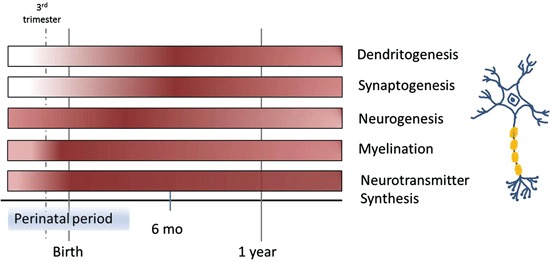
Iron deficiency is the most common form of nutrient deficiency worldwide. It is highly prevalent due to the limited availability of high quality food in developing countries and poor dietary habits in industrialized countries. According to the World Health Organization, it affects nearly 2 billion people and up to 50% of women who are pregnant. Maternal anemia during pregnancy is especially burdensome to healthy neurodevelopment in the fetus because iron is needed for proper neurogenesis, development, and myelination. Maternal anemia also increases the risk of low birth weight, either due to premature birth or fetal growth restriction, which is associated with delayed neurocognitive development and even psychiatric illness. As rapid neurodevelopment continues after birth infants that received sufficient iron in utero, but that receive a low iron diet after 6 months of age, also show deficits in neurocognitive development, including impairments in learning and memory. Unfortunately, the neurocognitive complications of iron deficiency during critical pre- and postnatal periods of brain development are difficult to remedy, persisting into adulthood. Thus, preventing iron deficiency in the pre- and postnatal periods is critical as is devising new means to recapture cognitive function in individuals who experienced early iron deficiency. This review will discuss the prevalence of pre- and postnatal iron deficiency, the mechanism, and effects of iron deficiency on brain and cognitive development.
Overview
The claims and statistics of this paper haven’t been checked yet.
Run the check — free, no account needed. It reads the open-access text and checks the sources it cites.
Integrity signals
Registry
Cites
Statistics
Figures
Verification
Claims the paper makes
The claims and statistics of this paper haven’t been checked yet.
Run the check — free, no account needed. It reads the open-access text and checks the sources it cites.
Claims other papers make about this one
Each is checked against this paper’s own text: does it say what the citing paper says it does?
In the citing paper
“the neurocognitive damage elicited by iron deficiency during this period is irreversible and will persist into adulthood [176].”
From Vitamins and Minerals for Energy, Fatigue and Cognition: A Narrative Review of the Biochemical and Clinical Evidence (2020) · cites this paper as [176]
In the citing paper
“There is a wide consensus regarding the critical importance of appropriate iron supply during neurodevelopment from birth, and even before, up to the first years of life”
From Vitamins and Minerals for Energy, Fatigue and Cognition: A Narrative Review of the Biochemical and Clinical Evidence (2020) · cites this paper as [176]
Self-check
Percentages, sums and reported differences re-computed from the paper’s own numbers.
The self-check needs the paper’s full text.
Citations
Cites
Two new Later Stone Age sites from the Final Pleistocene in the Falémé Valley, eastern Senegal
Ndiaye, M., Lespez, L., Tribolo, C., Rassé, M., Hadjas, I., Davidoux, S., Huysecom, É., & Douze, K. (2024) · Monash University Research Portal (Monash University) · doi:10.3929/ethz-b-000667478 · Cited by 24,214
Home visits: a strategy to improve newborn survival - Authors' reply
(2008) · Americanae (AECID Library) · doi:10.1016/s0140 · Cited by 22,524
(1996) · Institutional Research Information System University of Turin (University of Turin) · doi:10.1111/j · Cited by 5,486
Rice, D., & Barone, S. (2000) · Environmental Health Perspectives · doi:10.1289/ehp.00108s3511 · Cited by 2,944
Worldwide prevalence of anaemia, WHO Vitamin and Mineral Nutrition Information System, 1993–2005
McLean, E., Cogswell, M., Egli, I., Wojdyla, D., & de Benoist, B. (2009) · Public Health Nutrition · doi:10.1017/s1368980008002401 · Cited by 2,734
The worldwide incidence of preterm birth: a systematic review of maternal mortality and morbidity
Beck, S., WOJDYLA, D. M., Say, L., Betrán, A. P., Meraldi, M., Requejo, J. H., Rubens, C. E., Menon, R., & Look, P. V. (2009) · Bulletin of the World Health Organization · doi:10.2471/blt.08.062554 · Cited by 2,190 · cited 1×
“As the incidence of both these conditions is increasing worldwide (Beck et al., 2010; Martin et al., 2010; Danaei et al., 2011), it is likely that iron deficiency in infants will become an even greater concern in the future.”
BackgroundSTRESS AND HIPPOCAMPAL PLASTICITY
McEwen, B. S. (1999) · Annual Review of Neuroscience · doi:10.1146/annurev.neuro.22.1.105 · Cited by 2,087 · cited 2×
“This phase of rapid growth represents a sensitive period, wherein environmental insults alter neurodevelopment (McEwen, 1999).”
BackgroundInfluentialPyramidal neurons: dendritic structure and synaptic integration
Spruston, N. (2008) · Nature Reviews Neuroscience · doi:10.1038/nrn2286 · Cited by 1,688 · cited 3×
“Like dendritic arbor structure, a spine’s morphology can impact its function (Spruston, 2008).”
BackgroundInfluentialThe developmental role of serotonin: news from mouse molecular genetics
Gaspar, P., Cases, O., & Maroteaux, L. (2003) · Nature Reviews Neuroscience · doi:10.1038/nrn1256 · Cited by 1,297 · cited 1×
“The SERT, which is responsible for re-uptake of serotonin within the brain, is the predominant mechanism controlling strength and duration of serotonergic neurotransmission (Gaspar et al., 2003).”
BackgroundDanaei, G., Finucane, M. M., Lin, J. K., Singh, G. M., Paciorek, C. J., Cowan, M. J., Farzadfar, F., Stevens, G. A., Lim, S. S., Riley, L. M., et al. (2011) · The Lancet · doi:10.1016/s0140-6736(10)62036-3 · Cited by 1,239
Cited by
Sorted by citations
Lopez, A., Cacoub, P., Macdougall, I. C., & Peyrin‐Biroulet, L. (2015) · The Lancet · doi:10.1016/s0140-6736(15)60865-0 · Cited by 1,603
Iron neurochemistry in Alzheimer's disease and Parkinson's disease: targets for therapeutics
Belaidi, A. A., & Bush, A. I. (2015) · Journal of Neurochemistry · doi:10.1111/jnc.13425 · Cited by 594
Tardy, A.-L., Pouteau, E., Marquez, D., Yilmaz, C., & Scholey, A. (2020) · Nutrients · doi:10.3390/nu12010228 · Cited by 541
Striking while the iron is hot: Iron metabolism and ferroptosis in neurodegeneration
Masaldan, S., Bush, A. I., Devos, D., Rolland, A., & Moreau, C. (2018) · Free Radical Biology and Medicine · doi:10.1016/j.freeradbiomed.2018.09.033 · Cited by 494
“stages, where the dysfunction may affect memory and learning ability [171].”
Iron Deficiency, Cognitive Functions, and Neurobehavioral Disorders in Children
Pivina, L., Semenova, Y., Doşa, M. D., Dauletyarova, M., & Bjørklund, G. (2019) · Journal of Molecular Neuroscience · doi:10.1007/s12031-019-01276-1 · Cited by 263
Metadata
- Authors
- Radlowski, E. C., & Johnson, R. W.
- Affiliations
- University of Illinois Urbana-Champaign (US)
- Corresponding author
- Johnson, Rodney W.
- ORCID
- Johnson, Rodney W.
- Venue
- Frontiers in Human Neuroscience
- Publisher
- Frontiers Media SA
- Published
- 2013
- Volume
- 7
- Pages
- 585-585
- ISSN
- 1662-5161 (ISSN-L)
- PMC
- PMC3779843
- OpenAlex
- W1980560945
- Cited by
- 315
- References
- 104
- Citations by year
- 2026: 16 · 2025: 27 · 2024: 17 · 2023: 32 · 2022: 34 · 2021: 25 · 2020: 23 · 2019: 23 · 2018: 29 · 2017: 33 · 2016: 20 · 2015: 21 · 2014: 13 · 2013: 1
- FWCI
- 2.79
- Type
- journal article
- Language
- en
- Open access
- gold
- doi.org
- Licence
- cc-by
- Locations
- Frontiers in Human Neuroscience (publishedVersion, cc-by)
- Europe PMC (PubMed Central) (publishedVersion, cc-by)
- PubMed Central (publishedVersion, cc-by)
- PubMed (publishedVersion)
- DOAJ (DOAJ: Directory of Open Access Journals) (submittedVersion, cc-by-sa)
- Funders
- National Institute on Aging (R01AG016710)
- Eunice Kennedy Shriver National Institute of Child Health and Human Development (R01HD069899)
- Topics
- Health Sciences › Medicine › Hematology › Iron Metabolism and Disorders
- Health Sciences › Nursing › Nutrition and Dietetics › Trace Elements in Health
- Health Sciences › Nursing › Nutrition and Dietetics › Child Nutrition and Water Access
- Keywords
- iron deficiency, neurocognitive development, low birth weight, fetal growth restriction, preterm birth, brain development, neurogenesis, myelination, learning and memory impairment, cognitive recovery, iron deficiency prevention
About these checks
Registry, retraction, Cites and statistics results are computed, not judged, with one exception: a printed reference that no index lists is read once by a model before it counts as a citation error. Claims are extracted by a model and kept only when their quote appears verbatim in the text; each cited source is then checked, with a model’s help, for whether it says what the claim relies on. Those verdicts can be wrong — read the claim’s quote and the cited source before relying on one.
Statistics and arithmetic are recomputed, not judged.
Confidence bands are shown only for fields calibrated on our annotated test set. None is calibrated yet, so no band is shown.
What counts as a claim ›How we measure confidence ›How we check this ›
Are you an author, or do you see a problem with this page? Request a review
