

The DOI matches its Crossref record; 255 of the 255 references it cites were found in a registry or an index.
Alzheimer's Disease and Type 2 Diabetes: A Critical Assessment of the Shared Pathological Traits
Open accessAbstract
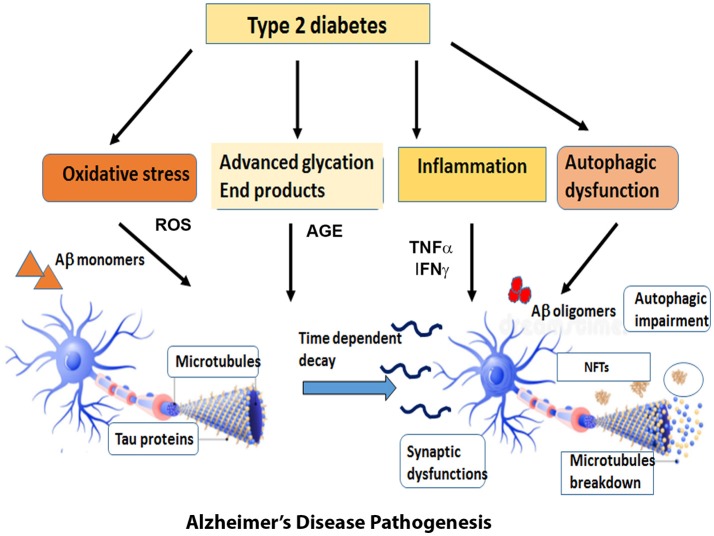
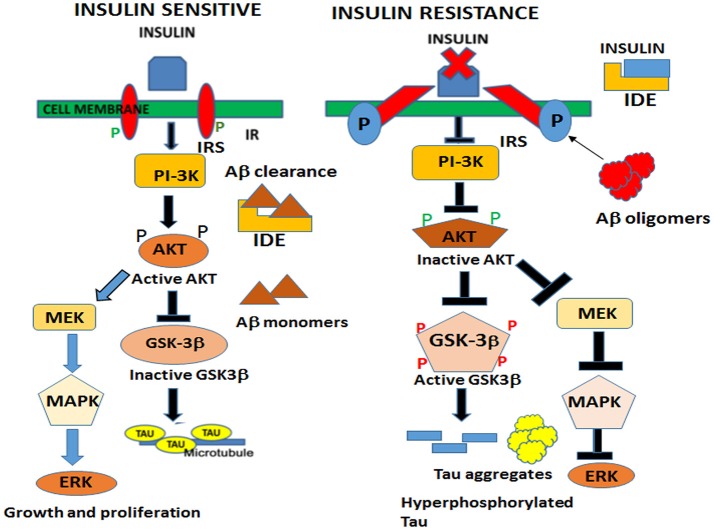
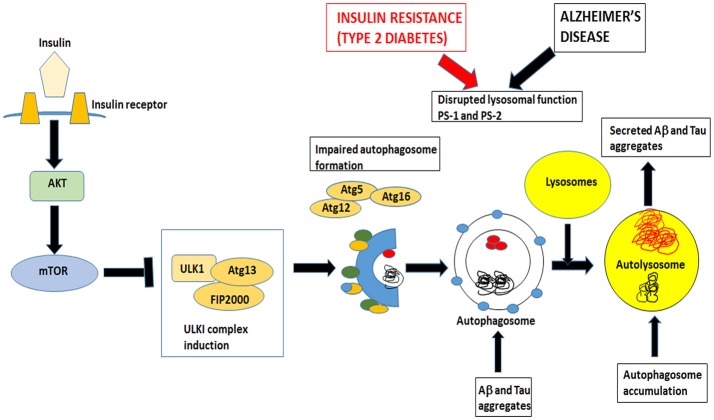
Alzheimer's disease (AD) and Type 2 Diabetes Mellitus (T2DM) are two of the most prevalent diseases in the elderly population worldwide. A growing body of epidemiological studies suggest that people with T2DM are at a higher risk of developing AD. Likewise, AD brains are less capable of glucose uptake from the surroundings resembling a condition of brain insulin resistance. Pathologically AD is characterized by extracellular plaques of Aβ and intracellular neurofibrillary tangles of hyperphosphorylated tau. T2DM, on the other hand is a metabolic disorder characterized by hyperglycemia and insulin resistance. In this review we have discussed how Insulin resistance in T2DM directly exacerbates Aβ and tau pathologies and elucidated the pathophysiological traits of synaptic dysfunction, inflammation, and autophagic impairments that are common to both diseases and indirectly impact Aβ and tau functions in the neurons. Elucidation of the underlying pathways that connect these two diseases will be immensely valuable for designing novel drug targets for Alzheimer's disease.
Overview
The claims and statistics of this paper haven’t been checked yet.
Run the check — free, no account needed. It reads the open-access text and checks the sources it cites.
Integrity signals
Registry
Cites
Statistics
Figures
Verification
Claims the paper makes
The claims and statistics of this paper haven’t been checked yet.
Run the check — free, no account needed. It reads the open-access text and checks the sources it cites.
Claims other papers make about this one
Each is checked against this paper’s own text: does it say what the citing paper says it does?
The source backs part of the claim, not all of it — or backs it for a different population, condition or comparison.
In the citing paper
“Although CA1 and CA2 did not show the largest changes in PIK3CA transcriptionally, each exhibited pronounced proteomic evidence of downstream pathway remodeling, suggesting that reduced insulin/PI3K signaling contributes to widespread proteomic synaptic and metabolic compromise in CA1/CA2, 42 , 66 , 67 even when transcriptional changes in PI3K components are modest.”
From Disruption of hippocampal upstream regulators of mTOR and insulin pathways in Down syndrome with Alzheimer's disease neuropathology: Preliminary observations (2026) · cites this paper as [66]
Experimental — accuracy not yet measured
Self-check
Percentages, sums and reported differences re-computed from the paper’s own numbers.
The self-check needs the paper’s full text.
Citations
Cites
Items 201–255 of 255
Tau hyperphosphorylation induces oligomeric insulin accumulation and insulin resistance in neurons
Rodriguez‐Rodriguez, P., Matton, A., Merino‐Serrais, P., Parrado‐Fernández, C., Rábano, A., Winblad, B. G., Ávila, J., Ferrer, I., & Cedazo-Mínguez, Á. (2017) · Brain · doi:10.1093/brain/awx256 · Cited by 99
Extracellular Signal-Regulated Kinase, Synaptic Plasticity, and Memory
Thiels, E., & Klann, E. (2001) · Reviews in the Neurosciences · doi:10.1515/revneuro.2001.12.4.327 · Cited by 98
The double-edged effect of autophagy in pancreatic beta cells and diabetes
Chen, Z.-F., Li, Y.-B., Han, J.-Y., Wang, J., Yin, J.-J., Li, J.-B., & Tian, H. (2010) · Autophagy · doi:10.4161/auto.7.1.13607 · Cited by 97
Pyroglutamate and Isoaspartate modified Amyloid-Beta in ageing and Alzheimer’s disease
Moro, M. L., Phillips, A. S., Gaimster, K., Paul, C., Mudher, A. K., Nicoll, J. A. R., & Boche, D. (2018) · Acta Neuropathologica Communications · doi:10.1186/s40478-017-0505-x · Cited by 97
Self-citationReno, C. M., Puente, E. C., Sheng, Z., Daphna-Iken, D., Bree, A. J., Routh, V. H., Kahn, B. B., & Fisher, S. J. (2016) · Diabetes · doi:10.2337/db16-0917 · Cited by 97
Tau Is Hyperphosphorylated in the Insulin-Like Growth Factor-I Null Brain
Cheng, C. M., Tseng, V., Wang, J., Wang, D., Matyakhina, L., & Bondy, C. A. (2005) · Endocrinology · doi:10.1210/en.2005-0063 · Cited by 94
Glucose deficit triggers tau pathology and synaptic dysfunction in a tauopathy mouse model
Lauretti, E., Li, J.-G., Meco, A. D., & Praticò, D. (2017) · Translational Psychiatry · doi:10.1038/tp.2016.296 · Cited by 92
Effects of streptozotocin-induced diabetes on tau phosphorylation in the rat brain
Qu, Z., Jiao, Z., Sun, X., Zhao, Y., Jinpeng, R., & Xu, G. (2011) · Brain Research · doi:10.1016/j.brainres.2011.01.084 · Cited by 91
Criscuolo, C., Fontebasso, V., Middei, S., Stazi, M., Ammassari‐Teule, M., Yan, S. S., & Origlia, N. (2017) · Scientific Reports · doi:10.1038/srep42370 · Cited by 83
Chen, X., Kondo, K., Motoki, K., Homma, H., & Okazawa, H. (2015) · Scientific Reports · doi:10.1038/srep12115 · Cited by 83
Li, W., Wang, T., & Xiao, S. (2016) · Neuropsychiatric Disease and Treatment · doi:10.2147/ndt.s111298 · Cited by 82
Yin, Y., Chen, F., Wang, W., Wang, H., & Zhang, X. (2017) · Europe PMC (PubMed Central) · Cited by 82
GSK-3 mouse models to study neuronal apoptosis and neurodegeneration
Gómez‐Sintes, R. (2011) · Frontiers in Molecular Neuroscience · doi:10.3389/fnmol.2011.00045 · Cited by 81
NAP (davunetide) rescues neuronal dysfunction in a Drosophila model of tauopathy
Quraishe, S., Cowan, C. M., & Mudher, A. K. (2013) · Molecular Psychiatry · doi:10.1038/mp.2013.32 · Cited by 76
Self-citationKim, B., Backus, C., Oh, S., & Feldman, E. L. (2013) · Journal of Alzheimer s Disease · doi:10.3233/jad-121669 · Cited by 74
Insulin: An Emerging Treatment for Alzheimer’s Disease Dementia?
Morris, J. K., & Burns, J. M. (2012) · Current Neurology and Neuroscience Reports · doi:10.1007/s11910-012-0297-0 · Cited by 72
Diabetes Induces Lysine Acetylation of Intermediary Metabolism Enzymes in the Kidney
Kosanam, H., Thai, K., Zhang, Y., Advani, A., Connelly, K. A., Diamandis, E. P., & Gilbert, R. E. (2014) · Diabetes · doi:10.2337/db12-1770 · Cited by 72
Gratuze, M., Julien, J., Petry, F. R., Morin, F., & Planel, E. (2017) · Scientific Reports · doi:10.1038/srep46359 · Cited by 68
Early Cognitive Deficits in Type 2 Diabetes: A Population-Based Study
Marseglia, A., Fratiglioni, L., Laukka, E. J., Santoni, G., Pedersen, N. L., Bäckman, L., & Xu, W. (2016) · Journal of Alzheimer s Disease · doi:10.3233/jad-160266 · Cited by 62
Niewidok, B., Igaev, M., Sündermann, F., Janning, D., Bakota, L., & Brandt, R. (2016) · Molecular Biology of the Cell · doi:10.1091/mbc.e16-06-0402 · Cited by 62
Ávila, J. (2008) · Journal of Cellular and Molecular Medicine · doi:10.1111/j.1582-4934.2007.00214.x · Cited by 57
Lathuilière, A., Valdés, P., Papin, S., Cacquevel, M., Maclachlan, C., Knott, G. W., Muhs, A., Paganetti, P., & Schneider, B. L. (2017) · Scientific Reports · doi:10.1038/s41598-017-13786-2 · Cited by 57
Antidiabetic Drugs in Alzheimer’s Disease: Mechanisms of Action and Future Perspectives
Femminella, G. D., Bencivenga, L., Petraglia, L., Visaggi, L., Gioia, L., Grieco, F. V., de Lucia, C., Komici, K., Corbi, G., Edison, P., et al. (2017) · Journal of Diabetes Research · doi:10.1155/2017/7420796 · Cited by 57
Increased GABA concentrations in type 2 diabetes mellitus are related to lower cognitive functioning
van Bussel, F. C. G., Backes, W. H., Hofman, P. A. M., Puts, N. A. J., Edden, R. A. E., van Boxtel, M. P. J., Schram, M. T., Stehouwer, C. D. A., Wildberger, J. E., & Jansen, J. F. A. (2016) · Medicine · doi:10.1097/md.0000000000004803 · Cited by 54
Glycogen synthase kinase‐3 inhibition prevents learning deficits in diabetic mice
King, M. R., Anderson, N. J., Guernsey, L. S., & Jolivalt, C. G. (2013) · Journal of Neuroscience Research · doi:10.1002/jnr.23192 · Cited by 53
Farrar, C. E., Houser, C. R., & Clarke, S. G. (2004) · Aging Cell · doi:10.1111/j.1474-9728.2004.00136.x · Cited by 51
Li, X., Shen, N., Zhang, S., Liu, J., Jiang, Q., Liao, M., Feng, R., Zhang, L., Wang, G., Ma, G., et al. (2014) · Molecular Neurobiology · doi:10.1007/s12035-014-8880-9 · Cited by 49
Jung, H.-J., Kim, Y.-J., Eggert, S., Chung, K. C., Choi, K. S., & Park, S. A. (2013) · Experimental Neurology · doi:10.1016/j.expneurol.2013.07.013 · Cited by 47
Genetic Ablation of Tau Mitigates Cognitive Impairment Induced by Type 1 Diabetes
Abbondante, S., Baglietto‐Vargas, D., Rodríguez‐Ortiz, C. J., Estrada-Hernandez, T., Medeiros, R., & LaFerla, F. M. (2014) · American Journal Of Pathology · doi:10.1016/j.ajpath.2013.11.021 · Cited by 47
Upregulation of RAGE at the blood‐brain barrier in streptozotocin‐induced diabetic mice
Liu, L. P., Hong, H., Liao, J. M., Wang, T. S., Wu, J., Chen, S. S., Li, Y. Q., Long, Y., & Xia, Y. Z. (2009) · Synapse · doi:10.1002/syn.20644 · Cited by 44
Gene-Environment Interaction Research and Transgenic Mouse Models of Alzheimer's Disease (Erratum)
Chouliaras, L., Sierksma, A. S. R., Kenis, G., Prickaerts, J., Lemmens, M. A. M., Brasnjevic, I., van Donkelaar, E. L., Martínez‐Martínez, P., Losen, M. H., Baets, M. H. D., et al. (2010) · International Journal of Alzheimer s Disease · doi:10.4061/2010/356862 · Cited by 44
Qu, Z., Li, L., Sun, X., Zhao, Y., Zhang, J., Geng, Z., Fu, J., & Ren, Q. (2014) · The Scientific World JOURNAL · doi:10.1155/2014/878123 · Cited by 43
Blood glucose levels and cortical thinning in cognitively normal, middle-aged adults
Wennberg, A. M. V., Spira, A. P., Pettigrew, C. A., Soldan, A., Zipunnikov, V. M., Rebok, G. W., Roses, A. D., Lutz, M. W., Miller, M. M., Thambisetty, M., et al. (2016) · Journal of the Neurological Sciences · doi:10.1016/j.jns.2016.04.017 · Cited by 41
Triiodothyronine Potentiates Vasorelaxation via PKG/VASP Signaling in Vascular Smooth Muscle Cells
Samuel, S., Zhang, K., Tang, Y., Gerdes, A. M., & Carrillo-Sepúlveda, M. A. (2017) · Cellular Physiology and Biochemistry · doi:10.1159/000471938 · Cited by 32
Jiménez, S., Navarro, V., Moyano, J., Sanchez-Mico, M. V., Torres, M., Dávila, J. C., Vizuete, M., Gutiérrez, A., & Vitórica, J. (2014) · PLoS ONE · doi:10.1371/journal.pone.0114041 · Cited by 31
Katsuse, O., Lin, W.-L., Lewis, J. M., Hutton, M. L., & Dickson, D. W. (2006) · Neuroscience Letters · doi:10.1016/j.neulet.2006.09.021 · Cited by 30
Increased Aβ pathology in aged Tg2576 mice born to mothers fed a high fat diet
Nizari, S., Carare, R. O., & Hawkes, C. A. (2016) · Scientific Reports · doi:10.1038/srep21981 · Cited by 30
Gene-Environment Interaction Research and Transgenic Mouse Models of Alzheimer's Disease
Chouliaras, L., Sierksma, A. S. R., Kenis, G., Prickaerts, J., Lemmens, M. A. M., Brasnjevic, I., van Donkelaar, E. L., Martínez‐Martínez, P., Losen, M. H., Baets, M. H. D., et al. (2010) · International Journal of Alzheimer s Disease · doi:10.4061/2010/859101 · Cited by 30
Morel, C., Standen, C. L., Jung, D. Y., Gray, S., Ong, H., Flavell, R. A., Kim, J. K., & Davis, R. J. (2010) · Molecular and Cellular Biology · doi:10.1128/mcb.00585-10 · Cited by 30
Regulation of Diet-Induced Adipose Tissue and Systemic Inflammation by Salicylates and Pioglitazone
Kim, M., Yamamoto, Y., Kim, K.-J., Kamei, N., Shimada, T., Liu, L., Moore, K., Woo, J. R., Shoelson, S. E., & Lee, J. (2013) · PLoS ONE · doi:10.1371/journal.pone.0082847 · Cited by 27
Mislocalization of neuronal tau in the absence of tangle pathology in phosphomutant tau knockin mice
Gilley, J., Ando, K., Seereeram, A., Rodríguez-Martín, T., Pooler, A. M., Sturdee, L., Anderton, B. H., Brion, J., Hanger, D. P., & Coleman, M. P. (2015) · Neurobiology of Aging · doi:10.1016/j.neurobiolaging.2015.11.028 · Cited by 26
Jung, H. J., Park, S. S., Mok, J. O., Lee, T. K., Park, C. S., & Park, S. A. (2011) · Experimental Neurology · doi:10.1016/j.expneurol.2011.01.012 · Cited by 25
The Roots of Alzheimer's Disease: Are High-Expanding Cortical Areas Preferentially Targeted?
Fjell, A. M., Amlien, I. K., Sneve, M. H., Grydeland, H., Tamnes, C. K., Chaplin, T. A., Rosa, M. G. P., & Walhovd, K. B. (2014) · Cerebral Cortex · doi:10.1093/cercor/bhu055 · Cited by 24
Michalovicz, L. T., Lally, B. E., & Konat, G. W. (2015) · Journal of Neuroimmunology · doi:10.1016/j.jneuroim.2015.06.003 · Cited by 19
Decreased expression of CD33 in peripheral mononuclear cells of Alzheimer's disease patients
Hu, N., Tan, M., Sun, L., Jiang, T., Wang, Y., Tan, L., Zhang, W., Yu, J., & Tan, L. (2014) · Neuroscience Letters · doi:10.1016/j.neulet.2014.01.004 · Cited by 18
O-GlcNAc cycling shows neuroprotective potential inC. elegansmodels of neurodegenerative disease
Hanover, J. A., & Wang, P. (2013) · Worm · doi:10.4161/worm.27043 · Cited by 18
NF-κB activation in organs from STZ-treated rats
Locke, M., & Anderson, J. (2011) · Applied Physiology Nutrition and Metabolism · doi:10.1139/h10-094 · Cited by 18
Dissociation of ERK and Akt signaling in endothelial cell angiogenic responses to β-amyloid
Magrané, J., Christensen, R. A., Rosen, K. M., Veereshwarayya, V., & Querfurth, H. W. (2006) · Experimental Cell Research · doi:10.1016/j.yexcr.2005.12.009 · Cited by 16
Modulation of autophagy as a therapeutic target for Alzheimer’s disease
Steele, J., Fan, E. Y., Kelahmetaglu, Y., Tian, Y., & Bustos, V. (2013) · Postdoc Journal · doi:10.14304/surya.jpr.v1n2.3 · Cited by 16
Presenilin-1 Regulates the Expression of p62 to Govern p62-dependent Tau Degradation
Tung, Y.-T., Wang, B.-J., Hsu, W., Hu, M., Her, G. M., Huang, W., & Liao, Y. (2013) · Molecular Neurobiology · doi:10.1007/s12035-013-8482-y · Cited by 14
Savu, O., Bradescu, O. M., Serafinceanu, C., Iosif, L., Tîrgoviște, C. I., & Stoian, I. A.-M. (2013) · Redox Report · doi:10.1179/1351000213y.0000000040 · Cited by 13
Huda, M. N., Erdene-Ochir, E., & Pan, C. (2017) · Journal of Visualized Experiments · doi:10.3791/55932 · Cited by 11
Lysosomes convene to keep the synapse clean
Kononenko, N. L. (2017) · The Journal of Cell Biology · doi:10.1083/jcb.201707070 · Cited by 11
Tau pathology in diabetes mellitus
Wu, J., Nie, S., & Wang, S. (2013) · Die Pharmazie · doi:10.31083/ph.2013.2901 · Cited by 10
Biophysical characterization of Ca 2+ -binding of S100A5 and Ca 2+ -induced interaction with RAGE
Kim, I., Lee, K. O., Yun, Y.-J., Jeong, J. Y., Kim, E., Cheong, H., Ryu, K., Kim, N., & Suh, J. (2016) · Biochemical and Biophysical Research Communications · doi:10.1016/j.bbrc.2016.12.143 · Cited by 7
Cited by
Sorted by citations
Amyloid Beta in Aging and Alzheimer’s Disease
Sehar, U., Rawat, P., Reddy, A. P., Kopel, J. J., & Reddy, P. H. (2022) · International Journal of Molecular Sciences · doi:10.3390/ijms232112924 · Cited by 409
Degradation of proteins by PROTACs and other strategies
Wang, Y., Jiang, X., Feng, F., Liu, W., & Sun, H. (2020) · Acta Pharmaceutica Sinica B · doi:10.1016/j.apsb.2019.08.001 · Cited by 335
Fernández-Calle, R., Konings, S. C., Frontiñán-Rubio, J., García-Revilla, J., Camprubí-Ferrer, L., Svensson, M., Martinson, I., Boza-Serrano, A., Venero, J. L., Nielsen, H. M., et al. (2022) · Molecular Neurodegeneration · doi:10.1186/s13024-022-00566-4 · Cited by 278
The Impact of Disease Comorbidities in Alzheimer’s Disease
Santiago, J. A., & Potashkin, J. A. (2021) · Frontiers in Aging Neuroscience · doi:10.3389/fnagi.2021.631770 · Cited by 259
Lima, J. E. B. F., Moreira, N. C. S., & Sakamoto-Hojo, E. T. (2022) · Mutation Research/Genetic Toxicology and Environmental Mutagenesis · doi:10.1016/j.mrgentox.2021.503437 · Cited by 203
Metadata
- Authors
- Chatterjee, S., & Mudher, A.
- Affiliations
- University of Southampton (GB)
- Corresponding author
- Chatterjee, Shreyasi
- Venue
- Frontiers in Neuroscience
- Publisher
- Frontiers Media SA
- Published
- 2018-06-08
- Volume
- 12
- Pages
- 383-383
- ISSN
- 1662-453X (ISSN-L)
- PMC
- PMC6008657
- OpenAlex
- W2804519474
- Cited by
- 270
- References
- 255
- Citations by year
- 2026: 27 · 2025: 41 · 2024: 29 · 2023: 44 · 2022: 39 · 2021: 43 · 2020: 33 · 2019: 13 · 2018: 1
- FWCI
- 2.95
- Type
- journal article
- Language
- en
- Open access
- gold
- doi.org
- Locations
- Frontiers in Neuroscience (publishedVersion, cc-by)
- Europe PMC (PubMed Central) (publishedVersion, cc-by)
- PubMed Central (publishedVersion, cc-by)
- PubMed (publishedVersion)
- Nottingham Trent University's Institutional Repository (Nottingham Trent Repository) (acceptedVersion)
- DOAJ (DOAJ: Directory of Open Access Journals) (submittedVersion, cc-by-sa)
- ePrints Soton (University of Southampton) (submittedVersion)
- Funders
- University of Southampton
- Topics
- Life Sciences › Neuroscience › Cellular and Molecular Neuroscience › Alzheimer's disease research and treatments
- Health Sciences › Medicine › Psychiatry and Mental health › Dementia and Cognitive Impairment Research
- Life Sciences › Neuroscience › Neurology › Neuroinflammation and Neurodegeneration Mechanisms
- Keywords
- Alzheimer's disease, type 2 diabetes, insulin resistance, amyloid-beta, tau hyperphosphorylation, synaptic dysfunction, neuroinflammation, autophagy dysfunction, shared pathophysiology, therapeutic target
About these checks
Registry, retraction, Cites and statistics results are computed, not judged, with one exception: a printed reference that no index lists is read once by a model before it counts as a citation error. Claims are extracted by a model and kept only when their quote appears verbatim in the text; each cited source is then checked, with a model’s help, for whether it says what the claim relies on. Those verdicts can be wrong — read the claim’s quote and the cited source before relying on one.
Statistics and arithmetic are recomputed, not judged.
Confidence bands are shown only for fields calibrated on our annotated test set. None is calibrated yet, so no band is shown.
What counts as a claim ›How we measure confidence ›How we check this ›
Are you an author, or do you see a problem with this page? Request a review
