

The DOI matches its Crossref record; 255 of the 255 references it cites were found in a registry or an index.
Alzheimer's Disease and Type 2 Diabetes: A Critical Assessment of the Shared Pathological Traits
Open accessAbstract
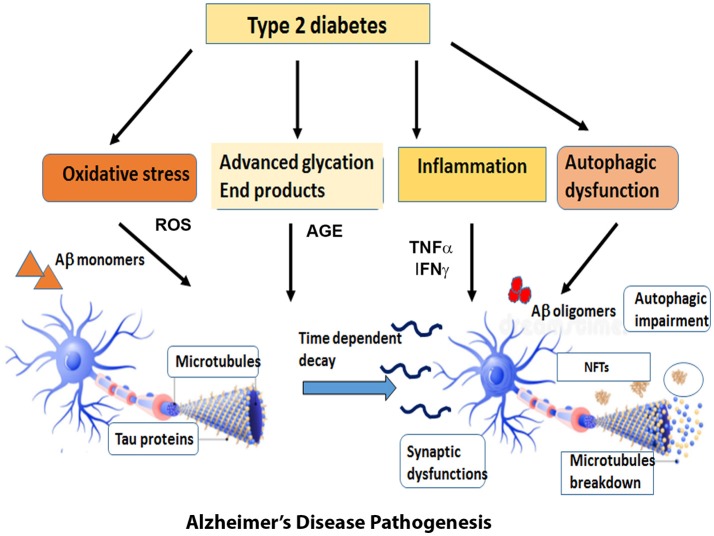
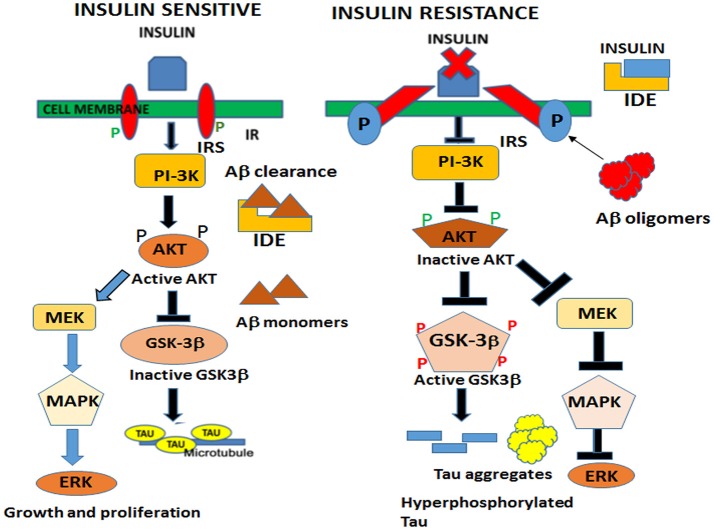
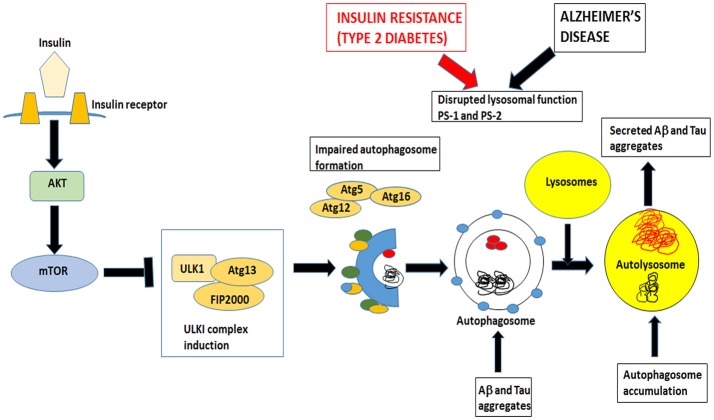
Alzheimer's disease (AD) and Type 2 Diabetes Mellitus (T2DM) are two of the most prevalent diseases in the elderly population worldwide. A growing body of epidemiological studies suggest that people with T2DM are at a higher risk of developing AD. Likewise, AD brains are less capable of glucose uptake from the surroundings resembling a condition of brain insulin resistance. Pathologically AD is characterized by extracellular plaques of Aβ and intracellular neurofibrillary tangles of hyperphosphorylated tau. T2DM, on the other hand is a metabolic disorder characterized by hyperglycemia and insulin resistance. In this review we have discussed how Insulin resistance in T2DM directly exacerbates Aβ and tau pathologies and elucidated the pathophysiological traits of synaptic dysfunction, inflammation, and autophagic impairments that are common to both diseases and indirectly impact Aβ and tau functions in the neurons. Elucidation of the underlying pathways that connect these two diseases will be immensely valuable for designing novel drug targets for Alzheimer's disease.
Overview
The claims and statistics of this paper haven’t been checked yet.
Run the check — free, no account needed. It reads the open-access text and checks the sources it cites.
Integrity signals
Registry
Cites
Statistics
Figures
Verification
Claims the paper makes
The claims and statistics of this paper haven’t been checked yet.
Run the check — free, no account needed. It reads the open-access text and checks the sources it cites.
Claims other papers make about this one
Each is checked against this paper’s own text: does it say what the citing paper says it does?
The source backs part of the claim, not all of it — or backs it for a different population, condition or comparison.
In the citing paper
“Although CA1 and CA2 did not show the largest changes in PIK3CA transcriptionally, each exhibited pronounced proteomic evidence of downstream pathway remodeling, suggesting that reduced insulin/PI3K signaling contributes to widespread proteomic synaptic and metabolic compromise in CA1/CA2, 42 , 66 , 67 even when transcriptional changes in PI3K components are modest.”
From Disruption of hippocampal upstream regulators of mTOR and insulin pathways in Down syndrome with Alzheimer's disease neuropathology: Preliminary observations (2026) · cites this paper as [66]
Experimental — accuracy not yet measured
Self-check
Percentages, sums and reported differences re-computed from the paper’s own numbers.
The self-check needs the paper’s full text.
Citations
Cites
Diagnosis and Classification of Diabetes Mellitus
American Diabetes Association (2010) · Diabetes Care · doi:10.2337/dc11-s062 · Cited by 14,094
Amyloid oligomers exacerbate tau pathology in a mouse model of tauopathy
Selenica, M.-L. B., Brownlow, M., Jimenez, J. P., Lee, D. C., Pena, G., Dickey, C. A., Gordon, M. N., & Morgan, D. (2013) · Neurodegenerative Diseases · doi:10.1159/000337230 · Cited by 10,359
Inflammation, stress, and diabetes
Wellen, K. E., & Hotamisligil, G. S. (2005) · Journal of Clinical Investigation · doi:10.1172/jci25102 · Cited by 4,143
Endoplasmic Reticulum Stress Links Obesity, Insulin Action, and Type 2 Diabetes
Özcan, U., Cao, Q., Yilmaz, E., Lee, A.-H., Iwakoshi, N. N., Özdelen, E., Tuncman, G., Görgün, C., Glimcher, L. H., & Hotamisligil, G. S. (2004) · Science · doi:10.1126/science.1103160 · Cited by 3,844
Neuropathological alterations in Alzheimer disease
Serrano-Pozo, A., Frosch, M. P., Masliah, E., & Hyman, B. T. (2011) · Cold Spring Harbor Perspectives in Medicine · doi:10.1101/cshperspect.a006189 · Cited by 3,345
Synapse Loss and Microglial Activation Precede Tangles in a P301S Tauopathy Mouse Model
Yoshiyama, Y., Higuchi, M., Zhang, B., Huang, S.-M., Iwata, N., Saido, T. C., Maeda, J., Suhara, T., Trojanowski, J. Q., & Lee, V. M.-Y. (2007) · Neuron · doi:10.1016/j.neuron.2007.01.010 · Cited by 2,208
Oxidative stress and the amyloid beta peptide in Alzheimer’s disease
Cheignon, C., Tomas, M., Bonnefont-Rousselot, D., Faller, P., Hureau, C., & Collin, F. (2018) · Redox Biology · doi:10.1016/j.redox.2017.10.014 · Cited by 2,185
Nelson, P. T., Alafuzoff, I., Bigio, E. H., Bouras, C., Braak, H., Cairns, N. J., Castellani, R. J., Crain, B. J., Davies, P., Tredici, K. D., et al. (2012) · Journal of Neuropathology & Experimental Neurology · doi:10.1097/nen.0b013e31825018f7 · Cited by 2,050 · cited 2×
“A wealth of emerging studies in recent years indicate that the density of the neurofibrillary tau tangles deposited at the neocortex of the brains of MCI patients correlated more strongly with the severity of the disease (Bierer et al., 1995; Nelson et al., 2012).”
BackgroundTalbot, K., Wang, H.-Y., Kazi, H., Han, L.-Y., Bakshi, K. P., Stucky, A., Fuino, R. L., Kawaguchi, K. R., Samoyedny, A. J., Wilson, R. S., et al. (2012) · Journal of Clinical Investigation · doi:10.1172/jci59903 · Cited by 1,871
Diagnosis and classification of diabetes mellitus
American Diabetes Association (2009) · Diabetes Care · doi:10.2337/dc09-s062 · Cited by 1,817
Cited by
Sorted by citations
Amyloid Beta in Aging and Alzheimer’s Disease
Sehar, U., Rawat, P., Reddy, A. P., Kopel, J. J., & Reddy, P. H. (2022) · International Journal of Molecular Sciences · doi:10.3390/ijms232112924 · Cited by 409
Degradation of proteins by PROTACs and other strategies
Wang, Y., Jiang, X., Feng, F., Liu, W., & Sun, H. (2020) · Acta Pharmaceutica Sinica B · doi:10.1016/j.apsb.2019.08.001 · Cited by 335
Fernández-Calle, R., Konings, S. C., Frontiñán-Rubio, J., García-Revilla, J., Camprubí-Ferrer, L., Svensson, M., Martinson, I., Boza-Serrano, A., Venero, J. L., Nielsen, H. M., et al. (2022) · Molecular Neurodegeneration · doi:10.1186/s13024-022-00566-4 · Cited by 278
The Impact of Disease Comorbidities in Alzheimer’s Disease
Santiago, J. A., & Potashkin, J. A. (2021) · Frontiers in Aging Neuroscience · doi:10.3389/fnagi.2021.631770 · Cited by 259
Lima, J. E. B. F., Moreira, N. C. S., & Sakamoto-Hojo, E. T. (2022) · Mutation Research/Genetic Toxicology and Environmental Mutagenesis · doi:10.1016/j.mrgentox.2021.503437 · Cited by 203
Metadata
- Authors
- Chatterjee, S., & Mudher, A.
- Affiliations
- University of Southampton (GB)
- Corresponding author
- Chatterjee, Shreyasi
- Venue
- Frontiers in Neuroscience
- Publisher
- Frontiers Media SA
- Published
- 2018-06-08
- Volume
- 12
- Pages
- 383-383
- ISSN
- 1662-453X (ISSN-L)
- PMC
- PMC6008657
- OpenAlex
- W2804519474
- Cited by
- 270
- References
- 255
- Citations by year
- 2026: 27 · 2025: 41 · 2024: 29 · 2023: 44 · 2022: 39 · 2021: 43 · 2020: 33 · 2019: 13 · 2018: 1
- FWCI
- 2.95
- Type
- journal article
- Language
- en
- Open access
- gold
- doi.org
- Locations
- Frontiers in Neuroscience (publishedVersion, cc-by)
- Europe PMC (PubMed Central) (publishedVersion, cc-by)
- PubMed Central (publishedVersion, cc-by)
- PubMed (publishedVersion)
- Nottingham Trent University's Institutional Repository (Nottingham Trent Repository) (acceptedVersion)
- DOAJ (DOAJ: Directory of Open Access Journals) (submittedVersion, cc-by-sa)
- ePrints Soton (University of Southampton) (submittedVersion)
- Funders
- University of Southampton
- Topics
- Life Sciences › Neuroscience › Cellular and Molecular Neuroscience › Alzheimer's disease research and treatments
- Health Sciences › Medicine › Psychiatry and Mental health › Dementia and Cognitive Impairment Research
- Life Sciences › Neuroscience › Neurology › Neuroinflammation and Neurodegeneration Mechanisms
- Keywords
- Alzheimer's disease, type 2 diabetes, insulin resistance, amyloid-beta, tau hyperphosphorylation, synaptic dysfunction, neuroinflammation, autophagy dysfunction, shared pathophysiology, therapeutic target
About these checks
Registry, retraction, Cites and statistics results are computed, not judged, with one exception: a printed reference that no index lists is read once by a model before it counts as a citation error. Claims are extracted by a model and kept only when their quote appears verbatim in the text; each cited source is then checked, with a model’s help, for whether it says what the claim relies on. Those verdicts can be wrong — read the claim’s quote and the cited source before relying on one.
Statistics and arithmetic are recomputed, not judged.
Confidence bands are shown only for fields calibrated on our annotated test set. None is calibrated yet, so no band is shown.
What counts as a claim ›How we measure confidence ›How we check this ›
Are you an author, or do you see a problem with this page? Request a review
