

Data leakage in deep learning studies of translational EEG
Open accessPublished version of a preprint
The DOI matches its Crossref record; 94 of the 99 references it cites were found in a registry or an index, and 1 are not checked yet; 11 of the 17 sources its claims cite were checked for support.
Abstract
A growing number of studies apply deep neural networks (DNNs) to recordings of human electroencephalography (EEG) to identify a range of disorders. In many studies, EEG recordings are split into segments, and each segment is randomly assigned to the training or test set. As a consequence, data from individual subjects appears in both the training and the test set. Could high test-set accuracy reflect data leakage from subject-specific patterns in the data, rather than patterns that identify a disease? We address this question by testing the performance of DNN classifiers using segment-based holdout (in which segments from one subject can appear in both the training and test set), and comparing this to their performance using subject-based holdout (where all segments from one subject appear exclusively in either the training set or the test set). In two datasets (one classifying Alzheimer's disease, and the other classifying epileptic seizures), we find that performance on previously-unseen subjects is strongly overestimated when models are trained using segment-based holdout. Finally, we survey the literature and find that the majority of translational DNN-EEG studies use segment-based holdout. Most published DNN-EEG studies may dramatically overestimate their classification performance on new subjects.
Verified 2026-11-22 · 1 reference not checked yet
Overview
CoChat Summary
TL;DR
This paper shows that segment-based train/test splits in deep learning EEG studies leak subject-specific information and inflate test accuracy. In two reproduced CNN case studies, performance on unseen subjects dropped sharply under subject-based holdout, and a literature review found most translational DNN-EEG studies used segment-based holdout.
Key findings
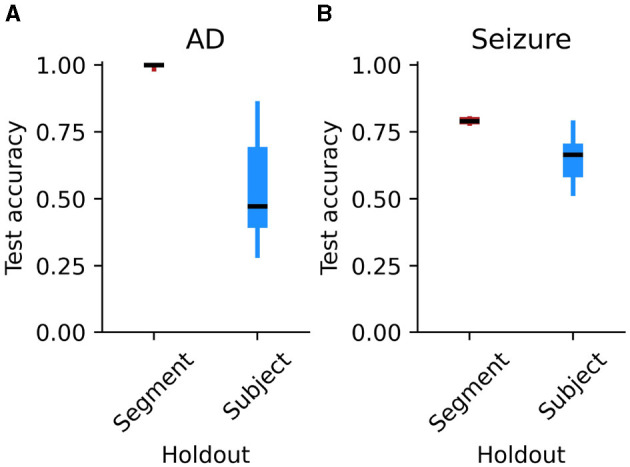
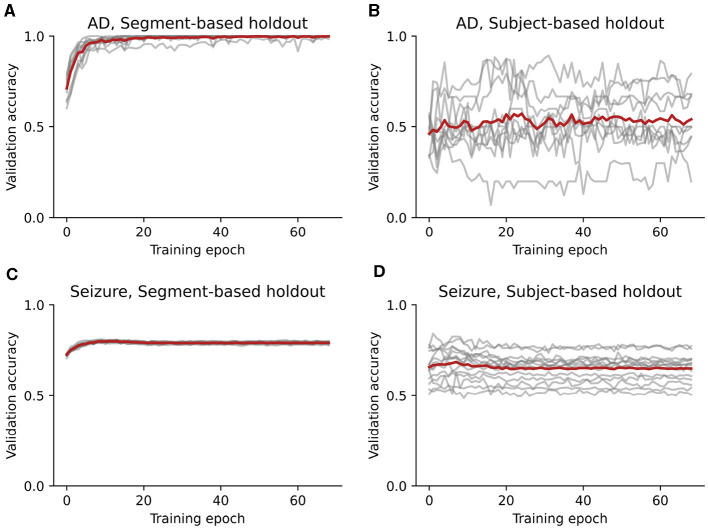
- Alzheimer’s disease classification: segment-based holdout reached 99.8% test accuracy (99.1–100.0%), but subject-based holdout fell to 53.0% (43.1–64.8%), near chance; the difference was significant (Wilcoxon T = 0.0, p = 0.002).
- Seizure detection: segment-based holdout reached 79.1% (78.8–79.4%), while subject-based holdout fell to 65.1% (61.3–69.1%); the difference was significant (Wilcoxon T = 0.0, p = 0.0001).
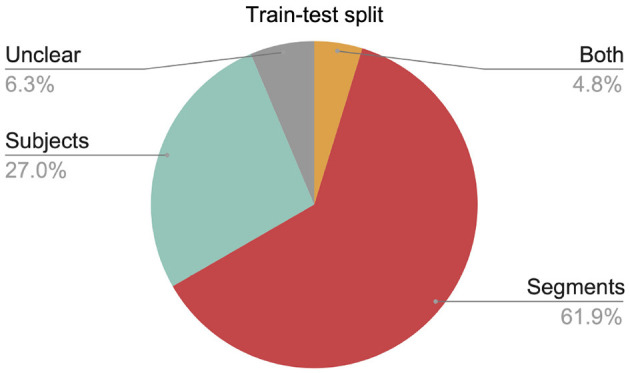
- In a literature review of 63 relevant papers, only 17 (27.0%) unambiguously avoided subject-specific data leakage; the majority used segment-based holdout or were unclear.
Methods
- Reproduced two published CNN architectures without modification: a 1D CNN for Alzheimer’s disease diagnosis from eyes-open resting-state EEG (49 AD, 49 SCI; 250 Hz; 2-s segments) and a 2D CNN for seizure detection from the Siena Scalp EEG Database (14 epilepsy patients; 47 seizures; spectrogram images).
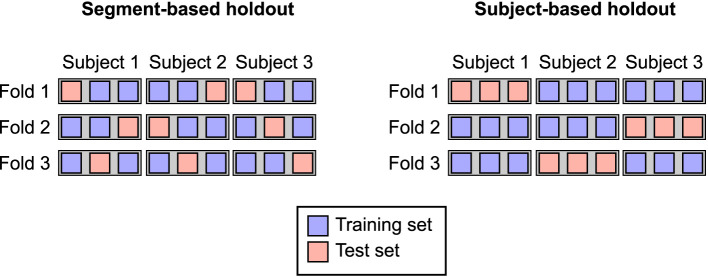
- Compared segment-based holdout, where EEG segments are split without regard to subject ID, against subject-based holdout, where all segments from a subject appear only in training or test.
- Surveyed 63 papers published since 2018 using DNNs with EEG for Alzheimer’s, Parkinson’s, ADHD, depression, schizophrenia, or seizures, classifying each study’s train-test split as segments, subjects, both, or unclear.
Limitations
- The paper states that the precise amount of data leakage and bias likely differs by experiment details, including fewer participants possibly producing stronger bias and model architecture possibly influencing how much subject-specific representation is learned.
- Evident from the text: the literature review was non-exhaustive, included 63 papers, and relied on whether papers explicitly reported subject-based splitting; some studies were labeled “unclear.”
- Evident from the text: the empirical demonstration is limited to two datasets and two reused CNN architectures, with no hyperparameter tuning or model selection, so the exact magnitude of inflation may not generalize to all DNN-EEG studies.
Model-written summary. Check it against the paper before relying on it.
Integrity signals
Registry
Cites
Statistics
Figures
Verification
Claims the paper makes
6 Valid · 0 Not valid · 4 Not checked · 54 Own results and interpretations
The cited sources support only part of this claim — read each source’s verdict below.
In the paper
“Segments of EEG from one subject are more similar to each other than to segments from different subjects (Demuru and Fraschini, 2020).”
§ Data leakage in deep learning studies of translational EEG > 1 Introduction
What the sources say
- Partly supportedcites Demuru and Fraschini, 2020 matched to “EEG fingerprinting: subject-specific signature based on the aperiodic component of power spectrum” (2020) sourceExperimental — accuracy not yet measured
The Discussion reports strong subject-specific properties in EEG’s aperiodic power-spectrum features, and the Performance evaluation compares similarity scores for feature vectors from genuine and impostor pairs. This supports greater within-subject similarity for those features, but the claim generalizes the finding to EEG segments as a whole. (LLM, conf=0.85)
plainstates an association- Asserted: passes — The authors put it forward as true.
- Checkable: passes — It can be checked against evidence.
- Load-bearing: passes — The paper’s conclusions depend on it.
- Based: passes — The paper gives a reason why it holds.
- Partly supported
Every source the paper cites for this claim was checked and supports it.
In the paper
“For example, if a study trains a classifier to identify individual subjects with a disease, then there may be stronger bias when the study involves fewer participants (Saeb et al., 2017).”
§ Data leakage in deep learning studies of translational EEG > 4 Discussion > 4.4 Caveats
What the sources say
- Supportedcites Saeb et al., 2017 matched to “The need to approximate the use-case in clinical machine learning” (2017) source
In “Simulated clinical prediction > Analyses,” the difference between record-wise and subject-wise classification errors was largest with fewer subjects and decreased as the number increased. The paper identifies this as bias from record-wise cross-validation in a classifier distinguishing diseased from healthy subjects; the claim’s “may” is consistent with that specific finding. (LLM, conf=0.88)
hedgedstates a possible cause- Asserted: passes — The authors put it forward as true.
- Checkable: passes — It can be checked against evidence.
- Load-bearing: unclear — It is unclear whether the paper’s conclusions depend on it.
- Based: passes — The paper gives a reason why it holds.
- Supported
The cited sources support only part of this claim — read each source’s verdict below.
In the paper
“This conclusion mirrors results from studies examining a variety of other types of data and classifier models (Saeb et al., 2017; Wen et al., 2018, 2020; Chaibub Neto et al., 2019; Tougui et al., 2021; Tampu et al., 2022).”
§ Data leakage in deep learning studies of translational EEG > 4 Discussion > 4.4 Caveats
What the sources say
- Supportedcites Saeb et al., 2017 matched to “The need to approximate the use-case in clinical machine learning” (2017) source
In Human activity recognition (Data description and methods; Analyses), Saeb et al. compare record-wise and subject-wise cross-validation using smartphone sensor data and a random-forest classifier. They find that record-wise splitting mixes subjects across training and test folds and significantly inflates estimated accuracy for prediction on new subjects. This supports the cited paper as an example of the analogous leakage problem; it does not need to establish the results of the other studies cited alongside it. (LLM, conf=0.88)
- Could not verifycites Wen et al., 2018 matched to “Deep learning methods to process fMRI data and their application in the diagnosis of cognitive impairment: a brief overview and our opinion” (2018) sourceExperimental — accuracy not yet measured
The 'Other deep learning methods' section discusses overfitting from small training samples, and the Conclusion discusses limitations of deep learning, but neither addresses leakage caused by segment-based cross-validation. Searches for segment-based cross-validation and for training and testing on the same subjects found no passage in our copy supporting that point; page numbers were not available. (LLM, conf=0.74)
- Supportedcites Chaibub Neto et al., 2019 matched to “Detecting the impact of subject characteristics on machine learning-based diagnostic applications” (2019) source
The Discussion reports identity confounding when voice and tapping classifiers were evaluated with record-wise splits, and recommends subject-wise splits instead. The Results report the same issue across three digital-health datasets. This supports citing the study as an example of the leakage problem in other data, without implying that this individual study tested multiple classifier models. (LLM, conf=0.90)
plainstates an association- Asserted: passes — The authors put it forward as true.
- Checkable: passes — It can be checked against evidence.
- Load-bearing: unclear — It is unclear whether the paper’s conclusions depend on it.
- Based: passes — The paper gives a reason why it holds.
- Supported
The sources with a verdict support this claim; the rest weren’t checked yet, have no full text we could read, or their verdicts aren’t rated yet.
In the paper
“Similar patterns of “identity confounding” data leakage have been documented in studies using functional (Wen et al., 2018) and anatomical (Wen et al., 2020) MRI, optical coherence tomography (OCT) (Tampu et al., 2022), accelerometer and gyroscope recordings from smartphones (Saeb et al., 2017), audio voice recordings (Chaibub Neto et al., 2019; Tougui et al., 2021), and performance on motor tasks”
§ Data leakage in deep learning studies of translational EEG > 4 Discussion > 4.3 Data leakage in other methods
What the sources say
- Could not verifycites Wen et al., 2018 matched to “Deep learning methods to process fMRI data and their application in the diagnosis of cognitive impairment: a brief overview and our opinion” (2018) sourceExperimental — accuracy not yet measured
The 'Other deep learning methods' section warns that small fMRI samples may lead to overfitting, but it does not document identity confounding or data leakage in functional MRI studies. Searches for identity confounding, leakage, and subject-level train/test splitting found no passage addressing that specific claim. (LLM, conf=0.75)
- Not checked — no full text of the sourcecites Wen et al., 2020 matched to “Convolutional neural networks for classification of Alzheimer's disease: Overview and reproducible evaluation” (2020) source
- Supportedcites Tampu et al., 2022 matched to “Inflation of test accuracy due to data leakage in deep learning-based classification of OCT images” (2022) source
The Tampu citation is attached to the OCT example, not the other data types in the sentence. The Introduction describes leakage when images from the same subject appear in both training and testing sets, and the Discussion reports inflated performance from such overlap in OCT datasets. Page numbers are not provided in our copy. (LLM, conf=0.93)
plainstates an association- Asserted: passes — The authors put it forward as true.
- Checkable: passes — It can be checked against evidence.
- Load-bearing: unclear — It is unclear whether the paper’s conclusions depend on it.
- Based: passes — The paper gives a reason why it holds.
- Could not verify
A result the paper states — it cites no source for it, so there is none to check. The quote shows it is in the paper.
In the paper
“Models trained using segment-based holdout, however, strongly overestimate their ability to perform this task.”
§ Data leakage in deep learning studies of translational EEG > 4 Discussion
boostedstates a cause- Asserted: passes — The authors put it forward as true.
- Checkable: passes — It can be checked against evidence.
- Load-bearing: passes — The paper’s conclusions depend on it.
- Based: passes — The paper gives a reason why it holds.
- Rests on an assumption not shown here.
41 more claims
Create a free account to see all 64 claims and to verify the 1 reference still open.
- It may state two separate claims as one. 14
- Probably not a substantial claim. 5
Self-check
Percentages, sums and reported differences re-computed from the paper’s own numbers.
Each contradiction between two passages listed here was confirmed by an independent check.
Rated minor: it would not touch a result — a value no result rests on, a p-value that stays on the same side of the significance level, or a conflict that is clerical, resolved elsewhere in the paper, or outside its own findings.
In the paper
§ Data leakage in deep learning studies of translational EEG > 2 Method > 2.5 Literature review
“This non-exhaustive search included 63 papers, all of which were published since 2018 and used deep learning to study one of the conditions named above.”
§ Data leakage in deep learning studies of translational EEG > 3 Results > 3.2 Data leakage in published EEG studies
“| Zhao and He (2015) | Alzheimer's | Segments |”
Rated minor: it would not touch a result — a value no result rests on, a p-value that stays on the same side of the significance level, or a conflict that is clerical, resolved elsewhere in the paper, or outside its own findings.
In the paper
§ Data leakage in deep learning studies of translational EEG > 2 Method > 2.5 Literature review
“This non-exhaustive search included 63 papers, all of which were published since 2018 and used deep learning to study one of the conditions named above.”
§ Data leakage in deep learning studies of translational EEG > 3 Results > 3.2 Data leakage in published EEG studies
“| Kim et al. (2018) | Alcoholism | Segments |”
Cited works that were retracted
Works this paper cites that were later retracted, from the retraction notices publishers deposit. Major when the notice came out before this paper was published.
Rated major: it would touch a result — a value a result rests on, reported and recomputed p-values on opposite sides of the significance level, two passages that conflict with no sign which is right, or a cited work retracted before this paper was published.
In the paper
“Zhou, 2022, Deep learning enabled diagnosis of children's ADHD based on the big data of video screen long-range EEG, J. Healthc. Eng, 2022, 5222136, 10.1155/2022/5222136”
Cited work 10.1155/2022/5222136 · retracted 2023-12-06 · notice 10.1155/2023/9856982 · this paper published 2024-05-03
Citations
Cites
1 retracted
Zhou, D., Liao, Z., & Chen, R. (2022) · Journal of Healthcare Engineering · doi:10.1155/2022/5222136 · Cited by 18
RetractedFolstein, M. F., Folstein, S. E., & McHugh, P. R. (1975) · Journal of Psychiatric Research · doi:10.1016/0022-3956(75)90026-6 · Cited by 88,282 · cited 1×
“Diagnoses were performed using standard clinical methods on the basis of neurological examinations, cognitive testing (MMSE Folstein et al., 1975 or MoCA Nasreddine et al., 2005), clinical history (e.g., hypertension, diabetes, head injury, depression), and laboratory results (e.g., vitamin B-12…”
MethodThe Montreal Cognitive Assessment, MoCA: a brief screening tool for mild cognitive impairment
Nasreddine, Z. S., Phillips, N. A., Bédirian, V., Charbonneau, S., Whitehead, V., Collin, I., Cummings, J. L., & Chertkow, H. (2005) · Journal of the American Geriatrics Society · doi:10.1111/j.1532-5415.2005.53221.x · Cited by 25,553 · cited 4×
“Diagnoses were performed using standard clinical methods on the basis of neurological examinations, cognitive testing (MMSE Folstein et al., 1975 or MoCA Nasreddine et al., 2005), clinical history (e.g., hypertension, diabetes, head injury, depression), and laboratory results (e.g., vitamin B-12…”
MethodInfluentialHirono, N., Mori, E., Ikejiri, Y., Imamura, T., Shimomura, T., Hashimoto, M., Yamashita, H., & Ikeda, M. (1997) · Brain and nerve · Cited by 21,039
Kok, J. S., Berg, I. J., & Scherder, E. J. A. (2013) · Dementia and Geriatric Cognitive Disorders Extra · doi:10.1159/000353441 · Cited by 20,589
Older Adults' Reasons for Using Technology while Aging in Place
Peek, S. T. M., Luijkx, K. G., Rijnaard, M. D., Nieboer, M. E., van der Voort, C. S., Aarts, S., van Hoof, J., Vrijhoef, H. J. M., & Wouters, E. J. M. (2016) · Gerontology · doi:10.1159/000430949 · Cited by 19,690
Sensitivity and False Alarm Rate of a Fall Sensor in Long-Term Fall Detection in the Elderly
Kangas, M., Korpelainen, R., Vikman, I., Nyberg, L., & Jämsä, T. (2015) · Gerontology · doi:10.1159/000362720 · Cited by 18,909
Goldberger, A. L., Amaral, L. A. N., Glass, L., Hausdorff, J. M., Ivanov, P. C., Mark, R. G., Mietus, J. E., Moody, G. B., Peng, C.-K., & Stanley, H. E. (2000) · Circulation · doi:10.1161/01.cir.101.23.e215 · Cited by 14,809
Artificial intelligence in radiology
Hosny, A., Parmar, C., Quackenbush, J., Schwartz, L. H., & Aerts, H. J. W. L. (2018) · Nature Reviews Cancer · doi:10.1038/s41568-018-0016-5 · Cited by 3,803 · cited 10×
“Our Alzheimer’s CNN classifier appeared to have an accuracy of above 99% when using segment-based holdout, but its true performance on previously-unseen subjects was indistinguishable from chance.”
InfluentialAcharya, U. R., Oh, S. L., Hagiwara, Y., Tan, J. H., & Adeli, H. (2018) · Computers in Biology and Medicine · doi:10.1016/j.compbiomed.2017.09.017 · Cited by 1,647
The Diagnosis and Management of Mild Cognitive Impairment: A Clinical Review
Langa, K. M., & Levine, D. A. (2014) · JAMA · doi:10.1001/jama.2014.13806 · Cited by 1,337 · cited 2×
“These tests were used to rule out reversible causes of memory loss and to diagnose subjective cognitive impairment (SCI), mild cognitive impairment (MCI), and dementia.”
BackgroundMethodWen, J., Thibeau-Sutre, E., Diaz-Melo, M., Samper-González, J., Routier, A., Bottani, S., Dormont, D., Durrleman, S., Burgos, N., & Colliot, O. (2020) · Medical Image Analysis · doi:10.1016/j.media.2020.101694 · Cited by 809 · cited 4×
“To increase the number of observations available to train the model, these studies often split a single neural recording into multiple samples, and use each sample as a separate observation during training or testing.”
BackgroundInfluentialLeakage in data mining: Formulation, detection, and avoidance
Kaufman, S., Rosset, S., Perlich, C., & Stitelman, O. (2012) · ACM Transactions on Knowledge Discovery from Data · doi:10.1145/2382577.2382579 · Cited by 791
Automated EEG-based screening of depression using deep convolutional neural network
Acharya, U. R., Oh, S. L., Hagiwara, Y., Tan, J. H., Adeli, H., & Subha, D. P. (2018) · Computer Methods and Programs in Biomedicine · doi:10.1016/j.cmpb.2018.04.012 · Cited by 650 · cited 1×
“This high accuracy is consistent with prior studies that use segment-based holdout and report high accuracy for CNNs at identifying neurological disorders (Acharya et al., 2018b; Lee et al., 2019; Oh et al., 2020).”
ResultTruong, N. D., Nguyen, A. D., Kuhlmann, L., Bonyadi, M. R., Yang, J., Ippolito, S., & Kavehei, O. (2018) · Neural Networks · doi:10.1016/j.neunet.2018.04.018 · Cited by 635
A deep learning approach for Parkinson’s disease diagnosis from EEG signals
Oh, S. L., Hagiwara, Y., Raghavendra, U., Yuvaraj, R., Arunkumar, N., Murugappan, M., & Acharya, U. R. (2020) · Neural Computing and Applications · doi:10.1007/s00521-018-3689-5 · Cited by 627 · cited 3×
“These EEG recordings were provided to us by the Pacific Neuroscience Institute.”
MethodResultAn automated system for epilepsy detection using EEG brain signals based on deep learning approach
Ullah, I., Hussain, M., Qazi, E.-U.-H., & Aboalsamh, H. (2018) · Expert Systems with Applications · doi:10.1016/j.eswa.2018.04.021 · Cited by 622
Efficient Epileptic Seizure Prediction Based on Deep Learning
Daoud, H., & Bayoumi, M. A. (2019) · IEEE Transactions on Biomedical Circuits and Systems · doi:10.1109/tbcas.2019.2929053 · Cited by 483
Epileptic Seizure Detection Based on EEG Signals and CNN
Zhou, M., Tian, C., Cao, R., Wang, B., Niu, Y., Hu, T., Guo, H., & Xiang, J. (2018) · Frontiers in Neuroinformatics · doi:10.3389/fninf.2018.00095 · Cited by 483
Epileptic Seizures Detection Using Deep Learning Techniques: A Review
Shoeibi, A., Khodatars, M., Ghassemi, N., Jafari, M., Moridian, P., Alizadehsani, R., Panahiazar, M., Khozeimeh, F., Zare, A., Hosseini-Nejad, H., et al. (2021) · International Journal of Environmental Research and Public Health · doi:10.3390/ijerph18115780 · Cited by 459
Machine Learning for Predicting Epileptic Seizures Using EEG Signals: A Review
Rasheed, K., Qayyum, A., Qadir, J., Sivathamboo, S., Kwan, P., Kuhlmann, L., O'Brien, T., & Razi, A. (2021) · IEEE Reviews in Biomedical Engineering · doi:10.1109/rbme.2020.3008792 · Cited by 409
Raghu, S., Sriraam, N., Temel, Y., Rao, S. V., & Kubben, P. L. (2020) · Neural Networks · doi:10.1016/j.neunet.2020.01.017 · Cited by 382
Systematic Review on Resting-State EEG for Alzheimer’s Disease Diagnosis and Progression Assessment
Cassani, R., Estarellas, M., San-Martin, R., Fraga, F. J., & Falk, T. H. (2018) · Disease Markers · doi:10.1155/2018/5174815 · Cited by 376 · cited 1×
“Prior review articles have summarized the details and idiosyncrasies of DNN models in the context of AD (Cassani et al., 2018; Wen et al., 2020) and seizures (Rasheed et al., 2020; Shoeibi et al., 2021).”
BackgroundThe need to approximate the use-case in clinical machine learning
Saeb, S., Lonini, L., Jayaraman, A., Mohr, D. C., & Kording, K. P. (2017) · GigaScience · doi:10.1093/gigascience/gix019 · Cited by 367 · cited 5×
“…anatomical (Wen et al., 2020) MRI, optical coherence tomography (OCT) (Tampu et al., 2022), accelerometer and gyroscope recordings from smartphones (Saeb et al., 2017), audio voice recordings (Chaibub Neto et al., 2019; Tougui et al., 2021), and performance on motor tasks (Chaibub Neto et al.,…”
BackgroundResultInfluentialFocal Onset Seizure Prediction Using Convolutional Networks
Khan, H., Marcuse, L., Fields, M., Swann, K., & Yener, B. (2018) · IEEE Transactions on Biomedical Engineering · doi:10.1109/tbme.2017.2785401 · Cited by 353
Deep Convolutional Neural Network Model for Automated Diagnosis of Schizophrenia Using EEG Signals
Oh, S. L., Vicnesh, J., Ciaccio, E. J., Yuvaraj, R., & Acharya, U. R. (2019) · Applied Sciences · doi:10.3390/app9142870 · Cited by 304
Ieracitano, C., Mammone, N., Bramanti, A., Hussain, A., & Morabito, F. C. (2019) · Neurocomputing · doi:10.1016/j.neucom.2018.09.071 · Cited by 294
Automated Depression Detection Using Deep Representation and Sequence Learning with EEG Signals
Ay, B., Yildirim, O., Talo, M., Baloglu, U. B., Aydin, G., Puthankattil, S. D., & Acharya, U. R. (2019) · Journal of Medical Systems · doi:10.1007/s10916-019-1345-y · Cited by 289
Li, Y., Liu, Y., Cui, W.-G., Guo, Y.-Z., Huang, H., & Hu, Z.-Y. (2020) · IEEE Transactions on Neural Systems and Rehabilitation Engineering · doi:10.1109/tnsre.2020.2973434 · Cited by 285 · cited 1×
“Instead, it must learn a representation of the labels—albeit a representation that may be contaminated by multiple segments coming from the same event, or one that may be specific to a given participant.”
BackgroundMall, P. K., Singh, P. K., Srivastav, S., Narayan, V., Paprzycki, M., Jaworska, T., & Ganzha, M. (2023) · Healthcare Analytics · doi:10.1016/j.health.2023.100216 · Cited by 276
Hussein, R., Palangi, H., Ward, R. K., & Wang, Z. J. (2019) · Clinical Neurophysiology · doi:10.1016/j.clinph.2018.10.010 · Cited by 263
Deep Convolutional Neural Network-Based Epileptic Electroencephalogram (EEG) Signal Classification
Gao, Y., Gao, B., Chen, Q., Liu, J., & Zhang, Y. (2020) · Frontiers in Neurology · doi:10.3389/fneur.2020.00375 · Cited by 209
Tougui, I., Jilbab, A., & Mhamdi, J. E. (2021) · Healthcare Informatics Research · doi:10.4258/hir.2021.27.3.189 · Cited by 199
A deep learning framework for identifying children with ADHD using an EEG-based brain network
Chen, H., Song, Y., & Li, X. (2019) · Neurocomputing · doi:10.1016/j.neucom.2019.04.058 · Cited by 189
Indoor Air Quality Assessment Using a CO2 Monitoring System Based on Internet of Things
Marques, G., Ferreira, C. R., & Pitarma, R. (2019) · Journal of Medical Systems · doi:10.1007/s10916-019-1184-x · Cited by 182
Dubreuil-Vall, L., Ruffini, G., & Camprodon, J. A. (2020) · Frontiers in Neuroscience · doi:10.3389/fnins.2020.00251 · Cited by 170
Early Alzheimer’s disease diagnosis based on EEG spectral images using deep learning
Bi, X., & Wang, H. (2019) · Neural Networks · doi:10.1016/j.neunet.2019.02.005 · Cited by 169
EEG Synchronization Analysis for Seizure Prediction: A Study on Data of Noninvasive Recordings
Detti, P., Vatti, G., & Zabalo Manrique de Lara, G. (2020) · Processes · doi:10.3390/pr8070846 · Cited by 162 · cited 2×
“EEG data for experiment 2 were downloaded from the publicly-available Siena Scalp EEG Database hosted on PhysioNet (https://physionet.org/content/siena-scalp-eeg/1.0.0/).”
MethodInfluentialShalbaf, A., Bagherzadeh, S., & Maghsoudi, A. (2020) · Physical and Engineering Sciences in Medicine · doi:10.1007/s13246-020-00925-9 · Cited by 160
Emami, A., Kunii, N., Matsuo, T., Shinozaki, T., Kawai, K., & Takahashi, H. (2019) · NeuroImage: Clinical · doi:10.1016/j.nicl.2019.101684 · Cited by 160
Automatic seizure detection using three-dimensional CNN based on multi-channel EEG
Wei, X., Zhou, L., Chen, Z., Zhang, L., & Zhou, Y. (2018) · BMC Medical Informatics and Decision Making · doi:10.1186/s12911-018-0693-8 · Cited by 159
A deep learning framework for automatic diagnosis of unipolar depression
Mumtaz, W., & Qayyum, A. (2019) · International Journal of Medical Informatics · doi:10.1016/j.ijmedinf.2019.103983 · Cited by 155
A Novel Deep Neural Network for Robust Detection of Seizures Using EEG Signals
Zhao, W., Zhao, W., Wang, W., Jiang, X., Zhang, X., Peng, Y., Zhang, B., & Zhang, G. (2020) · Computational and Mathematical Methods in Medicine · doi:10.1155/2020/9689821 · Cited by 152
PDCNNet: An Automatic Framework for the Detection of Parkinson’s Disease Using EEG Signals
Khare, S. K., Bajaj, V., & Acharya, U. R. (2021) · IEEE Sensors Journal · doi:10.1109/jsen.2021.3080135 · Cited by 151
EEG-based mild depression recognition using convolutional neural network
Li, X., La, R., Wang, Y., Niu, J., Zeng, S., Sun, S., & Zhu, J. (2019) · Medical & Biological Engineering & Computing · doi:10.1007/s11517-019-01959-2 · Cited by 151
Moghaddari, M., Lighvan, M. Z., & Danishvar, S. (2020) · Computer Methods and Programs in Biomedicine · doi:10.1016/j.cmpb.2020.105738 · Cited by 148
Morabito, F. C., Campolo, M., Ieracitano, C., Ebadi, J. M., Bonanno, L., Bramanti, A., Desalvo, S., Mammone, N., & Bramanti, P. (2016) · 2016 IEEE 2nd International Forum on Research and Technologies for Society and Industry Leveraging a better tomorrow (RTSI) · doi:10.1109/rtsi.2016.7740576 · Cited by 145
Multicenter Validation of an MMSE ‐Mo CA Conversion Table
Bergeron, D., Flynn, K., Verret, L., Poulin, S., Bouchard, R. W., Bocti, C., Fülöp, T., Lacombe, G., Gauthier, S., Nasreddine, Z., et al. (2017) · Journal of the American Geriatrics Society · doi:10.1111/jgs.14779 · Cited by 144 · cited 2×
“Diagnoses were performed using standard clinical methods on the basis of neurological examinations, cognitive testing (MMSE Folstein et al., 1975 or MoCA Nasreddine et al., 2005), clinical history (e.g., hypertension, diabetes, head injury, depression), and laboratory results (e.g., vitamin B-12 levels, thyroid stimul…”
MethodLoh, H. W., Ooi, C. P., Palmer, E., Barua, P. D., Dogan, S., Tuncer, T., Baygin, M., & Acharya, U. R. (2021) · Electronics · doi:10.3390/electronics10141740 · Cited by 144 · cited 1×
“For example, some EEG-based DNNs treat every channel independently, and use information from each channel as a separate observation (Loh et al., 2021).”
BackgroundUyulan, C., Ergüzel, T. T., Unubol, H., Cebi, M., Sayar, G. H., Nezhad Asad, M., & Tarhan, N. (2021) · Clinical EEG and Neuroscience · doi:10.1177/1550059420916634 · Cited by 141
Early prediction of epileptic seizures using a long-term recurrent convolutional network
Wei, X., Zhou, L., Zhang, Z., Chen, Z., & Zhou, Y. (2019) · Journal of Neuroscience Methods · doi:10.1016/j.jneumeth.2019.108395 · Cited by 140
Rashed-Al-Mahfuz, M., Moni, M. A., Uddin, S., Alyami, S. A., Summers, M. A., & Eapen, V. (2021) · IEEE Journal of Translational Engineering in Health and Medicine · doi:10.1109/jtehm.2021.3050925 · Cited by 138 · cited 3×
“We therefore reused the model architecture presented by Rashed-Al-Mahfuz et al. (2021) without modification.”
Method(2019) · Handbook of clinical neurology · doi:10.1016/b978-0-444-64032-1.00006-0 · Cited by 134 · cited 1×
“Those studies are likely to suffer from substantial data leakage, since physiological sources of electrical activity appear redundantly across multiple EEG scalp electrodes (Michel and He, 2019).”
BackgroundDeep Learning Based on Event-Related EEG Differentiates Children with ADHD from Healthy Controls
Vahid, A., Bluschke, A., Roessner, V., Stober, S., & Beste, C. (2019) · Journal of Clinical Medicine · doi:10.3390/jcm8071055 · Cited by 115
Li, X., La, R., Wang, Y., Hu, B., & Zhang, X. (2020) · Frontiers in Neuroscience · doi:10.3389/fnins.2020.00192 · Cited by 115 · cited 1×
“Subject-specific studies indicate that a bespoke classifier could be trained to identify seizures in each new patient (Jana et al., 2020; Liang et al., 2020; Li Y. et al., 2020).”
BackgroundComputer aided diagnosis system using deep convolutional neural networks for ADHD subtypes
Ahmadi, A., Kashefi, M., Shahrokhi, H., & Nazari, M. A. (2020) · Biomedical Signal Processing and Control · doi:10.1016/j.bspc.2020.102227 · Cited by 109
Fürbass, F., Kural, M. A., Gritsch, G., Hartmann, M., Kluge, T., & Beniczky, S. (2020) · Clinical Neurophysiology · doi:10.1016/j.clinph.2020.02.032 · Cited by 106
Huggins, C. J., Escudero, J., Parra, M. A., Scally, B., Anghinah, R., Vitória Lacerda De Araújo, A., Basile, L. F., & Abasolo, D. (2021) · Journal of Neural Engineering · doi:10.1088/1741-2552/ac05d8 · Cited by 105
2018 IEEE International Conference on Consumer Electronics (ICCE)
(2018) · doi:10.1109/icce42323.2018 · Cited by 104
Identification of Children at Risk of Schizophrenia via Deep Learning and EEG Responses
Ahmedt-Aristizabal, D., Fernando, T., Denman, S., Robinson, J. E., Sridharan, S., Johnston, P. J., Laurens, K. R., & Fookes, C. (2021) · IEEE Journal of Biomedical and Health Informatics · doi:10.1109/jbhi.2020.2984238 · Cited by 103
Shi, X., Wang, T., Wang, L., Liu, H., & Yan, N. (2019) · Asia-Pacific Signal and Information Processing Association Annual Summit and Conference (APSIPA ASC) · doi:10.1109/apsipaasc47483.2019.9023190 · Cited by 101
Liang, W., Pei, H., Cai, Q., & Wang, Y. (2020) · Neurocomputing · doi:10.1016/j.neucom.2018.10.108 · Cited by 100 · cited 1×
“Instead, it must learn a representation of the labels—albeit a representation that may be contaminated by multiple segments coming from the same event, or one that may be specific to a given participant.”
BackgroundWen, D., Wei, Z., Zhou, Y., Li, G., Zhang, X., & Han, W. (2018) · Frontiers in Neuroinformatics · doi:10.3389/fninf.2018.00023 · Cited by 93 · cited 2×
“Similar patterns of “identity confounding” data leakage have been documented in studies using functional (Wen et al., 2018) and anatomical (Wen et al., 2020) MRI, optical coherence tomography (OCT) (Tampu et al., 2022), accelerometer and gyroscope recordings from smartphones (Saeb et al., 2017),…”
BackgroundLee, S., Hussein, R., & McKeown, M. J. (2019) · IEEE Global Conference on Signal and Information Processing · doi:10.1109/globalsip45357.2019.8969309 · Cited by 88
Detecting the impact of subject characteristics on machine learning-based diagnostic applications
Chaibub Neto, E., Pratap, A., Perumal, T. M., Tummalacherla, M., Snyder, P., Bot, B. M., Trister, A. D., Friend, S. H., Mangravite, L., & Omberg, L. (2019) · npj Digital Medicine · doi:10.1038/s41746-019-0178-x · Cited by 83
EEG fingerprinting: subject-specific signature based on the aperiodic component of power spectrum
Demuru, M., & Fraschini, M. (2020) · Computers in Biology and Medicine · doi:10.1016/j.compbiomed.2020.103748 · Cited by 82 · cited 1×
“Segments of EEG from one subject are more similar to each other than to segments from different subjects (Demuru and Fraschini, 2020).”
BackgroundADHD detection using dynamic connectivity patterns of EEG data and ConvLSTM with attention framework
Bakhtyari, M., & Mirzaei, S. (2022) · Biomedical Signal Processing and Control · doi:10.1016/j.bspc.2022.103708 · Cited by 82
Chen, H., Song, Y., & Li, X. (2019) · Journal of Neural Engineering · doi:10.1088/1741-2552/ab3a0a · Cited by 81
Resting-state electroencephalography based deep-learning for the detection of Parkinson’s disease
Shaban, M., & Amara, A. W. (2022) · PLoS ONE · doi:10.1371/journal.pone.0263159 · Cited by 81
Seizure Detection Using Least Eeg Channels by Deep Convolutional Neural Network
Avcu, M. T., Zhang, Z., & Shih Chan, D. W. (2019) · ICASSP 2019 - 2019 IEEE International Conference on Acoustics, Speech and Signal Processing (ICASSP) · doi:10.1109/icassp.2019.8683229 · Cited by 77
Detection of Early Stage Alzheimer’s Disease using EEG Relative Power with Deep Neural Network
Kim, D., & Kim, K. (2018) · 2018 40th Annual International Conference of the IEEE Engineering in Medicine and Biology Society (EMBC) · doi:10.1109/embc.2018.8512231 · Cited by 76
Artificial Intelligence and Deep Learning in Neuroradiology: Exploring the New Frontier
Kaka, H., Zhang, E., & Khan, N. M. (2020) · Canadian Association of Radiologists Journal · doi:10.1177/0846537120954293 · Cited by 76
Deep Learning in the EEG Diagnosis of Alzheimer’s Disease
Zhao, Y., & He, L. (2015) · Lecture notes in computer science · doi:10.1007/978-3-319-16628-5_25 · Cited by 76
Detection of ADHD cases using CNN and classical classifiers of raw EEG
TaghiBeyglou, B., Shahbazi, A., Bagheri, F., Akbarian, S., & Jahed, M. (2022) · Computer Methods and Programs in Biomedicine Update · doi:10.1016/j.cmpbup.2022.100080 · Cited by 73
Deep learning applied to electroencephalogram data in mental disorders: a systematic review
de Bardeci, M., Ip, C. T., & Olbrich, S. (2021) · Biological Psychology · doi:10.1016/j.biopsycho.2021.108117 · Cited by 71 · cited 1×
“For example, this type of data-leakage occurs in published MRI studies (Wen et al., 2020).”
BackgroundA Novel Multi-scale 3D CNN with Deep Neural Network for Epileptic Seizure Detection
Choi, G., Park, C., Kim, J., Cho, K., Kim, T., Bae, H., Min, K.-Y., Jung, K., & Chong, J. (2019) · International Conference on Consumer Electronics · doi:10.1109/icce.2019.8661969 · Cited by 71
Bouallegue, G., Djemal, R., Alshebeili, S. A., & Aldhalaan, H. (2020) · IEEE Access · doi:10.1109/access.2020.3037995 · Cited by 69
Tosun, M. (2021) · Physical and Engineering Sciences in Medicine · doi:10.1007/s13246-021-01018-x · Cited by 69
Automated Screening of Parkinson's Disease Using Deep Learning Based Electroencephalography
Shaban, M. (2021) · International IEEE/EMBS Conference on Neural Engineering · doi:10.1109/ner49283.2021.9441065 · Cited by 58
Zhang, X., Li, J., Hou, K., Hu, B., Shen, J. G., Pan, J., & Hu, B. (2020) · Annual International Conference of the IEEE Engineering in Medicine and Biology Society (EMBC) · doi:10.1109/embc44109.2020.9175956 · Cited by 57
Medical data mining: insights from winning two competitions
Rosset, S., Perlich, C., Świrszcz, G., Melville, P., & Liu, Y. (2009) · Data Mining and Knowledge Discovery · doi:10.1007/s10618-009-0158-x · Cited by 50 · cited 2×
“Because the ID number was assigned based on patients’ diagnosis, it constitutes a source of data leakage (Rosset et al., 2010).”
BackgroundAlzheimer's Disease Classification With a Cascade Neural Network
You, Z., Zeng, R., Lan, X., Ren, H., You, Z., Shi, X., Zhao, S., Guo, Y., Jiang, X., & Hu, X. (2020) · Frontiers in Public Health · doi:10.3389/fpubh.2020.584387 · Cited by 50
Convolutional neural network for detection and classification of seizures in clinical data
Iešmantas, T., & Alzbutas, R. (2020) · Medical & Biological Engineering & Computing · doi:10.1007/s11517-020-02208-7 · Cited by 49
Neurological state changes indicative of ADHD in children learned via EEG-based LSTM networks
Chang, Y., Stevenson, C., Chen, I., Lin, D., & Ko, L. (2022) · Journal of Neural Engineering · doi:10.1088/1741-2552/ac4f07 · Cited by 47
Anxiety and Depression Diagnosis Method Based on Brain Networks and Convolutional Neural Networks
Xie, Y., Yang, B., Lu, X., Zheng, M., Fan, C., Bi, X., zhou, S., & Li, Y. (2020) · 2020 42nd Annual International Conference of the IEEE Engineering in Medicine & Biology Society (EMBC) · doi:10.1109/embc44109.2020.9176471 · Cited by 38
Chu, L., Qiu, R. C., Liu, H., Ling, Z., Zhang, T., & Wang, J. (2017) · arXiv (Cornell University) · doi:10.48550/arxiv.1707.03467 · Cited by 34
Wave2Vec: Vectorizing Electroencephalography Bio-Signal for Prediction of Brain Disease
Kim, S., Kim, J., & Chun, H.-W. (2018) · International Journal of Environmental Research and Public Health · doi:10.3390/ijerph15081750 · Cited by 27
Detti, P. (2020) · PhysioNet · doi:10.13026/s309-a395 · Cited by 26
Gkenios, G., Latsiou, K., Diamantaras, K., Chouvarda, I., & Tsolaki, M. (2022) · Annual International Conference of the IEEE Engineering in Medicine and Biology Society (EMBC) · doi:10.1109/embc48229.2022.9871302 · Cited by 24
Deep Learning based Pre-screening method for Depression with Imagery Frontal EEG Channels
Kwon, H., Kang, S., Park, W., Park, J., & Lee, Y. (2019) · International Conference on Information and Communication Technology Convergence (ICTC) · doi:10.1109/ictc46691.2019.8939919 · Cited by 17
Ganapathi, A. S., Glatt, R. M., Bookheimer, T., Popa, E. S., Ingemanson, M. L., Richards, C. J., Hodes, J. F., Pierce, K. P., Slyapich, C. B., Iqbal, F., et al. (2022) · Journal of Alzheimer s Disease · doi:10.3233/jad-220616 · Cited by 17
Self-citationHigh Dimensional Convolutional Neural Network for EEG Connectivity-Based Diagnosis of ADHD
Mafi, M., & Radfar, S. (2022) · Journal of Biomedical Physics and Engineering · doi:10.31661/jbpe.v0i0.2108-1380 · Cited by 12
“Patient-specific seizure prediction using the convolutional neural networks,”
Jana, R., Bhattacharyya, S., & Das, S. (2020) · Advances in intelligent systems and computing · doi:10.1007/978-981-15-2021-1_7 · Cited by 9 · cited 1×
“Instead, it must learn a representation of the labels—albeit a representation that may be contaminated by multiple segments coming from the same event, or one that may be specific to a given participant.”
BackgroundInflation of test accuracy due to data leakage in deep learning-based classification of OCT images
Tampu, I. E., Eklund, A., & Haj-Hosseini, N. (2022) · Scientific Data · doi:10.1038/s41597-022-01618-6 · Cited by 1 · cited 2×
“Prior research has shown that leakage of subject-specific information—sometimes referred to as “identity confounding” (Chaibub Neto et al., 2019)—occurs in a number of different research areas.”
BackgroundDetti, P. (2020) · PhysioNet · doi:10.13026/5d4a-j060
Cited by
Don’t push the button! Exploring data leakage risks in machine learning and transfer learning
Apicella, A., Isgrò, F., & Prevete, R. (2025) · Artificial Intelligence Review · doi:10.1007/s10462-025-11326-3 · Cited by 223
Rokhva, S., Teimourpour, B., & Soltani, A. H. (2024) · Food and Humanity · doi:10.1016/j.foohum.2024.100378 · Cited by 58
How EEG preprocessing shapes decoding performance
Kessler, R., Enge, A., & Skeide, M. A. (2025) · Communications Biology · doi:10.1038/s42003-025-08464-3 · Cited by 74
“Recent studies have investigated how leakage is introduced when decoding is performed across participants with segment-based instead of subject-based holdout sets during cross-validation 73 .”
Pup, F. D., Zanola, A., Tshimanga, L. F., Bertoldo, A., Finos, L., & Atzori, M. (2025) · Computers in Biology and Medicine · doi:10.1016/j.compbiomed.2025.110608 · Cited by 75
Sadeq, M. A., Ghorab, R. M. F., Ashry, M. H., Abozaid, A. M., Banihani, H. A., Salem, M., Aisheh, M. T. A., Abuzahra, S., Mourid, M. R., Assker, M. M., et al. (2024) · Scientific Reports · doi:10.1038/s41598-024-68996-2 · Cited by 36
Metadata
- Authors
- Brookshire, G., Kasper, J., Blauch, N. M., Wu, Y. C., Glatt, R., Merrill, D. A., Gerrol, S., Yoder, K. J., Quirk, C., & Lucero, C.
- Affiliations
- Carnegie Mellon University (US)
- University of California, Los Angeles (US)
- Corresponding author
- Brookshire, Geoffrey
- ORCID
- Venue
- Frontiers in Neuroscience
- Publisher
- Frontiers Media SA
- Published
- 2024-05-03
- Volume
- 18
- Pages
- 1373515-1373515
- ISSN
- 1662-453X (ISSN-L)
- PMC
- PMC11099244
- OpenAlex
- W4396619951
- Semantic Scholar
- d59558f683e7d6e02aedc0b8510e7a601c103054
- Cited by
- 103
- References
- 99
- Citations by year
- 2026: 81 · 2025: 17 · 2024: 5
- FWCI
- 24.95
- Type
- journal article
- Language
- en
- Open access
- gold
- doi.org
- Licence
- Locations
- Frontiers in Neuroscience (publishedVersion, cc-by)
- medRxiv (acceptedVersion, cc-by-nd)
- PubMed Central (publishedVersion, cc-by)
- PubMed (publishedVersion)
- DOAJ (DOAJ: Directory of Open Access Journals) (submittedVersion, cc-by-sa)
- Topics
- Life Sciences › Neuroscience › Cognitive Neuroscience › EEG and Brain-Computer Interfaces
- Physical Sciences › Computer Science › Artificial Intelligence › Machine Learning in Healthcare
- Physical Sciences › Computer Science › Artificial Intelligence › Emotion and Mood Recognition
- Keywords
- data leakage, deep neural network, cross-subject generalization, Alzheimer's disease classification, epileptic seizure classification
About these checks
Registry, retraction, Cites and statistics results are computed, not judged, with one exception: a printed reference that no index lists is read once by a model before it counts as a citation error. Claims are extracted by a model and kept only when their quote appears verbatim in the text; each cited source is then checked, with a model’s help, for whether it says what the claim relies on. Those verdicts can be wrong — read the claim’s quote and the cited source before relying on one.
The claim verdicts this report counts are experimental: their accuracy is not yet measured.
A language model drew the claims from the paper on 2026-10-10, under version 3 of the claim definition (model deepseek-v4.1-flash, prompt extract-v3).
A second model labelled each claim on 2026-10-10 (model jev-1.13-20260917, definition revision gold-guideline-v0.2).
Cited sources are checked with a language model’s help (gpt-6-sol).
Statistics and arithmetic are recomputed, not judged.
Confidence bands are shown only for fields calibrated on our annotated test set. None is calibrated yet, so no band is shown.
What counts as a claim ›How we measure confidence ›How we check this ›
Are you an author, or do you see a problem with this page? Request a review
Data sources
Bibliographic data: Semantic Scholar, OpenAlex, Crossref.
Contains information from the Semantic Scholar Academic Graph Datasets, made available under the ODC Attribution License (ODC-BY 1.0).
Semantic Scholar’s data is described in: Kinney, R., et al. (2023). The Semantic Scholar Open Data Platform. arXiv:2301.10140.
