

The DOI matches its Crossref record; 302 of the 305 references it cites were found in a registry or an index.
Putting desire on a budget: dopamine and energy expenditure, reconciling reward and resources
Open accessAbstract
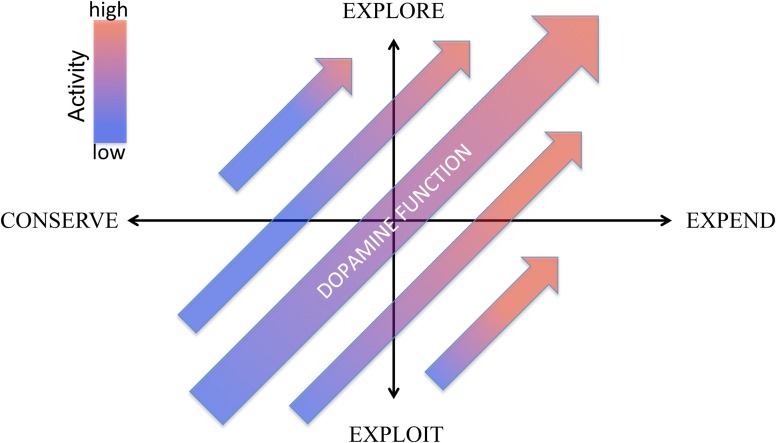
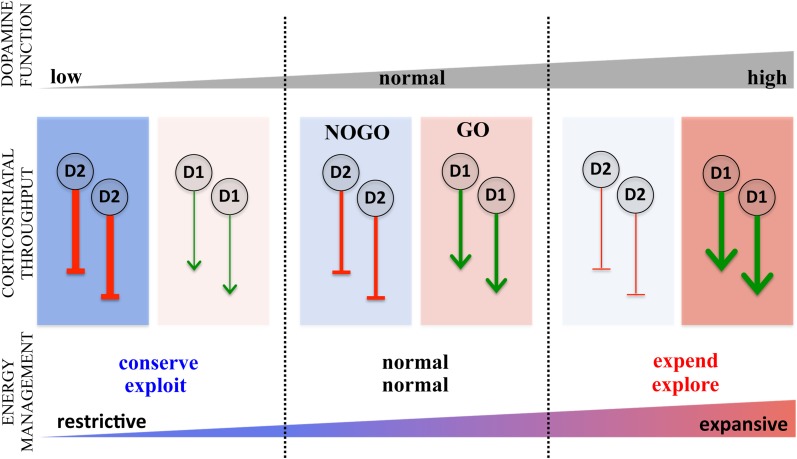
Accumulating evidence indicates integration of dopamine function with metabolic signals, highlighting a potential role for dopamine in energy balance, frequently construed as modulating reward in response to homeostatic state. Though its precise role remains controversial, the reward perspective of dopamine has dominated investigation of motivational disorders, including obesity. In the hypothesis outlined here, we suggest instead that the primary role of dopamine in behavior is to modulate activity to adapt behavioral energy expenditure to the prevailing environmental energy conditions, with the role of dopamine in reward and motivated behaviors derived from its primary role in energy balance. Dopamine has long been known to modulate activity, exemplified by psychostimulants that act via dopamine. More recently, there has been nascent investigation into the role of dopamine in modulating voluntary activity, with some investigators suggesting that dopamine may serve as a final common pathway that couples energy sensing to regulated voluntary energy expenditure. We suggest that interposed between input from both the internal and external world, dopamine modulates behavioral energy expenditure along two axes: a conserve-expend axis that regulates generalized activity and an explore-exploit axes that regulates the degree to which reward value biases the distribution of activity. In this view, increased dopamine does not promote consumption of tasty food. Instead increased dopamine promotes energy expenditure and exploration while decreased dopamine favors energy conservation and exploitation. This hypothesis provides a mechanistic interpretation to an apparent paradox: the well-established role of dopamine in food seeking and the findings that low dopaminergic functions are associated with obesity. Our hypothesis provides an alternative perspective on the role of dopamine in obesity and reinterprets the "reward deficiency hypothesis" as a perceived energy deficit. We propose that dopamine, by facilitating energy expenditure, should be protective against obesity. We suggest the apparent failure of this protective mechanism in Western societies with high prevalence of obesity arises as a consequence of sedentary lifestyles that thwart energy expenditure.
Overview
The claims and statistics of this paper haven’t been checked yet.
Run the check — free, no account needed. It reads the open-access text and checks the sources it cites.
Integrity signals
Registry
Cites
Statistics
Figures
Verification
Claims the paper makes
The claims and statistics of this paper haven’t been checked yet.
Run the check — free, no account needed. It reads the open-access text and checks the sources it cites.
Claims other papers make about this one
Each is checked against this paper’s own text: does it say what the citing paper says it does?
The check wasn’t confident either way, so it gives no verdict — never disputed.
In the citing paper
“While preliminary, these studies appear to demonstrate only modest gains in motor skill performance.”
From Exercise-enhanced neuroplasticity targeting motor and cognitive circuitry in Parkinson's disease (2013) · cites this paper as [49]
Experimental — accuracy not yet measuredIn the citing paper
“Further evidence for exercise effects on neuroplasticity and circuitry involved in automatic motor control is observed in studies utilizing forced cycling 49.”
From Exercise-enhanced neuroplasticity targeting motor and cognitive circuitry in Parkinson's disease (2013) · cites this paper as [49]
In the citing paper
“Only a few studies have examined the effects of aerobic training alone that incorporate limited or no aspects of skill learning 13, 22, 49.”
From Exercise-enhanced neuroplasticity targeting motor and cognitive circuitry in Parkinson's disease (2013) · cites this paper as [49]
Self-check
Percentages, sums and reported differences re-computed from the paper’s own numbers.
The self-check needs the paper’s full text.
Citations
Cites
‘Small Changes' to Diet and Physical Activity Behaviors for Weight Management
Hills, A. P., Byrne, N. M., Lindstrom, R. C., & Hill, J. O. (2013) · Obesity Facts · doi:10.1159/000345030 · Cited by 9,526
A neural substrate of prediction and reward
Schultz, W., Dayan, P., & Montague, P. R. (1997) · Science · doi:10.1126/science.275.5306.1593 · Cited by 9,388
Molecular Mechanisms of Depression: Perspectives on New Treatment Strategies
Lang, U. E., & Borgwardt, S. (2013) · Cellular Physiology and Biochemistry · doi:10.1159/000350094 · Cited by 8,526
Health benefits of physical activity: the evidence
Warburton, D. E. R. (2006) · Canadian Medical Association Journal · doi:10.1503/cmaj.051351 · Cited by 8,007
Genetics of Food Intake Self-Regulation in Childhood: Literature Review and Research Opportunities
Faith, M. S., Carnell, S., & Kral, T. V. E. (2013) · Human Heredity · doi:10.1159/000353879 · Cited by 7,633
The neural basis of drug craving: An incentive-sensitization theory of addiction
Robinson, T. (1993) · Brain Research Reviews · doi:10.1016/0165-0173(93)90013-p · Cited by 7,346
Introduction to Reinforcement Learning
Sutton, R. S., & Barto, A. G. (1998) · The MIT Press eBooks · Cited by 6,855
The functional anatomy of basal ganglia disorders
Albin, R. L., Young, A. B., & Penney, J. B. (1989) · Trends in Neurosciences · doi:10.1016/0166-2236(89)90074-x · Cited by 5,353
Koob, G. F., & Volkow, N. D. (2010) · Neuropsychopharmacology · doi:10.1038/npp.2009.110 · Cited by 5,340
Functional architecture of basal ganglia circuits: neural substrates of parallel processing
Alexander, G. E., & Crutcher, M. D. (1990) · Trends in Neurosciences · doi:10.1016/0166-2236(90)90107-l · Cited by 4,131
Cited by
Sorted by citations
Items 101–143 of 143
Faculty Opinions recommendation of What Is the Relationship between Dopamine and Effort?
Fellows, L. K. (2019) · Faculty Opinions – Post-Publication Peer Review of the Biomedical Literature · doi:10.3410/f.734283795.793559475
Hamzehpour, L., Bohn, T., Jaspers, L., & Grimm, O. (2022) · medRxiv · doi:10.1101/2022.06.27.22276810
(2022) · Oxford University Press eBooks · doi:10.1093/oso/9780192845368.002.0005
(2022) · Oxford University Press eBooks · doi:10.1093/oso/9780192845368.002.0010
Macdonald, D. W., & Newman, C. (2022) · Oxford University Press eBooks · doi:10.1093/oso/9780192845368.003.0001
Macdonald, D. W., & Newman, C. (2022) · Oxford University Press eBooks · doi:10.1093/oso/9780192845368.003.0013
Macdonald, D. W., & Newman, C. (2022) · Oxford University Press eBooks · doi:10.1093/oso/9780192845368.003.0016
Macdonald, D. W., & Newman, C. (2022) · Oxford University Press eBooks · doi:10.1093/oso/9780192845368.003.0012
(2022) · Oxford University Press eBooks · doi:10.1093/oso/9780192845368.002.0006
Macdonald, D. W., & Newman, C. (2022) · Oxford University Press eBooks · doi:10.1093/oso/9780192845368.003.0015
Senescence, Telomeres, and Life history Trade-offs
Macdonald, D. W., & Newman, C. (2022) · Oxford University Press eBooks · doi:10.1093/oso/9780192845368.003.0018
Macdonald, D. W., & Newman, C. (2022) · Oxford University Press eBooks · doi:10.1093/oso/9780192845368.003.0006
Macdonald, D. W., & Newman, C. (2022) · Oxford University Press eBooks · doi:10.1093/oso/9780192845368.003.0011
Social Behaviour in an Uncooperative Society
Macdonald, D. W., & Newman, C. (2022) · Oxford University Press eBooks · doi:10.1093/oso/9780192845368.003.0008
(2022) · Oxford University Press eBooks · doi:10.1093/oso/9780192845368.002.0009
Setts, Society, and Super-groups
Macdonald, D. W., & Newman, C. (2022) · Oxford University Press eBooks · doi:10.1093/oso/9780192845368.003.0004
(2022) · Oxford University Press eBooks · doi:10.1093/oso/9780192845368.002.0002
Macdonald, D. W., & Newman, C. (2022) · Oxford University Press eBooks · doi:10.1093/oso/9780192845368.003.0002
Apprenticeships for Badger Society
Macdonald, D. W., & Newman, C. (2022) · Oxford University Press eBooks · doi:10.1093/oso/9780192845368.003.0003
(2022) · Oxford University Press eBooks · doi:10.1093/oso/9780192845368.002.0008
Genetic Mate Choice—Quality Matters
Macdonald, D. W., & Newman, C. (2022) · Oxford University Press eBooks · doi:10.1093/oso/9780192845368.003.0017
The Ecological Foundations to Badger Group Living
Macdonald, D. W., & Newman, C. (2022) · Oxford University Press eBooks · doi:10.1093/oso/9780192845368.003.0010
(2022) · Oxford University Press eBooks · doi:10.1093/oso/9780192845368.002.0004
Macdonald, D. W., & Newman, C. (2022) · Oxford University Press eBooks · doi:10.1093/oso/9780192845368.003.0007
Macdonald, D. W., & Newman, C. (2022) · Oxford University Press eBooks · doi:10.1093/oso/9780192845368.003.0005
Macdonald, D. W., & Newman, C. (2022) · Oxford University Press eBooks · doi:10.1093/oso/9780192845368.003.0014
Pierrieau, E. (2022) · Knowledge UdeS (Institutional Deposit of the University of Sherbrooke)
Cuttoli, R. D.-D. (2018) · theses.fr (ABES) · doi:10.70675/5c4cff84za45az4928zb998zb62ea6f6c10f
Immunometabolic state modulation of sequential decision making in patch-foraging micePreprint
Lau, D., Gagnon, P., Fay, A., Palmer, D. D., Boisjoly, F., Majeur, D., Manceau, R., Nakajima, S., Robb, J. L., Zeighami, Y., et al. (2025) · bioRxiv (Cold Spring Harbor Laboratory) · doi:10.1101/2025.09.07.674667
Mehrhof, S. Z. (2024) · Apollo (University of Cambridge) · doi:10.17863/cam.117708
Vega-Villar, M. (2020) · CUNY Academic Works (City University of New York)
Embodied timing and the contribution of the dorsal striatum
Safaie, M. (2020) · theses.fr (ABES) · doi:10.70675/f36c2c09zfba4z482cz8704zb9dbea2423b7
Essays on the economics of body weight, nutrition and physical activity
Tzintzun, I. (2021) · theses.fr (ABES) · doi:10.70675/6265b20ezfe03z4c29zbbdaz6b36a9b6bd7e
Role of the endocannabinoid system in exercise motivation
Redon, B. (2021) · theses.fr (ABES) · doi:10.70675/844c9d99zd3c6z4550z97a6zebab239b226c
Dynamiques dopaminergiques dans la prise de décision : rôle dans la variabilité et l’exploration
Côme, M. (2023) · theses.fr (ABES) · doi:10.70675/a7b03d10z7e3cz45a1z817bza6c6344893af
Dopamine D2-receptor blockade in humans disrupts the effect of effort on learning
Jarvis, H., Obawede, O., Huynh, A. Q., Coxon, J. P., Bellgrove, M. A., & Chong, T. T. ‐. (2026) · PLoS Biology · doi:10.1371/journal.pbio.3003765
Olivares-García, R. (2026) · Repositori UJI (Universitat Jaume I)
A Bayesian network analysis of gait speed change upon transition to uneven surfaces in older adults
Song, Y., Rosano, C., Chahine, L., Rosso, A. L., Ambrosio, F., Bohnen, N. I., Chen, Z., & Kim, S. (2026) · The Journals of Gerontology Series A · doi:10.1093/gerona/glag137
Hyperdopaminergic States Bias Explorations–Exploitation Trade‐Off in Foraging and Impair Survival
Chi, W., Fu, W., Frazier, C. R. M., Xu, L., Beeler, J. A., & Zhuang, X. (2026) · European Journal of Neuroscience · doi:10.1111/ejn.70669
Self-citationWestbrook, S. R., Wang, Q., Jensen, A. L., Klappenbach, C. M., Touretsky, K., & Delevich, K. M. (2026) · Hormones and Behavior · doi:10.1016/j.yhbeh.2026.106000
Zhang, Z., Chen, N., Wang, D., Gill, H., Badulescu, S., Shah, H., Brudner, R. M., Vincenzo, J. D. D., Tabassum, A., Llach, C.-D., et al. (2026) · Psychological Medicine · doi:10.1017/s0033291726106412
Metadata
- Authors
- Beeler, J. A., Frazier, C. R. M., & Zhuang, X.
- Affiliations
- University of Chicago (US)
- Corresponding author
- Beeler, Jeff A.
- Venue
- Frontiers in Integrative Neuroscience
- Publisher
- Frontiers Media SA
- Published
- 2012
- Volume
- 6
- Pages
- 49-49
- ISSN
- 1662-5145 (ISSN-L)
- PMC
- PMC3400936
- OpenAlex
- W2149878007
- Cited by
- 136
- References
- 301
- Citations by year
- 2026: 7 · 2025: 4 · 2024: 4 · 2023: 4 · 2022: 33 · 2021: 10 · 2020: 11 · 2019: 9 · 2018: 10 · 2017: 10 · 2016: 8 · 2015: 10 · 2014: 4 · 2013: 7 · 2012: 5
- FWCI
- 3.43
- Type
- journal article
- Language
- en
- Open access
- gold
- doi.org
- Licence
- cc-by
- Locations
- Frontiers in Integrative Neuroscience (publishedVersion, cc-by)
- PubMed Central (publishedVersion)
- PubMed (publishedVersion)
- DOAJ (DOAJ: Directory of Open Access Journals) (submittedVersion, cc-by-sa)
- Funders
- National Institute on Drug Abuse (F31DA026802, R01DA25875, R01DA025875)
- National Institute of General Medical Sciences (R01GM100768)
- National Institute of Diabetes and Digestive and Kidney Diseases (R56DK088515)
- Topics
- Life Sciences › Neuroscience › Cellular and Molecular Neuroscience › Neurotransmitter Receptor Influence on Behavior
- Life Sciences › Neuroscience › Endocrine and Autonomic Systems › Regulation of Appetite and Obesity
- Social Sciences › Psychology › Clinical Psychology › Eating Disorders and Behaviors
- Keywords
- dopamine, energy expenditure, energy balance, reward, obesity, energy conservation, food seeking, sedentary lifestyle, metabolic signals, homeostasis, psychostimulants
About these checks
Registry, retraction, Cites and statistics results are computed, not judged, with one exception: a printed reference that no index lists is read once by a model before it counts as a citation error. Claims are extracted by a model and kept only when their quote appears verbatim in the text; each cited source is then checked, with a model’s help, for whether it says what the claim relies on. Those verdicts can be wrong — read the claim’s quote and the cited source before relying on one.
Statistics and arithmetic are recomputed, not judged.
Confidence bands are shown only for fields calibrated on our annotated test set. None is calibrated yet, so no band is shown.
What counts as a claim ›How we measure confidence ›How we check this ›
Are you an author, or do you see a problem with this page? Request a review
