

The DOI matches its Crossref record; 251 of the 251 references it cites were found in a registry or an index.
The Molecular Basis of Depression: Implications of Sex-Related Differences in Epigenetic Regulation
Open accessAbstract
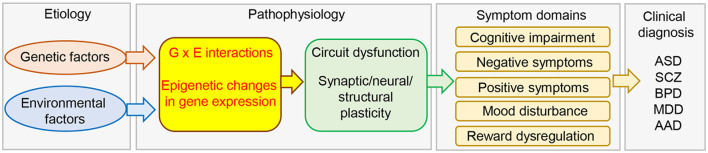
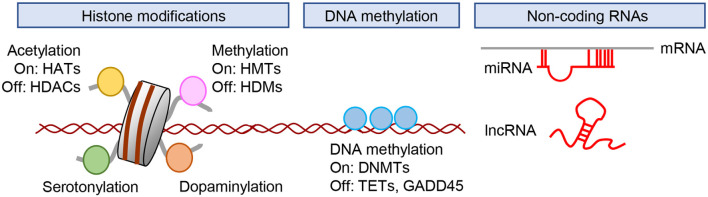
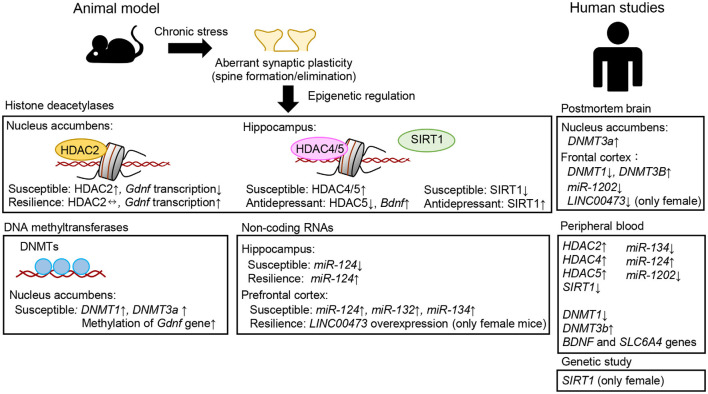
Major depressive disorder (MDD) is a leading cause of disability worldwide. Although the etiology and pathophysiology of MDD remain poorly understood, aberrant neuroplasticity mediated by the epigenetic dysregulation of gene expression within the brain, which may occur due to genetic and environmental factors, may increase the risk of this disorder. Evidence has also been reported for sex-related differences in the pathophysiology of MDD, with female patients showing a greater severity of symptoms, higher degree of functional impairment, and more atypical depressive symptoms. Males and females also differ in their responsiveness to antidepressants. These clinical findings suggest that sex-dependent molecular and neural mechanisms may underlie the development of depression and the actions of antidepressant medications. This review discusses recent advances regarding the role of epigenetics in stress and depression. The first section presents a brief introduction of the basic mechanisms of epigenetic regulation, including histone modifications, DNA methylation, and non-coding RNAs. The second section reviews their contributions to neural plasticity, the risk of depression, and resilience against depression, with a particular focus on epigenetic modulators that have causal relationships with stress and depression in both clinical and animal studies. The third section highlights studies exploring sex-dependent epigenetic alterations associated with susceptibility to stress and depression. Finally, we discuss future directions to understand the etiology and pathophysiology of MDD, which would contribute to optimized and personalized therapy.
Overview
The claims and statistics of this paper haven’t been checked yet.
Run the check — free, no account needed. It reads the open-access text and checks the sources it cites.
Integrity signals
Registry
Cites
Statistics
Figures
Verification
Claims the paper makes
The claims and statistics of this paper haven’t been checked yet.
Run the check — free, no account needed. It reads the open-access text and checks the sources it cites.
Claims other papers make about this one
Each is checked against this paper’s own text: does it say what the citing paper says it does?
The source backs part of the claim, not all of it — or backs it for a different population, condition or comparison.
In the citing paper
“Accumulating evidence suggests that female patients are more likely to exhibit promoter hypermethylation of stress-related genes, including NR3C1 and SLC6A4, which has been associated with increased vulnerability to depression and differential treatment response (Kawatake-Kuno et al., 2021).”
From Histone modifications and depression: epigenetic mechanisms, therapeutic targets, and translational outlook (2026) · cites this paper as Kawatake-Kuno et al., 2021
Experimental — accuracy not yet measured
Self-check
Percentages, sums and reported differences re-computed from the paper’s own numbers.
The self-check needs the paper’s full text.
Citations
Cites
Kessler, R. C., Chiu, W. T., Demler, O., & Walters, E. E. (2005) · Archives of General Psychiatry · doi:10.1001/archpsyc.62.6.617 · Cited by 12,052
Chromatin modifications and their function
Kouzarides, T. (2007) · Cell · doi:10.1016/j.cell.2007.02.005 · Cited by 10,883
Jaenisch, R., & Bird, A. (2003) · Nature Genetics · doi:10.1038/ng1089 · Cited by 6,325
Whiteford, H. A., Degenhardt, L., Rehm, J., Baxter, A. J., Ferrari, A. J., Erskine, H. E., Charlson, F. J., Norman, R. E., Flaxman, A. D., Johns, N., et al. (2013) · The Lancet · doi:10.1016/s0140-6736(13)61611-6 · Cited by 6,006
Molecular Mechanisms of Long Noncoding RNAs
Wang, K., & Chang, H. Y. (2011) · Molecular Cell · doi:10.1016/j.molcel.2011.08.018 · Cited by 4,462
Malhi, G. S., & Mann, J. J. (2018) · The Lancet · doi:10.1016/s0140-6736(18)31948-2 · Cited by 4,099
Epigenetic regulation of the glucocorticoid receptor in human brain associates with childhood abuse
McGowan, P. O., Sasaki, A., D'Alessio, A. C., Dymov, S., Labonté, B., Szyf, M., Turecki, G., & Meaney, M. J. (2009) · Nature Neuroscience · doi:10.1038/nn.2270 · Cited by 3,531
Nestler, E. J., Barrot, M., DiLeone, R. J., Eisch, A. J., Gold, S. J., & Monteggia, L. M. (2002) · Neuron · doi:10.1016/s0896-6273(02)00653-0 · Cited by 3,217
DNA methylation landscapes: Provocative insights from epigenomics
Suzuki, M. M., & Bird, A. (2008) · Nature Reviews Genetics · doi:10.1038/nrg2341 · Cited by 3,039
Hammen, C. (2005) · Annual Review of Clinical Psychology · doi:10.1146/annurev.clinpsy.1.102803.143938 · Cited by 2,979
Cited by
Sorted by citations
Li, H., Kawatake-Kuno, A., Inaba, H., Miyake, Y., Itoh, Y., Ueki, T., Oishi, N., Murai, T., Suzuki, T., & Uchida, S. (2024) · Neuron · doi:10.1016/j.neuron.2023.12.004 · Cited by 36
Kawatake-Kuno, A., Li, H., Inaba, H., Hikosaka, M., Ishimori, E., Ueki, T., Garkun, Y., Morishita, H., Narumiya, S., Oishi, N., et al. (2024) · Neuron · doi:10.1016/j.neuron.2024.01.023 · Cited by 31
Inaba, H., Li, H., Kawatake-Kuno, A., Dewa, K., Nagai, J., Oishi, N., Murai, T., & Uchida, S. (2023) · Science Advances · doi:10.1126/sciadv.ade5397 · Cited by 32
Kawatake-Kuno, A., Murai, T., & Uchida, S. (2021) · Frontiers in Behavioral Neuroscience · doi:10.3389/fnbeh.2021.749180 · Cited by 26
Zha, B., Cai, A., Yu, H., & Wang, Z. (2025) · Journal of Affective Disorders · doi:10.1016/j.jad.2025.04.139 · Cited by 17
Funayama, Y., Li, H., Ishimori, E., Kawatake-Kuno, A., Inaba, H., Yamagata, H., Seki, T., Nakagawa, S., Watanabe, Y., Murai, T., et al. (2022) · Biological Psychiatry Global Open Science · doi:10.1016/j.bpsgos.2021.12.009 · Cited by 16
Sawaguchi, E., Nakamura, S., Watanabe, K., Tsuno, K., Ikegami, H., Shinmura, N., Saito, Y., & Narimatsu, H. (2022) · Frontiers in Public Health · doi:10.3389/fpubh.2022.1010720 · Cited by 16
Zhang, Y., Wang, M., Zhang, X., Jiang, Z.-Y., Zhang, Y., Fu, X., Li, Y., Cao, D., Han, J. H., & Tong, J. (2022) · Contrast Media & Molecular Imaging · doi:10.1155/2022/9242827 · Cited by 13
RetractedSex Significantly Impacts the Function of Major Depression–Linked Variants In Vivo
Mulvey, B., Selmanovic, D., & Dougherty, J. D. (2021) · Biological Psychiatry · doi:10.1016/j.biopsych.2023.02.009 · Cited by 12
Identification of Specific Plasma miRNAs as Potential Biomarkers for Major Depressive Disorder
Prodan-Bărbulescu, C., Alin, C. D., Faur, F. I., Bujor, G. C., Șeclăman, E. P., ENĂTESCU, V. R., Dănilă, A.-I., Dăescu, E., Hajjar, R., Ghenciu, L. A., et al. (2024) · Biomedicines · doi:10.3390/biomedicines12102165 · Cited by 7
Lv, L.-Z., Wang, Z.-D., Ren, J.-J., Li, L.-H., Liu, X.-B., Li, J.-L., Zhu, H., Jiang, B., Han, Y.-P., Zhou, X.-M., et al. (2026) · Frontiers in Genetics · doi:10.3389/fgene.2025.1722453 · Cited by 7
Tran, S. H., Zhang, S., Lee, H., Hitayezu, E., Nguyen, U. T. T., Lee, S., Kang, S. W., Park, K., Kim, S. H., Kwon, H. C., et al. (2025) · Phytomedicine · doi:10.1016/j.phymed.2025.157581 · Cited by 4
Depression: epigenetics and epitranscriptomic modifications
Banerjee, S., Shrilaxmi, M. S., Banerjee, S., Prajwal, B. G., Smith, C., D’Mello, S. R., & Dastidar, S. G. (2025) · The World Journal of Biological Psychiatry · doi:10.1080/15622975.2025.2602171 · Cited by 4
Li, B., Zhao, H., & Sun, J. (2022) · Computational and Mathematical Methods in Medicine · doi:10.1155/2022/4244425 · Cited by 3
Retractedda Silva, S. V., Santos, I. S., Bivanco-Lima, D., Goulart, A. C., Varella, A. C., Lotufo, P. A., Brunoni, A. R., & Benseñor, I. M. (2024) · Clinics · doi:10.1016/j.clinsp.2024.100488 · Cited by 1
Depression and Cancer: The Inflammatory Bridge
Leite, F., & Leite, Â. M. T. (2023) · Interdisciplinary cancer research · doi:10.1007/16833_2022_106 · Cited by 1
Gao, J., Wang, Q., Liu, J., Zheng, S., Liu, J., Gao, Z., & Zhu, C. (2025) · Frontiers in Psychiatry · doi:10.3389/fpsyt.2025.1564095 · Cited by 1
Sex significantly impacts the function of major depression-linked variants in vivoPreprint
Mulvey, B., Selmanovic, D., & Dougherty, J. D. (2021) · bioRxiv (Cold Spring Harbor Laboratory) · doi:10.1101/2021.11.01.466849 · Cited by 1
da Silva, S. V. (2024) · Digital Library of Theses and Dissertations (Universidade de São Paulo) · doi:10.11606/d.5.2024.tde-03122024-125357
Jiang, W., Chen, C., Wang, S., Liu, Y., Li, P., & Zhang, B. (2025) · Brain Imaging and Behavior · doi:10.1007/s11682-025-01062-1
Distinct prefrontal neuronal circuits determine repeated stress-induced behavioral styles in mice
Uchida, S. (2026) · Folia Pharmacologica Japonica · doi:10.1254/fpj.25040
Corral-Castillo, D. A., Blanco-Salazar, A., Garcia-Murillo, O. G., Ruiz-Olvera, A., Hernández-Lepe, M. A., Llamas-Alonso, L. A., Amaro‐Gahete, F. J., Egan, B., & Chávez-Guevara, I. A. (2026) · Translational Journal of the American College of Sports Medicine · doi:10.1249/tjx.0000000000000345
Comparative evaluation of two chronic stress models in zebrafish for advancing depression research
Tripathy, C., Dhaygude, S. S., Vijay, V., Mondal, A., Soren, K., Kumar, A. T. R., & Chakravarty, S. (2026) · Physiology & Behavior · doi:10.1016/j.physbeh.2026.115453
Metadata
- Authors
- Kawatake-Kuno, A., Murai, T., & Uchida, S.
- Affiliations
- Kyoto University (JP)
- Corresponding author
- Uchida, Shusaku
- Venue
- Frontiers in Molecular Neuroscience
- Publisher
- Frontiers Media SA
- Published
- 2021-07-01
- Volume
- 14
- Pages
- 708004-708004
- ISSN
- 1662-5099 (ISSN-L)
- PMC
- PMC8282210
- OpenAlex
- W3182076372
- Cited by
- 23
- References
- 251
- Citations by year
- 2026: 4 · 2025: 5 · 2024: 5 · 2023: 3 · 2022: 4 · 2021: 2
- FWCI
- 2.04
- Type
- journal article
- Language
- en
- Open access
- gold
- doi.org
- Licence
- Locations
- Frontiers in Molecular Neuroscience (publishedVersion, cc-by)
- PubMed Central (publishedVersion, cc-by)
- PubMed (publishedVersion)
- DOAJ (DOAJ: Directory of Open Access Journals) (submittedVersion)
- Funders
- Japan Society for the Promotion of Science
- Japan Agency for Medical Research and Development
- Ministry of Education, Culture, Sports, Science and Technology
- Topics
- Health Sciences › Medicine › Pharmacology (medical) › Treatment of Major Depression
- Life Sciences › Biochemistry, Genetics and Molecular Biology › Molecular Biology › Epigenetics and DNA Methylation
- Life Sciences › Neuroscience › Behavioral Neuroscience › Stress Responses and Cortisol
- Keywords
- major depressive disorder, sex differences, epigenetic regulation, DNA methylation, histone modifications, non-coding RNA, neuroplasticity, stress, antidepressant response, depression resilience, depression vulnerability, personalized treatment
About these checks
Registry, retraction, Cites and statistics results are computed, not judged, with one exception: a printed reference that no index lists is read once by a model before it counts as a citation error. Claims are extracted by a model and kept only when their quote appears verbatim in the text; each cited source is then checked, with a model’s help, for whether it says what the claim relies on. Those verdicts can be wrong — read the claim’s quote and the cited source before relying on one.
Statistics and arithmetic are recomputed, not judged.
Confidence bands are shown only for fields calibrated on our annotated test set. None is calibrated yet, so no band is shown.
What counts as a claim ›How we measure confidence ›How we check this ›
Are you an author, or do you see a problem with this page? Request a review
