

The DOI matches its Crossref record; 163 of the 163 references it cites were found in a registry or an index.
Developing algae as a sustainable food source
Open accessAbstract
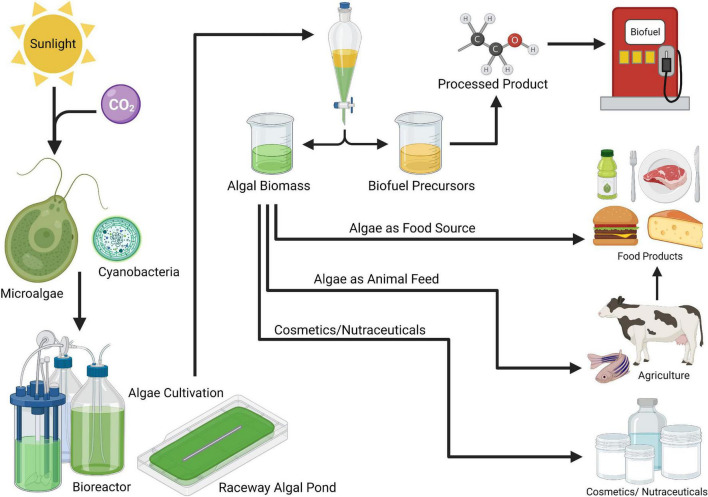
Current agricultural and food production practices are facing extreme stress, posed by climate change and an ever-increasing human population. The pressure to feed nearly 8 billion people while maintaining a minimal impact on the environment has prompted a movement toward new, more sustainable food sources. For thousands of years, both the macro (seaweed and kelp) and micro (unicellular) forms of algae have been cultivated as a food source. Algae have evolved to be highly efficient at resource utilization and have proven to be a viable source of nutritious biomass that could address many of the current food production issues. Particularly for microalgae, studies of their large-scale growth and cultivation come from the biofuel industry; however, this knowledge can be reasonably translated into the production of algae-based food products. The ability of algae to sequester CO 2 lends to its sustainability by helping to reduce the carbon footprint of its production. Additionally, algae can be produced on non-arable land using non-potable water (including brackish or seawater), which allows them to complement rather than compete with traditional agriculture. Algae inherently have the desired qualities of a sustainable food source because they produce highly digestible proteins, lipids, and carbohydrates, and are rich in essential fatty acids, vitamins, and minerals. Although algae have yet to be fully domesticated as food sources, a variety of cultivation and breeding tools exist that can be built upon to allow for the increased productivity and enhanced nutritional and organoleptic qualities that will be required to bring algae to mainstream utilization. Here we will focus on microalgae and cyanobacteria to highlight the current advancements that will expand the variety of algae-based nutritional sources, as well as outline various challenges between current biomass production and large-scale economic algae production for the food market.
Overview
The claims and statistics of this paper haven’t been checked yet.
Run the check — free, no account needed. It reads the open-access text and checks the sources it cites.
Integrity signals
Registry
Cites
Statistics
Figures
Verification
Claims the paper makes
The claims and statistics of this paper haven’t been checked yet.
Run the check — free, no account needed. It reads the open-access text and checks the sources it cites.
Claims other papers make about this one
Each is checked against this paper’s own text: does it say what the citing paper says it does?
The source backs part of the claim, not all of it — or backs it for a different population, condition or comparison.
In the citing paper
“This metabolic feature allows microalgae to contribute simultaneously to pollutant removal and, in certain contexts, to alleviating the demand for arable land when compared with conventional agriculture, reinforcing their role as an ecologically viable resource (Abdelfattah et al., 2023; Diaz et al., 2023; Chen et al., 2024; Iñiguez-Moreno et al., 2025).”
From Microalgae biotechnology and its role in sustainable and healthy food design (2025) · cites this paper as Diaz et al., 2023
Experimental — accuracy not yet measured
Self-check
Percentages, sums and reported differences re-computed from the paper’s own numbers.
The self-check needs the paper’s full text.
Citations
Cites
The new frontier of genome engineering with CRISPR-Cas9
Doudna, J. A., & Charpentier, E. (2014) · Science · doi:10.1126/science.1258096 · Cited by 7,062
How a century of ammonia synthesis changed the world
Erisman, J. W., Sutton, M. A., Galloway, J. N., Klimont, Z., & Winiwarter, W. (2008) · Nature Geoscience · doi:10.1038/ngeo325 · Cited by 4,630
Commercial Applications of Microalgae
Spolaore, P., Joannis-Cassan, C., Duran, E., & Isambert, A. (2006) · Journal of Bioscience and Bioengineering · doi:10.1263/jbb.101.87 · Cited by 4,285
The green, blue and grey water footprint of crops and derived crop products
Mekonnen, M. M., & Hoekstra, A. Y. (2011) · Hydrology and earth system sciences · doi:10.5194/hess-15-1577-2011 · Cited by 3,023
Protein and amino acid requirements in human nutrition.
(2007) · PubMed · Cited by 2,234
Khan, M. I., Shin, J. H., & Kim, J. D. (2018) · Microbial Cell Factories · doi:10.1186/s12934-018-0879-x · Cited by 2,082
CRISPR/Cas Genome Editing and Precision Plant Breeding in Agriculture
Chen, K., Wang, Y., Zhang, R., Zhang, H., & Gao, C. (2019) · Annual Review of Plant Biology · doi:10.1146/annurev-arplant-050718-100049 · Cited by 1,696
Algae as nutritional and functional food sources: revisiting our understanding.
Wells, M. L., Potin, P., Craigie, J. S., Raven, J. A., Merchant, S. S., Helliwell, K. E., Smith, A. G., Camire, M. E., & Brawley, S. H. (2017) · Journal of Applied Phycology · doi:10.1007/s10811-016-0974-5 · Cited by 1,562
Haematococcus astaxanthin: applications for human health and nutrition
Guerin, M., Huntley, M. E., & Olaizola, M. (2003) · Trends in Biotechnology · doi:10.1016/s0167-7799(03)00078-7 · Cited by 1,495
Potential Role of Carotenoids as Antioxidants in Human Health and Disease
Fiedor, J., & Burda, K. (2014) · Nutrients · doi:10.3390/nu6020466 · Cited by 1,420
Research works printed but not linked: 22
- 2022, Better Policies to Improve the Environmental Performance of the Agriculture Sector. Agriculture and the Environment.
- Gaan, 2020, Plant-Based Food Retail Market Overview.
- Mateo-Sagasta, 2017, Water Pollution from Agriculture: a Global Review. Rome, Colombo: The Food and Agriculture Organization of the United Nations Rome, 2017 and the International Water Management Institute on behalf of the Water Land and Ecosystems research program Colombo, 2017.
- 2021, FAO Statistical Yearbook 2021 - World Food and Agriculture.
- 2019, Fertilizer Use and Price.
- 2020, Flour, Corn, Yellow, Fine Meal, Enriched. FoodData Central Search Results.
- 2022, Agricultural Biotechnology Glossary.
- 2022, World Agricultural Production. Circular Series WAP 8-22.
- 2020, Recent Trends in GE Adoption.
- 2022, How GMOs Are Regulated in the United States.
- 2006, How U.S. FDA’s GRAS Notification Program Works: FOOD SAFETY MAGAZINE.
- 2019, Soybeans, Mature Seeds, Raw. FoodData Central Search Results.
- 2020, Flour, Wheat, All-Purpose, Enriched, Unbleached. FoodData Central Search Results.
- 2020, Flour, Rice, White, Unenriched. FoodData Central Search Results.
- 2012, GRN No. 417 Dried biomass of Arthrospira platensis also known as Spirulina platensis (spirulina). GRAS Notices.
- 2019, GRN No. 773 Dried biomass of Chlamydomonas reinhardtii. GRAS Notices.
- 2014, GRN No. 519 Chlorella protothecoides strain S106 flour with 40-75% protein. GRAS Notices.
- 2012, GRN No. 396 Chlorella vulgaris strain Beij. GRAS Notices.
- 2011, GRN No. 351, Dunaliella bardawil. GRAS Notices Print Share E-mail.
- 2017, GRN No. 698 Paramylon isolate from Euglena gracilis. GRAS Notices Print Share E-mail.
- 2015, GRN No. 580 Haematococcus pluvialis extract containing astaxanthin esters. GRAS Notices.
- 2021, GRN No. 934 Algal oil (=35% docosahexanoic acid (DHA)) derived from Schizochytrium sp. strain CABIO-A-2. GRAS Notices.
Cited by
Sorted by citations
Items 101–194 of 194
Microalgae: A Solution for Food Security and Multiplanetary Farming
Xie, X., Zhan, J., & Ren, M. (2025) · Food Frontiers · doi:10.1002/fft2.70020 · Cited by 3
Ambika, H. D., & U, H. V. P. (2025) · Grand challenges in biology and biotechnology · doi:10.1007/978-3-031-84282-5_8 · Cited by 3
Yao, X., Wan, X., Chi, Y., & Nie, X. (2025) · Antonie van Leeuwenhoek · doi:10.1007/s10482-025-02146-0 · Cited by 3
Improving trans‐cinnamic acid production in a model cyanobacterium
Hunstiger, D., Ma, H., Paton, A. J., & Peebles, C. A. M. (2024) · Biotechnology Progress · doi:10.1002/btpr.3512 · Cited by 2
Exploring Algal Metabolism: Insights from Metabolomics and Computational Approaches
Carpena, M., Silva, A., Chamorro, F., Echave, J., Jorge, A. O. S., Barroso, M. F., & Prieto, M. A. (2024) · International Electronic Conference on Biomedicines (IECBM) · doi:10.3390/blsf2024035009 · Cited by 2
Aswathy, V. P., Mavai, S., Bains, A., Sridhar, K., Inbaraj, B. S., Chawla, P., & Sharma, M. (2025) · South African Journal of Botany · doi:10.1016/j.sajb.2024.12.023 · Cited by 3
Commercial and Industrial Algae Culture and Applications
Islam, M. S., Saha, B. B., Rahman, M. M., & Fayyaz, R. (2025) · IntechOpen eBooks · doi:10.5772/intechopen.1008949 · Cited by 1
Luo, T., Shi, J., Zhang, P., Yang, S., Guo, L., & Peijnenburg, W. J. G. M. (2025) · Aquatic Toxicology · doi:10.1016/j.aquatox.2025.107330 · Cited by 2
Kumar, S., Yadav, S., & Ghangrekar, M. M. (2025) · Elsevier eBooks · doi:10.1016/b978-0-443-23967-0.00022-x · Cited by 2
Haque, M. E., Acharjee, M. R., Newase, S., Nur, S., Das, T., Afrin, S. S., Minhaz, T. M., Islam, Z., & Khatoon, H. (2025) · Aquaculture Research · doi:10.1155/are/9668918 · Cited by 3
Environmental and Economic Benefits of Algal-Microbial Remediation
Kaur, B. (2025) · Springer eBooks · doi:10.1007/978-981-96-8054-2_11 · Cited by 2
Plant‐Based Analogs: Potential Chemical Risks & Mitigation Strategies
Arinzechukwu, C., Tang, J., Chen, C., & Corradini, M. G. (2025) · Journal of Food Science · doi:10.1111/1750-3841.70545 · Cited by 2
Gundersen, E., Kazbar, A., Boboescu, I. Z., Kempen, P. J., Holdt, S. L., Jakobsen, J., Barbosa, M. J., & Jacobsen, C. (2025) · Algal Research · doi:10.1016/j.algal.2025.104469 · Cited by 2
Recent Advances in Sustainable Aviation Fuel from Renewable Feedstocks: A Biobased Perspective
Sarkar, O., Sravan, J. S., Katakojwala, R., Rohit, M. V., Hemalatha, M., Narayanasamy, A., Mohanakrishna, G., Aristya, G. R., & Chang, Y.-C. (2026) · Processes · doi:10.3390/pr14152441 · Cited by 1
Role of Algae in Sustainable Food Production
Lohakar, S., Kulkarni, S. J., Dubey, S., & Goswami, A. K. (2024) · Advances in environmental engineering and green technologies book series · doi:10.4018/979-8-3693-4240-4.ch008 · Cited by 2
Diatoms as Tools for Aquaculture and Food Production
Mathew, J. T., Inobeme, A., Monday, M., Azeh, Y., Shaba, E. Y., Etsuyankpa, M. B., Adetunji, C. O., Mamman, A., & Tanko, M. S. (2024) · Springer eBooks · doi:10.1007/978-981-97-5057-3_4 · Cited by 2
Establishing the green algae Chlamydomonas incerta as a platform for recombinant protein productionPreprint
Kang, K., Santo, É. D. E., Diaz, C. J., Oliver, A., Saxton, L., May, L., Mayfield, S. P., & Molino, J. V. D. (2024) · bioRxiv (Cold Spring Harbor Laboratory) · doi:10.1101/2024.10.25.618925 · Cited by 2
Self-citationGe, M., Liu, B., Mao, X., Huang, J., & Cheng, K. (2024) · Food Bioscience · doi:10.1016/j.fbio.2024.104823 · Cited by 1
Gupta, P. L., & Oza, T. (2024) · Springer eBooks · doi:10.1007/978-981-97-8561-2_9 · Cited by 1
Potential Applications of Algae in Foods
Kaur, H., Kaur, M., Gupta, S. K., Singh, Y., & Singh, R. P. (2025) · Springer eBooks · doi:10.1007/978-981-96-1844-6_4 · Cited by 1
Lin, M.-W., Lin, C., Chiu, W.-H., Chang, H., Cheang, W.-M., Chang, C.-C., Wu, V. C. H., Lin, C., & Kuo, C.-M. (2025) · Food Research International · doi:10.1016/j.foodres.2025.116978 · Cited by 1
Lipids, fatty acids, and sterols from microalgae
Vendruscolo, R. G., & Fagundes, M. B. (2025) · Elsevier eBooks · doi:10.1016/b978-0-443-22080-7.00031-4 · Cited by 1
Du, X., Song, H., Xu, L., Kou, G., & Chen, X. (2025) · Polar Biology · doi:10.1007/s00300-025-03413-6 · Cited by 1
Algal nutraceuticals: a potential alternative to health supplementation for athletes
Kumawat, K. R., Pareek, A., & Singh, N. (2025) · Sport Sciences for Health · doi:10.1007/s11332-025-01545-0 · Cited by 1
Ahmed, R., Landi, N., Chikkaputtaiah, C., Basar, E., & Velmurugan, N. (2025) · Biomass Conversion and Biorefinery · doi:10.1007/s13399-025-06893-y · Cited by 1
Green Algae: A Sustainable Solution for Future Nutrition and Health
Mirmohammadmakki, F., Massoud, R., & Banerjee, R. (2025) · BiotechIntellect · doi:10.61882/biotechintellect.2.1.19 · Cited by 1
Toxicity and safety analysis of alternative and novel food sources
D’Amore, T., Akermi, S., Amara, F. B., & Smaoui, S. (2025) · Elsevier eBooks · doi:10.1016/b978-0-443-32920-3.00007-0 · Cited by 1
Health Benefits of Polysaccharides in Red Algae: A Comprehensive Review
Ong, S. E., Myint, M. K., Chia, S., Tan, C. F., Hong, Y. F., Lakshmanan, M., Ho, Y. S., Wheeler, T. T., Bi, X., Walsh, I., et al. (2026) · Food Frontiers · doi:10.1002/fft2.70132 · Cited by 2
Novel Insight into Pigment’s Synthesis and Accumulation in Microalgae Under Environmental Stress
Yamashita, K., Suzuki, K., & Tokunaga, E. (2026) · Springer eBooks · doi:10.1007/978-3-031-93945-7_6 · Cited by 1
Zhang, L., Han, Y., Song, G., Wang, J., & Ma, P. (2026) · Sensors · doi:10.3390/s26041221 · Cited by 1
Shanmugam, B. (2026) · Polymer Bulletin · doi:10.1007/s00289-026-06473-8 · Cited by 1
Prospects of microalgae as a tenable feed source for aquaculture
Hussain, K., Hussain, S. M., Ali, S., Zahoor, A. F., Ali, Q., Hussain, M., Yilmaz, E., Shahzad, M. M., & Naeem, E. (2026) · North American Journal of Aquaculture · doi:10.1093/naaqua/vraf029 · Cited by 1
Shareefdeen, Z. M., & Mansour, S. (2026) · ChemEngineering · doi:10.3390/chemengineering10070080 · Cited by 1
Greening Spirulina Value Chain Towards Environmental Sustainability in Malaysia
Shukri, A. S. M., Nor, A. N. M., Amin, M. F. M., Rasat, M. S. M., & Abas, M. A. (2023) · BIO Web of Conferences · doi:10.1051/bioconf/20237303005 · Cited by 1
FROM OCEAN TO PLATE: EMBRACING ALGAE AS A HEALTHY AND SUSTAINABLE FOOD SOURCE: A REVIEW
Chauhan, J., Reshi, M., Bandral, J. D., Gupta, N., Sharma, N., Sambyal, B., Singh, M. P., Jankawat, G. S., & Sharma, B. (2024) · PLANT ARCHIVES · doi:10.51470/plantarchives.2024.v24.no.1.116 · Cited by 1
Bischoff, L.-S. (2024) · Environmental science and engineering · doi:10.1007/978-981-97-2371-3_22 · Cited by 1
Kim, I. J., Subkhan, A. R., Prasetya, R. P., & Muharam, Y. (2024) · Communications in Science and Technology · doi:10.21924/cst.9.1.2024.1420 · Cited by 1
Nachhaltige Ernährung der Zukunft – Beitrag alternativer Proteinquellen
Kirner, T., & Manns, B. (2024) · Sustainable Development Goals (SDG) - Umsetzung in Praxis, Lehre und Entscheidungsprozessen · doi:10.1007/978-3-658-44103-6_13 · Cited by 1
Engineering the green algae Chlamydomonas incerta for recombinant protein production
Kang, K., Santo, É. D. E., Diaz, C. J., Oliver, A., Saxton, L., May, L., Mayfield, S. P., & Molino, J. V. D. (2025) · PLoS ONE · doi:10.1371/journal.pone.0321071 · Cited by 3
Self-citationUnlocking the Antiadipogenic Potential of Carotenoids From Galdieria phlegrea
Giustino, E., Imbimbo, P., Trepiana, J., Portillo, M. P., & Monti, D. M. (2025) · BioFactors · doi:10.1002/biof.70027 · Cited by 1
Paquette, A. J., Rattray, J. E., Vadlamani, A., Scheffer, G., Demirkaya, C., Strous, M., & Siegler, H. D. L. H. (2025) · Biomass and Bioenergy · doi:10.1016/j.biombioe.2025.108660 · Cited by 1
Prates, J. A. M. (2025) · Springer eBooks · doi:10.1007/978-3-031-32671-4_94-1 · Cited by 1
Sertori, F. D. N., de Lira, G. S., Furlan, B. J., da Silva, P. A. S., Dias, A. R., & Moreira, M. A. C. (2023) · Springer eBooks · doi:10.1007/978-3-031-42026-9_18
Dashtaki, E., Esteki, M., Mehdinia, A., & Simal‐Gándara, J. (2023) · SSRN Electronic Journal · doi:10.2139/ssrn.4678349
Biochemical, Techno-Functional and Sensory Properties of Food Prepared with Algae
Kong, H. (2024) · Environmental science and engineering · doi:10.1007/978-981-97-2371-3_24
Ethnobotanical Knowledge of Nostocales and its Contribution to the SDGS
Carhuapoma–Delacruz, V., Jurado-Escobar, M., Mamani, N. V., Lizana–Hilario, E., Huere-Peña, J. L., Méndez-Enríquez, A., Castrejón-Valdez, M., & Esparza, M. (2024) · Journal of Lifestyle and SDGs Review · doi:10.47172/2965-730x.sdgsreview.v4.n02.pe02169
Algae-Derived Food and Feed Products
Senapati, P. K., Singh, M., & Karmi, M. (2024) · Springer eBooks · doi:10.1007/978-3-031-70698-1_6
Chen, F., Lu, S., Wu, Q., Zhao, M., Nie, Z., & Zhang, S. (2025) · Algal Research · doi:10.1016/j.algal.2024.103871
Algal biomass: A climate resilient feedstock for food, feed, and therapeutic applications
Pavithra, V., Kumar, T. S. J., & Arumugam, M. (2025) · Elsevier eBooks · doi:10.1016/b978-0-443-23967-0.00007-3
Biscarrat, P., Pepke, F., Defois-Fraysse, C., Jeaidi, A., Hennequet‐Antier, C., Rué, O., Castelli, F. A., Chollet, C., Bedu-Ferrari, C., Berthon, J., et al. (2025) · SSRN Electronic Journal · doi:10.2139/ssrn.5256310
Sustainable production of plastic-degrading enzymes in Chlamydomonas pacificaPreprint
Diaz, C. J., Molino, J. V. D., Saucedo, B., Kang, K., Santo, É. D. E., Tessman, M., Gupta, A., Burkart, M. D., Simkovsky, R., & Mayfield, S. P. (2025) · bioRxiv (Cold Spring Harbor Laboratory) · doi:10.1101/2025.05.14.654053
Self-citationVela-Albarrán, M., Calero, N., Carrillo, F., Santos, J., & Trujillo-Cayado, L. A. (2025) · SSRN Electronic Journal · doi:10.2139/ssrn.5362333
Algae industry and the farm to fork strategy
Fernández‐Ríos, A., Laso, J., García, R. A., & Margallo, M. (2025) · Elsevier eBooks · doi:10.1016/b978-0-443-22080-7.00026-0
Yahya, R. T., Yaqub, H. M., ghanim, S., & Mohammed, A. A.-H. (2025) · Regulatory Mechanisms in Biosystems · doi:10.15421/0225084
Bocăneală, M., Brezeştean, I., Rákosy-Tican, E., & Dina, N. E. (2025) · Analytical Letters · doi:10.1080/00032719.2025.2543154
Alternative Sources of Fodder: An Indian Perspective
Kumar, A., Bohra, T., & Singh, S. K. (2025) · Frontier studies in soil science · doi:10.1007/978-3-031-91114-9_35
Introduction to Algal Bioengineering and Microbial Synergy
Sharma, S., & Sharma, S. (2025) · Springer eBooks · doi:10.1007/978-981-96-8054-2_1
Arıcı, E. (2025) · Journal of Applied Phycology · doi:10.1007/s10811-025-03605-x
Protein extraction from native algal species: A sustainable approach for food security
Aslam, F., Tahir, A., Arshad, M. I., Mammadova, K., Murguzova, M., Abbas, M., & Javed, H. (2025) · Sustainable Chemistry for the Environment · doi:10.1016/j.scenv.2025.100301
Navigating challenges and unlocking opportunities of algal food industries in India
Singh, D. P., Duggal, M., Agarwal, N., Singh, S. P., Garg, M., Kansal, S. K., & Krishania, M. (2025) · Proceedings of the Indian National Science Academy · doi:10.1007/s43538-025-00625-6
Global patent panorama of 3D bioprinting: Trends, maturity and key stakeholders
Pantoja, K. C., Tarabal, V. S., Oliveira, M. E. J., Oliveira, A. G. S., da Silva, C. L. V., Nascimento, P. F., França, T. A., Ribeiro, R. I. M. D. A., Dernowsek, J., & Granjeiro, P. A. (2025) · World Patent Information · doi:10.1016/j.wpi.2025.102421
Kharka, N., Goyal, E., Fayaz, T., Renuka, N., Bhoyar, M. S., & Ratha, S. K. (2026) · Springer eBooks · doi:10.1007/978-981-95-5887-2_13
Maity, S., & Yadav, A. K. (2026) · Preparative Biochemistry & Biotechnology · doi:10.1080/10826068.2026.2625200
Biscarrat, P., Pepke, F., Defois-Fraysse, C., Jeaidi, A., Hennequet‐Antier, C., Ruë, O., Castelli, F. A., Chollet, C., Bedu-Ferrari, C., Berthon, J., et al. (2026) · Current Research in Microbial Sciences · doi:10.1016/j.crmicr.2026.100567 · Cited by 1
Schouteten, J. J., Proserpio, C., Sandvik, P., Neugart, S., Dahlstedt, S. R., Rabitti, N. S., Bayudan, S., & Laureati, M. (2026) · Food Quality and Preference · doi:10.1016/j.foodqual.2026.105881
Temraleeva, A. D., Sinetova, M. A., GABRIELYAN, D. A., Витальевна, Д. С., & Kamenev, A. O. (2025) · Biologia et Biotechnologia · doi:10.61847/pbcras.bbt.2025.3.1
Samarajeewa, U. (2026) · Food Safety and Health · doi:10.1002/fsh3.70097
Giakoumatos, S. D. V., & Tsoulfas, G. Τ. (2026) · Waste and Biomass Valorization · doi:10.1007/s12649-026-03582-3
Al-Saud, N. B. S. (2026) · Journal of King Saud University - Science · doi:10.25259/jksus_1756_2025
Circularity of nutrient recovery technologies in hydroponics: A systematic review
Kenga, V. V., Nomura, Y., Zhang, W., Totañes, L. V. L., Hiraoka, M., & Fujiwara, T. (2026) · Journal of Water Process Engineering · doi:10.1016/j.jwpe.2026.110095
Kinawy, R. N. (2026) · MethodsX · doi:10.1016/j.mex.2026.103923 · Cited by 1
Edible Algae: Nutritional Benefits, Culinary Uses, and Market Trends
Panda, T., Banchhor, Y. K., Sahu, P., Achary, G. H. N., & Shakya, A. (2026) · Springer eBooks · doi:10.1007/978-3-032-22521-4_5
Vitamins from Algae: Sources, Benefits, and Applications in Nutraceuticals
Naeem, Z., Jabeen, A., & Mumtaz, A. S. (2026) · Springer eBooks · doi:10.1007/978-3-032-22521-4_14
Nutritional and Functional Applications of Algae in Sustainable Food Systems
Mostafa, S. S. M., Zohir, W. F., Makhlof, M. E. M., & El-Sheekh, M. M. (2026) · Springer eBooks · doi:10.1007/978-3-032-22521-4_2
Formulating Algal Feeds: Techniques for Effective Integration and Nutrient Stabilities
Panda, S. K., & Rai, A. (2026) · Springer eBooks · doi:10.1007/978-3-032-22521-4_9
Is Spirulina safe in terms of heavy metals? A public health risk assessment
Kuru-Yaşar, R., Üstün‐Aytekin, Ö., Yılmaz, Ş., & Şahin, F. (2026) · Journal of Applied Phycology · doi:10.1007/s10811-026-03901-0
Prates, J. A. M. (2026) · Springer eBooks · doi:10.1007/978-3-032-19927-0_94
Riad, O. K. M., Selim, H. M. R. M., & Omran, M. E. (2026) · Discover Sustainability · doi:10.1007/s43621-026-03350-2
Trieu, K., Bishé, B., Taton, A., Tieu, B. P., & Golden, J. W. (2026) · Applied and Environmental Microbiology · doi:10.1128/aem.00598-26
Biosynthesis and Applications of Phenolic Compounds of Algae
Efe, I. L., & Sabiu, S. (2026) · Reference series in phytochemistry · doi:10.1007/978-3-031-80866-1_9-1
From Pond to Plate: Tailored Functional Proteins for Next-Gen Microalgal Food
Zoehrer, J., Wang, X., Stopfer, A., Tarlabasi, P., Castells, C. B., Fernández, C. C., de Juan, P. R., Garbe, D., Brück, T., & Awad, D. (2026) · Foods · doi:10.3390/foods15142428
Baek, S., Miao, Y., Cao, L., Chun, O. K., & Lee, S. G. (2026) · Journal of Food Measurement & Characterization · doi:10.1007/s11694-026-04697-w
Correia, N., Trovão, M., Santo, G. E., Guerra, I., Cunha, P., Fonseca, J., Pereira, H., Costa, M. M., Ferreira, S., Santos, T., et al. (2026) · Journal of Applied Phycology · doi:10.1007/s10811-026-03969-8
Chai, K. F., Samarasiri, M. H., Lim, H. K., & Chen, W. N. (2026) · Food Engineering Reviews · doi:10.1007/s12393-026-09455-8
Bernáth, G., Nagy, B., Solymosi, E., Zsáky, T., Koós, Á., Komóczi, A., Nagy, V., Pásztor, V., Sztanó, J., Ladányi, J., et al. (2026) · Aquaculture Fish and Fisheries · doi:10.1002/aff2.70301
Developing vegan spreads with fish-like sensory attributes through co-creation
Samek, D. U., Županjac, M., Ikonić, P., Šojić, B., Škrobot, D., & Pojić, M. M. (2026) · Future Foods · doi:10.1016/j.fufo.2026.101159
Wang, Y., Roell, G., Cruz, R. D., Durďáková, M., Maruwan, J., Rong, K., Novotny, R., Esquivel, M., Wilkens, L., Su, W. W., et al. (2026) · Advanced Biotechnology · doi:10.1007/s44307-026-00129-4
Edible Nanozymes as Functional Nutrients: Redefining Antioxidant and Metabolic Roles in Food Systems
Singh, L., Sharma, A., Verma, J., Kaur, J., Kaur, S., & Jain, H. (2026) · Food and Bioprocess Technology · doi:10.1007/s11947-026-04521-9
Algae Bioreactor Performance Under Different Light Wavelengths
Shareefdeen, Z. M., & Aidan, A. A. (2026) · Gases · doi:10.3390/gases6030042
Boonprab, K., Kongthong, S., & Chankaew, W. (2026) · Journal of the Science of Food and Agriculture · doi:10.1002/jsfa.71118
Phyu, Y. P., Rawdkuen, S., & Konsue, N. (2026) · Foods · doi:10.3390/foods15203595
Terzioğlu, M. E. (2026) · Applied Sciences · doi:10.3390/app162010303
Nicolai, R., Vasiljev, T. G., Morelli, L., Greselin, F., Galli, P., Zuccarello, G. C., & Colombo, M. (2026) · Algal Research · doi:10.2139/ssrn.7002659
Katra, A., & Grembecka, M. (2026) · Applied Sciences · doi:10.3390/app162110647
Metadata
- Authors
- Diaz, C. J., Douglas, K. J., Kang, K., Kolarik, A. L., Malinovski, R., Torres-Tiji, Y., Molino, J. V., Badary, A., & Mayfield, S. P.
- Affiliations
- University of California San Diego (US)
- Corresponding author
- Mayfield, Stephen P.
- Venue
- Frontiers in Nutrition
- Publisher
- Frontiers Media SA
- Published
- 2023-01-19
- Volume
- 9
- Pages
- 1029841-1029841
- ISSN
- 2296-861X (ISSN-L)
- PMC
- PMC9892066
- OpenAlex
- W4317388099
- Cited by
- 194
- References
- 162
- Citations by year
- 2026: 43 · 2025: 74 · 2024: 65 · 2023: 12
- FWCI
- 2.97
- Type
- journal article
- Language
- en
- Open access
- gold
- doi.org
- Licence
- Locations
- Frontiers in Nutrition (publishedVersion, cc-by)
- PubMed Central (publishedVersion, cc-by)
- PubMed (publishedVersion)
- eScholarship (California Digital Library) (submittedVersion, cc-by)
- DOAJ (DOAJ: Directory of Open Access Journals) (submittedVersion, cc-by-sa)
- OSTI OAI (U.S. Department of Energy Office of Scientific and Technical Information) (submittedVersion)
- Funders
- U.S. Department of Energy
- Topics
- Physical Sciences › Energy › Renewable Energy, Sustainability and the Environment › Algal biology and biofuel production
- Life Sciences › Agricultural and Biological Sciences › Aquatic Science › Aquaculture Nutrition and Growth
- Life Sciences › Agricultural and Biological Sciences › Aquatic Science › Seaweed-derived Bioactive Compounds
- Keywords
- algae-based foods, microalgae, cyanobacteria, sustainable food production, seaweed, kelp, CO2 sequestration, algal biomass, essential fatty acids, nutritional value, economic feasibility
About these checks
Registry, retraction, Cites and statistics results are computed, not judged, with one exception: a printed reference that no index lists is read once by a model before it counts as a citation error. Claims are extracted by a model and kept only when their quote appears verbatim in the text; each cited source is then checked, with a model’s help, for whether it says what the claim relies on. Those verdicts can be wrong — read the claim’s quote and the cited source before relying on one.
Statistics and arithmetic are recomputed, not judged.
Confidence bands are shown only for fields calibrated on our annotated test set. None is calibrated yet, so no band is shown.
What counts as a claim ›How we measure confidence ›How we check this ›
Are you an author, or do you see a problem with this page? Request a review
