

The DOI matches its Crossref record; 163 of the 163 references it cites were found in a registry or an index.
Developing algae as a sustainable food source
Open accessAbstract
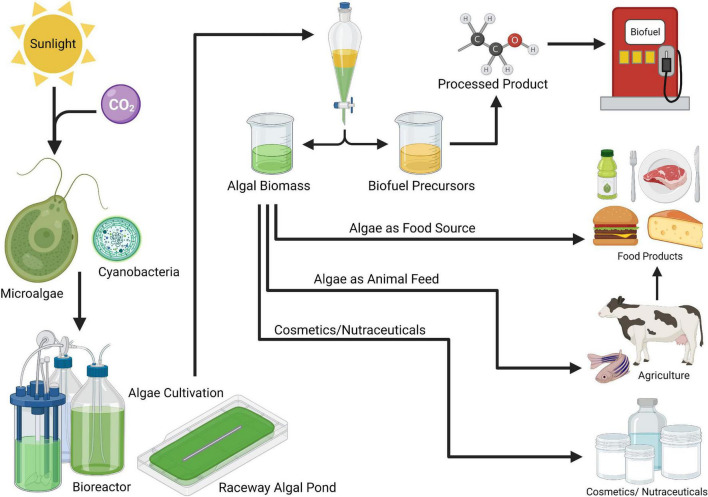
Current agricultural and food production practices are facing extreme stress, posed by climate change and an ever-increasing human population. The pressure to feed nearly 8 billion people while maintaining a minimal impact on the environment has prompted a movement toward new, more sustainable food sources. For thousands of years, both the macro (seaweed and kelp) and micro (unicellular) forms of algae have been cultivated as a food source. Algae have evolved to be highly efficient at resource utilization and have proven to be a viable source of nutritious biomass that could address many of the current food production issues. Particularly for microalgae, studies of their large-scale growth and cultivation come from the biofuel industry; however, this knowledge can be reasonably translated into the production of algae-based food products. The ability of algae to sequester CO 2 lends to its sustainability by helping to reduce the carbon footprint of its production. Additionally, algae can be produced on non-arable land using non-potable water (including brackish or seawater), which allows them to complement rather than compete with traditional agriculture. Algae inherently have the desired qualities of a sustainable food source because they produce highly digestible proteins, lipids, and carbohydrates, and are rich in essential fatty acids, vitamins, and minerals. Although algae have yet to be fully domesticated as food sources, a variety of cultivation and breeding tools exist that can be built upon to allow for the increased productivity and enhanced nutritional and organoleptic qualities that will be required to bring algae to mainstream utilization. Here we will focus on microalgae and cyanobacteria to highlight the current advancements that will expand the variety of algae-based nutritional sources, as well as outline various challenges between current biomass production and large-scale economic algae production for the food market.
Overview
The claims and statistics of this paper haven’t been checked yet.
Run the check — free, no account needed. It reads the open-access text and checks the sources it cites.
Integrity signals
Registry
Cites
Statistics
Figures
Verification
Claims the paper makes
The claims and statistics of this paper haven’t been checked yet.
Run the check — free, no account needed. It reads the open-access text and checks the sources it cites.
Claims other papers make about this one
Each is checked against this paper’s own text: does it say what the citing paper says it does?
The source backs part of the claim, not all of it — or backs it for a different population, condition or comparison.
In the citing paper
“This metabolic feature allows microalgae to contribute simultaneously to pollutant removal and, in certain contexts, to alleviating the demand for arable land when compared with conventional agriculture, reinforcing their role as an ecologically viable resource (Abdelfattah et al., 2023; Diaz et al., 2023; Chen et al., 2024; Iñiguez-Moreno et al., 2025).”
From Microalgae biotechnology and its role in sustainable and healthy food design (2025) · cites this paper as Diaz et al., 2023
Experimental — accuracy not yet measured
Self-check
Percentages, sums and reported differences re-computed from the paper’s own numbers.
The self-check needs the paper’s full text.
Citations
Cites
The new frontier of genome engineering with CRISPR-Cas9
Doudna, J. A., & Charpentier, E. (2014) · Science · doi:10.1126/science.1258096 · Cited by 7,062
How a century of ammonia synthesis changed the world
Erisman, J. W., Sutton, M. A., Galloway, J. N., Klimont, Z., & Winiwarter, W. (2008) · Nature Geoscience · doi:10.1038/ngeo325 · Cited by 4,630
Commercial Applications of Microalgae
Spolaore, P., Joannis-Cassan, C., Duran, E., & Isambert, A. (2006) · Journal of Bioscience and Bioengineering · doi:10.1263/jbb.101.87 · Cited by 4,285
The green, blue and grey water footprint of crops and derived crop products
Mekonnen, M. M., & Hoekstra, A. Y. (2011) · Hydrology and earth system sciences · doi:10.5194/hess-15-1577-2011 · Cited by 3,023
Protein and amino acid requirements in human nutrition.
(2007) · PubMed · Cited by 2,234
Khan, M. I., Shin, J. H., & Kim, J. D. (2018) · Microbial Cell Factories · doi:10.1186/s12934-018-0879-x · Cited by 2,082
CRISPR/Cas Genome Editing and Precision Plant Breeding in Agriculture
Chen, K., Wang, Y., Zhang, R., Zhang, H., & Gao, C. (2019) · Annual Review of Plant Biology · doi:10.1146/annurev-arplant-050718-100049 · Cited by 1,696
Algae as nutritional and functional food sources: revisiting our understanding.
Wells, M. L., Potin, P., Craigie, J. S., Raven, J. A., Merchant, S. S., Helliwell, K. E., Smith, A. G., Camire, M. E., & Brawley, S. H. (2017) · Journal of Applied Phycology · doi:10.1007/s10811-016-0974-5 · Cited by 1,562
Haematococcus astaxanthin: applications for human health and nutrition
Guerin, M., Huntley, M. E., & Olaizola, M. (2003) · Trends in Biotechnology · doi:10.1016/s0167-7799(03)00078-7 · Cited by 1,495
Potential Role of Carotenoids as Antioxidants in Human Health and Disease
Fiedor, J., & Burda, K. (2014) · Nutrients · doi:10.3390/nu6020466 · Cited by 1,420
Research works printed but not linked: 22
- 2022, Better Policies to Improve the Environmental Performance of the Agriculture Sector. Agriculture and the Environment.
- Gaan, 2020, Plant-Based Food Retail Market Overview.
- Mateo-Sagasta, 2017, Water Pollution from Agriculture: a Global Review. Rome, Colombo: The Food and Agriculture Organization of the United Nations Rome, 2017 and the International Water Management Institute on behalf of the Water Land and Ecosystems research program Colombo, 2017.
- 2021, FAO Statistical Yearbook 2021 - World Food and Agriculture.
- 2019, Fertilizer Use and Price.
- 2020, Flour, Corn, Yellow, Fine Meal, Enriched. FoodData Central Search Results.
- 2022, Agricultural Biotechnology Glossary.
- 2022, World Agricultural Production. Circular Series WAP 8-22.
- 2020, Recent Trends in GE Adoption.
- 2022, How GMOs Are Regulated in the United States.
- 2006, How U.S. FDA’s GRAS Notification Program Works: FOOD SAFETY MAGAZINE.
- 2019, Soybeans, Mature Seeds, Raw. FoodData Central Search Results.
- 2020, Flour, Wheat, All-Purpose, Enriched, Unbleached. FoodData Central Search Results.
- 2020, Flour, Rice, White, Unenriched. FoodData Central Search Results.
- 2012, GRN No. 417 Dried biomass of Arthrospira platensis also known as Spirulina platensis (spirulina). GRAS Notices.
- 2019, GRN No. 773 Dried biomass of Chlamydomonas reinhardtii. GRAS Notices.
- 2014, GRN No. 519 Chlorella protothecoides strain S106 flour with 40-75% protein. GRAS Notices.
- 2012, GRN No. 396 Chlorella vulgaris strain Beij. GRAS Notices.
- 2011, GRN No. 351, Dunaliella bardawil. GRAS Notices Print Share E-mail.
- 2017, GRN No. 698 Paramylon isolate from Euglena gracilis. GRAS Notices Print Share E-mail.
- 2015, GRN No. 580 Haematococcus pluvialis extract containing astaxanthin esters. GRAS Notices.
- 2021, GRN No. 934 Algal oil (=35% docosahexanoic acid (DHA)) derived from Schizochytrium sp. strain CABIO-A-2. GRAS Notices.
Cited by
Sorted by citations
Consumer acceptance of novel sustainable food technologies: A multi-country survey
Giacalone, D., & Jaeger, S. R. (2023) · Journal of Cleaner Production · doi:10.1016/j.jclepro.2023.137119 · Cited by 195
Artificial Intelligence and/or Machine Learning Algorithms in Microalgae Bioprocesses
Imamoglu, E. (2024) · Bioengineering · doi:10.3390/bioengineering11111143 · Cited by 143
Karabulut, G., Purkiewicz, A., & Goksen, G. (2024) · Comprehensive Reviews in Food Science and Food Safety · doi:10.1111/1541-4337.13372 · Cited by 85
Yu, B. S., Pyo, S., Lee, J., & Han, K. (2024) · Microbial Cell Factories · doi:10.1186/s12934-024-02588-7 · Cited by 97
Seaweed Proteins: A Step towards Sustainability?
Pereira, L., Cotas, J., & Gonçalves, A. M. M. (2024) · Nutrients · doi:10.3390/nu16081123 · Cited by 93
Metadata
- Authors
- Diaz, C. J., Douglas, K. J., Kang, K., Kolarik, A. L., Malinovski, R., Torres-Tiji, Y., Molino, J. V., Badary, A., & Mayfield, S. P.
- Affiliations
- University of California San Diego (US)
- Corresponding author
- Mayfield, Stephen P.
- Venue
- Frontiers in Nutrition
- Publisher
- Frontiers Media SA
- Published
- 2023-01-19
- Volume
- 9
- Pages
- 1029841-1029841
- ISSN
- 2296-861X (ISSN-L)
- PMC
- PMC9892066
- OpenAlex
- W4317388099
- Cited by
- 194
- References
- 162
- Citations by year
- 2026: 43 · 2025: 74 · 2024: 65 · 2023: 12
- FWCI
- 2.97
- Type
- journal article
- Language
- en
- Open access
- gold
- doi.org
- Licence
- Locations
- Frontiers in Nutrition (publishedVersion, cc-by)
- PubMed Central (publishedVersion, cc-by)
- PubMed (publishedVersion)
- eScholarship (California Digital Library) (submittedVersion, cc-by)
- DOAJ (DOAJ: Directory of Open Access Journals) (submittedVersion, cc-by-sa)
- OSTI OAI (U.S. Department of Energy Office of Scientific and Technical Information) (submittedVersion)
- Funders
- U.S. Department of Energy
- Topics
- Physical Sciences › Energy › Renewable Energy, Sustainability and the Environment › Algal biology and biofuel production
- Life Sciences › Agricultural and Biological Sciences › Aquatic Science › Aquaculture Nutrition and Growth
- Life Sciences › Agricultural and Biological Sciences › Aquatic Science › Seaweed-derived Bioactive Compounds
- Keywords
- algae-based foods, microalgae, cyanobacteria, sustainable food production, seaweed, kelp, CO2 sequestration, algal biomass, essential fatty acids, nutritional value, economic feasibility
About these checks
Registry, retraction, Cites and statistics results are computed, not judged, with one exception: a printed reference that no index lists is read once by a model before it counts as a citation error. Claims are extracted by a model and kept only when their quote appears verbatim in the text; each cited source is then checked, with a model’s help, for whether it says what the claim relies on. Those verdicts can be wrong — read the claim’s quote and the cited source before relying on one.
Statistics and arithmetic are recomputed, not judged.
Confidence bands are shown only for fields calibrated on our annotated test set. None is calibrated yet, so no band is shown.
What counts as a claim ›How we measure confidence ›How we check this ›
Are you an author, or do you see a problem with this page? Request a review
