

Pycnogenol® French maritime pine bark extract in randomized, double-blind, placebo-controlled human clinical studies
Open accessThe DOI matches its Crossref record; 77 of the 77 references it cites were found in a registry or an index.
Abstract
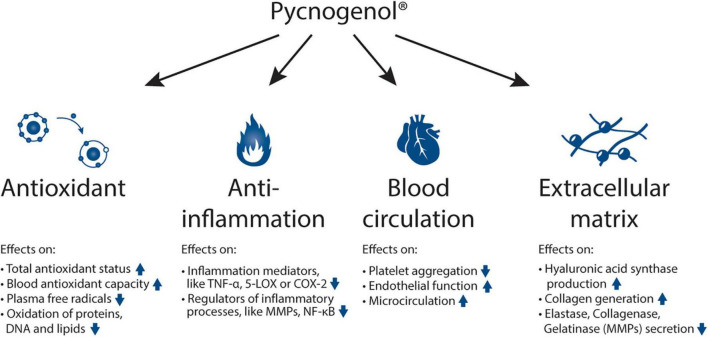
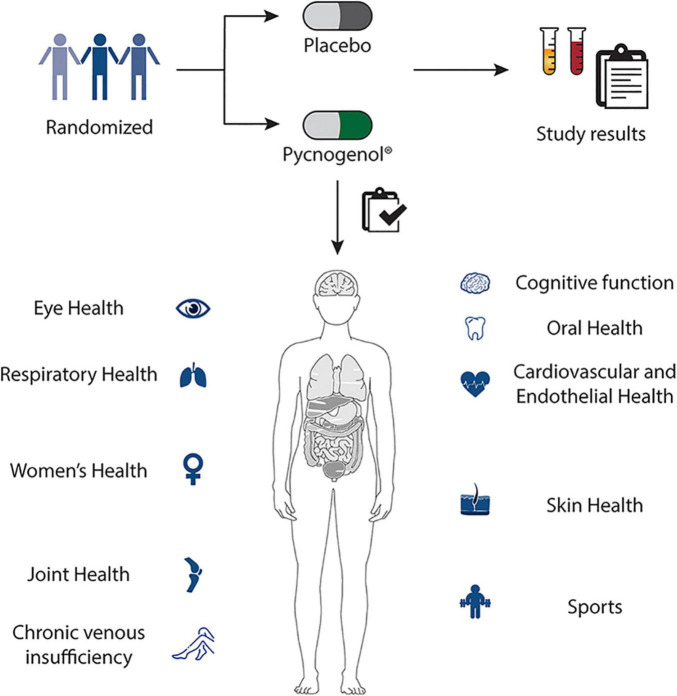
Pycnogenol® French maritime pine bark extract is a well-known and thoroughly studied patented extract from the bark of Pinus pinaster Ait. ssp. Atlantica. In 39 randomized double-blind, placebo-controlled (RDP) human clinical trials including 2,009 subjects, Pycnogenol® French maritime pine bark extract supplementation for two weeks to six months has been shown to beneficially affect cardiovascular health, chronic venous insufficiency, cognition, joint health, skin health, eye health, women’s health, respiratory health and allergies, oral health and sports performance. The mechanisms of action that can explain the respective effects on different conditions in the human body are discussed as well. As investigated in several in vitro, in vivo and in clinical studies, Pycnogenol® French maritime pine bark extract showed antioxidative effects, anti-inflammatory abilities, beneficial effects on endothelial function and reinforcing effects on the extracellular matrix. The present review aims to give a comprehensive overview of currently available “gold standard” RDP trials of Pycnogenol®’s benefits across various health domains compared to placebo. In addition, some of the processes on which the presented effects of Pycnogenol® French maritime pine bark extract are based will be elucidated and discussed. This broad overview of RDP studies on Pycnogenol® in different health domains can be used as a basis for further research on applications and mechanisms of this unique French maritime pine bark extract.
Overview
The claims and statistics of this paper haven’t been checked yet.
Free: it reads the open-access text and checks the first 5 claims that cite a source we can check. Create a free account to check every claim.
Integrity signals
Registry
Cites
Statistics
Figures
Verification
Claims the paper makes
The claims and statistics of this paper haven’t been checked yet.
Free: it reads the open-access text and checks the first 5 claims that cite a source we can check. Create a free account to check every claim.
Claims other papers make about this one
Each is checked against this paper’s own text: does it say what the citing paper says it does?
The check wasn’t confident either way, so it gives no verdict — never disputed.
In the citing paper
“In summary, citrus flavonoids may improve glycemic control, increase GLP-1 secretion, lower inflammation, and support weight management, making them potential adjunctive candidates to GLP-1RAs [117,118,347], though no clinical studies have directly evaluated their combined use.”
From Nutritional Approaches to Enhance GLP-1 Analogue Therapy in Obesity: A Narrative Review (2025) · cites this paper as [347]
Experimental — accuracy not yet measuredIn the citing paper
“Animal studies also show citrus flavonoids reduce weight gain and adiposity by activating AMPK and upregulating adipocyte thermogenesis [346,347], suggesting weightmodulating effects.”
From Nutritional Approaches to Enhance GLP-1 Analogue Therapy in Obesity: A Narrative Review (2025) · cites this paper as [347]
In the citing paper
“In summary, citrus flavonoids may improve glycemic control, increase GLP-1 secretion, lower inflammation, and support weight management, making them potential adjunctive candidates to GLP-1RAs [117,118,347], though no clinical studies have directly evaluated their combined use.”
From Nutritional Approaches to Enhance GLP-1 Analogue Therapy in Obesity: A Narrative Review (2025) · cites this paper as [347]
Self-check
Percentages, sums and reported differences re-computed from the paper’s own numbers.
The self-check needs the paper’s full text.
Citations
Cites
Cheung, N., Mitchell, P., & Wong, T. Y. (2010) · The Lancet · doi:10.1016/s0140-6736(09)62124-3 · Cited by 3,288
Understanding Asthma Phenotypes, Endotypes, and Mechanisms of Disease
Kuruvilla, M. E., Lee, F. E.-H., & Lee, G. B. (2019) · Clinical Reviews in Allergy & Immunology · doi:10.1007/s12016-018-8712-1 · Cited by 1,228
Epidemiology of Asthma in Children and Adults
Dharmage, S. C., Perret, J. L., & Custovic, A. (2019) · Frontiers in Pediatrics · doi:10.3389/fped.2019.00246 · Cited by 1,200 · cited 1×
“With almost 300 million people affected, asthma is one of the most common respiratory diseases worldwide (77).”
BackgroundOxidative stress in brain agingImplications for therapeutics of neurodegenerative diseases
FLOYD, R., & HENSLEY, K. (2002) · Neurobiology of Aging · doi:10.1016/s0197-4580(02)00019-2 · Cited by 830 · cited 1×
“Impairment in memory skills has 10.3389/fnut.2024.1389374 been found to be associated with increased age and oxidative stress (68), explaining Pycnogenol R (cid:13) ’s effects on cognitive function.”
BackgroundInfluentialEndothelial Dysfunction and Hypertension
Konukoglu, D., & Uzun, H. (2016) · Advances in Experimental Medicine and Biology · doi:10.1007/5584_2016_90 · Cited by 594
Rohdewald, P. (2002) · Int. Journal of Clinical Pharmacology and Therapeutics · doi:10.5414/cpp40158 · Cited by 481
Self-citationKawamura, T., & Muraoka, I. (2018) · Antioxidants · doi:10.3390/antiox7090119 · Cited by 307
Inflammatory Markers in Dysmenorrhea and Therapeutic Options
Barcikowska, Z., Rajkowska-Labon, E., Grzybowska, M. E., Hansdorfer-Korzon, R., & Zorena, K. (2020) · International Journal of Environmental Research and Public Health · doi:10.3390/ijerph17041191 · Cited by 269
Endothelium and Its Alterations in Cardiovascular Diseases: Life Style Intervention
Favero, G., Paganelli, C., Buffoli, B., Rodella, L. F., & Rezzani, R. (2014) · BioMed Research International · doi:10.1155/2014/801896 · Cited by 252 · cited 1×
“…human clinical RDP studies (9, 11, 12, 20–22 As the endothelium—the inner lining of blood vessels—is actively involved in many physiological functions, like controlling blood pressure, blood clotting and signaling during inflammation, endothelial function is crucial for cardiovascular health (62).”
BackgroundDiagnosis and management of ADHD in children.
Felt, B. T., Biermann, B., Christner, J. G., Kochhar, P., & Harrison, R. V. (2014) · PubMed · Cited by 222
Research works printed but not linked: 6
- 5. Oliff H. Scientific and clinical monograph for Pycnogenol. Austin, TX: American Botanical Council; (2019). p. 1–46.
- 7. The United States Pharmacopeia. USP monograph. Maritime pine extract. (Vol. 39). North Bethesda, MD: The United States Pharmacopeia; (2016). p. 6748–9.
- 31. Wang S, Tan D, Zhao Y, Gao G, Gao X, Hu L. The effect of Pycnogenol® on the microcirculation, platelet function and ischaemic myocardium in patients with coronary artery diseases. Eur Bull Drug Res. (1999) 7:19–25.
- 47. Kohama T, Negami M. Effect of low-dose French maritime pine bark extract on climacteric syndrome in 170 perimenopausal women. J Reprod Med. (2013) 58:39–46.
- 53. Pavlovic P. Improved Endurance By Use Of Antioxidants. Eur Bull Drug Res. (1999) 7:26–9.
- 70. World Health Organization. Osteoarthritis. Geneva: World Health Organization; (2023).
Cited by
Tienaho, J., Liimatainen, J., Myllymäki, L., Kaipanen, K., Tagliavento, L., Ruuttunen, K., Rudolfsson, M., Karonen, M., Marjomäki, V., Hagerman, A. E., et al. (2024) · Separation and Purification Technology · doi:10.1016/j.seppur.2024.130925 · Cited by 23
Supriyadi, D., Damayanti, D., Veigel, S., Hansmann, C., & Gindl‐Altmutter, W. (2025) · Materials Today Sustainability · doi:10.1016/j.mtsust.2025.101074 · Cited by 33
Chen, L., Li, Z., & Fan, Y. (2025) · Frontiers in Cellular and Infection Microbiology · doi:10.3389/fcimb.2025.1601888 · Cited by 16
Nutritional Approaches to Enhance GLP-1 Analogue Therapy in Obesity: A Narrative Review
Dias, D. D., Vasconcelos, A. R., Souza, A. C. R., Menezes, C. D., Silva, I. S. T. E., & Name, J. J. (2025) · Obesities · doi:10.3390/obesities5040088 · Cited by 8
“French maritime pine bark extract, derived from Pinus pinaster and rich in procyanidin, is a well-researched botanical with multiple clinically demonstrated benefits, including for metabolic, cardiovascular, and cognitive health [344].”
Dunlop, K., Dillon, G., Crowley, R. K., Phillips, C., Twomey, P. J., & McAuliffe, F. M. (2025) · Nutrition & Metabolism · doi:10.1186/s12986-025-00908-1 · Cited by 10
“Due to the age of the participants, the small sample size, and the fact use of the supplement was completely voluntary, results were considered equivocal [49].”
Nisaa, A. A., Mageswary, M. U., Pei, X., Kadir, M. N., Oon, C. E., Rajendran, D., Tan, J. J., Roslan, F. F., Balasubramaniam, S. D., Sany, S. B., et al. (2025) · Beneficial Microbes · doi:10.1163/18762891-bja00061 · Cited by 8
Mohammadi, S., Fülöp, T., Khalil, A., Ebrahimi, S., Hasani, M., Ziaei, S., Farsi, F., Mirtaheri, E., Afsharianfar, M., & Heshmati, J. (2025) · BMC Complementary Medicine and Therapies · doi:10.1186/s12906-025-04819-9 · Cited by 9
“PBEs have been extensively studied, and are generally considered safe for human consumption [38, 100, 101].”
Bayer, J., Petersen, N. K., Hess, J. V., Jockel‐Schneider, Y., & Högger, P. (2025) · Nutrients · doi:10.3390/nu17091546 · Cited by 7
“…p 0.0001), while caffeic acid showed a significant positive correlation with both p-coumaric acid (r = 0 The French maritime pine bark extract Pycnogenol ® had been previously reported to beneficially influence the inflammatory processes in various disease contexts, such as osteoarthritis [16].”
InfluentialSustainable Supply Chains in the Forest Bioeconomy: A Systematic Review
van der Ven, H., & Bear, K. (2025) · Sustainability · doi:10.3390/su17219738 · Cited by 6
Barros, D., Grenho, L., Fernandes, M. H., Gomes, P. S., & Fernandes, É. M. R. (2025) · Antioxidants · doi:10.3390/antiox14111377 · Cited by 4
“The low toxicity profile of pine bark extracts is further supported by their established clinical use, reinforcing their potential health-promoting benefits [11,82].”
Impact of Dietary Antioxidants on Redox Homeostasis and Its Effects on Health and Disease
Reyed, R. M., & Prabhakar, P. K. (2025) · Advances in medical diagnosis, treatment, and care (AMDTC) book series · doi:10.4018/979-8-3693-7919-6.ch003 · Cited by 5
Gunnarsdottir, S. H., Rehrl, J., Sepperer, T., Haretzmüller, L., Sesink, D., Löwenstein, K., Gadermayr, M., Hölzl, C., Stelzhammer, B., Himmelsbach, M., et al. (2025) · Scientific Reports · doi:10.1038/s41598-025-06105-7 · Cited by 3
Rehrl, J., Sepperer, T., Gunnarsdottir, S. H., Schnabel, T., Oostingh, G. J., & Schuster, A. (2025) · PLoS ONE · doi:10.1371/journal.pone.0328790 · Cited by 4
Sellés, A. J. N., Nuevas-Paz, L., & Gómez-Torres, E. A. (2025) · Frontiers in Pharmacology · doi:10.3389/fphar.2025.1680390 · Cited by 2
“Modern research has validated the therapeutic potential of Pycnogenol ® , demonstrating its ef fi cacy in improving blood circulation, reducing oxidative stress, and supporting cognitive function (Weichmann and Rohdewald, 2024).”
Kayesh, M. E. H., Kohara, M., & Tsukiyama–Kohara, K. (2026) · Frontiers in Pharmacology · doi:10.3389/fphar.2026.1755175 · Cited by 3
“Additional studies have further supported its antiviral efficacy (Matsumori et al., 2007; Ezzikouri et al., 2015; Weichmann and Rohdewald, 2024), highlighting its potential as an alternative or adjunct antiviral therapy.”
Escobar‐Avello, D., Oñate-Valdés, T., Ferrer, V., Fuentealba, C., Benavides, S., Cabrera-Barjas, G., Bravo‐Arrepol, G., Giordano, A., Gullón, B., & Santos, J. (2026) · Antioxidants · doi:10.3390/antiox15050565 · Cited by 3
Natural Products Targeting Oxidative Stress–Inflammation Crosstalk in Endometriosis
Mhatre, D., Jadhav, T., Shirodkar, S., & Doshi, G. (2026) · American Journal of Reproductive Immunology · doi:10.1111/aji.70293 · Cited by 2
“It demonstrates pharmaceutical potential through defined procyanidin content and positive endometriosis RCT data [ 134 ].”
InfluentialClinical evidence of venoactive drugs in diabetic microvascular complications: a scoping review
Gastaldi, G., Zingg, D., CALABRESE, A., Bouskela, E., van Rijn, M. J., Bozkurt, K., Rosas-Saucedo, J., Rabe, E., Mansilha, A., & Haller, H. G. (2025) · International Angiology · doi:10.23736/s0392-9590.25.05389-1 · Cited by 1
Bayrak, H. Ç., Dinç, M., Karasu, R., Karagöz, B., Topçu, M. E., & Soydemir, Ö. C. (2026) · Injury · doi:10.1016/j.injury.2026.113150 · Cited by 1
Eicosanoids and flavonoids in asthma: Bridging inflammatory pathways and therapeutic potential
Raj, A., Khan, F. A., & Dong, J. (2026) · Pathology - Research and Practice · doi:10.1016/j.prp.2026.156596 · Cited by 1
Scherg, C., Genest, F., Maghary, J., Seefried, L., Docheva, D., Krischke, M., & Högger, P. (2026) · Frontiers in Nutrition · doi:10.3389/fnut.2026.1923949 · Cited by 1
Ashok Kumar, B. S., Disha, N. S., Khalid, M., & Mamatha, H. (2024) · INTERNATIONAL JOURNAL OF MULTIDISCIPLINARY RESEARCH AND ANALYSIS · doi:10.47191/ijmra/v7-i12-33
Liu, Q., Wu, J., Wang, N., Bürki, C., Grether‐Beck, S., & Krutmann, J. (2025) · Phytomedicine Plus · doi:10.1016/j.phyplu.2025.100821
Comhaire, F. H. (2025) · Journal of Clinical Images and Medical Case Reports · doi:10.52768/2766-7820/3508
“Its therapeutic and protective potentials have been objectively documented [21].”
Costa, D. R. (2025) · Journal of Vascular Surgery Cases and Innovative Techniques · doi:10.1016/j.jvscit.2025.102029
“19 In our therapeutic strategy, these agents were selected to modulate inflammation and potentially improve aesthetic outcomes.”
Yamamoto, A., Ogushi, K., Morikawa, T., Takashima, S., Kamiya, T., Takagaki, K., & Miura, N. (2025) · Food and Nutrition Sciences · doi:10.4236/fns.2025.1610091
Yakut, S., Ulaş, N., & İmik, A. (2026) · Veteriner Hekimler Derneği Dergisi · doi:10.33188/vetheder.1790255
Devaraj, D. K., Parameswaran, R., Marappan, M., & Husain, S. (2025) · International Journal of Orthodontic Rehabilitation · doi:10.56501/intjorthodrehabil.164.ijor0049
“Studies also report beneficial effects on plasma lipid profiles, reducing high blood pressure and inhibiting platelet aggregation without increasing the risk of bleeding [12] .”
Maletin, N., Denda, N., Milanović, M., Milić, N., Pavkov, N., Rašković, A., & Kusturica, M. P. (2026) · Plants · doi:10.3390/plants15030462
Arunachalam, S. (2026) · Journal of Cosmetic Dermatology · doi:10.1111/jocd.70757
Popescu, V. S., Bilo, F., Sweeney, E. M., Borgese, L., Peron, G., Abate, G., & Mastinu, A. (2026) · Chemistry & Biodiversity · doi:10.1002/cbdv.71561
Protective effect of Pinus eldarica bark extract on doxorubicin-induced cardiotoxicity in rats
Izadi, M. S., Jalali, M., Safaeian, L., & Zolfaghari, B. (2026) · Proceedings of the Indian National Science Academy · doi:10.1007/s43538-026-00891-y
Fogacci, F., Micoli, V. D., Арманович, А. А., ALGhasab, N. S., Perone, F., & Cicero, A. F. G. (2026) · Clinical Nutrition · doi:10.1016/j.clnu.2026.106801
Yang, Y., Xian, K., Lai, R., Li, Y., & Zhong, J. Q. (2026) · Frontiers in Pharmacology · doi:10.3389/fphar.2026.1958407
“Consistently, a systematic review of Pycnogenol, a French maritime pine bark extract rich in oligomeric PCs, concluded that it was essentially free of adverse effects and constitutes an effective and safe supplement (Weichmann and Rohdewald, 2024).”
Hanna, M. L., & Högger, P. (2026) · Frontiers in Pharmacology · doi:10.3389/fphar.2026.1949994
“In clinical studies, Pycnogenol ® showed, e.g., anti-inflammatory and antioxidative effects as well as improvement of endothelial function parameters (Weichmann and Rohdewald, 2024).”
InfluentialSenhaji, Y., Duret, E., Robles, E., Herrera, R., Raydan, N. D. V., & Charrier, F. (2026) · Biomass Conversion and Biorefinery · doi:10.1007/s13399-026-07294-5
Lorenço, M. S., de Abreu, D. J. M., Araújo, E. D. S., Zidanes, U. L., dos Santos, L. D. J., Villarruel, D. C. V., Carvalho, E. E. N., & Mori, F. A. (2026) · Biofuels Bioproducts and Biorefining · doi:10.1002/bbb.70230
Scherg, C., Genest, F., Maghary, J., Seefried, L., & Högger, P. (2026) · Frontiers in Nutrition · doi:10.3389/fnut.2026.1924081
“The positive impact of Pycnogenol ® on pain scores is likely related to its established anti-inflammatory and antioxidant activities (10).”
Kumar, H., Peter, L., Akhtar, N., Kumar, V., Tariq, M., & Harun, H. B. C. (2026) · Current Research in Biotechnology · doi:10.1016/j.crbiot.2026.100434
Metadata
- Authors
- Weichmann, F., & Rohdewald, P.
- Affiliations
- Horphag Research (Switzerland) (CH)
- University of Münster (DE)
- Corresponding author
- Weichmann, Franziska
- ORCID
- Weichmann, Franziska
- Venue
- Frontiers in Nutrition
- Publisher
- Frontiers Media SA
- Published
- 2024-05-02
- Volume
- 11
- Pages
- 1389374-1389374
- ISSN
- 2296-861X (ISSN-L)
- PMC
- PMC11096518
- OpenAlex
- W4396590316
- Cited by
- 38
- References
- 77
- Citations by year
- 2026: 17 · 2025: 19 · 2024: 2
- FWCI
- 1.45
- Type
- journal article
- Language
- en
- Open access
- gold
- doi.org
- Licence
- Locations
- Frontiers in Nutrition (publishedVersion, cc-by)
- PubMed Central (publishedVersion, cc-by)
- PubMed (publishedVersion)
- DOAJ (DOAJ: Directory of Open Access Journals) (submittedVersion, cc-by-sa)
- Topics
- Health Sciences › Medicine › Biochemistry (medical) › Phytochemicals and Antioxidant Activities
- Health Sciences › Medicine › Complementary and alternative medicine › Ginkgo biloba and Cashew Applications
- Life Sciences › Agricultural and Biological Sciences › Plant Science › Natural Compound Pharmacology Studies
- Keywords
- Pycnogenol, Pinus pinaster, dietary supplementation, cardiovascular health, chronic venous insufficiency, cognition, joint health, skin health, eye health, women's health, respiratory health, allergy, oral health, athletic performance, antioxidant activity, anti-inflammatory activity, endothelial function, extracellular matrix
About these checks
Registry, retraction, Cites and statistics results are computed, not judged, with one exception: a printed reference that no index lists is read once by a model before it counts as a citation error. Claims are extracted by a model and kept only when their quote appears verbatim in the text; each cited source is then checked, with a model’s help, for whether it says what the claim relies on. Those verdicts can be wrong — read the claim’s quote and the cited source before relying on one.
Statistics and arithmetic are recomputed, not judged.
Confidence bands are shown only for fields calibrated on our annotated test set. None is calibrated yet, so no band is shown.
What counts as a claim ›How we measure confidence ›How we check this ›
Are you an author, or do you see a problem with this page? Request a review
Data sources
Bibliographic data: Semantic Scholar, OpenAlex, Crossref.
Contains information from the Semantic Scholar Academic Graph Datasets, made available under the ODC Attribution License (ODC-BY 1.0).
Semantic Scholar’s data is described in: Kinney, R., et al. (2023). The Semantic Scholar Open Data Platform. arXiv:2301.10140.
