

The DOI matches its Crossref record; 151 of the 152 references it cites were found in a registry or an index; none of the 172 sources its claims cite is checked for support yet.
Junior athletes’ nutritional demands: a narrative review of consumption and prevalence of eating disorders
Open accessAbstract
Information regarding the dietary requirements and consumption of young athletes is limited. Hence, the aim of this narrative review is to provide a comprehensive combination of research and review papers on the nutritional status of young athletes aged 5–18 years old, as well as quantitative, qualitative, wholesome foods, food choices, and eating disordered data concerning the dietary requirements for growing young athletes. This study involved systematic searches of electronic databases, including Google Scholar, PubMed, Science Direct, Scopus, and Web of Science. The specific criteria for identifying research papers published in English from July 1980 until May 2024 were included. Only 48 studies out of 1,262 were included in this narrative review. The findings of this study suggest that, compared with adults, junior athletes need a unique approach to meet their dietary needs. Growth, development, and general athletic performance depend on macronutrients, as they are vital nutrients for young active athletes. However, research on enhancing junior athletes’ performance is still in progress, and studies on hydration status, and eating disorders are limited.
Overview
CoChat Summary
TL;DR
This narrative review synthesizes 48 studies involving 4,005 junior athletes aged 5–18 years and concludes that junior athletes have distinct nutritional needs, yet many fail to meet dietary recommendations and are at risk of eating disorders. Macronutrients are emphasized as vital for growth, development, and performance, but evidence on hydration, supplements, and eating disorders in this population remains limited.
Key findings
- The review included 48 research articles involving 4,005 juniors from an initial 1,262 records; it concludes that junior athletes need a unique approach compared with adults, with macronutrients vital for growth, development, and athletic performance.
- Many junior athletes did not adhere to healthy nutrition guidelines and showed energy imbalances or nutrient deficiencies. In one included study, male junior athletes consumed 2,285.5 kcal versus a recommended 2,650 kcal, with only 8.1% meeting the recommended caloric intake and generally meeting about 60–80% of macronutrient and micronutrient needs.
- Eating disorder risk varied across studies: 33.3% of adolescent swimmers were identified as at risk of eating disorders; a global meta-analysis of over 70,000 athletes reported 19% engaged in disordered eating; Norwegian elite adolescent athletes had 7.0% prevalence versus 2.3% in non-athlete controls; and Spanish elite athletes showed approximately 5% possible eating disorders (7.6% females, 2.5% males).
- Supplement use was prevalent, with protein-based supplements and multivitamins most common among males and caffeine anhydrous among females; caffeine studies generally showed ergogenic effects on performance, but evidence was limited and often male-only.
Methods
- Narrative review using PRISMA-guided searches of Google Scholar, PubMed, Science Direct, Scopus, and Web of Science, plus manual reference searching, covering English-language articles from July 1980 to May 2024.
- Inclusion criteria focused on healthy young athletes aged 5–18 years; exclusions included adults, non-athletes, diseased or disabled individuals, non-English articles, reviews, and books.
- From 1,262 initially identified articles, 839 were removed after keyword analysis and 48 research articles involving 4,005 juniors were included; data were extracted independently by two authors and narratively synthesized into macronutrients, micronutrients, supplements, and eating disorders.
Limitations
- The paper states that research on junior athletes’ performance, hydration status, and eating disorders is limited; only vitamin D had studies among vitamins in this review, and clinical trials of nutrients, supplements, and eating disorders in junior athletes are limited.
- The paper states that eating disorder studies often rely on self-reported questionnaires whose effectiveness and validity in athletes are questioned, lack precise terminology for disordered eating, focus on specific groups or sports, and often lack non-athlete controls of the same age.
- Evident from the text: as a narrative review, no formal meta-analysis or risk-of-bias/quality appraisal is described, and many included studies have small samples (e.g., n=5, 9, 10, 12) and sex-skewed samples, limiting generalizability.
Model-written summary. Check it against the paper before relying on it.
Integrity signals
Registry
Cites
Statistics
Figures
Verification
Claims the paper makes
0 Valid · 13 Not valid · 132 Not checked · 34 Own results and interpretations
None of the sources cited for this claim have been checked yet.
In the paper
“In addition, the typical dietary intake did not meet the recommended intake to meet their needs for macro- and micronutrients (17, 21, 22, 24) (Table 1).”
§ Junior athletes’ nutritional demands: a narrative review of consumption and prevalence of eating disorders > Results
What the sources say
- Not checked yetcites [17] Insani, 2023, The relationship between food consumption and nutritional status of male junior athletes: a cross sectional study in Sumedang, Int J Hum Mov Sports Sci source
- Not checked yetcites [21] Braun, 2018, Nutrition status of young elite female German football players, Pediatr Exerc Sci source
- Not checked yetcites [22] Dey, 2018, Comparison of dietary intake, energy adequacy and anthropometric parameters between Indian junior male and female hockey players, Malays J Nutr doi:10.5555/20193019973
plain- Asserted: passes — The authors put it forward as true.
- Checkable: passes — It can be checked against evidence.
- Load-bearing: passes — The paper’s conclusions depend on it.
- Based: passes — The paper gives a reason why it holds.
In the paper
“and are more susceptible to eating disorders (18).”
§ Junior athletes’ nutritional demands: a narrative review of consumption and prevalence of eating disorders > Results
What the sources say
- Not checked yetcites [18] Assyifa, 2023, Correlation between body image, eating disorders, and nutrient adequacy level with nutritional status of adolescent swimmers in Bogor City, Indonesia Am Nutr source
plainstates an association- Asserted: passes — The authors put it forward as true.
- Checkable: passes — It can be checked against evidence.
- Load-bearing: passes — The paper’s conclusions depend on it.
- Based: passes — The paper gives a reason why it holds.
A result the paper states — it cites no source for it, so there is none to check. The quote shows it is in the paper.
In the paper
“Information regarding the dietary requirements and consumption of young athletes is limited.”
- Also stated in: § Introduction · plain
“There is limited information available about the nutritional needs, nutritional intake, wholesome food, and eating disorders for young athletes.”
§ Junior athletes’ nutritional demands: a narrative review of consumption and prevalence of eating disorders > Abstract
plain- Asserted: passes — The authors put it forward as true.
- Checkable: passes — It can be checked against evidence.
- Load-bearing: passes — The paper’s conclusions depend on it.
- Based: passes — The paper gives a reason why it holds.
- Also stated in: § Introduction · plain
A result the paper reports from its own data — it cites no other source for it, so there is none to check. The quote shows it is in the paper.
In the paper
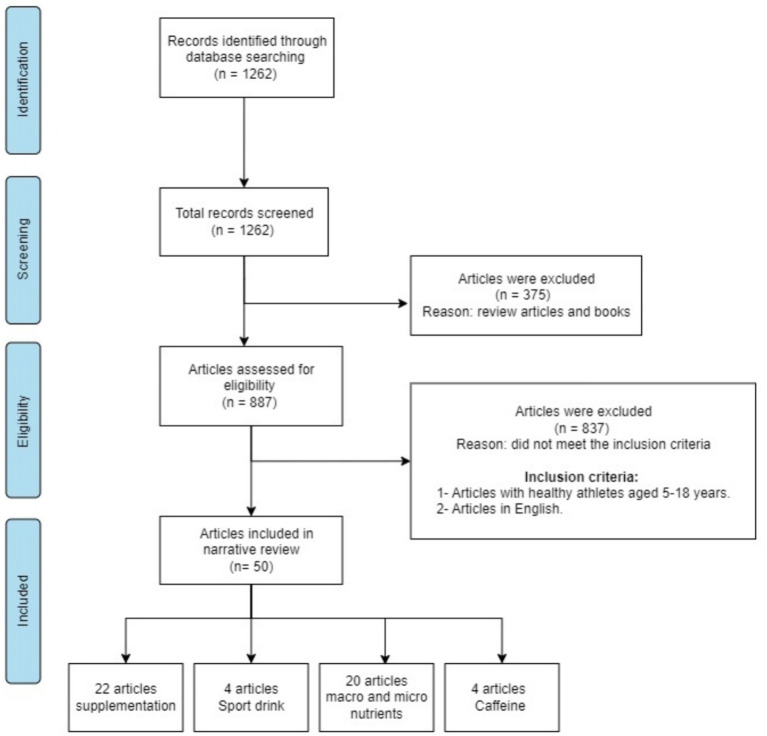
“A total of 1,262 research and review articles were obtained in the initial search, and only 48 research articles involving 4,005 juniors related to the nutritional status of junior athletes (≤ 18 years) remained (Figure 1).”
§ Junior athletes’ nutritional demands: a narrative review of consumption and prevalence of eating disorders > Results
plain- Asserted: passes — The authors put it forward as true.
- Checkable: passes — It can be checked against evidence.
- Load-bearing: unclear — It is unclear whether the paper’s conclusions depend on it.
- Based: passes — The paper gives a reason why it holds.
A result the paper reports from its own data — it cites no other source for it, so there is none to check. The quote shows it is in the paper.
In the paper
“Research on the effects of vitamins and vitamin supplements on junior athletes is limited and inconclusive.”
§ Junior athletes’ nutritional demands: a narrative review of consumption and prevalence of eating disorders > Results > Vitamins
plain- Asserted: passes — The authors put it forward as true.
- Checkable: passes — It can be checked against evidence.
- Load-bearing: unclear — It is unclear whether the paper’s conclusions depend on it.
- Based: passes — The paper gives a reason why it holds.
69 more claims
Create a free account to see all 179 claims and to verify the 170 references still open.
- Probably not a substantial claim. 43
- It may state two separate claims as one. 67
- The quote only partly states this claim. 6
Claims other papers make about this one
Each is checked against this paper’s own text: does it say what the citing paper says it does?
In the citing paper
“Young athletes exhibit higher energy requirements compared to non-athlete peers due to simultaneous energy expenditure for growth and sport performance [19,20].”
From Use of Nutritional Strategies, Bioactive Compounds, and Dietary Supplements in Young Athletes: From Evidence to Potential Risks—A Narrative Review (2025) · cites this paper as [19]
In the citing paper
“An inadequate understanding of fuelling strategies, recovery processes and micronutrient requirements may contribute to negative energy balance, impaired growth, and increased susceptibility to illness and injury [126].”
From Dietary intake, nutrition knowledge, and behavior in youth team sport athletes: a scoping review and call to advance research and practice (2026) · cites this paper as [126]
Self-check
Percentages, sums and reported differences re-computed from the paper’s own numbers.
Each contradiction between two passages listed here was confirmed by an independent check.
Rated minor: it would not touch a result — a value no result rests on, a p-value that stays on the same side of the significance level, or a conflict that is clerical, resolved elsewhere in the paper, or outside its own findings.
In the paper
§ Junior athletes’ nutritional demands: a narrative review of consumption and prevalence of eating disorders > Results
“| 22 | Caffeine’s effect on intermittent sprint cycling performance with different rest intervals. | Lee C. (30) | 2011 | RCT | Caffeine | 14 | 18.7 ± 0.8 | 100% |”
§ Junior athletes’ nutritional demands: a narrative review of consumption and prevalence of eating disorders > Materials and methods > Data selection
“Articles were included based on peer-reviewed published work in the English language and articles with healthy young athletes aged 5–18 years old.”
Rated minor: it would not touch a result — a value no result rests on, a p-value that stays on the same side of the significance level, or a conflict that is clerical, resolved elsewhere in the paper, or outside its own findings.
In the paper
§ Junior athletes’ nutritional demands: a narrative review of consumption and prevalence of eating disorders > Results
“| 22 | Caffeine’s effect on intermittent sprint cycling performance with different rest intervals. | Lee C. (30) | 2011 | RCT |”
§ Junior athletes’ nutritional demands: a narrative review of consumption and prevalence of eating disorders > References
“30. Lee CL Cheng CF Lin JC Huang HW. Caffeine’s effect on intermittent sprint cycling performance with different rest intervals. Eur J Appl Physiol. (2012) 112: 2107– 16.”
Rated minor: it would not touch a result — a value no result rests on, a p-value that stays on the same side of the significance level, or a conflict that is clerical, resolved elsewhere in the paper, or outside its own findings.
In the paper
§ Junior athletes’ nutritional demands: a narrative review of consumption and prevalence of eating disorders > Results > Risk factors and prevalence of eating disorders among junior athletes
“In a study by Teixidor-Batlle et al. (154) approximately 5% (7.6% of females and 2.5% of male athletes) of 646 Spanish elite athletes with a mean age of 16.7 demonstrated the possibility of having EDs”
§ Junior athletes’ nutritional demands: a narrative review of consumption and prevalence of eating disorders > References
“154. Reel JJ Galli N Miyairi M Voelker D Greenleaf C. Development and validation of the intuitive exercise scale.”
Rated minor: it would not touch a result — a value no result rests on, a p-value that stays on the same side of the significance level, or a conflict that is clerical, resolved elsewhere in the paper, or outside its own findings.
In the paper
§ Junior athletes’ nutritional demands: a narrative review of consumption and prevalence of eating disorders > Results > Supplements
“Table 1 shows that a study of junior Canadian athletes concluded that dietary sources of vitamin D, calcium, iron, and folate (for female athletes) should be the basic concern and interest (39).”
§ Junior athletes’ nutritional demands: a narrative review of consumption and prevalence of eating disorders > Results
“| 32 | The preliminary analysis of protein catabolism and nitrogen balance in young gymnasts. | Sawicki P. (39) | 2018 | RCT | CHO and Protein supplementation |”
Rated minor: it would not touch a result — a value no result rests on, a p-value that stays on the same side of the significance level, or a conflict that is clerical, resolved elsewhere in the paper, or outside its own findings.
In the paper
§ Junior athletes’ nutritional demands: a narrative review of consumption and prevalence of eating disorders > Results > Vitamins
“The effects of other vitamins on junior athletes were not the topic of any scientific studies (Table 1).”
§ Junior athletes’ nutritional demands: a narrative review of consumption and prevalence of eating disorders > Results
“| 34 | Vitamin C, A and E supplementation decreases the expression of HSPA1A and HSPB1 genes in the leukocytes of young polish figure skaters during a 10-day training camp. | Zychowska M. (41) | 2015 | RCT | Vitamin C, A and E supplementation |”
Citations
Cites
Trumbo, P., Schlicker, S., Yates, A. A., & Poos, M. (2002) · Journal of the American Dietetic Association · doi:10.1016/s0002-8223(02)90346-9 · Cited by 5,993
The Human Intestinal Microbiome in Health and Disease
Lynch, S. V., & Pedersen, O. (2016) · New England Journal of Medicine · doi:10.1056/nejmra1600266 · Cited by 3,637
The compelling link between physical activity and the body's defense system
Nieman, D. C., & Wentz, L. M. (2019) · Journal of Sport and Health Science · doi:10.1016/j.jshs.2018.09.009 · Cited by 1,340
Nutrition and Athletic Performance
(2016) · Medicine & Science in Sports & Exercise · doi:10.1249/mss.0000000000000852 · Cited by 1,305
International Society of Sports Nutrition Position Stand: Caffeine and Exercise Performance
Guest, N. S., VanDusseldorp, T. A., Nelson, M. T., Grgic, J., Schoenfeld, B. J., Jenkins, N. D. M., Arent, S. M., Antonio, J., Stout, J. R., Trexler, E. T., et al. (2021) · Journal of the International Society of Sports Nutrition · doi:10.1186/s12970-020-00383-4 · Cited by 665
Vitamin and mineral status: effects on physical performance
Lukaski, H. C. (2004) · Nutrition · doi:10.1016/j.nut.2004.04.001 · Cited by 587
Dietary protein for athletes: From requirements to optimum adaptation
Phillips, S. M., & Van Loon, L. J. C. (2011) · Journal of Sports Sciences · doi:10.1080/02640414.2011.619204 · Cited by 530 · cited 2×
“In comparison, both the American College of Sports Medicine and the American Dietetic Association recommend protein intake between 1.2 and 1.8 g/kg body mass for active adults, which is a sufficient requirement for junior athletes (7, 67, 68).”
BackgroundInfluentialBratland‐Sanda, S., & Sundgot‐Borgen, J. (2013) · European Journal of Sport Science · doi:10.1080/17461391.2012.740504 · Cited by 508
Prevalence and severity of DSM‐5 eating disorders in a community cohort of adolescents
Smink, F. R. E., van Hoeken, D., Oldehinkel, A. J., & Hoek, H. W. (2014) · International Journal of Eating Disorders · doi:10.1002/eat.22316 · Cited by 415 · cited 2×
“…and Statistical Manual of Mental Disorders (DSM-5) and the International Classification of Diseases (ICD-11), anorexia nervosa (AN), bulimia nervosa (BN), restrictive eating disorder, and binge-eating disorder (BED) are some classifications of what are known as eating disorders (EDs) (132–134).”
BackgroundMeasurement of Oxidized/Reduced Glutathione Ratio
Owen, J. B., & Butterfield, D. A. (2010) · Methods in Molecular Biology · doi:10.1007/978-1-60761-756-3_18 · Cited by 411
Research works printed but not linked: 1
- Dey, 2018, Comparison of dietary intake, energy adequacy and anthropometric parameters between Indian junior male and female hockey players, Malays J Nutr, 24, 242, 10.5555/20193019973 · doi:10.5555/20193019973
Cited by
De Zan, D., Eletti, F., Fiore, G., Di Girolamo, E., Bozzini, G. G. M., Perico, V., Tosi, M., Norsa, L., Zuccotti, G., & Verduci, E. (2025) · Nutrients · doi:10.3390/nu17132194 · Cited by 11
Ghazzawi, H., Aqaili, R. A., Khataybeh, B., Al-aittan, F., Hamaideh, S., Alhalaiqah, T., Amawi, A. T., Trabelsi, K., Jahrami, H., & Hasan, M. A. (2025) · Frontiers in Nutrition · doi:10.3389/fnut.2025.1572961 · Cited by 10
Self-citationIsmail, F., Khalifeh, M., Hananeh, W. M., Khataybeh, B., Al-Azaizeh, R., & Al‐Ghadi, M. Q. (2025) · Frontiers in Veterinary Science · doi:10.3389/fvets.2025.1582086 · Cited by 5
Self-citationIrwin, N., Ó Catháin, C., Ward, C., & Kelly, D. T. (2026) · Journal of the International Society of Sports Nutrition · doi:10.1080/15502783.2026.2671431 · Cited by 4
Vitamin Supplementation in Sports: A Decade of Evidence-Based Insights
Wiącek, M., Nowak, E., Lipka, P., Denda, R., & Zubrzycki, I. Z. (2026) · Nutrients · doi:10.3390/nu18020213 · Cited by 4
Ghazzawi, H., Khataybeh, B., Aqaili, R. A., Alnimer, L., Omoush, R. M., & Ali, H. A. (2026) · Frontiers in Sports and Active Living · doi:10.3389/fspor.2026.1776533 · Cited by 2
Self-citationAmawi, A. T., Alduraidi, H., Almasri, A., Obaid, B., Trk, N., Boued, P., Trabelsi, K., Jahrami, H., & Ghazzawi, H. (2025) · International journal of human movement and sports sciences · doi:10.13189/saj.2025.130209 · Cited by 2
Self-citationDoležalová, Z., Matejovičová, M., & Jůzl, M. (2025) · Konference o jakosti potravin a potravinových surovin / Conference on Food Quality and Safety · doi:10.11118/978-80-7701-048-1-0038 · Cited by 1
Analysis of the market of specialized foodstuffs for nutrition of athletes of child and youth age
Kobelkova, I. V., Vrzhesinskaya, O. A., & Tarmaeva, I. Y. (2025) · Voprosy Pitaniya · doi:10.33029/0042-8833-2025-94-6-129-150 · Cited by 1
Anisa Lailatul Fitria, S. G., Salsabila, Q., Pribadi, H. P., Kusumawardhani, M. P., Ramadhan, S. A., Azzahra, A., Diana, R., Rifqi, M. A., Pratiwi, A. A., Atmaka, D. R., et al. (2025) · Media Gizi Indonesia · doi:10.20473/mgi.v20i2.116-126
Nahar, N., García-Durán, J., González-Jurado, J. A., & Sánchez-Oliver, A. J. (2025) · SPORT TK-Revista EuroAmericana de Ciencias del Deporte · doi:10.6018/sportk.633331
Sun, Y. (2026) · International Journal of Healthcare Information Systems and Informatics · doi:10.4018/ijhisi.400753
Beyond Sectoral Policies: A Hybrid Optimization Framework for Water–Food–Energy Nexus CoordinationPreprint
Ming, S. M. S. (2026) · SSRN Electronic Journal · doi:10.2139/ssrn.6521167
Ichsania, N., Alfiandari, A. D., & Chandrawati, A. A. (2026) · COMPETITOR Jurnal Pendidikan Kepelatihan Olahraga · doi:10.26858/cpjok.v18i1.535
Sundgot-Borgen, C., Sundgot‐Borgen, J., & Mathisen, T. F. (2026) · International Journal of Sports Physiology and Performance · doi:10.1123/ijspp.2025-0687
Anti-Inflammatory Nutrition Strategy for Athletes' Performance and Recovery
Banerjee, S., Mamodiya, U., & Auttawetchasakoon, P. (2026) · IGI Global eBooks · doi:10.4018/979-8-3373-9544-9.ch011
Dietary intake and compliance with UEFA nutrition guidelines in soccer players
Sánchez, J. G., de Oleo-Ogando, L. M., & Muciño-Arellano, M. D. R. (2026) · Journal of Human Sport and Exercise · doi:10.55860/net7d643
Rahmawati, A. D., & Mukarromah, S. B. (2026) · Riyadhoh Jurnal Pendidikan Olahraga · doi:10.31602/rjpo.v9i1.24071
Investigation of Nutrition Knowledge and Eating Behaviors of Sports High School Students
Kurt, H. İ., & Civil, T. (2026) · IJPANH · doi:10.71350/ijpanh.41
FARKLI BRANŞLARDAKİ ADÖLESAN KADIN SPORCULARIN BESLENME DURUMLARININ DEĞERLENDİRİLMESİ
Kendir, D., ÖNEN, D., & Karabudak, E. (2026) · Ankara Üniversitesi Beden Eğitimi ve Spor Yüksekokulu SPORMETRE Beden Eğitimi ve Spor Bilimleri Dergisi · doi:10.33689/spormetre.1799821
REVISIÓN BIBLIOGRÁFICA: ACTIVIDAD FÍSICA Y NUTRICIÓN EN ATLETAS DE 16 A 18 AÑOS DE CHIMBORAZO
Fernández, D. O., Silva, E. R. N., Murillo, R. O. S., & Jarrín, H. A. Z. (2026) · Revista Científica Multidisciplinaria InvestiGo · doi:10.56519/945qb418
Adequacy of nutritional intakes of young professional cyclists during the competitive season
Krajnc, E. (2026) · Repository of the University of Ljubljana (University of Ljubljana)
Zakariah, M. A., Subair, M. A., Novita, Mauliah, F. U., Dalle, A., & Suwarna, A. P. (2026) · International Journal of Educational Review Law And Social Sciences (IJERLAS) · doi:10.54443/ijerlas.v6i3.5269
Az edző pedagógiai és egészségfejlesztő funkciói: elméleti és szakirodalmi keretek
Kónya, R. (2026) · Neveléstudomány · doi:10.21549/ntny.54.2026.3.6
Критерии оценки эффективности организации питания школьников в туристском походе
Шеркевич, А. Н., Рыльский, С. В., & Рыльский, Н. С. (2026) · Higher education today · doi:10.18137/rnu.het.26.04.p.235
Metadata
- Authors
- Amawi, A., Khataybeh, B., Al Aqaili, R., Ababneh, N., Alnimer, L., Qoqazeh, A., Oukal, F., Jahrami, H., Mousa Ay, K., Al Saoud, H., & Ghazzawi, H.
- Affiliations
- University of Jordan (JO)
- Jordan University of Science and Technology (JO)
- Al-Balqa Applied University (JO)
- Government Hospitals (BH)
- Corresponding author
- Ghazzawi, Hadeel
- Venue
- Frontiers in Nutrition
- Publisher
- Frontiers Media SA
- Published
- 2024-09-24
- Volume
- 11
- Pages
- 1390204-1390204
- ISSN
- 2296-861X (ISSN-L)
- PMC
- PMC11458482
- OpenAlex
- W4402786190
- Cited by
- 26
- References
- 152
- Citations by year
- 2026: 18 · 2025: 8
- FWCI
- 1.24
- Type
- journal article
- Language
- en
- Open access
- gold
- doi.org
- Licence
- Locations
- Frontiers in Nutrition (publishedVersion, cc-by)
- PubMed Central (publishedVersion, cc-by)
- PubMed (publishedVersion)
- DOAJ (DOAJ: Directory of Open Access Journals) (submittedVersion)
- Funders
- University of Jordan
- Topics
- Health Sciences › Nursing › Nutrition and Dietetics › Nutrition, Health and Food Behavior
- Social Sciences › Psychology › Clinical Psychology › Eating Disorders and Behaviors
- Health Sciences › Nursing › Nutrition and Dietetics › Muscle metabolism and nutrition
- Keywords
- youth athletes, nutrient requirements, eating disorders, dietary intake, macronutrients, hydration status, food choice, athletic performance
About these checks
Registry, retraction, Cites and statistics results are computed, not judged, with one exception: a printed reference that no index lists is read once by a model before it counts as a citation error. Claims are extracted by a model and kept only when their quote appears verbatim in the text; each cited source is then checked, with a model’s help, for whether it says what the claim relies on. Those verdicts can be wrong — read the claim’s quote and the cited source before relying on one.
A language model drew the claims from the paper on 2026-11-14, under version 3 of the claim definition (model deepseek-v4.1-flash, prompt extract-v3).
A second model labelled each claim on 2026-11-14 (model jev-1.13-20260917, definition revision gold-guideline-v0.2).
Statistics and arithmetic are recomputed, not judged.
Confidence bands are shown only for fields calibrated on our annotated test set. None is calibrated yet, so no band is shown.
What counts as a claim ›How we measure confidence ›How we check this ›
Are you an author, or do you see a problem with this page? Request a review
Data sources
Bibliographic data: Semantic Scholar, OpenAlex, Crossref.
Contains information from the Semantic Scholar Academic Graph Datasets, made available under the ODC Attribution License (ODC-BY 1.0).
Semantic Scholar’s data is described in: Kinney, R., et al. (2023). The Semantic Scholar Open Data Platform. arXiv:2301.10140.
