

The DOI matches its Crossref record; 240 of the 240 references it cites were found in a registry or an index.
Cannabidiol as a Therapeutic Target: Evidence of its Neuroprotective and Neuromodulatory Function in Parkinson’s Disease
Open accessAbstract
The phytocannabinoids of Cannabis sativa L. have, since ancient times, been proposed as a pharmacological alternative for treating various central nervous system (CNS) disorders. Interestingly, cannabinoid receptors (CBRs) are highly expressed in the basal ganglia (BG) circuit of both animals and humans. The BG are subcortical structures that regulate the initiation, execution, and orientation of movement. CBRs regulate dopaminergic transmission in the nigro-striatal pathway and, thus, the BG circuit also. The functioning of the BG is affected in pathologies related to movement disorders, especially those occurring in Parkinson’s disease (PD), which produces motor and non-motor symptoms that involving GABAergic, glutamatergic, and dopaminergic neural networks. To date, the most effective medication for PD is levodopa (l-DOPA); however, long-term levodopa treatment causes a type of long-term dyskinesias, l-DOPA-induced dyskinesias (LIDs). With neuromodulation offering a novel treatment strategy for PD patients, research has focused on the endocannabinoid system (ECS), as it participates in the physiological neuromodulation of the BG in order to control movement. CBRs have been shown to inhibit neurotransmitter release, while endocannabinoids (eCBs) play a key role in the synaptic regulation of the BG. In the past decade, cannabidiol (CBD), a non-psychotropic phytocannabinoid, has been shown to have compensatory effects both on the ECS and as a neuromodulator and neuroprotector in models such as 6-hydroxydopamine (6-OHDA), 1-methyl-4-phenyl-1,2,3,6-tetrahydropyridine (MPTP), and reserpine, as well as other PD models. Although the CBD-induced neuroprotection observed in animal models of PD has been attributed to the activation of the CB1 receptor, recent research conducted at a molecular level has proposed that CBD is capable of activating other receptors, such as CB2 and the TRPV-1 receptor, both of which are expressed in the dopaminergic neurons of the nigro-striatal pathway. These findings open new lines of scientific inquiry into the effects of CBD at the level of neural communication. Cannabidiol activates the PPARγ, GPR55, GPR3, GPR6, GPR12, and GPR18 receptors, causing a variety of biochemical, molecular, and behavioral effects due to the broad range of receptors it activates in the CNS. Given the low number of pharmacological treatment alternatives for PD currently available, the search for molecules with the therapeutic potential to improve neuronal communication is crucial. Therefore, the investigation of CBD and the mechanisms involved in its function is required in order to ascertain whether receptor activation could be a treatment alternative for both PD and LID.
Overview
The claims and statistics of this paper haven’t been checked yet.
Run the check — free, no account needed. It reads the open-access text and checks the sources it cites.
Integrity signals
Registry
Cites
Statistics
Figures
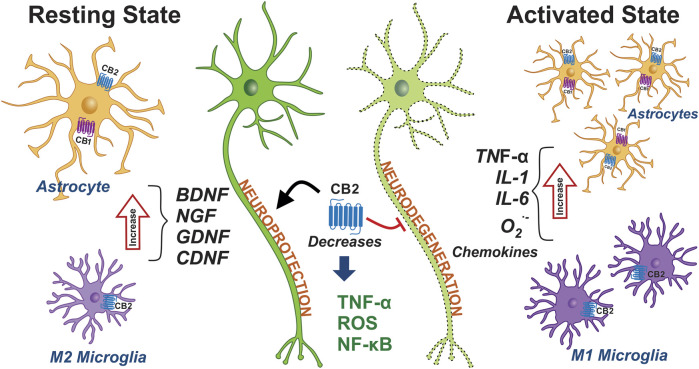
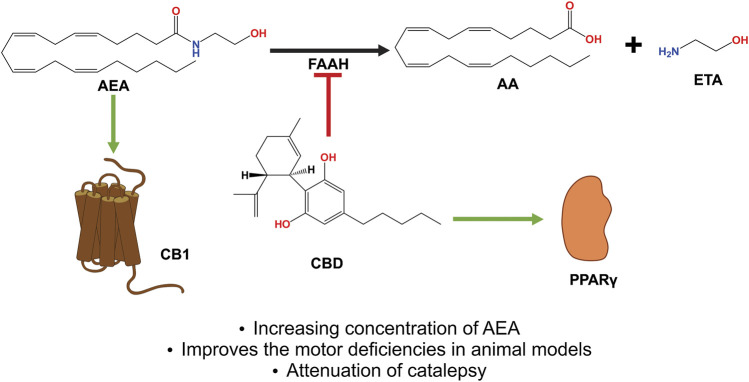
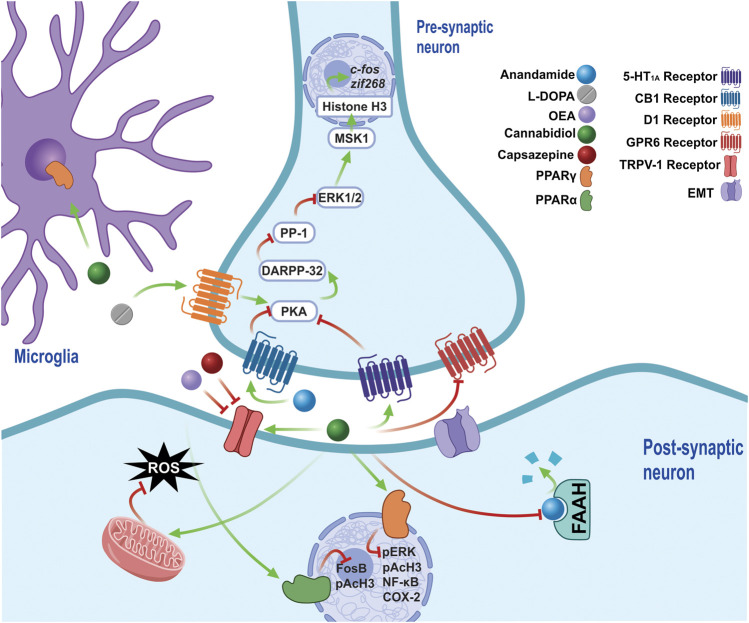
Verification
Claims the paper makes
The claims and statistics of this paper haven’t been checked yet.
Run the check — free, no account needed. It reads the open-access text and checks the sources it cites.
Claims other papers make about this one
Each is checked against this paper’s own text: does it say what the citing paper says it does?
In the citing paper
“CBD is the non-psychotropic component of marijuana, and there are numerous therapeutic effects of this drug including treatment of anxiety, pain, nausea, and motor deficits including the tremor in Parkinson’s disease [116].”
From An Update on Psychopharmacological Treatment of Autism Spectrum Disorder (2022) · cites this paper as [116]
In the citing paper
“CBD has both neuromodulatory and neuroprotective effects through a number of mechanisms including blocking neuroinflammation and potentiating anti-inflammatory pathways, improving mitochondrial function, GABAA agonist potentiation, stimulation of 5HT1A receptors, and enhancing levels of anandamide (AEA) [116–119].”
From An Update on Psychopharmacological Treatment of Autism Spectrum Disorder (2022) · cites this paper as [116]
Self-check
Percentages, sums and reported differences re-computed from the paper’s own numbers.
The self-check needs the paper’s full text.
Citations
Cites
Neurotoxic reactive astrocytes are induced by activated microglia
Liddelow, S. A., Guttenplan, K. A., Clarke, L. E., Bennett, F. C., Bohlen, C. J., Schirmer, L., Bennett, M. L., Münch, A. E., Chung, W.-S., Peterson, T. C., et al. (2017) · Nature · doi:10.1038/nature21029 · Cited by 7,971
Isolation and Structure of a Brain Constituent That Binds to the Cannabinoid Receptor
Devane, W. A., Hanuš, L., Breuer, A., Pertwee, R. G., Stevenson, L. A., Griffin, G., Gibson, D., Mandelbaum, A., Etinger, A., & Mechoulam, R. (1992) · Science · doi:10.1126/science.1470919 · Cited by 5,633
The functional anatomy of basal ganglia disorders
Albin, R. L., Young, A. B., & Penney, J. B. (1989) · Trends in Neurosciences · doi:10.1016/0166-2236(89)90074-x · Cited by 5,353
Molecular characterization of a peripheral receptor for cannabinoids
Munro, S., Thomas, K. L., & Abu-Shaar, M. (1993) · Nature · doi:10.1038/365061a0 · Cited by 5,092
Structure of a cannabinoid receptor and functional expression of the cloned cDNA
Matsuda, L. A., Lolait, S. J., Brownstein, M. J., Young, A. C., & Bonner, T. I. (1990) · Nature · doi:10.1038/346561a0 · Cited by 5,011
Functional architecture of basal ganglia circuits: neural substrates of parallel processing
Alexander, G. E., & Crutcher, M. D. (1990) · Trends in Neurosciences · doi:10.1016/0166-2236(90)90107-l · Cited by 4,131
Primate models of movement disorders of basal ganglia origin
DeLong, M. R. (1990) · Trends in Neurosciences · doi:10.1016/0166-2236(90)90110-v · Cited by 3,824
Mechoulam, R., Ben-Shabat, S., Hanus, L., Ligumsky, M., Kaminski, N. E., Schatz, A. R., Gopher, A., Almog, S., Martin, B. R., Compton, D. R., et al. (1995) · Biochemical Pharmacology · doi:10.1016/0006-2952(95)00109-d · Cited by 2,913
2-Arachidonoylgylcerol: A Possible Endogenous Cannabinoid Receptor Ligand in Brain
Sugiura, T., Kondo, S., Sukagawa, A., Nakane, S., Shinoda, A., Itoh, K., Yamashita, A., & Waku, K. (1995) · Biochemical and Biophysical Research Communications · doi:10.1006/bbrc.1995.2437 · Cited by 2,196
Differential Roles of M1 and M2 Microglia in Neurodegenerative Diseases
Tang, Y., & Le, W. (2016) · Molecular Neurobiology · doi:10.1007/s12035-014-9070-5 · Cited by 2,190
Research works printed but not linked: 4
- Mechoulam, 2010, Pharmaceutical compositions comprising cannabidiol derivatives
- Perez-Reyes, 1976, Intravenous administration of cannabinoids on intraocular pressure, 829
- Pertwee, 2004, The pharmacology and therapeutic potential of cannabidiol, 32
- Snider, 1985, Beneficial and adverse effects of cannabidiol in a Parkinson patient with sinemet-induced dystonic dyskinesia, Neurology, 35, 201
Cited by
Sorted by citations
An Update on Psychopharmacological Treatment of Autism Spectrum Disorder
Aishworiya, R., Valica, T., Hagerman, R., & Restrepo, B. (2022) · Neurotherapeutics · doi:10.1007/s13311-022-01183-1 · Cited by 233
Fragile X-associated tremor/ataxia syndrome: Pathophysiology and management
Hagerman, R., & Hagerman, P. (2021) · Current Opinion in Neurology · doi:10.1097/wco.0000000000000954 · Cited by 40
Metadata
- Authors
- Patricio, F., Morales-Andrade, A. A., Patricio-Martínez, A., & Limón, I. D.
- Affiliations
- Benemérita Universidad Autónoma de Puebla (MX)
- Corresponding author
- Limón, Ilhuicamina Daniel
- Venue
- Frontiers in Pharmacology
- Publisher
- Frontiers Media SA
- Published
- 2020-12-15
- Volume
- 11
- Pages
- 595635-595635
- ISSN
- 1663-9812 (ISSN-L)
- PMC
- PMC7770114
- OpenAlex
- W3112818719
- Cited by
- 129
- References
- 240
- Citations by year
- 2026: 11 · 2025: 21 · 2024: 21 · 2023: 35 · 2022: 30 · 2021: 11
- FWCI
- 2.49
- Type
- journal article
- Language
- en
- Open access
- gold
- doi.org
- Licence
- Locations
- Frontiers in Pharmacology (publishedVersion, cc-by)
- PubMed Central (publishedVersion, cc-by)
- PubMed (publishedVersion)
- DOAJ (DOAJ: Directory of Open Access Journals) (submittedVersion, cc-by-sa)
- Funders
- Consejo Nacional de Ciencia y Tecnología (2019-2020)
- Benemérita Universidad Autónoma de Puebla (VIEP-BUAP 2019)
- Topics
- Health Sciences › Medicine › Pharmacology (medical) › Cannabis and Cannabinoid Research
- Health Sciences › Medicine › Clinical Neurology › Parkinson's Disease Mechanisms and Treatments
- Health Sciences › Medicine › Clinical Neurology › Deep Brain Stimulation and Movement Disorders
- Keywords
- cannabidiol, Parkinson's disease, neuroprotection, neuromodulation, endocannabinoid system, basal ganglia, nigrostriatal pathway, CB1 receptor, CB2 receptor, TRPV1 receptor, PPARγ, GPR55, GPR3, GPR6, GPR18, GPR30, GPR31, GPR34, GPR35, GPR37, GPR39, GPR40, GPR41, GPR
About these checks
Registry, retraction, Cites and statistics results are computed, not judged, with one exception: a printed reference that no index lists is read once by a model before it counts as a citation error. Claims are extracted by a model and kept only when their quote appears verbatim in the text; each cited source is then checked, with a model’s help, for whether it says what the claim relies on. Those verdicts can be wrong — read the claim’s quote and the cited source before relying on one.
Statistics and arithmetic are recomputed, not judged.
Confidence bands are shown only for fields calibrated on our annotated test set. None is calibrated yet, so no band is shown.
What counts as a claim ›How we measure confidence ›How we check this ›
Are you an author, or do you see a problem with this page? Request a review
