

The DOI matches its Crossref record; 49 of the 49 references it cites were found in a registry or an index.
Role of Corticosteroids in Drug-Induced Liver Injury. A Systematic Review
Abstract
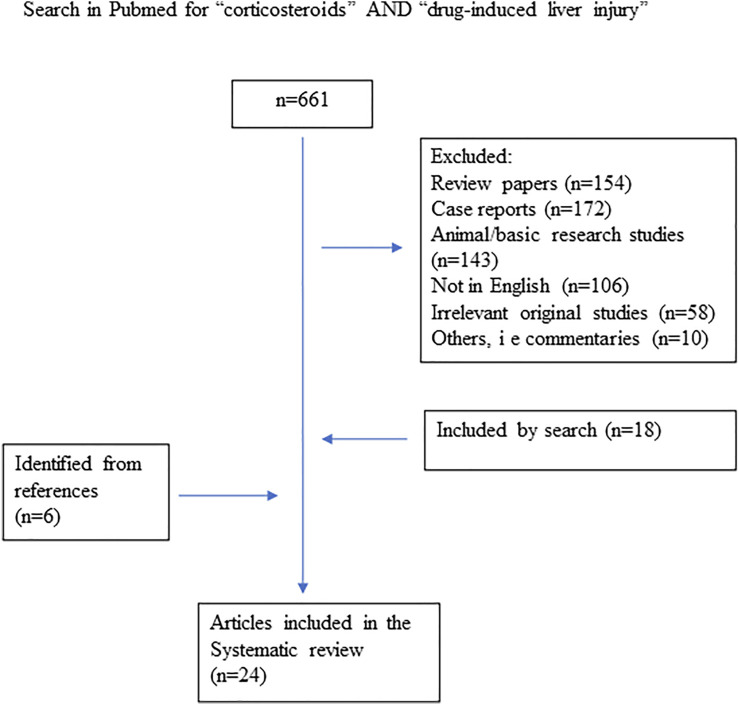
Introduction: Apart from cessation of the implicated agent leading to drug-induced liver injury (DILI), there is no standard therapy for DILI. Corticosteroids have been used in DILI, although their efficacy is unclear. Published data showed either beneficial effects or no improvement associated with steroid therapy. The aim of the current study was to perform a systematic review of the role of corticosteroids in the treatment of DILI. Methods: A search was performed in PubMed, searching for the terms: “corticosteroids” and “drug-induced liver injury”. Observation studies were included, but case reports excluded. Results: A total of 24 papers were retrieved. Most of these were observational studies on the effects of corticosteroids in moderate/severe DILI (n = 8), reports on the corticosteroid treatment in patients with drug-induced autoimmune hepatitis (DI-AIH) (n = 5), and effects of corticosteroids in drug-induced fulminant acute liver failure (ALF, n = 2). Furthermore, treatment of corticosteroids in patients with liver injury due to check point inhibitors (CPIs) was addressed in nine studies. In moderate/severe DILI, six out of eight studies suggested steroid treatment to be beneficial, whereas two studies showed negative results. All five observational studies on the effects of corticosteroids in DI-AIH showed good therapeutic response with rapid and long lasting effects after discontinuation of corticosteroids and without evidence of relapse. Steroid therapy was not associated with improved overall survival in patients with drug-induced fulminant ALF. CPIs-induced liver injury was found to improve spontaneously in 33–50% without corticosteroids, and the rate of patients who were treated responded to steroids in 33–100% (mean 72%). Conclusions: The majority of studies analyzing the effects of corticosteroids in moderate/severe DILI have demonstrated beneficial effects. However, this was not the case in drug-induced fulminant ALF. Patients with DI-AIH had an excellent response to corticosteroids. The majority of those with CPIs-induced liver injury responded to corticosteroids; however, patients without treatment usually recovered spontaneously. The observational design and comparison with historical controls in these studies makes it very difficult to draw conclusions on the efficacy of corticosteroids in DILI. Therefore, there is a strong need for a randomized controlled trial to properly assess the role of corticosteroids in DILI.
Overview
The claims and statistics of this paper haven’t been checked yet.
Run the check — free, no account needed. It reads the open-access text and checks the sources it cites.
Integrity signals
Registry
Cites
Statistics
Figures
Verification
Claims the paper makes
The claims and statistics of this paper haven’t been checked yet.
Run the check — free, no account needed. It reads the open-access text and checks the sources it cites.
Claims other papers make about this one
Each is checked against this paper’s own text: does it say what the citing paper says it does?
In the citing paper
“Data on corticosteroid use in DILI is scarce with no randomized controlled studies to evaluate their efficacy and safety; however, there are reports of corticosteroids having beneficial effects in patients with moderate or severe DILI.[18,23]”
From Drug-induced liver injury: Diagnosis, management and the role of liver transplantation (2025) · cites this paper as [23]
Self-check
Percentages, sums and reported differences re-computed from the paper’s own numbers.
The self-check needs the paper’s full text.
Citations
Cites
Brahmer, J. R., Lacchetti, C., Schneider, B. J., Atkins, M. B., Brassil, K. J., Caterino, J. M., Chau, I., Ernstoff, M. S., Gardner, J. M., Ginex, P., et al. (2018) · Journal of Clinical Oncology · doi:10.1200/jco.2017.77.6385 · Cited by 3,713
Haanen, J. B. A. G., Carbonnel, F., Robert, C., Kerr, K. M., Peters, S., Larkin, J., & Jordan, K. (2017) · Annals of Oncology · doi:10.1093/annonc/mdx225 · Cited by 2,367
Ostapowicz, G., Fontana, R. J., Schiødt, F. V., Larson, A., Davern, T. J., Han, S. H. B., McCashland, T. M., Shakil, A. O., Hay, J. E., Hynan, L., et al. (2002) · Annals of Internal Medicine · doi:10.7326/0003-4819-137-12-200212170-00007 · Cited by 2,227
on behalf of the Society for Immunotherapy of Cancer Toxicity Management Working Group, Puzanov, I., Diab, A., Abdallah, K., Bingham, C. O., Brogdon, C., Dadu, R., Hamad, L., Kim, S., Lacouture, M. E., et al. (2017) · Journal for ImmunoTherapy of Cancer · doi:10.1186/s40425-017-0300-z · Cited by 1,992
EASL Clinical Practice Guidelines: autoimmune hepatitis
(2015) · Journal of Hepatology · doi:10.1016/j.jhep.2015.06.030 · Cited by 1,245
Drug-Induced Acute Liver Failure: Results of a U.S. Multicenter, Prospective Study
Reuben, A., Koch, D. G., & Lee, W. M. (2010) · Hepatology · doi:10.1002/hep.23937 · Cited by 772
Chalasani, N., Fontana, R. J., Bonkovsky, H. L., Watkins, P. B., Davern, T., Serrano, J., Yang, H., & Rochon, J. (2008) · Gastroenterology · doi:10.1053/j.gastro.2008.09.011 · Cited by 755
Drug-induced liver injury—types and phenotypes
Hoofnagle, J. H., & Björnsson, E. S. (2019) · New England Journal of Medicine · doi:10.1056/nejmra1816149 · Cited by 652
Characterization of liver injury induced by cancer immunotherapy using immune checkpoint inhibitors
De Martin, E., Michot, J.-M., Papouin, B., Champiat, S., Mateus, C., Lambotte, O., Roche, B., Antonini, T. M., Coilly, A., Laghouati, S., et al. (2018) · Journal of Hepatology · doi:10.1016/j.jhep.2018.01.033 · Cited by 520
Faje, A. T., Lawrence, D., Flaherty, K., Freedman, C., Fadden, R., Rubin, K., Cohen, J., & Sullivan, R. J. (2018) · Cancer · doi:10.1002/cncr.31629 · Cited by 486
Cited by
Andrade, R. J., Aithal, G. P., de Boer, Y. S., Liberal, R., Gerbes, A., Regev, A., Terziroli Beretta-Piccoli, B., Schramm, C., Kleiner, D. E., De Martin, E., et al. (2023) · Journal of Hepatology · doi:10.1016/j.jhep.2023.04.033 · Cited by 166
Self-citationBjörnsson, E. S., Stephens, C., Atallah, E., Robles‐Diaz, M., Alvarez‐Alvarez, I., Gerbes, A., Weber, S., Stirnimann, G., Kullak‐Ublick, G., Cortez‐Pinto, H., et al. (2023) · Liver International · doi:10.1111/liv.15378 · Cited by 69
Self-citationDrug-induced liver injury: Diagnosis, management and the role of liver transplantation
Ozturk, N. B., Uskudar, E., Toruner, M. D., Simsek, C., & Gurakar, A. (2025) · Hepatology Forum · doi:10.14744/hf.2024.2024.0003 · Cited by 9
The contemporary epidemiology, causes, and management of drug-induced liver injury
Swanson, L., & Fontana, R. J. (2026) · Hepatology Communications · doi:10.1097/hc9.0000000000001011
Metadata
- Authors
- Björnsson, E. S., Vucic, V., Stirnimann, G., & Robles-Díaz, M.
- Venue
- Frontiers in Pharmacology
- Publisher
- Frontiers Media SA
- Published
- 2022-02-10
- Volume
- 13
- ISSN
- 1663-9812
- PMC
- PMC8867035
- Cited by
- 62
- References
- 49
About these checks
Registry, retraction, Cites and statistics results are computed, not judged, with one exception: a printed reference that no index lists is read once by a model before it counts as a citation error. Claims are extracted by a model and kept only when their quote appears verbatim in the text; each cited source is then checked, with a model’s help, for whether it says what the claim relies on. Those verdicts can be wrong — read the claim’s quote and the cited source before relying on one.
Statistics and arithmetic are recomputed, not judged.
Confidence bands are shown only for fields calibrated on our annotated test set. None is calibrated yet, so no band is shown.
What counts as a claim ›How we measure confidence ›How we check this ›
Are you an author, or do you see a problem with this page? Request a review
How to cite
Cite CoChat for the checks on this page, and the paper for its own findings.
- This page
- CoChat. (2026). Citation check: Role of Corticosteroids in Drug-Induced Liver Injury. A Systematic Review. https://app.cochat.ai/papers/10.3389/fphar.2022.820724
- The paper
- Björnsson, E. S., Vucic, V., Stirnimann, G., & Robles-Díaz, M. (2022). Role of Corticosteroids in Drug-Induced Liver Injury. A Systematic Review. Frontiers in Pharmacology. https://doi.org/10.3389/fphar.2022.820724
Data sources
Bibliographic data: Semantic Scholar, OpenAlex, Crossref.
Contains information from the Semantic Scholar Academic Graph Datasets, made available under the ODC Attribution License (ODC-BY 1.0).
Semantic Scholar’s data is described in: Kinney, R., et al. (2023). The Semantic Scholar Open Data Platform. arXiv:2301.10140.
