

The DOI matches its Crossref record; 63 of the 64 references it cites were found in a registry or an index.
The metal hyperaccumulators from New Caledonia can broaden our understanding of nickel accumulation in plants
Open accessAbstract
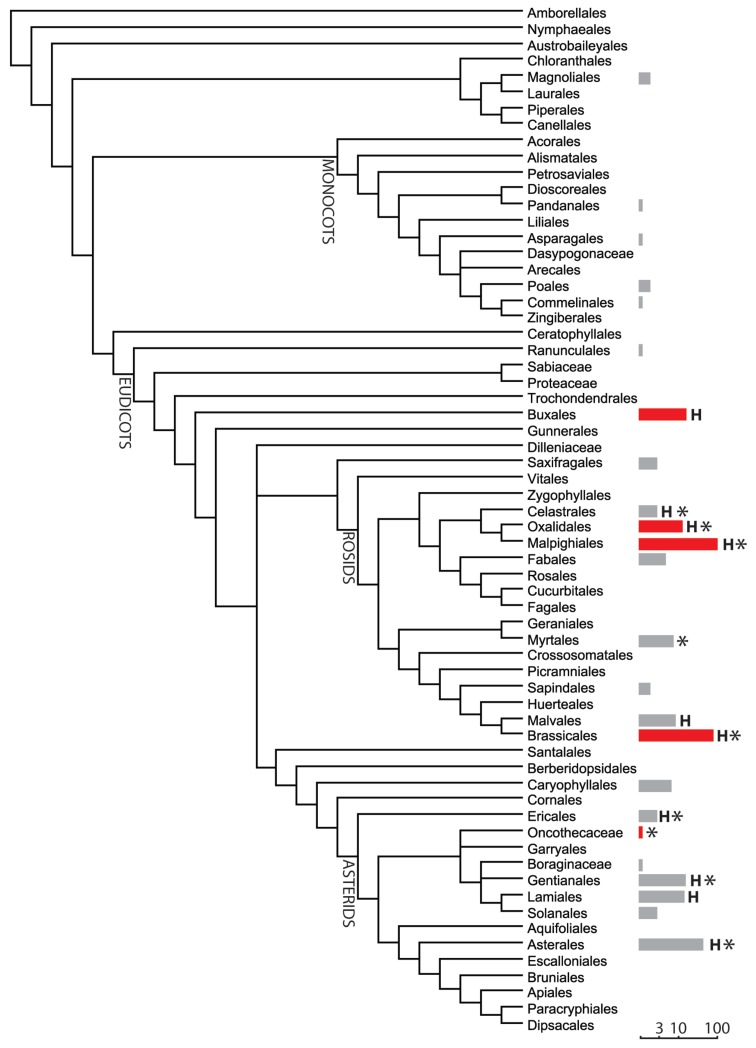
While an excess of metals such as zinc, cadmium or nickel (Ni) is toxic for most plants, about 500 plant species called hyperaccumulators are able to accumulate high amounts of these metals. These plants and the underlying mechanisms are receiving an increasing interest because of their potential use in sustainable biotechnologies such as biofortification, phytoremediation, and phytomining. Among hyperaccumulators, about 400 species scattered in 40 families accumulate Ni. Despite this wide diversity, our current knowledge of the mechanisms involved in Ni accumulation is still limited and mostly restricted to temperate herbaceous Brassicaceae. New Caledonia is an archipelago of the tropical southwest pacific with a third of its surface (5500 km(2)) covered by Ni-rich soils originating from ultramafic rocks. The rich New Caledonia flora contains 2145 species adapted to these soils, among which 65 are Ni hyperaccumulators, including lianas, shrubs or trees, mostly belonging to the orders Celastrales, Oxalidales, Malpighiales, and Gentianales. We present here our current knowledge on Ni hyperaccumulators from New Caledonia and the latest molecular studies developed to better understand the mechanisms of Ni accumulation in these plants.
Overview
The claims and statistics of this paper haven’t been checked yet.
Run the check — free, no account needed. It reads the open-access text and checks the sources it cites.
Integrity signals
Registry
Cites
Statistics
Figures
Verification
Claims the paper makes
The claims and statistics of this paper haven’t been checked yet.
Run the check — free, no account needed. It reads the open-access text and checks the sources it cites.
Claims other papers make about this one
Each is checked against this paper’s own text: does it say what the citing paper says it does?
The source backs part of the claim, not all of it — or backs it for a different population, condition or comparison.
In the citing paper
“Angiosperms predominantly accumulate Ni, as evident in the reports of 140 species grown on the islands of New Caledonia and Cuba (Whiting et al., 2004; Jaffré et al., 2013).”
From Plant hyperaccumulators: a state-of-the-art review on mechanism of heavy metal transport and sequestration (2025) · cites this paper as Jaffré et al., 2013
Experimental — accuracy not yet measured
Self-check
Percentages, sums and reported differences re-computed from the paper’s own numbers.
The self-check needs the paper’s full text.
Citations
Cites
Biodiversity hotspots for conservation priorities
Myers, N., Mittermeier, R. A., Mittermeier, C. G., da Fonseca, G. A. B., & Kent, J. (2000) · Nature · doi:10.1038/35002501 · Cited by 31,710
Two new Later Stone Age sites from the Final Pleistocene in the Falémé Valley, eastern Senegal
Ndiaye, M., Lespez, L., Tribolo, C., Rassé, M., Hadjas, I., Davidoux, S., Huysecom, É., & Douze, K. (2024) · Monash University Research Portal (Monash University) · doi:10.3929/ethz-b-000667478 · Cited by 24,214
Induced root-secreted phenolic compounds as a belowground plant defense
Lanoue, A., Burlat, V., Schurr, U., & Röse, U. S. R. (2010) · Plant Signaling & Behavior · doi:10.4161/psb.5.8.12337 · Cited by 5,462
Baker, A. J. M., & Brooks, R. R. (1989) · Cited by 2,213
Heavy metal hyperaccumulating plants: how and why do they do it? And what makes them so interesting
Rascio, N., & Navari-Izzo, F. (2011) · Plant Science · doi:10.1016/j.plantsci.2010.08.016 · Cited by 2,012
Hyperaccumulators of metal and metalloid trace elements: Facts and fiction
van der Ent, A., Baker, A. J. M., Reeves, R. D., Pollard, A. J., & Schat, H. (2012) · Plant and Soil · doi:10.1007/s11104-012-1287-3 · Cited by 1,463
Metal hyperaccumulation in plants
Krämer, U. (2010) · Annual Review of Plant Biology · doi:10.1146/annurev-arplant-042809-112156 · Cited by 1,284
Molecular mechanisms of metal hyperaccumulation in plants
Verbruggen, N., Hermans, C., & Schat, H. (2009) · New Phytologist · doi:10.1111/j.1469-8137.2008.02748.x · Cited by 1,128
Free histidine as a metal chelator in plants that accumulate nickel
Krämer, U., Cotter-Howells, J. D., Charnock, J., Baker, A. J. M., & Smith, J. A. C. (1996) · Nature · doi:10.1038/379635a0 · Cited by 963
Detection of nickeliferous rocks by analysis of herbarium specimens of indicator plants
Brooks, R. R., Lee, J., Reeves, R. D., & Jaffré, T. (1977) · Journal of Geochemical Exploration · doi:10.1016/0375-6742(77)90074-7 · Cited by 896
Self-citation
Cited by
Sorted by citations
Remediation techniques for heavy metal-contaminated soils: principles and applicability
Liu, L., Li, W., Song, W., & Guo, M. (2018) · Science of The Total Environment · doi:10.1016/j.scitotenv.2018.03.161 · Cited by 1,828
Nickel: Human Health and Environmental Toxicology
Genchi, G., Carocci, A., Lauria, G., Sinicropi, M. S., & Catalano, A. (2020) · International Journal of Environmental Research and Public Health · doi:10.3390/ijerph17030679 · Cited by 1,602
A global database for plants that hyperaccumulate metal and metalloid trace elements
Reeves, R. D., Baker, A. J. M., Jaffré, T., Erskine, P. D., Echevarria, G., & van der Ent, A. (2018) · New Phytologist · doi:10.1111/nph.14907 · Cited by 769
Self-citationPhytoremediation of heavy metals assisted by plant growth promoting (PGP) bacteria: A review
Ullah, A., Heng, S., Munis, M. F. H., Fahad, S., & Yang, X. (2015) · Environmental and Experimental Botany · doi:10.1016/j.envexpbot.2015.05.001 · Cited by 714
Trace metal metabolism in plants
Andresen, E., Peiter, E., & Küpper, H. (2018) · Journal of Experimental Botany · doi:10.1093/jxb/erx465 · Cited by 431
Metadata
- Authors
- Jaffré, T., Pillon, Y., Thomine, S., & Merlot, S.
- Affiliations
- Institut de Recherche pour le Développement (NC)
- University of Hawaii at Hilo (US)
- Centre National de la Recherche Scientifique (FR)
- Corresponding author
- Merlot, Sylvain
- Venue
- Frontiers in Plant Science
- Publisher
- Frontiers Media SA
- Published
- 2013
- Volume
- 4
- Pages
- 279-279
- ISSN
- 1664-462X (ISSN-L)
- PMC
- PMC3724167
- OpenAlex
- W2070221591
- Cited by
- 146
- References
- 64
- Citations by year
- 2026: 4 · 2025: 6 · 2024: 12 · 2023: 8 · 2022: 13 · 2021: 13 · 2020: 21 · 2019: 12 · 2018: 16 · 2017: 16 · 2016: 7 · 2015: 8 · 2014: 9 · 2013: 1
- FWCI
- 6.53
- Type
- journal article
- Language
- en
- Open access
- gold
- doi.org
- Licence
- cc-by
- Locations
- Frontiers in Plant Science (publishedVersion, cc-by)
- Europe PMC (PubMed Central) (publishedVersion, cc-by)
- PubMed Central (publishedVersion, cc-by)
- PubMed (publishedVersion)
- HAL (submittedVersion, other-oa)
- DOAJ (DOAJ: Directory of Open Access Journals) (submittedVersion, cc-by-sa)
- Funders
- Centre National de la Recherche Scientifique
- Topics
- Physical Sciences › Environmental Science › Pollution › Heavy metals in environment
- Physical Sciences › Chemistry › Analytical Chemistry › Heavy Metals in Plants
- Life Sciences › Agricultural and Biological Sciences › Plant Science › Plant Micronutrient Interactions and Effects
- Keywords
- nickel hyperaccumulator, New Caledonia flora, ultramafic soils, phytoremediation, phytomining, biofortification, Celastrales, Oxalidales, Malpighiales, Gentianales
About these checks
Registry, retraction, Cites and statistics results are computed, not judged, with one exception: a printed reference that no index lists is read once by a model before it counts as a citation error. Claims are extracted by a model and kept only when their quote appears verbatim in the text; each cited source is then checked, with a model’s help, for whether it says what the claim relies on. Those verdicts can be wrong — read the claim’s quote and the cited source before relying on one.
Statistics and arithmetic are recomputed, not judged.
Confidence bands are shown only for fields calibrated on our annotated test set. None is calibrated yet, so no band is shown.
What counts as a claim ›How we measure confidence ›How we check this ›
Are you an author, or do you see a problem with this page? Request a review
