

The DOI matches its Crossref record; 364 of the 364 references it cites were found in a registry or an index.
Multidimensional Role of Silicon to Activate Resilient Plant Growth and to Mitigate Abiotic Stress
Open accessAbstract
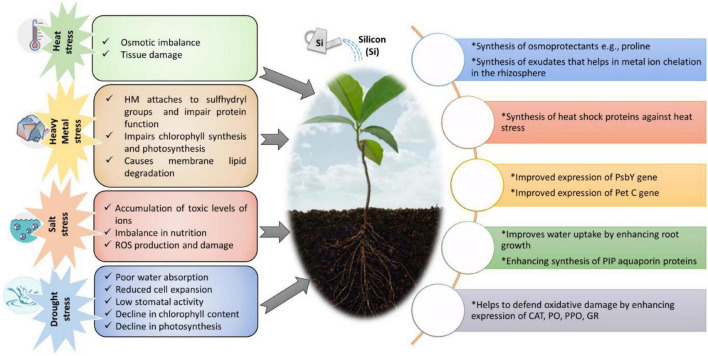
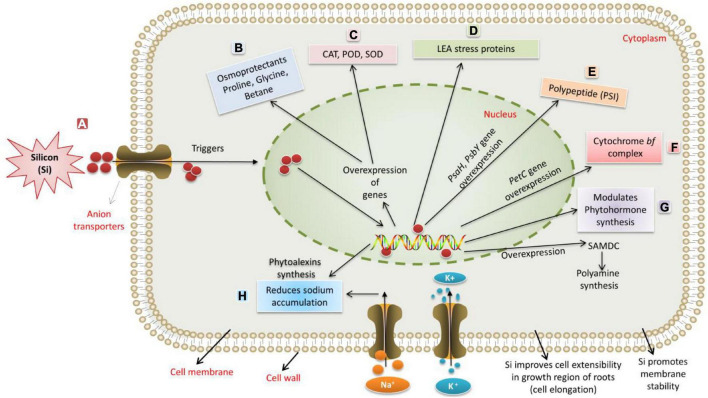
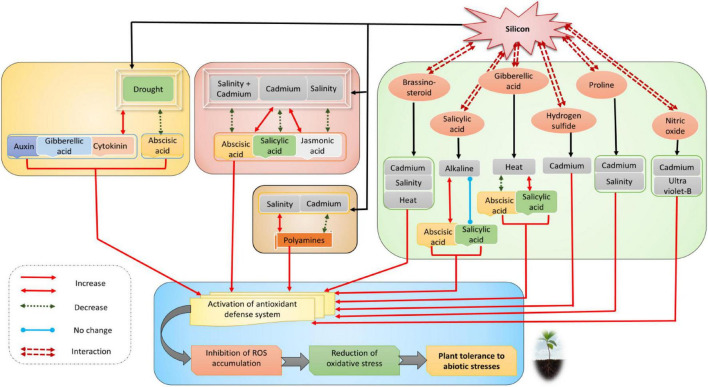
Sustainable agricultural production is critically antagonistic by fluctuating unfavorable environmental conditions. The introduction of mineral elements emerged as the most exciting and magical aspect, apart from the novel intervention of traditional and applied strategies to defend the abiotic stress conditions. The silicon (Si) has ameliorating impacts by regulating diverse functionalities on enhancing the growth and development of crop plants. Si is categorized as a non-essential element since crop plants accumulate less during normal environmental conditions. Studies on the application of Si in plants highlight the beneficial role of Si during extreme stressful conditions through modulation of several metabolites during abiotic stress conditions. Phytohormones are primary plant metabolites positively regulated by Si during abiotic stress conditions. Phytohormones play a pivotal role in crop plants' broad-spectrum biochemical and physiological aspects during normal and extreme environmental conditions. Frontline phytohormones include auxin, cytokinin, ethylene, gibberellin, salicylic acid, abscisic acid, brassinosteroids, and jasmonic acid. These phytohormones are internally correlated with Si in regulating abiotic stress tolerance mechanisms. This review explores insights into the role of Si in enhancing the phytohormone metabolism and its role in maintaining the physiological and biochemical well-being of crop plants during diverse abiotic stresses. Moreover, in-depth information about Si's pivotal role in inducing abiotic stress tolerance in crop plants through metabolic and molecular modulations is elaborated. Furthermore, the potential of various high throughput technologies has also been discussed in improving Si-induced multiple stress tolerance. In addition, a special emphasis is engrossed in the role of Si in achieving sustainable agricultural growth and global food security.
Overview
The claims and statistics of this paper haven’t been checked yet.
Run the check — free, no account needed. It reads the open-access text and checks the sources it cites.
Integrity signals
Registry
Cites
Statistics
Figures
Verification
Claims the paper makes
The claims and statistics of this paper haven’t been checked yet.
Run the check — free, no account needed. It reads the open-access text and checks the sources it cites.
Claims other papers make about this one
Each is checked against this paper’s own text: does it say what the citing paper says it does?
The check wasn’t confident either way, so it gives no verdict — never disputed.
In the citing paper
“The hyperaccumulation of metal ions is a potential defense against attacks by pathogens or herbivores (Dueli et al., 2021; Mushtaq et al., 2021a; Mir et al., 2022).”
From Plant hyperaccumulators: a state-of-the-art review on mechanism of heavy metal transport and sequestration (2025) · cites this paper as Mir et al., 2022
Experimental — accuracy not yet measured
Self-check
Percentages, sums and reported differences re-computed from the paper’s own numbers.
The self-check needs the paper’s full text.
Citations
Cites
3 retracted
Ahmad, A. H., Aslam, Z., Naz, M., et al. (2021) · PLoS ONE · doi:10.1371/journal.pone.0260556 · Cited by 94
RetractedPhytoremediation of nickel by quinoa: Morphological and physiological response
Haseeb, M. A., Iqbal, S., Hafeez, M. B., Saddiq, M. S., Zahra, N., Raza, A., lbrahim, M. U., Iqbal, J., Kamran, M. A., Ali, Q., et al. (2022) · PLoS ONE · doi:10.1371/journal.pone.0262309 · Cited by 32
Self-citationRetractedDas, P., Manna, I., Sil, P., et al. (2021) · Plant Physiology and Biochemistry · doi:10.1016/j.plaphy.2021.05.030 · Cited by 28
RetractedReactive oxygen species and antioxidant machinery in abiotic stress tolerance in crop plants
Gill, S. S., & Tuteja, N. (2010) · Plant Physiology and Biochemistry · doi:10.1016/j.plaphy.2010.08.016 · Cited by 11,734
Abiotic Stress Signaling and Responses in Plants
Zhu, J. (2016) · Cell · doi:10.1016/j.cell.2016.08.029 · Cited by 5,837
P LANT C ELLULAR AND M OLECULAR R ESPONSES TO H IGH S ALINITY
Hasegawa, P. M., Bressan, R. A., Zhu, J., & Bohnert, H. J. (2000) · Annual Review of Plant Physiology and Plant Molecular Biology · doi:10.1146/annurev.arplant.51.1.463 · Cited by 4,596
Hasanuzzaman, M., Bhuyan, M. H. M. B., Zulfiqar, F., Raza, A., Mohsin, S. M., Mahmud, J. A., Fujita, M., & Fotopoulos, V. (2020) · Antioxidants · doi:10.3390/antiox9080681 · Cited by 3,314
Self-citationHormonal Modulation of Plant Immunity
Pieterse, C. M. J., van der Does, D., Zamioudis, C., León-Reyes, A., & Wees, S. C. M. V. (2011) · Annual Review of Cell and Developmental Biology · doi:10.1146/annurev-cellbio-092910-154055 · Cited by 3,128
Liu, Q., Kasuga, M., Sakuma, Y., Abe, H., Miura, S., Yamaguchi-Shinozaki, K., & Shinozaki, K. (1998) · The Plant Cell · doi:10.1105/tpc.10.8.1391 · Cited by 3,044
Plant hormone-mediated regulation of stress responses
Verma, V. C., Ravindran, P., & Kumar, P. P. (2016) · BMC Plant Biology · doi:10.1186/s12870-016-0771-y · Cited by 2,178
Research works printed but not linked: 5
- da Silva, 2008, Revealing response of plants to biotic and abiotic stresses with microarray technology., Genes Genomes Genomics, 2, 14
- Nosrati, 2014, The role of silicon to increase salt tolerance in red and white varieties of bean (Phaseolus vulgaris L.)., J. Plant Sci. Res., 30
- Sierra, 2021, How management practices affect silicon uptake by Hordeum vulgare grown in a highly calcareous soil., Soil Use Manage., 2021
- Zargar, 2013, Impact of silicon on various agro-morphological and physiological parameters in maize and revealing its role in enhancing water stress tolerance., Emirates J. Food Agricult., 2013, 138
- Zia, 2021, Biochemical responses of wheat to silicon application under salinity., J. Plant Nutrit. Soil Sci., 184, 255, 10.1016/j.plaphy.2021.02.023 · DOI
Cited by
Sorted by citations
Bhat, B. A., Rather, M. A., Bilal, T., Nazir, R., Qadir, R. U., & Mir, R. A. (2025) · Frontiers in Plant Science · doi:10.3389/fpls.2025.1631378 · Cited by 68
Self-citationTranscription factors-golden keys to modulate the plant metabolism to develop salinity tolerance
Bhat, B. A., Mir, R. A., Mir, W. R., Hamdani, S. S., & Mir, M. A. (2024) · Plant Stress · doi:10.1016/j.stress.2024.100409 · Cited by 47
Self-citation
Metadata
- Authors
- Mir, R. A., Bhat, B. A., Yousuf, H., Islam, S. T., Raza, A., Rizvi, M. A., Charagh, S., Albaqami, M., Sofi, P. A., & Zargar, S. M.
- Affiliations
- Central University of Kashmir (IN)
- University of Kashmir (IN)
- Baba Ghulam Shah Badshah University (IN)
- Fujian Agriculture and Forestry University (CN)
- China National Rice Research Institute (CN)
- Umm al-Qura University (SA)
- Sher-e-Kashmir University of Agricultural Sciences and Technology of Kashmir (IN)
- Corresponding author
- Mir, Rakeeb Ahmad
- Raza, Ali
- Zargar, Sajad Majeed
- ORCID
- Venue
- Frontiers in Plant Science
- Publisher
- Frontiers Media SA
- Published
- 2022-03-23
- Volume
- 13
- Pages
- 819658-819658
- ISSN
- 1664-462X (ISSN-L)
- PMC
- PMC8984490
- OpenAlex
- W4220710366
- Cited by
- 178
- References
- 364
- Citations by year
- 2026: 35 · 2025: 43 · 2024: 52 · 2023: 25 · 2022: 23
- FWCI
- 3.28
- Type
- journal article
- Language
- en
- Open access
- gold
- doi.org
- Licence
- Locations
- Frontiers in Plant Science (publishedVersion, cc-by)
- PubMed Central (publishedVersion, cc-by)
- PubMed (publishedVersion)
- DOAJ (DOAJ: Directory of Open Access Journals) (submittedVersion)
- Funders
- Ministry of Environment
- Ministry of Environment, Forest and Climate Change
- Topics
- Life Sciences › Agricultural and Biological Sciences › Plant Science › Silicon Effects in Agriculture
- Life Sciences › Agricultural and Biological Sciences › Plant Science › Plant Stress Responses and Tolerance
- Life Sciences › Agricultural and Biological Sciences › Plant Science › Plant-Microbe Interactions and Immunity
- Keywords
- silicon, abiotic stress tolerance, phytohormone metabolism, plant growth, cultivated plants, auxin, cytokinins, ethylene, gibberellin, abscisic acid, brassinosteroids, jasmonic acid, salicylic acid, stress tolerance mechanisms, high-throughput screening, sustainable agriculture, food security
About these checks
Registry, retraction, Cites and statistics results are computed, not judged, with one exception: a printed reference that no index lists is read once by a model before it counts as a citation error. Claims are extracted by a model and kept only when their quote appears verbatim in the text; each cited source is then checked, with a model’s help, for whether it says what the claim relies on. Those verdicts can be wrong — read the claim’s quote and the cited source before relying on one.
Statistics and arithmetic are recomputed, not judged.
Confidence bands are shown only for fields calibrated on our annotated test set. None is calibrated yet, so no band is shown.
What counts as a claim ›How we measure confidence ›How we check this ›
Are you an author, or do you see a problem with this page? Request a review
