

The DOI matches its Crossref record; 60 of the 60 references it cites were found in a registry or an index.
Inner experience in the scanner: can high fidelity apprehensions of inner experience be integrated with fMRI?
Abstract
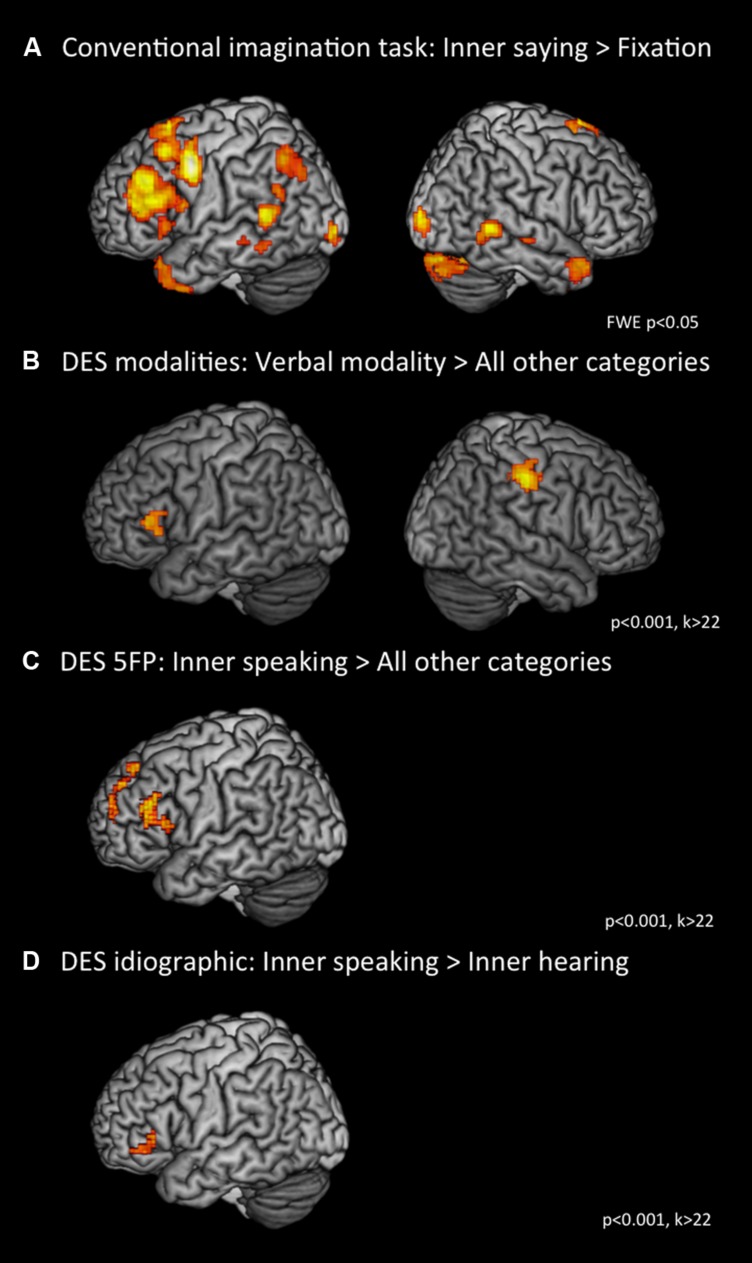
To provide full accounts of human experience and behavior, research in cognitive neuroscience must be linked to inner experience, but introspective reports of inner experience have often been found to be unreliable. The present case study aimed at providing proof of principle that introspection using one method, descriptive experience sampling (DES), can be reliably integrated with fMRI. A participant was trained in the DES method, followed by nine sessions of sampling within an MRI scanner. During moments where the DES interview revealed ongoing inner speaking, fMRI data reliably showed activation in classic speech processing areas including left inferior frontal gyrus. Further, the fMRI data validated the participant's DES observations of the experiential distinction between inner speaking and innerly hearing her own voice. These results highlight the precision and validity of the DES method as a technique of exploring inner experience and the utility of combining such methods with fMRI.
Overview
The claims and statistics of this paper haven’t been checked yet.
Run the check — free, no account needed. It reads the open-access text and checks the sources it cites.
Integrity signals
Registry
Cites
Statistics
Figures
Verification
Claims the paper makes
The claims and statistics of this paper haven’t been checked yet.
Run the check — free, no account needed. It reads the open-access text and checks the sources it cites.
Claims other papers make about this one
Each is checked against this paper’s own text: does it say what the citing paper says it does?
The cited source says what the claim attributes to it.
In the citing paper
“Reporting on a case study of one participant who self-described as regularly experiencing inner speech, Kühn et al. observed consistent activation of left inferior frontal gyrus for beeps associated with verbal thinking in general, and inner speech in particular.”
From Inner Speech: Development, Cognitive Functions, Phenomenology, and Neurobiology (2015) · cites this paper as Kühn, Hurlburt, Alderson-Day, & Fernyhough, 2014
Self-check
Percentages, sums and reported differences re-computed from the paper’s own numbers.
The self-check needs the paper’s full text.
Citations
Cites
Telling more than we can know: Verbal reports on mental processes.
Nisbett, R. E., & Wilson, T. D. (1977) · Psychological Review · doi:10.1037/0033-295x.84.3.231 · Cited by 11,317
The Brain's Default Network: Anatomy, Function, and Relevance to Disease
Buckner, R. L., Andrews‐Hanna, J. R., & Schacter, D. L. (2008) · Annals of the New York Academy of Sciences · doi:10.1196/annals.1440.011 · Cited by 9,761
Wandering minds: the default network and stimulus-independent thought
Mason, M. F., Norton, M. I., Van Horn, J. D., Wegner, D. M., Grafton, S. T., & Macrae, C. N. (2007) · Science · doi:10.1126/science.1131295 · Cited by 2,792
A wandering mind is an unhappy mind
Killingsworth, M. A., & Gilbert, D. T. (2010) · Science · doi:10.1126/science.1192439 · Cited by 2,575
Resting-State Functional Connectivity Reflects Structural Connectivity in the Default Mode Network
Greicius, M. D., Supekar, K., Menon, V., & Dougherty, R. F. (2009) · Cerebral Cortex · doi:10.1093/cercor/bhn059 · Cited by 2,175
A default mode of brain function: a brief history of an evolving idea
Raichle, M. E., & Snyder, A. Z. (2007) · NeuroImage · doi:10.1016/j.neuroimage.2007.02.041 · Cited by 2,173
Price, C. J. (2012) · NeuroImage · doi:10.1016/j.neuroimage.2012.04.062 · Cited by 2,159
Structure, Agency and the Internal Conversation
Archer, M. (2003) · Cambridge University Press eBooks · doi:10.1017/cbo9781139087315 · Cited by 1,938
The cognitive neuropsychology of schizophrenia
(1993) · Choice Reviews Online · doi:10.5860/choice.31-0601 · Cited by 1,901
Common blood flow changes across visual tasks: II. Decreases in cerebral cortex
Shulman, G. L., Fiez, J. A., Corbetta, M., Buckner, R. L., Miezin, F. M., Raichle, M. E., & Petersen, S. E. (1997) · Journal of Cognitive Neuroscience · doi:10.1162/jocn.1997.9.5.648 · Cited by 1,890
Research works printed but not linked: 3
- Hurlburt, 2009, Sensory awareness., J. Conscious. Stud., 16, 231
- Singer, 1966, Daydreaming.
- Ward, 2000, Simultaneous Inference for FMRI Data. Afni Alphasim Documentation.
Cited by
Inner Speech: Development, Cognitive Functions, Phenomenology, and Neurobiology
Alderson-Day, B., & Fernyhough, C. (2015) · Psychological Bulletin · doi:10.1037/bul0000021 · Cited by 864
Self-citationImagined speech can be decoded from low- and cross-frequency intracranial EEG features
Proix, T., Delgado Saa, J., Christen, A., Martin, S., Pasley, B. N., Knight, R. T., Tian, X., Poeppel, D., Doyle, W. K., Devinsky, O., et al. (2022) · Nature Communications · doi:10.1038/s41467-021-27725-3 · Cited by 212
Hurlburt, R. T., Alderson-Day, B., Kühn, S., & Fernyhough, C. (2016) · PLOS ONE · doi:10.1371/journal.pone.0147932 · Cited by 131
“It seems plausible that such disparate phenomena could have distinctly different neural correlates [7]: whereas inner speech production is often associated with activation of left inferior frontal gyrus (IFG) [2, 8], “hearing” experiences may be expected to engage temporal lobe regions associated with auditory imagery…”
BackgroundSelf-citationInner speech as language process and cognitive tool
Fernyhough, C., & Borghi, A. M. (2023) · Trends in Cognitive Sciences · doi:10.1016/j.tics.2023.08.014 · Cited by 101
“Within the category of IS is a further important distinction between inner speaking (where the subjective experience is of producing an utterance in IS, analogous to speaking into an audio recorder [9,10]) and inner hearing (where the experience is of perceiving an utterance that has been innerly spoken, such as in li…”
BackgroundSelf-citationDickens, Y. L., Van Raalte, J., & Hurlburt, R. T. (2018) · The Sport Psychologist · doi:10.1123/tsp.2016-0073 · Cited by 47
Self-citation
Metadata
- Authors
- Kühn, S., Fernyhough, C., Alderson-Day, B., & Hurlburt, R. T.
- Venue
- Frontiers in Psychology
- Publisher
- Frontiers Media SA
- Published
- 2014-12-09
- Volume
- 5
- ISSN
- 1664-1078
- PMC
- PMC4260673
- Cited by
- 27
- References
- 60
About these checks
Registry, retraction, Cites and statistics results are computed, not judged, with one exception: a printed reference that no index lists is read once by a model before it counts as a citation error. Claims are extracted by a model and kept only when their quote appears verbatim in the text; each cited source is then checked, with a model’s help, for whether it says what the claim relies on. Those verdicts can be wrong — read the claim’s quote and the cited source before relying on one.
Statistics and arithmetic are recomputed, not judged.
Confidence bands are shown only for fields calibrated on our annotated test set. None is calibrated yet, so no band is shown.
What counts as a claim ›How we measure confidence ›How we check this ›
Are you an author, or do you see a problem with this page? Request a review
How to cite
Cite CoChat for the checks on this page, and the paper for its own findings.
- This page
- CoChat. (2026). Citation check: Inner experience in the scanner: can high fidelity apprehensions of inner experience be integrated with fMRI? https://app.cochat.ai/papers/10.3389/fpsyg.2014.01393
- The paper
- Kühn, S., Fernyhough, C., Alderson-Day, B., & Hurlburt, R. T. (2014). Inner experience in the scanner: can high fidelity apprehensions of inner experience be integrated with fMRI? Frontiers in Psychology. https://doi.org/10.3389/fpsyg.2014.01393
Data sources
Bibliographic data: Semantic Scholar, OpenAlex, Crossref.
Contains information from the Semantic Scholar Academic Graph Datasets, made available under the ODC Attribution License (ODC-BY 1.0).
Semantic Scholar’s data is described in: Kinney, R., et al. (2023). The Semantic Scholar Open Data Platform. arXiv:2301.10140.
