

The DOI matches its Crossref record; 49 of the 49 references it cites were found in a registry or an index.
Bifactor analysis and construct validity of the five facet mindfulness questionnaire (FFMQ) in non-clinical Spanish samples
Open accessAbstract
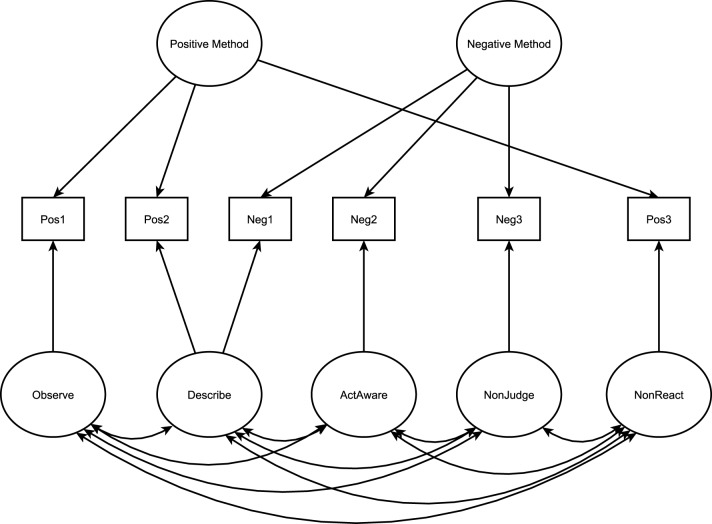
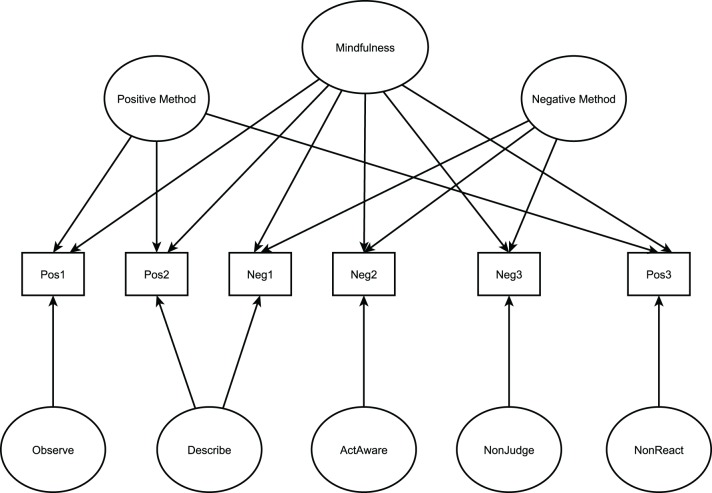
The objective of the present study was to examine the dimensionality, reliability, and construct validity of the Five Facet Mindfulness Questionnaire (FFMQ) in three Spanish samples using structural equation modeling (SEM). Pooling the FFMQ data from 3 Spanish samples (n = 1191), we estimated the fit of two competing models (correlated five-factor vs. bifactor) via confirmatory factor analysis. The factorial invariance of the best fitting model across meditative practice was also addressed. The pattern of relationships between the FFMQ latent dimensions and anxiety, depression, and distress was analyzed using SEM. FFMQ reliability was examined by computing the omega and omega hierarchical coefficients. The bifactor model, which accounted for the covariance among FFMQ items with regard to one general factor (mindfulness) and five orthogonal factors (observing, describing, acting with awareness, non-judgment, and non-reactivity), fit the FFMQ structure better than the correlated five-factor model. The relationships between the latent variables and their manifest indicators were not invariant across the meditative experience. Observing items had significant loadings on the general mindfulness factor, but only in the meditator sub-sample. The SEM analysis revealed significant links between mindfulness and symptoms of depression and stress. When the general factor was partialled out, the acting with awareness facet did not show adequate reliability. The FFMQ shows a robust bifactor structure among Spanish individuals. Nevertheless, the Observing subscale does not seem to be adequate for assessing mindfulness in individuals without meditative experience.
Overview
The claims and statistics of this paper haven’t been checked yet.
Run the check — free, no account needed. It reads the open-access text and checks the sources it cites.
Integrity signals
Registry
Cites
Statistics
Figures
Verification
Claims the paper makes
The claims and statistics of this paper haven’t been checked yet.
Run the check — free, no account needed. It reads the open-access text and checks the sources it cites.
Claims other papers make about this one
Each is checked against this paper’s own text: does it say what the citing paper says it does?
The cited source says what the claim attributes to it.
In the citing paper
“The FFMQ has shown measurement non-invariance in the form of scalar non-invariance (different intercepts) between clinical and non-clinical samples [28] and metric non-invariance (different loadings) between meditators and non-meditators [29].”
In the citing paper
“For instance, it has been demonstrated that the FFMQ “acting with awareness” subscale did not show adequate reliability and that the “observing” subscale does not seem to be adequate for assessing mindfulness in individuals without meditative practice (Aguado et al., 2015).”
From Efficacy of 8- and 4-Session Mindfulness-Based Interventions in a Non-clinical Population: A Controlled Study (2017) · cites this paper as Aguado et al., 2015
Self-check
Percentages, sums and reported differences re-computed from the paper’s own numbers.
The self-check needs the paper’s full text.
Citations
Cites
Lovibond, P. F., & Lovibond, S. H. (1995) · Behaviour Research and Therapy · doi:10.1016/0005-7967(94)00075-u · Cited by 14,523
Sensitivity of Goodness of Fit Indexes to Lack of Measurement Invariance
Chen, F. F. (2007) · Structural Equation Modeling: A Multidisciplinary Journal · doi:10.1080/10705510701301834 · Cited by 12,217
Schermelleh-Engel, K., Moosbrugger, H., & Müller, H. (2003) · Department of Psychology - University of Koblenz-Landau · doi:10.23668/psycharchives.12784 · Cited by 8,975
Using Self-Report Assessment Methods to Explore Facets of Mindfulness
Baer, R. A., Smith, G. T., Hopkins, J., Krietemeyer, J., & Toney, L. (2006) · Assessment · doi:10.1177/1073191105283504 · Cited by 7,511 · cited 7×
“…i Sant Pau, Barcelona, Spain, 6Centre for Biomedical Research in Mental Health, Madrid, Spain, 7Department of Psychiatry, Aragon Institute of Health Sciences (I+CS), Miguel Servet Hospital, Zaragoza, Spain The objective of the present study was to examine the dimensionality, reliability,…”
BackgroundMethodInfluential(1993) · Cited by 7,136
Cognitive-Behavioral Treatment of Borderline Personality Disorder
Cary, G. L. (1994) · American Journal of Psychotherapy · doi:10.1176/appi.psychotherapy.1994.48.1.155 · Cited by 6,299
Henry, J. D., & Crawford, J. R. (2005) · British Journal of Clinical Psychology · doi:10.1348/014466505x29657 · Cited by 5,801
Tripartite model of anxiety and depression: psychometric evidence and taxonomic implications
Clark, L. A., & Watson, D. (1991) · Journal of Abnormal Psychology · doi:10.1037/0021-843x.100.3.316 · Cited by 4,601
(2005) · Medical Entomology and Zoology · Cited by 3,197
Baer, R. A., Smith, G. T., Lykins, E., Button, D., Krietemeyer, J., Sauer, S., Walsh, E., Duggan, D., & Williams, J. M. G. (2008) · Assessment · doi:10.1177/1073191107313003 · Cited by 2,930
Cited by
Sorted by citations
The Math and Science Engagement Scales: Scale development, validation, and psychometric properties
Wang, M.-T., Fredricks, J. A., Ye, F., Hofkens, T. L., & Linn, J. S. (2016) · Learning and Instruction · doi:10.1016/j.learninstruc.2016.01.008 · Cited by 592
Bifactor and Hierarchical Models: Specification, Inference, and Interpretation
Markon, K. E. (2019) · Annual Review of Clinical Psychology · doi:10.1146/annurev-clinpsy-050718-095522 · Cited by 251
Wang, M.-T., Fredricks, J., Ye, F., Hofkens, T., & Linn, J. S. (2019) · European Journal of Psychological Assessment · doi:10.1027/1015-5759/a000431 · Cited by 214
Campos, D., Cebolla, A., Quero, S., Bretón-López, J. M., Botella, C., Soler, J., García‐Campayo, J., Demarzo, M., & Baños, R. (2015) · Personality and Individual Differences · doi:10.1016/j.paid.2015.08.040 · Cited by 145
Self-citationScherer, R., Nilsen, T., & Jansen, M. (2016) · Frontiers in Psychology · doi:10.3389/fpsyg.2016.00110 · Cited by 130
Metadata
- Authors
- Aguado, J., Luciano, J. V., Cebolla, A., Serrano-Blanco, A., Soler, J., & García-Campayo, J.
- Affiliations
- Parc Sanitari Sant Joan de Déu (ES)
- Red de Investigación en Actividades Preventivas y Promoción de la Salud (ES)
- Hospital de Sant Pau (ES)
- Corresponding author
- Luciano, Juan V.
- Venue
- Frontiers in Psychology
- Publisher
- Frontiers Media SA
- Published
- 2015-04-09
- Volume
- 6
- Pages
- 404-404
- ISSN
- 1664-1078 (ISSN-L)
- PMC
- PMC4390906
- OpenAlex
- W2070476597
- Cited by
- 137
- References
- 49
- Citations by year
- 2026: 5 · 2025: 9 · 2024: 6 · 2023: 13 · 2022: 8 · 2021: 21 · 2020: 13 · 2019: 20 · 2018: 16 · 2017: 11 · 2016: 12 · 2015: 3
- FWCI
- 17.36
- Type
- journal article
- Language
- en
- Open access
- gold
- doi.org
- Licence
- cc-by
- Locations
- Frontiers in Psychology (publishedVersion, cc-by)
- Europe PMC (PubMed Central) (publishedVersion, cc-by)
- PubMed Central (publishedVersion, cc-by)
- PubMed (publishedVersion)
- Repositori UJI (Universitat Jaume I) (publishedVersion, other-oa)
- Dipòsit Digital de Documents de la UAB (Universitat Autònoma de Barcelona) (submittedVersion, cc-by)
- LA Referencia (Red Federada de Repositorios Institucionales de Publicaciones Científicas) (submittedVersion, cc-by-nc)
- LA Referencia (Red Federada de Repositorios Institucionales de Publicaciones Científicas) (submittedVersion, cc-by-sa)
- DOAJ (DOAJ: Directory of Open Access Journals) (submittedVersion, cc-by-sa)
- Repository of Digital Objects for Teaching Research and Culture (University of Valencia) (submittedVersion, other-oa)
- Zaguan (University of Zaragoza Repository) (submittedVersion, cc-by)
- Funders
- Generalitat Valenciana (Conselleria de Educación, 2013/003, 2013/003)
- Centro de Investigación Biomédica en Red-Fisiopatología de la Obesidad y Nutrición
- Instituto de Salud Carlos III (CP14/00087)
- Topics
- Social Sciences › Psychology › Clinical Psychology › Mindfulness and Compassion Interventions
- Social Sciences › Decision Sciences › Management Science and Operations Research › Psychometric Methodologies and Testing
- Social Sciences › Psychology › Experimental and Cognitive Psychology › Mental Health Research Topics
- Keywords
- Five Facet Mindfulness Questionnaire, bifactor model, construct validity, mindfulness, non-clinical population, meditative experience, measurement invariance, observation, acting with awareness, non-judgment, non-reactivity, description, depression, anxiety, stress, reliability statistics, omega hierarchical
About these checks
Registry, retraction, Cites and statistics results are computed, not judged, with one exception: a printed reference that no index lists is read once by a model before it counts as a citation error. Claims are extracted by a model and kept only when their quote appears verbatim in the text; each cited source is then checked, with a model’s help, for whether it says what the claim relies on. Those verdicts can be wrong — read the claim’s quote and the cited source before relying on one.
Statistics and arithmetic are recomputed, not judged.
Confidence bands are shown only for fields calibrated on our annotated test set. None is calibrated yet, so no band is shown.
What counts as a claim ›How we measure confidence ›How we check this ›
Are you an author, or do you see a problem with this page? Request a review
