

When Learning Disturbs Memory – Temporal Profile of Retroactive Interference of Learning on Memory Formation
Open accessThe DOI matches its Crossref record; 33 of the 33 references it cites were found in a registry or an index; none of the 27 sources its claims cite is checked for support yet.
Abstract
Introduction: Consolidation is defined as the time necessary for memory stabilization after learning. In the present study we focused on effects of interference during the first twelve consolidation minutes after learning. Participants had to learn a set of German – Japanese word pairs in an initial learning task and a different set of German – Japanese word pairs in a subsequent interference task. The interference task started in different experimental conditions at different time points (0, 3, 6, and 9 minutes) after the learning task and was followed by subsequent cued recall tests. In a control experiment the interference periods were replaced by rest periods without any interference. Results: The interference task decreased memory performance by up to 20%, with negative effects at all interference time points and large variability between participants concerning both the time point and the size of maximal interference. Further, fast learners seem to be more affected by interference than slow learners. Discussion: Our results indicate that the first 12 minutes after learning are highly important for memory consolidation, without a general pattern concerning the precise time point of maximal interference across individuals. This finding raises doubts about the generalized learning recipes and calls for individuality of learning schedules.
Overview
CoChat Summary
TL;DR
In a within-group German–Japanese vocabulary paired-associate paradigm, a 3-min interference learning task during the first 12 min after initial learning reduced recall by up to 20%, with a significant TREATMENT effect but no TIME or TIME×TREATMENT interaction. The time point of maximal interference varied strongly between individuals, and fast learners showed larger maximal interference than slow learners.
Key findings
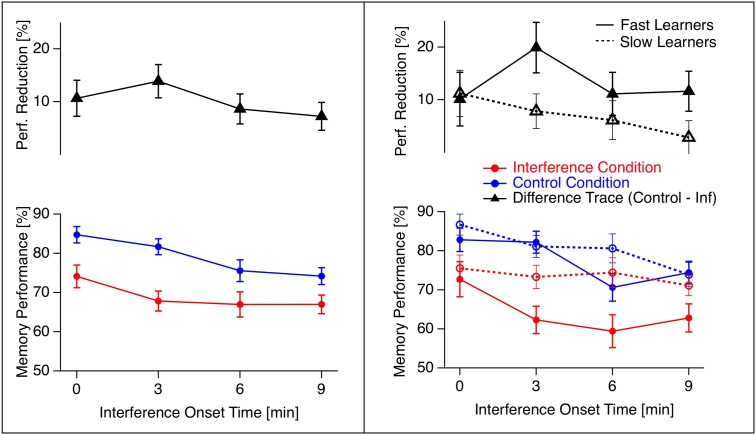
- The interference task decreased memory performance by up to 20%. The generalized linear mixed model showed significant effects for learning success (intercept: z = 2.45, p = 0.01) and TREATMENT (z = -2.06, p = 0.04), but no effect for TIME nor for the TIME × TREATMENT interaction.
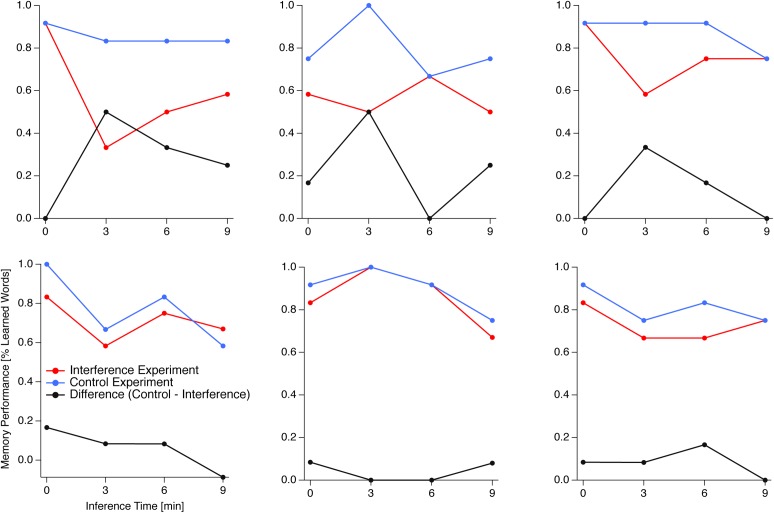
- Negative interference effects occurred at all interference time points, with large inter-individual variability. The Discussion reports that about 40% of participants had maximal interference within the first 3 min after learning, about 25% between 6 and 12 min, and later states about 33% at the second interference time point (3 min after learning).
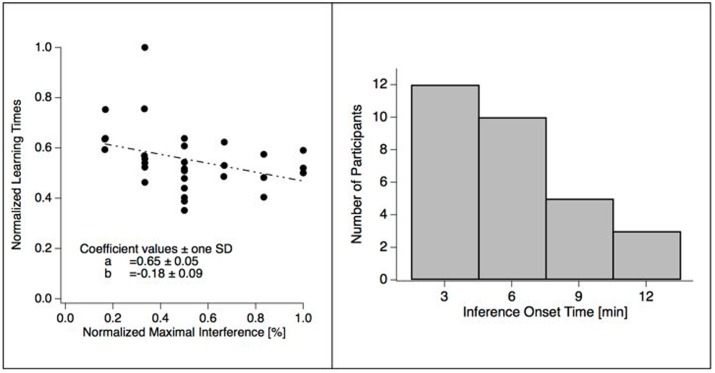
- Fast learners were more affected by interference than slow learners: maximal interference correlated negatively with learning time (rPearson = -0.35, p = 0.06; rSpearman = -0.42, threshold = 0.36), and a permutation test on median-split groups found fast learners had a larger maximal interference effect (p < 0.023).
- The authors conclude there is no general most-critical onset time of interference across participants within the first 12 min after encoding.
Methods
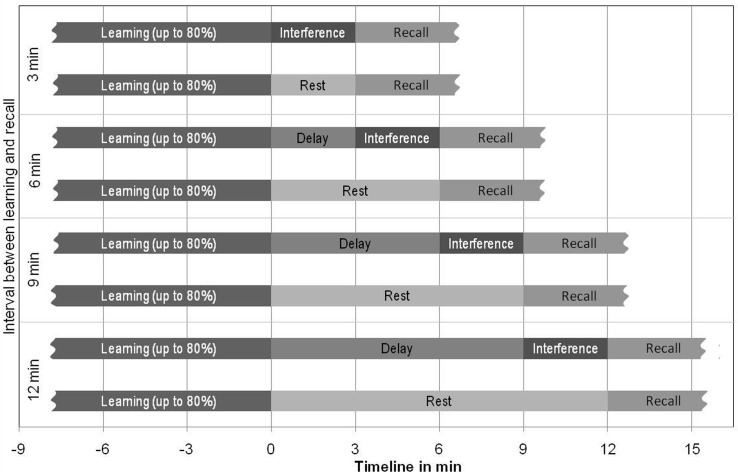
- Within-group design with two experiments (control and interference), each with four conditions. The interference task started at delays of 0, 3, 6, or 9 min after initial learning and lasted 3 min; final cued recall followed immediately. Control conditions replaced interference with rest.
- Thirty healthy German high school students (10 males, 20 females; mean age 15.03, range 13.05–15.10) with no prior Japanese knowledge learned German–Japanese word pairs. Five participants missed at least one condition due to illness, and gaps were filled with respective group means.
- Participants learned 12-pair German–Japanese vocabulary lists until 80% recall. The interference task was learning a new 12-pair German–Japanese list. Analysis used a generalized linear mixed model with binomial family and logit link, with TIME and TREATMENT as factors, plus individual difference scores, maximal interference, correlations, and a permutation test.
Limitations
- Stated: the fast-learner finding is based on a post-hoc analysis, is “not extraordinarily strong,” and needs replication.
- Stated: the study is a “keyhole” with a high-dimensional parameter space; it is unclear whether interference onset times later than 12 min, better temporal resolution, or other interference material would show larger effects.
- Evident from the text: the sample was small (N = 30), five participants had missing conditions imputed by group means, and the key TIME × TREATMENT interaction was not found despite the hypothesis.
Model-written summary. Check it against the paper before relying on it.
Integrity signals
Registry
Cites
Statistics
Figures
Verification
Claims the paper makes
0 Valid · 0 Not valid · 19 Not checked · 48 Own results and interpretations
A result the paper reports from its own data — it cites no other source for it, so there is none to check. The quote shows it is in the paper.
In the paper
“nor for the interaction between TIME and TREATMENT”
§ When Learning Disturbs Memory – Temporal Profile of Retroactive Interference of Learning on Memory Formation > Results
plain- Asserted: passes — The authors put it forward as true.
- Checkable: passes — It can be checked against evidence.
- Load-bearing: unclear — It is unclear whether the paper’s conclusions depend on it.
- Based: passes — The paper gives a reason why it holds.
A result the paper reports from its own data — it cites no other source for it, so there is none to check. The quote shows it is in the paper.
In the paper
“Fast learners showed a larger maximal interference effect than slow learners (p < 0.023, see also Figure 2, right).”
- Also stated in: § Abstract · hedged
“Further, fast learners seem to be more affected by interference than slow learners.”
- Also stated in: § Results · plain
“with larger effects for fast compared to slow learners”
§ When Learning Disturbs Memory – Temporal Profile of Retroactive Interference of Learning on Memory Formation > Results
plainstates an association- Asserted: passes — The authors put it forward as true.
- Checkable: passes — It can be checked against evidence.
- Load-bearing: passes — The paper’s conclusions depend on it.
- Based: passes — The paper gives a reason why it holds.
- Also stated in: § Abstract · hedged
A result the paper reports from its own data — it cites no other source for it, so there is none to check. The quote shows it is in the paper.
In the paper
“location of the interference time point does not correlate with effect size.”
§ When Learning Disturbs Memory – Temporal Profile of Retroactive Interference of Learning on Memory Formation > Results
plain- Asserted: passes — The authors put it forward as true.
- Checkable: passes — It can be checked against evidence.
- Load-bearing: unclear — It is unclear whether the paper’s conclusions depend on it.
- Based: passes — The paper gives a reason why it holds.
A result the paper reports from its own data — it cites no other source for it, so there is none to check. The quote shows it is in the paper.
In the paper
“with negative effects at all interference time points”
§ When Learning Disturbs Memory – Temporal Profile of Retroactive Interference of Learning on Memory Formation > Abstract
plainstates a cause- Asserted: passes — The authors put it forward as true.
- Checkable: passes — It can be checked against evidence.
- Load-bearing: passes — The paper’s conclusions depend on it.
- Based: passes — The paper gives a reason why it holds.
A result the paper reports from its own data — it cites no other source for it, so there is none to check. The quote shows it is in the paper.
In the paper
“Observation of individual data indicated a relation between the size of the maximal interference effect and the learning time.”
§ When Learning Disturbs Memory – Temporal Profile of Retroactive Interference of Learning on Memory Formation > Results
hedgedstates an association- Asserted: passes — The authors put it forward as true.
- Checkable: passes — It can be checked against evidence.
- Load-bearing: unclear — It is unclear whether the paper’s conclusions depend on it.
- Based: passes — The paper gives a reason why it holds.
41 more claims
Create a free account to see all 67 claims and to verify the 23 references still open.
- It may state two separate claims as one. 12
- Probably not a substantial claim. 17
Statistics recomputed
Every reported test result, recomputed from its test statistic and degrees of freedom. A result shows as not adding up only once an independent check has confirmed it.
- Consistentz = 2.45reported p = .01 · recomputed p = .014
“z = 2.45, p = .01”
- Consistentz = -2.06reported p = .04 · recomputed p = .039
“(z = -2.06, p = .04”
Self-check
Percentages, sums and reported differences re-computed from the paper’s own numbers.
Each contradiction between two passages listed here was confirmed by an independent check.
Rated minor: it would not touch a result — a value no result rests on, a p-value that stays on the same side of the significance level, or a conflict that is clerical, resolved elsewhere in the paper, or outside its own findings.
In the paper
§ When Learning Disturbs Memory – Temporal Profile of Retroactive Interference of Learning on Memory Formation > Materials and Methods > Experimental Conditions
“participants learned twelve German–Japanese vocabulary pairs in each of the 2 × 6 = 12 experimental conditions”
§ When Learning Disturbs Memory – Temporal Profile of Retroactive Interference of Learning on Memory Formation > Materials and Methods > Experimental Task and Study Procedure
“In total, the paradigm contained two experiments (control and interference), each with four conditions.”
Citations
Cites
Memory - A century of consolidation
McGaugh, J. L. (2000) · Science · doi:10.1126/science.287.5451.248 · Cited by 4,250
Short-term retention of individual verbal items.
Peterson, L., & Peterson, M. J. (1959) · Journal of Experimental Psychology · doi:10.1037/h0049234 · Cited by 2,939
The Neurobiology of Consolidations, Or, How Stable is the Engram?
Dudai, Y. (2004) · Annual Review of Psychology · doi:10.1146/annurev.psych.55.090902.142050 · Cited by 1,671 · cited 2×
“Examples are shuttle-box learning in goldfish and inhibitory avoidance learning in rats (Agranoff et al., 1966; Izquierdo et al., 1999, for a review see Dudai, 2004).”
BackgroundSome Tests of the Decay Theory of Immediate Memory
Brown, J. (1958) · Quarterly Journal of Experimental Psychology · doi:10.1080/17470215808416249 · Cited by 1,442
The Psychology and Neuroscience of Forgetting
Wixted, J. T. (2004) · Annual Review of Psychology · doi:10.1146/annurev.psych.55.090902.141555 · Cited by 999 · cited 3×
“In the modern psychological literature research articles on interference effects during consolidation are surprisingly rare, with some notable exceptions (Lechner et al., 1999; Altmann and Gray, 2002; Lewandowsky et al., 2004, 2009; Wixted, 2004; Oberauer and Lewandowsky, 2008).”
BackgroundThe Declaration of Helsinki and public health
Williams, J. (2008) · Bulletin of the World Health Organization · doi:10.2471/blt.08.050955 · Cited by 986 · cited 3×
“The study was conducted according the ethical standards of the Declaration of Helsinki (Williams, 2008) and was in full accordance with the ethical, legal and regulatory norms and”
MethodInfluential"Attention-like" processes in classical conditioning
Kamin, L. J. (1967) · NASA Technical Reports Server (NASA) · Cited by 973
Underwood, B. J. (1957) · Psychological Review · doi:10.1037/h0044616 · Cited by 818
Early consolidation in human primary motor cortex
Muellbacher, W., Ziemann, U., Wissel, J., Dang, N., Kofler, M., Facchini, S., Boroojerdi, B., Poewe, W., & Hallett, M. (2002) · Nature · doi:10.1038/nature712 · Cited by 803 · cited 1×
“Muellbacher et al. (2002) found that repetitive transcranial magnetic stimulation (rTMS) applied over the primary motor cortex within 15 min after learning in a skilled motor task, significantly disrupted the procedural memory performance.”
BackgroundA temporal ratio model of memory
Brown, G. D. A., Neath, I., & Chater, N. (2007) · Psychological Review · doi:10.1037/0033-295x.114.3.539 · Cited by 798 · cited 3×
“The smaller the temporal distance between the two items, the more they interfere with each other and the larger is their competition during retrieval (Brown et al., 2007).”
Background
Cited by
Dotan, D., & Zviran-Ginat, S. (2022) · Cognitive Research Principles and Implications · doi:10.1186/s41235-022-00451-0 · Cited by 37
Stone, C. B., Luminet, O., Jay, A. C. V., Klein, O., Licata, L., & Hirst, W. C. (2020) · Memory Studies · doi:10.1177/1750698019900949 · Cited by 36
How odor cues help to optimize learning during sleep in a real life-setting
Neumann, F., Oberhauser, V., & Kornmeier, J. (2020) · Scientific Reports · doi:10.1038/s41598-020-57613-7 · Cited by 35
Self-citationDo sequential lineups impair underlying discriminability?
Kaesler, M., Dunn, J. C., Ransom, K., & Semmler, C. (2020) · Cognitive Research Principles and Implications · doi:10.1186/s41235-020-00234-5 · Cited by 25
Memory Consolidation Is Similar in Waking and Sleep
Siegel, J. M. (2021) · Current Sleep Medicine Reports · doi:10.1007/s40675-020-00199-3 · Cited by 23
Spacing learning units affects both learning and forgetting
Kornmeier, J., Sosic-Vasic, Z., & Joos, E. (2022) · Trends in Neuroscience and Education · doi:10.1016/j.tine.2022.100173 · Cited by 19
Self-citationThe role of memory in counterfactual valuation.
Biderman, N., Gershman, S. J., & Shohamy, D. (2023) · Journal of Experimental Psychology General · doi:10.1037/xge0001364 · Cited by 15
The Effects of Acute Exercise on Retroactive Memory Interference
Loprinzi, P. D., Frith, E., & Crawford, L. K. (2019) · American Journal of Health Promotion · doi:10.1177/0890117119866138 · Cited by 12
Knötzele, J., Riemann, D. W., Frase, L., Feige, B., van Elst, L. T., & Kornmeier, J. (2023) · Scientific Reports · doi:10.1038/s41598-023-28676-z · Cited by 12
Self-citationDrift-Aware Multi-Memory Model for Imbalanced Data Streams
Abolfazli, A., & Ntoutsi, E. (2020) · IEEE International Conference on Big Data (BigData) · doi:10.1109/bigdata50022.2020.9378101 · Cited by 11
Anakwah, N., Horselenberg, R., Hope, L., Amankwah‐Poku, M., & Koppen, P. J. V. (2024) · Applied Cognitive Psychology · doi:10.1002/acp.4243 · Cited by 9
Difficulties in retrieval multiplication facts: The case of interference to reconsolidation
Katzoff, A., Mark‐Zigdon, N., & Ashkenazi, S. (2020) · Trends in Neuroscience and Education · doi:10.1016/j.tine.2020.100137 · Cited by 9
Considering the native land of witnesses: Cultural influences on memory reports
Anakwah, N. (2021) · Research Publications (Maastricht University) · doi:10.26481/dis.20210921na · Cited by 4
Hamzeloo, M., Bogenschütz, L., Hackländer, R. P. M., & Bermeitinger, C. (2025) · Chemical Senses · doi:10.1093/chemse/bjaf014 · Cited by 2
Interference-based accounts of forgetting via studies of minimal interference
McGhee, J. (2020) · ERA · doi:10.7488/era/296 · Cited by 2
Memory as a computational constraint in cross-situational word learning
Cognitive Science Society 2023, LaTourrette, A. S., Trueswell, J. C., Yang, C. D., & Yue, C. (2023) · eScholarship (California Digital Library) · doi:10.48448/btkm-zv51 · Cited by 2
Amalia, K. R., Safitri, S. D., Faradillah, A., & Miatun, A. (2025) · International Journal of Progressive Mathematics Education · doi:10.22236/ijopme.v5i2.20429 · Cited by 2
Lalla, A., & Sheldon, S. (2025) · Memory & Cognition · doi:10.3758/s13421-025-01792-z · Cited by 1
McKevitt, C. (2018) · NORMA · Cited by 1
Предко, В. В. (2024) · Digital Library NAES of Ukraine (National Academy of Educational Sciences of Ukraine) · Cited by 1
ESFORÇO MENTAL E SUSCETIBILIDADE À INTERFERÊNCIA NA RECUPERAÇÃO DA MEMÓRIA EPISÓDICA
Alves, M. V., Bueno, O., & Bueno, O. F. A. (2018) · LA Referencia (Red Federada de Repositorios Institucionales de Publicaciones Científicas) · doi:10.13140/rg.2.2.14781.79847 · Cited by 1
(2020) · Wolverhampton Intellectual Repository and E-Theses (University of Wolverhampton)
Anesthetic Amnesia: The Forgotten Importance of Forgetting?
Pryor, K. O., Jiang, Y., & SLEIGH, J. W. (2025) · Anesthesiology · doi:10.1097/aln.0000000000005544
Villaseñor-Cabrera, T. J., Macías-Islas, M. Á., Sanchez-Jacuinde, K. A., Curiel, G. R., Jiménez-Maldonado, M., Lopez, E., González-Ponce, F., Gámez-Nava, J. I., González-López, L., Nava-Valdivia, C. A., et al. (2026) · Healthcare · doi:10.3390/healthcare14050583
Study of social network interference of memory processes in adolescence
Baryshnikova, V. E., Nikishina, V. B., Петраш, Е. А., Андреевич, С. В., & Kulikova, E. I. (2023) · Digital sociology · doi:10.26425/2658-347x-2022-5-4-31-37
Alashwal, H., Dabool, H., van Zyl, T., van der Haar, D., Chakravarthy, S., Deldari, S., Salim, F. D., Lerner, I., & Moustafa, A. (2025) · PsyArXiv (OSF Preprints) · doi:10.31234/osf.io/up7yz_v1
Lalla, A. (2020) · eScholarship@McGill (McGill) · doi:10.82308/12851
Derouet, J. (2021) · theses.fr (ABES) · doi:10.70675/6d520606z17ebz4c9fzbf86z9257d3a4a8d1
Omerzu, T. (2022) · KOPS (University of Konstanz)
Memory Interference in the Lateral Entorhinal Cortex
Ghazy, O. (2025) · CUNY Academic Works (City University of New York)
Learning in Non-Stationary Environments
Abolfazli, A. (2025) · Institutional Repository of Leibniz Universität Hannover (Leibniz Universität Hannover) · doi:10.15488/20216
Cheng, F., Harper-Gampp, T., Planchart, R., Dunning, M., Hilligoss, Q., Peterson, M., Delgado, C., & Chen, K. (2026) · Human Factors The Journal of the Human Factors and Ergonomics Society · doi:10.1177/00187208261506560
3 Responsibilities of StudentsPreprint
Morsches, M., & Matthews, G. J. (2023) · SSRN Electronic Journal · doi:10.2139/ssrn.4634388
ИССЛЕДОВАНИЕ СОЦИАЛЬНО-СЕТЕВОЙ ИНТЕРФЕРЕНЦИИ ПРОЦЕССОВ ПАМЯТИ У ПОДРОСТКОВ
Baryshnikova, V. E., Б., Н. В., А., П. Е., А., С. В., & И., К. Е. (2022) · Digital sociology
Whose Lie is it Anyway? Eyewitness Memory Misinformation Effect and Public Perceptions of Police
Hopkins, J. L. (2022) · Tuwhera (Auckland University of Technology)
Metadata
- Authors
- Sosic-Vasic, Z., Hille, K., Kröner, J., Spitzer, M., & Kornmeier, J.
- Affiliations
- University Hospital Ulm (DE)
- Universität Ulm (DE)
- University of Freiburg (DE)
- Corresponding author
- Sosic-Vasic, Zrinka
- Venue
- Frontiers in Psychology
- Publisher
- Frontiers Media SA
- Published
- 2018-02-16
- Volume
- 9
- Pages
- 82-82
- ISSN
- 1664-1078 (ISSN-L)
- PMC
- PMC5820352
- OpenAlex
- W2791017274
- Cited by
- 36
- References
- 33
- Citations by year
- 2026: 2 · 2025: 7 · 2024: 2 · 2023: 6 · 2022: 5 · 2021: 3 · 2020: 8 · 2019: 1 · 2018: 2
- FWCI
- 1.62
- Type
- journal article
- Language
- en
- Open access
- gold
- doi.org
- Licence
- cc-by
- Locations
- Frontiers in Psychology (publishedVersion, cc-by)
- PubMed Central (publishedVersion, cc-by)
- PubMed (publishedVersion)
- DOAJ (DOAJ: Directory of Open Access Journals) (submittedVersion)
- OPen Access Repositorium der Universität Ulm (OPARU) (Ulm University) (submittedVersion, cc-by)
- Universität Ulm, Kommunikations- und Informationszentrum (kiz) (cc-by)
- Topics
- Life Sciences › Neuroscience › Cognitive Neuroscience › Memory Processes and Influences
- Life Sciences › Neuroscience › Cognitive Neuroscience › Memory and Neural Mechanisms
- Life Sciences › Neuroscience › Cognitive Neuroscience › Sleep and Wakefulness Research
- Keywords
- retroactive interference, memory consolidation, memory formation, cued recall, learning rate scheduling
About these checks
Registry, retraction, Cites and statistics results are computed, not judged, with one exception: a printed reference that no index lists is read once by a model before it counts as a citation error. Claims are extracted by a model and kept only when their quote appears verbatim in the text; each cited source is then checked, with a model’s help, for whether it says what the claim relies on. Those verdicts can be wrong — read the claim’s quote and the cited source before relying on one.
A language model drew the claims from the paper on 2026-11-24, under version 3 of the claim definition (model deepseek-v4.1-flash, prompt extract-v3).
A second model labelled each claim on 2026-11-24 (model jev-1.13-20260917, definition revision gold-guideline-v0.2).
Statistics and arithmetic are recomputed, not judged.
Confidence bands are shown only for fields calibrated on our annotated test set. None is calibrated yet, so no band is shown.
What counts as a claim ›How we measure confidence ›How we check this ›
Are you an author, or do you see a problem with this page? Request a review
Data sources
Bibliographic data: Semantic Scholar, OpenAlex, Crossref.
Contains information from the Semantic Scholar Academic Graph Datasets, made available under the ODC Attribution License (ODC-BY 1.0).
Semantic Scholar’s data is described in: Kinney, R., et al. (2023). The Semantic Scholar Open Data Platform. arXiv:2301.10140.
