

The DOI matches its Crossref record; 47 of the 47 references it cites were found in a registry or an index.
Personalizing Human-Agent Interaction Through Cognitive Models
Open accessAbstract
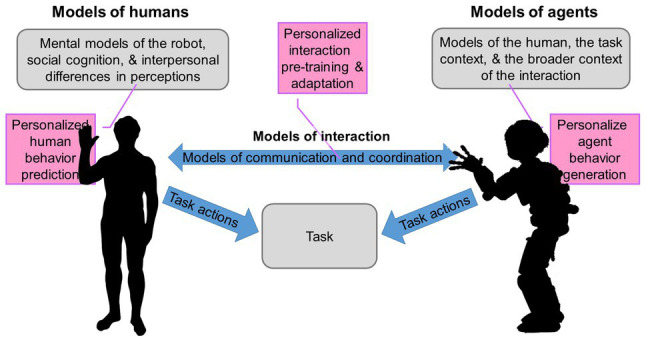
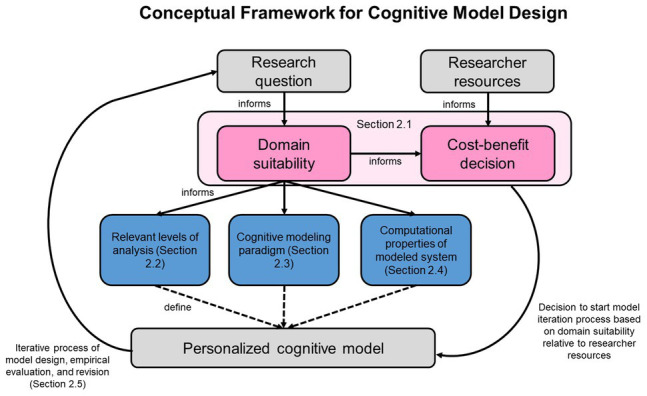
Cognitive modeling of human behavior has advanced the understanding of underlying processes in several domains of psychology and cognitive science. In this article, we outline how we expect cognitive modeling to improve comprehension of individual cognitive processes in human-agent interaction and, particularly, human-robot interaction (HRI). We argue that cognitive models offer advantages compared to data-analytical models, specifically for research questions with expressed interest in theories of cognitive functions. However, the implementation of cognitive models is arguably more complex than common statistical procedures. Additionally, cognitive modeling paradigms typically have an explicit commitment to an underlying computational theory. We propose a conceptual framework for designing cognitive models that aims to identify whether the use of cognitive modeling is applicable to a given research question. The framework consists of five external and internal aspects related to the modeling process: research question, level of analysis, modeling paradigms, computational properties, and iterative model development. In addition to deriving our framework from a concise literature analysis, we discuss challenges and potentials of cognitive modeling. We expect cognitive models to leverage personalized human behavior prediction, agent behavior generation, and interaction pretraining as well as adaptation, which we outline with application examples from personalized HRI.
Overview
The claims and statistics of this paper haven’t been checked yet.
Run the check — free, no account needed. It reads the open-access text and checks the sources it cites.
Integrity signals
Registry
Cites
Statistics
Figures
Verification
Claims the paper makes
The claims and statistics of this paper haven’t been checked yet.
Run the check — free, no account needed. It reads the open-access text and checks the sources it cites.
Self-check
Percentages, sums and reported differences re-computed from the paper’s own numbers.
The self-check needs the paper’s full text.
Citations
Cites
Barlow, H. B. (1983) · Journal of Mathematical Psychology · doi:10.1016/0022-2496(83)90030-5 · Cited by 5,508
Awad, N. F., & Krishnan, M. S. (2006) · MIS Quarterly · doi:10.2307/25148715 · Cited by 1,252
Personalization versus Privacy: An Empirical Examination of the Online Consumer’s Dilemma
Chellappa, R. K., & Sin, R. G. (2005) · Information Technology and Management · doi:10.1007/s10799-005-5879-y · Cited by 1,098
Causal Inference in Multisensory Perception
Körding, K. P., Beierholm, U., Ma, W. J., Quartz, S., Tenenbaum, J. B., & Shams, L. (2007) · PLoS ONE · doi:10.1371/journal.pone.0000943 · Cited by 1,069
Multialternative decision field theory: A dynamic connectionst model of decision making.
Roe, R. M., Busemeyer, J. R., & Townsend, J. T. (2001) · Psychological Review · doi:10.1037/0033-295x.108.2.370 · Cited by 789
Is There a Conceptual Difference between Theoretical and Conceptual Frameworks?
Imenda, S. N. (2014) · Journal of Social Sciences · doi:10.1080/09718923.2014.11893249 · Cited by 628
Cognitive Developmental Robotics: A Survey
Asada, M., Hosoda, K., Kuniyoshi, Y., Ishiguro, H., Inui, T., Yoshikawa, Y., Ogino, M., & Yoshida, C. T. (2009) · IEEE Transactions on Autonomous Mental Development · doi:10.1109/tamd.2009.2021702 · Cited by 574
How Computational Modeling Can Force Theory Building in Psychological Science
Guest, O., & Martin, A. E. (2021) · Perspectives on Psychological Science · doi:10.1177/1745691620970585 · Cited by 533
Vul (2014) · doi:10.1111/cogs.12101 · Cited by 502
Pons‐Moll, G., Pujades, S., Hu, S., & Black, M. J. (2017) · ACM Transactions on Graphics · doi:10.1145/3072959.3073711 · Cited by 495
Griffiths, T. L., Lieder, F., & Goodman, N. D. (2015) · Topics in Cognitive Science · doi:10.1111/tops.12142 · Cited by 434
How cognitive modeling can benefit from hierarchical Bayesian models
Lee, M. D. (2010) · Journal of Mathematical Psychology · doi:10.1016/j.jmp.2010.08.013 · Cited by 313
ACT‐R: A cognitive architecture for modeling cognition
Ritter, F. E., Tehranchi, F., & Oury, J. D. (2018) · Wiley Interdisciplinary Reviews Cognitive Science · doi:10.1002/wcs.1488 · Cited by 312
The Cambridge Handbook of Computational Psychology
(2001) · Cambridge University Press eBooks · doi:10.1017/cbo9780511816772 · Cited by 268
Body Schema in Robotics: A Review
Hoffmann, M., Marques, H. G., Arieta, A. H., Sumioka, H., Lungarella, M., & Pfeifer, R. (2010) · IEEE Transactions on Autonomous Mental Development · doi:10.1109/tamd.2010.2086454 · Cited by 253
The probabilistic nature of preferential choice.
Rieskamp, J. (2008) · Journal of Experimental Psychology Learning Memory and Cognition · doi:10.1037/a0013646 · Cited by 245
Computational Modeling of Cognition and Behavior
Farrell, S., & Lewandowsky, S. (2018) · Cambridge University Press eBooks · doi:10.1017/cbo9781316272503 · Cited by 242
How computational modeling can force theory building in psychological sciencePreprint
Guest, O., & Martin, A. E. (2020) · doi:10.31234/osf.io/rybh9 · Cited by 175
Probabilistic movement modeling for intention inference in human–robot interaction
Wang, Z., Mülling, K., Deisenroth, M. P., Ben Amor, H., Vogt, D., Schölkopf, B., & Peters, J. (2013) · The International Journal of Robotics Research · doi:10.1177/0278364913478447 · Cited by 171
From social brains to social robots: applying neurocognitive insights to human–robot interaction
Cross, E. S., Hortensius, R., & Wykowska, A. (2019) · Philosophical Transactions of the Royal Society B Biological Sciences · doi:10.1098/rstb.2018.0024 · Cited by 168
Bridging Levels of Analysis for Probabilistic Models of Cognition
Griffiths, T. L., Vul, E., & Sanborn, A. N. (2012) · Current Directions in Psychological Science · doi:10.1177/0963721412447619 · Cited by 159
Robust Modeling in Cognitive Science
Lee, M. D., Criss, A. H., Devezer, B., Donkin, C., Etz, A. J., Leite, F. P., Matzke, D., Rouder, J. N., Trueblood, J. S., White, C. N., et al. (2019) · Computational Brain & Behavior · doi:10.1007/s42113-019-00029-y · Cited by 148
Computational modelling for decision-making: where, why, what, who and how
Calder, M., Craig, C., Culley, D., de Cani, R., Donnelly, C. A., Douglas, R., Edmonds, B., Gascoigne, J., Gilbert, N., Hargrove, C., et al. (2018) · Royal Society Open Science · doi:10.1098/rsos.172096 · Cited by 147
Predicting human decisions with behavioural theories and machine learning
Plonsky, O., Apel, R., Ert, E., Tennenholtz, M., Bourgin, D., Peterson, J. C., Reichman, D., Griffiths, T. L., Russell, S., Carter, E. C., et al. (2025) · Nature Human Behaviour · doi:10.1038/s41562-025-02267-6 · Cited by 116
Online generative model personalization for hand tracking
Tkach, A., Tagliasacchi, A., Remelli, E., Pauly, M. V., & Fitzgibbon, A. W. (2017) · ACM Transactions on Graphics · doi:10.1145/3130800.3130830 · Cited by 89
Web personalization: The state of the art and future avenues for research and practice
Salonen, V., & Karjaluoto, H. (2016) · Telematics and Informatics · doi:10.1016/j.tele.2016.03.004 · Cited by 83
A common light-prior for visual search, shape, and reflectance judgments
Adams, W. J. (2007) · Journal of Vision · doi:10.1167/7.11.11 · Cited by 74
Schillaci, G., Hafner, V. V., & Lara, B. (2016) · Frontiers in Robotics and AI · doi:10.3389/frobt.2016.00039 · Cited by 74
Robots for the people, by the people: Personalizing human-machine interaction
Clabaugh, C., & Matarić, M. J. (2018) · Science Robotics · doi:10.1126/scirobotics.aat7451 · Cited by 70
Cognitive Human–Robot Interaction
Mutlu, B., Roy, N., & Šabanović, S. (2016) · Springer handbooks · doi:10.1007/978-3-319-32552-1_71 · Cited by 65
Cognitive Model Priors for Predicting Human DecisionsPreprint
Bourgin, D., Peterson, J. C., Reichman, D., Griffiths, T. L., & Russell, S. (2019) · arXiv (Cornell University) · doi:10.48550/arxiv.1905.09397 · Cited by 60
Collins, E. C. (2019) · Philosophical Transactions of the Royal Society B Biological Sciences · doi:10.1098/rstb.2018.0433 · Cited by 44
Memory and mental time travel in humans and social robots
Prescott, T. J., Camilleri, D., Martínez-Hernández, U., Damianou, A., & Lawrence, N. D. (2019) · Philosophical Transactions of the Royal Society B Biological Sciences · doi:10.1098/rstb.2018.0025 · Cited by 38
Personalizing human activity recognition models using incremental learningPreprint
Siirtola, P., Koskimäki, H., & Röning, J. (2019) · arXiv (Cornell University) · doi:10.48550/arxiv.1905.12628 · Cited by 27
A Bayesian Reformulation of the Extended Drift-Diffusion Model in Perceptual Decision Making
Fard, P. R., Park, H., Warkentin, A., Kiebel, S. J., & Bitzer, S. (2017) · Frontiers in Computational Neuroscience · doi:10.3389/fncom.2017.00029 · Cited by 26
Interactive AI with a Theory of MindPreprint
Çelikok, M. M., Peltola, T., Daee, P., & Samuel Kaski, A. (2019) · arXiv (Cornell University) · doi:10.48550/arxiv.1912.05284 · Cited by 26
How Cognitive Models of Human Body Experience Might Push Robotics
Schürmann, T., Mohler, B. J., Peters, J., & Beckerle, P. (2019) · Frontiers in Neurorobotics · doi:10.3389/fnbot.2019.00014 · Cited by 25
Self-citationComputational Modeling in Cognitive Science: A Manifesto for Change
Addyman, C., & French, R. M. (2012) · Topics in Cognitive Science · doi:10.1111/j.1756-8765.2012.01206.x · Cited by 22
Computational Modeling of Embodied Visual Perspective Taking
Fischer, T., & Demiris, Y. (2019) · IEEE Transactions on Cognitive and Developmental Systems · doi:10.1109/tcds.2019.2949861 · Cited by 22
1. Theory-grounded user modeling for personalized HCI
Graus, M. P., & Ferwerda, B. (2019) · De Gruyter eBooks · doi:10.1515/9783110552485-001 · Cited by 12
The contribution (and drawbacks) of models to the study of concepts
Murphy, G. L. (2011) · Cambridge University Press eBooks · doi:10.1017/cbo9780511921322.013 · Cited by 12
How does Bayesian reverse-engineering work?
Zednik, C., & Jäkel, F. (2025) · Technischen Universität Darmstadt · doi:10.26083/tuprints-00029995 · Cited by 8
Schürmann, T., Gerber, N., & Gerber, P. (2020) · Journal of Intellectual Capital · doi:10.1108/jic-05-2019-0126 · Cited by 7
Self-citationIndispensability of Computational Modeling in Cognitive Science
Farkaš, I. (2012) · Journal of Cognitive Science · doi:10.17791/jcs.2012.13.4.401 · Cited by 6
Ku, Y.-C., Li, P., & Lee, Y.-L. (2018) · Lecture notes in computer science · doi:10.1007/978-3-319-91716-0_27 · Cited by 3
Investigating Perceptions of Personalization and Privacy in India
Schneider, H., George, C., Eiband, M., & Lachner, F. (2017) · Lecture notes in computer science · doi:10.1007/978-3-319-68059-0_57 · Cited by 2
WHAT USE ARE COMPUTATIONAL MODELS OF COGNITIVE PROCESSES?
STAFFORD, T. (2009) · Connectionist Models of Behaviour and Cognition II · doi:10.1142/9789812834232_0022
Research works printed but not linked: 2
- Griffiths, 2008, Bayesian models of cognition, 59
- Sun, Introduction to computational cognitive modeling, 3
Cited by
Coronado, E., Kiyokawa, T., Ricardez, G. A. G., Ramírez-Alpizar, I. G., Venture, G., & Yamanobe, N. (2022) · Journal of Manufacturing Systems · doi:10.1016/j.jmsy.2022.04.007 · Cited by 306
Meaningful human control: actionable properties for AI system development
Cavalcante Siebert, L., Lupetti, M. L., Aizenberg, E., Beckers, N., Zgonnikov, A., Veluwenkamp, H., Abbink, D., Giaccardi, E., Houben, G.-J., Jonker, C. M., et al. (2023) · AI and Ethics · doi:10.1007/s43681-022-00167-3 · Cited by 138
Human Digital Twin, the Development and Impact on Design
Song, Y. (2023) · Journal of Computing and Information Science in Engineering · doi:10.1115/1.4063132 · Cited by 42
Zgonnikov, A., Beckers, N., George, A., Abbink, D. A., & Jonker, C. M. (2024) · International Journal of Human-Computer Studies · doi:10.1016/j.ijhcs.2024.103224 · Cited by 20
Interactive Human–Robot Skill Transfer: A Review of Learning Methods and User Experience
Cansev, M. E., Xue, H., Rottmann, N., Bliek, A., Miller, L. E., Rueckert, E., & Beckerle, P. (2021) · Advanced Intelligent Systems · doi:10.1002/aisy.202000247 · Cited by 13
Self-citation
Metadata
- Authors
- Schürmann, T., & Beckerle, P.
- Affiliations
- Technische Universität Darmstadt (DE)
- TU Dortmund University (DE)
- Corresponding author
- Beckerle, Philipp
- Venue
- Frontiers in Psychology
- Publisher
- Frontiers Media SA
- Published
- 2020-09-24
- Volume
- 11
- Pages
- 561510-561510
- ISSN
- 1664-1078 (ISSN-L)
- PMC
- PMC7541964
- OpenAlex
- W3089172315
- Cited by
- 24
- References
- 45
- Citations by year
- 2026: 2 · 2025: 5 · 2024: 4 · 2023: 4 · 2022: 3 · 2021: 6
- FWCI
- 3.35
- Type
- journal article
- Language
- en
- Open access
- gold
- doi.org
- Licence
- Locations
- Frontiers in Psychology (publishedVersion, cc-by)
- PubMed Central (publishedVersion, cc-by)
- PubMed (publishedVersion)
- Technische Universität Dortmund Eldorado (Technische Universität Dortmund) (submittedVersion, cc-by)
- Technischen Universität Darmstadt (submittedVersion, cc-by)
- DOAJ (DOAJ: Directory of Open Access Journals) (submittedVersion, cc-by-sa)
- TUbilio (Technical University of Darmstadt) (submittedVersion, cc-by)
- TUbilio (Technical University of Darmstadt) (submittedVersion)
- Technischen Universität Darmstadt (submittedVersion)
- Technische Universität Dortmund Eldorado (Technische Universität Dortmund)
- Technischen Universität Darmstadt (cc-by)
- Funders
- Deutsche Forschungsgemeinschaft
- Topics
- Social Sciences › Psychology › Social Psychology › Social Robot Interaction and HRI
- Physical Sciences › Computer Science › Artificial Intelligence › Psychiatry, Mental Health, Neuroscience
- Physical Sciences › Computer Science › Artificial Intelligence › Speech and dialogue systems
- Keywords
- cognitive modeling, human-agent interaction, human-robot interaction, personalized interaction, individual differences, agent adaptation, human behavior prediction
About these checks
Registry, retraction, Cites and statistics results are computed, not judged, with one exception: a printed reference that no index lists is read once by a model before it counts as a citation error. Claims are extracted by a model and kept only when their quote appears verbatim in the text; each cited source is then checked, with a model’s help, for whether it says what the claim relies on. Those verdicts can be wrong — read the claim’s quote and the cited source before relying on one.
Statistics and arithmetic are recomputed, not judged.
Confidence bands are shown only for fields calibrated on our annotated test set. None is calibrated yet, so no band is shown.
What counts as a claim ›How we measure confidence ›How we check this ›
Are you an author, or do you see a problem with this page? Request a review
