

The DOI matches its Crossref record; 114 of the 114 references it cites were found in a registry or an index.
The Glass Ceiling for Women Managers: Antecedents and Consequences for Work-Family Interface and Well-Being at Work
Open accessAbstract
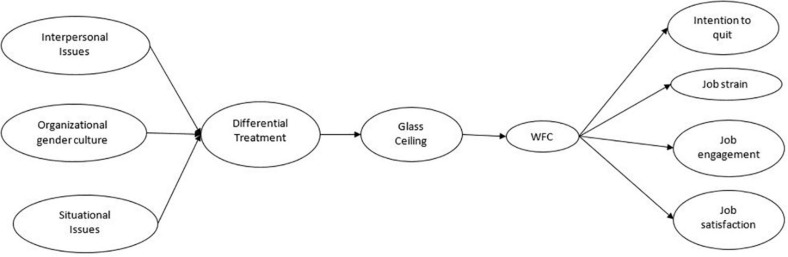
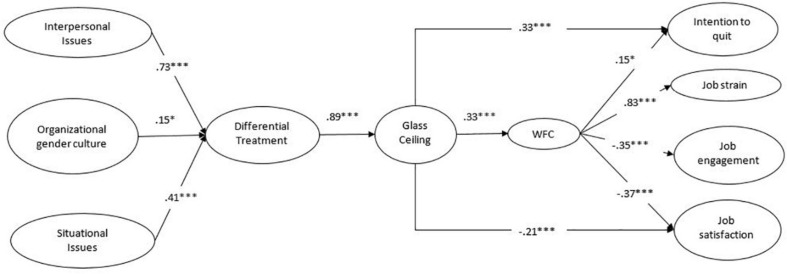
Despite significant promotion of diversity in companies, as well as legislation for equal opportunities for women and men, it must be noted that women still remain largely in the minority in decision-making positions. This observation reflects the phenomenon of the glass ceiling that constitutes vertical discrimination within companies against women. Although the glass ceiling has generated research interest, some authors have pointed out that theoretical models have made little attempt to develop an understanding of this phenomenon and its implications. Therefore, our study aims to fill this gap and to better understand the phenomenon of the glass ceiling by considering both its antecedents and its possible consequences. More precisely, we extend the model developed by Elacqua et al. (2009), proposing a more comprehensive model including organizational gender culture as a third factor (in addition to situational and interpersonal issues) in the emergence of the glass ceiling through the perception of differential treatment. We also investigated the glass ceiling’s consequences for organizational attitudes and well-being at work by considering work-to-family conflict (WFC) as a possible mediator. We surveyed 320 women in managerial positions in a Belgian organization. Our study highlights the importance of all three factors in the emergence of the perception of differential treatment and, ultimately, the perception that a glass ceiling exists. Moreover, our results show that WFC fully mediates the effects of the glass ceiling on job strain and job engagement, and partially mediates the effects of the glass ceiling on job satisfaction and intention to quit.
Overview
The claims and statistics of this paper haven’t been checked yet.
Run the check — free, no account needed. It reads the open-access text and checks the sources it cites.
Integrity signals
Registry
Cites
Statistics
Figures
Verification
Claims the paper makes
The claims and statistics of this paper haven’t been checked yet.
Run the check — free, no account needed. It reads the open-access text and checks the sources it cites.
Claims other papers make about this one
Each is checked against this paper’s own text: does it say what the citing paper says it does?
The source backs part of the claim, not all of it — or backs it for a different population, condition or comparison.
In the citing paper
“Other studies have identified specific barriers related to the social roles traditionally attributed to women, such as household responsibilities and child-rearing, which place them at a disadvantage in career advancement compared to men (Babic & Hansez, 2021;Moncayo Orjuela & Zuluaga, 2015;Undurraga & López Hornickel, 2020).”
From Barriers to Leadership: Experiences of Women Leaders in Business and Politics (2024) · cites this paper as Babic & Hansez, 2021
Experimental — accuracy not yet measuredThe cited source says what the claim attributes to it.
In the citing paper
“Paradoxically, contrary to what Babic and Hansez (2021) and Kerfoot and Knights (1998) suggested, they did not express any intention to resign.”
From Barriers to Leadership: Experiences of Women Leaders in Business and Politics (2024) · cites this paper as Babic and Hansez (2021)
Self-check
Percentages, sums and reported differences re-computed from the paper’s own numbers.
The self-check needs the paper’s full text.
Citations
Cites
Structural equation modeling in practice: A review and recommended two-step approach
Anderson, J. C., & Gerbing, D. W. (1988) · Psychological Bulletin · doi:10.1037/0033-2909.103.3.411 · Cited by 41,941
Principles and Practice of Structural Equation Modeling
Tabri, N., & Elliott, C. M. (2012) · Canadian Graduate Journal of Sociology and Criminology · doi:10.15353/cgjsc.v1i1.3787 · Cited by 39,094
Preacher, K. J., & Hayes, A. F. (2008) · Behavior Research Methods · doi:10.3758/brm.40.3.879 · Cited by 34,117
Significance tests and goodness of fit in the analysis of covariance structures.
Bentler, P. M., & Bonett, D. G. (1980) · Psychological Bulletin · doi:10.1037/0033-2909.88.3.588 · Cited by 20,015
Conservation of resources: A new attempt at conceptualizing stress
Hobfoll, S. E. (1989) · American Psychologist · doi:10.1037/0003-066x.44.3.513 · Cited by 18,187
Structural Equations with Latent Variables
Bollen, K. A. (1989) · Wiley series in probability and statistics · doi:10.1002/9781118619179 · Cited by 17,944
Sources of method bias in social science research and recommendations on how to control it
Podsakoff, P. M., MacKenzie, S. B., & Podsakoff, N. P. (2012) · Annual Review of Psychology · doi:10.1146/annurev-psych-120710-100452 · Cited by 15,744
Role congruity theory of prejudice toward female leaders.
Eagly, A. H., & Karau, S. J. (2002) · Psychological Review · doi:10.1037//0033-295x.109.3.573 · Cited by 7,300
Hobfoll, S. E. (2001) · Applied Psychology · doi:10.1111/1464-0597.00062 · Cited by 7,139
Job demands–resources theory: Taking stock and looking forward.
Bakker, A. B., & Demerouti, E. (2017) · Journal of Occupational Health Psychology · doi:10.1037/ocp0000056 · Cited by 6,979
Research works printed but not linked: 6
- Brislin, 1980, “Translation and content analysis of oral and written material,” in, Handbook of Cross-Cultural Psychology, 398
- Elkin, 2006, A review of mentorat relationships: formation, function, benefits and dysfunction., Otago Manag. Graduate Rev., 4, 11
- 2013, Femmes au Sommet 2012.
- Jöreskog, 2006, LISREL 8.80 for Window.
- Peeters, 2013, “Consequences of combining work and family roles: a closer look at cross-domain versus within-domain relations,” in, New Frontiers in Work and Family Research, 93
- Vinokur-Kaplan, 2009, “Motivating work performance in human services organizations,” in, The Handbook of Human Services Management, 209
Cited by
Sorted by citations
Gender equality in the 21st century: Overcoming barriers to women's leadership in global health
Smith, S. G., & Sinkford, J. C. (2022) · Journal of Dental Education · doi:10.1002/jdd.13059 · Cited by 232
van Veelen, R., & Derks, B. (2022) · Frontiers in Psychology · doi:10.3389/fpsyg.2022.790211 · Cited by 70
Singh, S., Sharma, C. B., Bali, P., Sharma, S., & Shah, M. A. (2023) · Cogent Social Sciences · doi:10.1080/23311886.2023.2181508 · Cited by 36
Zakhem, N. B., Farmanesh, P., Zargar, P., & El-Kassar, A.-N. (2022) · Frontiers in Psychology · doi:10.3389/fpsyg.2022.890265 · Cited by 34
Doing gender in energy communities: A gendered perspective on barriers and motivators
Vogel, M., Kacperski, C., Bielig, M., & Kutzner, F. (2024) · Environmental Innovation and Societal Transitions · doi:10.1016/j.eist.2024.100902 · Cited by 24
Metadata
- Authors
- Babic, A., & Hansez, I.
- Affiliations
- University of Liège (BE)
- Corresponding author
- Babic, Audrey
- Venue
- Frontiers in Psychology
- Publisher
- Frontiers Media SA
- Published
- 2021-03-09
- Volume
- 12
- Pages
- 618250-618250
- ISSN
- 1664-1078 (ISSN-L)
- PMC
- PMC7985459
- OpenAlex
- W3133906889
- Cited by
- 184
- References
- 114
- Citations by year
- 2026: 36 · 2025: 41 · 2024: 49 · 2023: 37 · 2022: 19 · 2021: 2
- FWCI
- 37.19
- Type
- journal article
- Language
- en
- Open access
- gold
- doi.org
- Licence
- Locations
- Frontiers in Psychology (publishedVersion, cc-by)
- PubMed Central (publishedVersion, cc-by)
- PubMed (publishedVersion)
- DOAJ (DOAJ: Directory of Open Access Journals) (submittedVersion, cc-by-sa)
- ORBi (University of Liège) (submittedVersion, other-oa)
- Funders
- Université de Liège
- Topics
- Social Sciences › Gender Studies › Gender Diversity and Inequality
- Social Sciences › Sociology and Political Science › Work-Family Balance Challenges
- Social Sciences › Business, Management and Accounting › Organizational Behavior and Human Resource Management › Job Satisfaction and Organizational Behavior
- Keywords
- glass ceiling, women in management, gender discrimination, work-to-family conflict, job strain, work engagement, job satisfaction, turnover intention, work-family interface, women in leadership
About these checks
Registry, retraction, Cites and statistics results are computed, not judged, with one exception: a printed reference that no index lists is read once by a model before it counts as a citation error. Claims are extracted by a model and kept only when their quote appears verbatim in the text; each cited source is then checked, with a model’s help, for whether it says what the claim relies on. Those verdicts can be wrong — read the claim’s quote and the cited source before relying on one.
Statistics and arithmetic are recomputed, not judged.
Confidence bands are shown only for fields calibrated on our annotated test set. None is calibrated yet, so no band is shown.
What counts as a claim ›How we measure confidence ›How we check this ›
Are you an author, or do you see a problem with this page? Request a review
