

The DOI matches its Crossref record; 116 of the 116 references it cites were found in a registry or an index.
Compromised Conscience: A Scoping Review of Moral Injury Among Firefighters, Paramedics, and Police Officers
Open accessAbstract
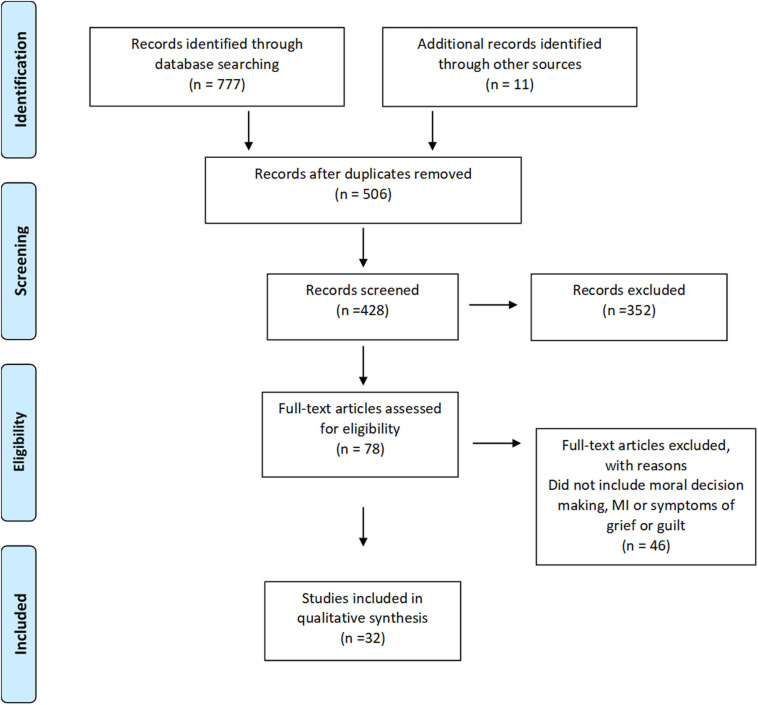
Background: Public Safety Personnel (e.g., firefighters, paramedics, and police officers) are routinely exposed to human suffering and need to make quick, morally challenging decisions. Such decisions can affect their psychological wellbeing. Participating in or observing an event or situation that conflicts with personal values can potentially lead to the development of moral injury. Common stressors associated with moral injury include betrayal, inability to prevent death or harm, and ethical dilemmas. Potentially psychologically traumatic event exposures and post-traumatic stress disorder can be comorbid with moral injury; however, moral injury extends beyond fear to include spiritual, cognitive, emotional or existential struggles, which can produce feelings of severe shame, guilt, and anger. Objective: This scoping review was designed to identify the extant empirical research regarding the construct of moral injury, its associated constructs, and how it relates to moral distress in firefighters, paramedics, and police officers. Methods: A systematic literature search of peer-reviewed research was conducted using databases MEDLINE, EMBASE, APA PsychInfo, CINHAL PLUS, Web of Science, SCOPUS, and Google Scholar. Included studies were selected based on the inclusion criteria before being manually extracted and independently screened by two reviewers. Results: The initial database search returned 777 articles, 506 of which remained after removal of duplicates. Following review of titles, abstracts, and full texts, 32 studies were included in the current review. Participants in the articles were primarily police officers, with fewer articles focusing on paramedics and firefighters. There were two studies that included mixed populations (i.e., one study with police officers, firefighters, and other emergency service workers; one study with paramedic and firefighter incident commanders). Most studies were qualitative and focused on four topics: values, ethical decision-making, organizational betrayal, and spirituality. Conclusion: Public safety organizations appear to recognize the experience of moral distress or moral injury among public safety personnel that results from disconnects between personal core values, formal and informal organizational values, vocational duties, and expectations. Further research is needed to better understand moral distress or moral injury specific to public safety personnel and inform training and treatment in support of public safety personnel mental health.
Overview
The claims and statistics of this paper haven’t been checked yet.
Run the check — free, no account needed. It reads the open-access text and checks the sources it cites.
Integrity signals
Registry
Cites
Statistics
Figures
Verification
Claims the paper makes
The claims and statistics of this paper haven’t been checked yet.
Run the check — free, no account needed. It reads the open-access text and checks the sources it cites.
Claims other papers make about this one
Each is checked against this paper’s own text: does it say what the citing paper says it does?
The cited source says what the claim attributes to it.
In the citing paper
“Inadequately fulfilling caring work according to their own ethical standards might also lead paramedics to develop moral distress, a phenomenon often occurring when healthcare professionals feel powerless to take the ethically correct action [17, 18].”
From Paramedics’ perceptions of job demands and resources in Finnish emergency medical services: a qualitative study (2022) · cites this paper as [17]
Self-check
Percentages, sums and reported differences re-computed from the paper’s own numbers.
The self-check needs the paper’s full text.
Citations
Cites
Scoping studies: towards a methodological framework
Arksey, H., & O'Malley, L. (2005) · International Journal of Social Research Methodology · doi:10.1080/1364557032000119616 · Cited by 36,742
The need to belong: Desire for interpersonal attachments as a fundamental human motivation.
Baumeister, R. F., & Leary, M. R. (1995) · Psychological Bulletin · doi:10.1037//0033-2909.117.3.497 · Cited by 23,245
Scoping studies: advancing the methodology
Levac, D., Colquhoun, H., & O'Brien, K. K. (2010) · Implementation Science · doi:10.1186/1748-5908-5-69 · Cited by 15,268
Perceived organizational support.
Eisenberger, R., Huntington, R., Hutchison, S., & Sowa, D. (1986) · Journal of Applied Psychology · doi:10.1037/0021-9010.71.3.500 · Cited by 10,023
Ethical Decision Making by Individuals in Organizations: An Issue-Contingent Model
Jones, T. M. (1991) · The Academy of Management Review · doi:10.2307/258867 · Cited by 4,135
Moral injury and moral repair in war veterans: A preliminary model and intervention strategy
Litz, B. T., Stein, N., Delaney, E., Lebowitz, L., Nash, W. P., Silva, C., & Maguen, S. (2009) · Clinical Psychology Review · doi:10.1016/j.cpr.2009.07.003 · Cited by 2,738
Popay, J., Roberts, H., Sowden, A., Petticrew, M., Arai, L., Rodgers, M., Britten, N., Roen, K., & Duffy, S. (2006) · Lancaster University · doi:10.13140/2.1.1018.4643 · Cited by 2,070
Nursing practice, the ethical issues
(1985) · International Journal of Nursing Studies · doi:10.1016/0020-7489(85)90057-4 · Cited by 1,524
Culture and stigma: Adding moral experience to stigma theory
Yang, L. H., Kleinman, A., Link, B. G., Phelan, J. C., Lee, S., & Good, B. J. (2006) · Social Science & Medicine · doi:10.1016/j.socscimed.2006.11.013 · Cited by 1,460
The Emerging Meanings of Religiousness and Spirituality: Problems and Prospects
Zinnbauer, B. J., Pargäment, K. I., & Scott, A. B. (1999) · Journal of Personality · doi:10.1111/1467-6494.00077 · Cited by 982
Research works printed but not linked: 10
- Baumeister, 1995, The need to belong., Psychol. Bull., 117, 497, 10.1037/0033-2909.117.3.497 · DOI · Paper page
- Buechner, 2016, Are moral injury and PTSD distinct syndromes: conceptual differences and clinical implications, Veteran and Family Reintegration, 47
- 2019, Glossary of Terms: A Shared Understanding of the Common Terms Used to Describe Psychological Trauma (Version 2.0).
- Ford, 2010, The Relationship Between Spirituality and Marital Satisfaction in Christian Heterosexual Marriages.
- Johnson, 2011, Developing moral resilience amidst moral complexity, Proceedings of the Fort Leavenworth Ethics Symposium: Exploring the Professional Military Ethic, Symposium Report, 275
- Patton, 1999, A Qualitative Study of Spirituality with Veteran Law Enforcement Officers.
- Shay, 1994, Achilles in Vietnam.
- 2015, Table 13-10-0098-01 Mental Health Characteristics and Suicidal Thoughts.
- Tick, 2012, War and the Soul: Healing our Nation’s Veterans from Post-Tramatic Stress Disorder.
- Tovar, 2011, Vicarious traumatization and spirituality in law enforcement., FBI L. Enforc. Bull., 80
Cited by
Sorted by citations
Treatment of Posttraumatic Stress Disorder: A State-of-the-art Review
Burback, L., Brémault‐Phillips, S., Nijdam, M. J., McFARLANE, A. C., & Vermetten, E. H. G. J. M. (2023) · Current Neuropharmacology · doi:10.2174/1570159x21666230428091433 · Cited by 251
Self-citationMoral Injury: An Increasingly Recognized and Widespread Syndrome
Koenig, H. G., & Al Zaben, F. (2021) · Journal of Religion and Health · doi:10.1007/s10943-021-01328-0 · Cited by 166
Moral injury: State of the Science
Litz, B. T. (2025) · Journal of Traumatic Stress · doi:10.1002/jts.23125 · Cited by 71
Xue, Y., Lopes, J., Ritchie, K., D’Alessandro, A. M., Banfield, L., McCabe, R. E., Heber, A., Lanius, R. A., & McKinnon, M. C. (2022) · Frontiers in Psychiatry · doi:10.3389/fpsyt.2022.863232 · Cited by 62
Ericsson, C. R., Lindström, V., Rudman, A., & Nordquist, H. (2022) · BMC Health Services Research · doi:10.1186/s12913-022-08856-9 · Cited by 40
“Inadequately fulfilling caring work according to their own ethical standards might also lead paramedics to develop moral distress, a phenomenon often occurring when healthcare professionals feel powerless to take the ethically correct action [17, 18].”
Background
Metadata
- Authors
- Lentz, L. M., Smith-MacDonald, L., Malloy, D., Carleton, R. N., & Brémault-Phillips, S.
- Affiliations
- Western University (CA)
- University of Regina (CA)
- Corresponding author
- Lentz, Liana M.
- Venue
- Frontiers in Psychology
- Publisher
- Frontiers Media SA
- Published
- 2021-03-31
- Volume
- 12
- Pages
- 639781-639781
- ISSN
- 1664-1078 (ISSN-L)
- PMC
- PMC8044342
- OpenAlex
- W3150699884
- Cited by
- 143
- References
- 116
- Citations by year
- 2026: 34 · 2025: 34 · 2024: 18 · 2023: 29 · 2022: 23 · 2021: 5
- FWCI
- 2.49
- Type
- journal article
- Language
- en
- Open access
- gold
- doi.org
- Licence
- Locations
- Frontiers in Psychology (publishedVersion, cc-by)
- PubMed Central (publishedVersion, cc-by)
- PubMed (publishedVersion)
- DOAJ (DOAJ: Directory of Open Access Journals) (submittedVersion, cc-by-sa)
- oURspace (University of Regina) (submittedVersion, cc-by)
- Funders
- Canadian Institutes of Health Research
- Topics
- Social Sciences › Psychology › Clinical Psychology › Posttraumatic Stress Disorder Research
- Health Sciences › Health Professions › General Health Professions › Ethics in medical practice
- Health Sciences › Medicine › Public Health, Environmental and Occupational Health › Occupational Health and Performance
- Keywords
- moral injury, moral distress, public safety personnel, firefighters, paramedics, police officers, ethical decision-making, personal values, spirituality, guilt and shame, workplace mental health, trauma exposure
About these checks
Registry, retraction, Cites and statistics results are computed, not judged, with one exception: a printed reference that no index lists is read once by a model before it counts as a citation error. Claims are extracted by a model and kept only when their quote appears verbatim in the text; each cited source is then checked, with a model’s help, for whether it says what the claim relies on. Those verdicts can be wrong — read the claim’s quote and the cited source before relying on one.
Statistics and arithmetic are recomputed, not judged.
Confidence bands are shown only for fields calibrated on our annotated test set. None is calibrated yet, so no band is shown.
What counts as a claim ›How we measure confidence ›How we check this ›
Are you an author, or do you see a problem with this page? Request a review
