

The DOI matches its Crossref record; 116 of the 116 references it cites were found in a registry or an index.
Compromised Conscience: A Scoping Review of Moral Injury Among Firefighters, Paramedics, and Police Officers
Open accessAbstract
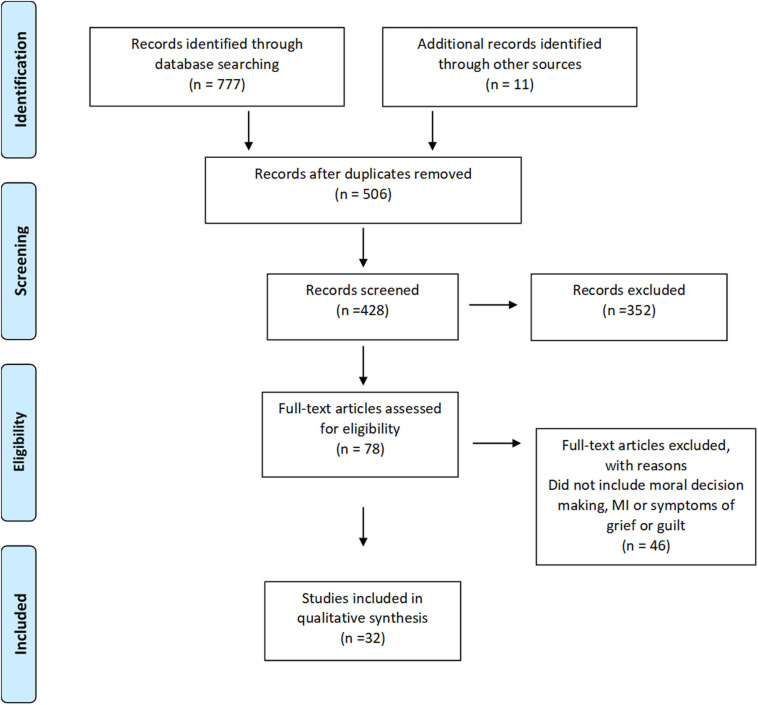
Background: Public Safety Personnel (e.g., firefighters, paramedics, and police officers) are routinely exposed to human suffering and need to make quick, morally challenging decisions. Such decisions can affect their psychological wellbeing. Participating in or observing an event or situation that conflicts with personal values can potentially lead to the development of moral injury. Common stressors associated with moral injury include betrayal, inability to prevent death or harm, and ethical dilemmas. Potentially psychologically traumatic event exposures and post-traumatic stress disorder can be comorbid with moral injury; however, moral injury extends beyond fear to include spiritual, cognitive, emotional or existential struggles, which can produce feelings of severe shame, guilt, and anger. Objective: This scoping review was designed to identify the extant empirical research regarding the construct of moral injury, its associated constructs, and how it relates to moral distress in firefighters, paramedics, and police officers. Methods: A systematic literature search of peer-reviewed research was conducted using databases MEDLINE, EMBASE, APA PsychInfo, CINHAL PLUS, Web of Science, SCOPUS, and Google Scholar. Included studies were selected based on the inclusion criteria before being manually extracted and independently screened by two reviewers. Results: The initial database search returned 777 articles, 506 of which remained after removal of duplicates. Following review of titles, abstracts, and full texts, 32 studies were included in the current review. Participants in the articles were primarily police officers, with fewer articles focusing on paramedics and firefighters. There were two studies that included mixed populations (i.e., one study with police officers, firefighters, and other emergency service workers; one study with paramedic and firefighter incident commanders). Most studies were qualitative and focused on four topics: values, ethical decision-making, organizational betrayal, and spirituality. Conclusion: Public safety organizations appear to recognize the experience of moral distress or moral injury among public safety personnel that results from disconnects between personal core values, formal and informal organizational values, vocational duties, and expectations. Further research is needed to better understand moral distress or moral injury specific to public safety personnel and inform training and treatment in support of public safety personnel mental health.
Overview
The claims and statistics of this paper haven’t been checked yet.
Run the check — free, no account needed. It reads the open-access text and checks the sources it cites.
Integrity signals
Registry
Cites
Statistics
Figures
Verification
Claims the paper makes
The claims and statistics of this paper haven’t been checked yet.
Run the check — free, no account needed. It reads the open-access text and checks the sources it cites.
Claims other papers make about this one
Each is checked against this paper’s own text: does it say what the citing paper says it does?
The cited source says what the claim attributes to it.
In the citing paper
“Inadequately fulfilling caring work according to their own ethical standards might also lead paramedics to develop moral distress, a phenomenon often occurring when healthcare professionals feel powerless to take the ethically correct action [17, 18].”
From Paramedics’ perceptions of job demands and resources in Finnish emergency medical services: a qualitative study (2022) · cites this paper as [17]
Self-check
Percentages, sums and reported differences re-computed from the paper’s own numbers.
The self-check needs the paper’s full text.
Citations
Cites
Scoping studies: towards a methodological framework
Arksey, H., & O'Malley, L. (2005) · International Journal of Social Research Methodology · doi:10.1080/1364557032000119616 · Cited by 36,742
The need to belong: Desire for interpersonal attachments as a fundamental human motivation.
Baumeister, R. F., & Leary, M. R. (1995) · Psychological Bulletin · doi:10.1037//0033-2909.117.3.497 · Cited by 23,245
Scoping studies: advancing the methodology
Levac, D., Colquhoun, H., & O'Brien, K. K. (2010) · Implementation Science · doi:10.1186/1748-5908-5-69 · Cited by 15,268
Perceived organizational support.
Eisenberger, R., Huntington, R., Hutchison, S., & Sowa, D. (1986) · Journal of Applied Psychology · doi:10.1037/0021-9010.71.3.500 · Cited by 10,023
Ethical Decision Making by Individuals in Organizations: An Issue-Contingent Model
Jones, T. M. (1991) · The Academy of Management Review · doi:10.2307/258867 · Cited by 4,135
Moral injury and moral repair in war veterans: A preliminary model and intervention strategy
Litz, B. T., Stein, N., Delaney, E., Lebowitz, L., Nash, W. P., Silva, C., & Maguen, S. (2009) · Clinical Psychology Review · doi:10.1016/j.cpr.2009.07.003 · Cited by 2,738
Popay, J., Roberts, H., Sowden, A., Petticrew, M., Arai, L., Rodgers, M., Britten, N., Roen, K., & Duffy, S. (2006) · Lancaster University · doi:10.13140/2.1.1018.4643 · Cited by 2,070
Nursing practice, the ethical issues
(1985) · International Journal of Nursing Studies · doi:10.1016/0020-7489(85)90057-4 · Cited by 1,524
Culture and stigma: Adding moral experience to stigma theory
Yang, L. H., Kleinman, A., Link, B. G., Phelan, J. C., Lee, S., & Good, B. J. (2006) · Social Science & Medicine · doi:10.1016/j.socscimed.2006.11.013 · Cited by 1,460
The Emerging Meanings of Religiousness and Spirituality: Problems and Prospects
Zinnbauer, B. J., Pargäment, K. I., & Scott, A. B. (1999) · Journal of Personality · doi:10.1111/1467-6494.00077 · Cited by 982
Shay, J. (2014) · Psychoanalytic Psychology · doi:10.1037/a0036090 · Cited by 882
Smith, C. P., & Freyd, J. J. (2014) · American Psychologist · doi:10.1037/a0037564 · Cited by 849
Moral Injury: An Integrative Review
Griffin, B. J., Purcell, N., Burkman, K., Litz, B. T., Bryan, C. J., Schmitz, M., Villierme, C., Walsh, J., & Maguen, S. (2019) · Journal of Traumatic Stress · doi:10.1002/jts.22362 · Cited by 752
Concerns about measuring spirituality in research
Koenig, H. G. (2008) · Journal of Nervous & Mental Disease · doi:10.1097/nmd.0b013e31816ff796 · Cited by 730
Lamiani, G., Borghi, L., & Argentero, P. (2015) · Journal of Health Psychology · doi:10.1177/1359105315595120 · Cited by 580
Mental Disorder Symptoms among Public Safety Personnel in Canada
Carleton, R. N., Afifi, T. O., Turner, S., Taillieu, T., Duranceau, S., LeBouthillier, D. M., Sareen, J., Ricciardelli, R., MacPhee, R. S., Groll, D., et al. (2018) · The Canadian Journal of Psychiatry · doi:10.1177/0706743717723825 · Cited by 558
Self-citationSense of belonging and indicators of social and psychological functioning
Hagerty, B. M., Williams, R. A., Coyne, J. C., & Early, M. R. (1996) · Archives of Psychiatric Nursing · doi:10.1016/s0883-9417(96)80029-x · Cited by 541
An exploration of the viability and usefulness of the construct of moral injury in war veterans.
Drescher, K. D., Foy, D. W., Kelly, C. M., Leshner, A., Schutz, K., & Litz, B. T. (2011) · Traumatology An International Journal · doi:10.1177/1534765610395615 · Cited by 494
Educational Leadership: The Moral Art
Coombs, C. R. C., & Hodgkinson, C. (1992) · Canadian Journal of Education / Revue canadienne de l éducation · doi:10.2307/1495323 · Cited by 439
Moral distress experienced by nurses
Oh, Y., & Gastmans, C. (2013) · Nursing Ethics · doi:10.1177/0969733013502803 · Cited by 430
Occupational moral injury and mental health: systematic review and meta-analysis
Williamson, V., Stevelink, S. A. M., & Greenberg, N. L. (2018) · The British Journal of Psychiatry · doi:10.1192/bjp.2018.55 · Cited by 395
The Effects of Sense of Belonging, Social Support, Conflict, and Loneliness on Depression
Hagerty, B. M., & Williams, A. (1999) · Nursing Research · doi:10.1097/00006199-199907000-00004 · Cited by 392
Defining and assessing moral injury: A syndrome perspective
Jinkerson, J. D. (2016) · Traumatology · doi:10.1037/trm0000069 · Cited by 381
Corneil, W., Beaton, R. D., Murphy, S. A., Johnson, C., & Pike, K. (1999) · Journal of Occupational Health Psychology · doi:10.1037//1076-8998.4.2.131 · Cited by 336
Corneil, W., Beaton, R., Murphy, S., Johnson, C., & Pike, K. (1999) · Journal of Occupational Health Psychology · doi:10.1037/1076-8998.4.2.131 · Cited by 336
Exposures to potentially traumatic events among public safety personnel in Canada
Carleton, R. N., Afifi, T. O., Taillieu, T., Turner, S., Krakauer, R., Anderson, G. S., MacPhee, R. S., Ricciardelli, R., Cramm, H. A., Groll, D., et al. (2019) · Canadian Journal of Behavioural Science/Revue canadienne des sciences du comportement · doi:10.1037/cbs0000115 · Cited by 324
Self-citationLitz, B. T., & Kerig, P. K. (2019) · Journal of Traumatic Stress · doi:10.1002/jts.22405 · Cited by 319
Dirty work designations: How police officers account for their use of coercive force
Dick, P. (2005) · Human Relations · doi:10.1177/0018726705060242 · Cited by 287
Moral injury, posttraumatic stress disorder, and suicidal behavior among National Guard personnel
Bryan, C. J., Bryan, A. O., Roberge, E., Leifker, F. R., & Rozek, D. C. (2018) · Psychological Trauma: Theory, Research, Practice, and Policy · doi:10.1037/tra0000290 · Cited by 230
A functional approach to understanding and treating military-related moral injury
Farnsworth, J. K., Drescher, K. D., Evans, W., & Walser, R. D. (2017) · Journal of Contextual Behavioral Science · doi:10.1016/j.jcbs.2017.07.003 · Cited by 226
Assessing the Relative Impact of Diverse Stressors among Public Safety Personnel
Carleton, R. N., Afifi, T. O., Taillieu, T., Turner, S., Mason, J. E., Ricciardelli, R., McCreary, D. R., Vaughan, A. D., Anderson, G. S., Krakauer, R. L., et al. (2020) · International Journal of Environmental Research and Public Health · doi:10.3390/ijerph17041234 · Cited by 225
Self-citationRaganella, A. J., & White, M. D. (2004) · Journal of Criminal Justice · doi:10.1016/j.jcrimjus.2004.08.009 · Cited by 222
Stigma: a social, cultural and moral process
Kleinman, A., & Hall‐Clifford, R. (2009) · Journal of Epidemiology & Community Health · doi:10.1136/jech.2008.084277 · Cited by 220
Moral injury, suicidal ideation, and suicide attempts in a military sample.
Bryan, A. O., Bryan, C. J., Morrow, C. E., Etienne, N., & Ray-Sannerud, B. N. (2014) · Traumatology An International Journal · doi:10.1037/h0099852 · Cited by 210
Brough, P. (2004) · International Journal of Stress Management · doi:10.1037/1072-5245.11.3.227 · Cited by 199
Police Ethics and Integrity: Breaking the Blue Code of Silence
Westmarland, L. (2005) · Policing & Society · doi:10.1080/10439460500071721 · Cited by 198
Huffman, D. M., & Rittenmeyer, L. (2012) · Critical Care Nursing Clinics of North America · doi:10.1016/j.ccell.2012.01.004 · Cited by 197
Papazoglou, K., & Chopko, B. A. (2017) · Frontiers in Psychology · doi:10.3389/fpsyg.2017.01999 · Cited by 188
Moral injury and PTSD: Often co-occurring yet mechanistically different
Barnes, H. A., Hurley, R. A., & Taber, K. H. (2019) · The Journal of Neuropsychiatry and Clinical Neurosciences · doi:10.1176/appi.neuropsych.19020036 · Cited by 172
Jordan, A., Eisen, E., Bolton, E. E., Nash, W. P., & Litz, B. T. (2017) · Psychological Trauma Theory Research Practice and Policy · doi:10.1037/tra0000249 · Cited by 171
White, M. D., Cooper, J. A., Saunders, J. M., & Raganella, A. J. (2010) · Journal of Criminal Justice · doi:10.1016/j.jcrimjus.2010.04.022 · Cited by 164
The impact of killing and injuring others on mental health symptoms among police officers
Komarovskaya, I., Maguen, S., McCaslin, S. E., Metzler, T. J., Madan, A., Brown, A. D., Galatzer-Levy, I. R., Henn-Haase, C., & Marmar, C. R. (2011) · Journal of Psychiatric Research · doi:10.1016/j.jpsychires.2011.05.004 · Cited by 161
Deconstructing the Gestalt: Mechanisms of Fear, Threat, and Trauma Memory Encoding
Maddox, S. A., Hartmann, J., Ross, R., & Ressler, K. J. (2019) · Neuron · doi:10.1016/j.neuron.2019.03.017 · Cited by 160
Carey, L. B., Hodgson, T. J., Krikheli, L., Soh, R. Y., Armour, A., Singh, T. K., & Impiombato, C. G. (2016) · Journal of Religion and Health · doi:10.1007/s10943-016-0231-x · Cited by 159
Assessment of Moral Injury in Veterans and Active Duty Military Personnel With PTSD: A Review
Koenig, H. G., Youssef, N. A., & Pearce, M. (2019) · Frontiers in Psychiatry · doi:10.3389/fpsyt.2019.00443 · Cited by 158
Vargas, A. F., Hanson, T. M., Kraus, D., Drescher, K. D., & Foy, D. W. (2013) · Traumatology An International Journal · doi:10.1177/1534765613476099 · Cited by 139
Rushton, C. H. (2017) · AJN American Journal of Nursing · doi:10.1097/01.naj.0000512205.93596.00 · Cited by 134
A concept analysis of moral resilience
Young, P. D., & Rushton, C. H. (2017) · Nursing Outlook · doi:10.1016/j.outlook.2017.03.009 · Cited by 132
Spirituality and Mental Well-Being in Combat Veterans: A Systematic Review
Smith‐MacDonald, L., Norris, J. M., Raffin‐Bouchal, S., & Sinclair, S. (2017) · Military Medicine · doi:10.7205/milmed-d-17-00099 · Cited by 128
Self-citationWorthington, E. L., & Langberg, D. (2012) · Journal of Psychology and Theology · doi:10.1177/009164711204000403 · Cited by 107
Ames, D., Erickson, Z. D., Youssef, N. A., Arnold, I. Y., Adamson, C. S., Sones, A. C., Yin, J., Haynes, K., Volk, F. A., Teng, E. J., et al. (2018) · Military Medicine · doi:10.1093/milmed/usy148 · Cited by 103
Guilt, shame and need for a container: a study of post-traumatic stress among ambulance personnel
Jonsson, A., & Segesten, K. (2004) · Accident and Emergency Nursing · doi:10.1016/j.aaen.2004.05.001 · Cited by 101
Giving “Moral Distress” a Voice: Ethical Concerns among Neonatal Intensive Care Unit Personnel
HEFFERMAN, P., & Heilig, S. (1999) · Cambridge Quarterly of Healthcare Ethics · doi:10.1017/s0963180199802060 · Cited by 98
Kelley, M. L., Bravo, A. J., Davies, R. L., Hamrick, H. C., Vinci, C., & Redman, J. C. (2019) · Psychological Trauma Theory Research Practice and Policy · doi:10.1037/tra0000447 · Cited by 98
An update of the empirical case for the need to belong.
Gere, J., & MacDonald, G. (2010) · The Journal of Individual Psychology · Cited by 95
Ethics Education in the Military
Robinson, P. D., de Lee, N., & Carrick, D. (2008) · Cited by 93
Nazarov, A., Fikretoglu, D., Liu, A., Thompson, M. M., & Zamorski, M. A. (2018) · Acta Psychiatrica Scandinavica · doi:10.1111/acps.12866 · Cited by 92
Spiritual features of war-related moral injury: A primer for clinicians.
Wortmann, J. H., Eisen, E., Hundert, C., Jordan, A., Smith, M. W., Nash, W. P., & Litz, B. T. (2017) · Spirituality in Clinical Practice · doi:10.1037/scp0000140 · Cited by 83
Conceptualizing Police Complex Spiral Trauma and its applications in the police field
Papazoglou, K. (2013) · Traumatology · doi:10.1177/1534765612466151 · Cited by 80
Police officers, mental (ill-)health and spoiled identity
Bullock, K., & Garland, J. (2017) · Criminology & Criminal Justice · doi:10.1177/1748895817695856 · Cited by 80
Torabi, M., Borhani, F., Abbaszadeh, A., & Atashzadeh-Shoorideh, F. (2018) · BMC Medical Ethics · doi:10.1186/s12910-018-0334-x · Cited by 80
Battles, A. R., Bravo, A. J., Kelley, M. L., White, T. D., Braitman, A. L., & Hamrick, H. C. (2018) · Traumatology An International Journal · doi:10.1037/trm0000153 · Cited by 76
Spirituality and Moral Injury Among Military Personnel: A Mini-Review
Brémault‐Phillips, S., Pike, A., Scarcella, F., & Cherwick, T. (2019) · Frontiers in Psychiatry · doi:10.3389/fpsyt.2019.00276 · Cited by 74
Self-citationSelf-forgiveness, posttraumatic stress, and suicide attempts among military personnel and veterans.
Bryan, A. O., Theriault, J. L., & Bryan, C. J. (2014) · Traumatology An International Journal · doi:10.1037/trm0000017 · Cited by 72
Smith‐MacDonald, L., Morin, J.-S., & Brémault‐Phillips, S. (2018) · Frontiers in Psychiatry · doi:10.3389/fpsyt.2018.00592 · Cited by 70
Self-citationPolice violence in West Africa: Perpetrators’ and ethnographers’ dilemmas
Beek, J., & Göpfert, M. (2012) · Ethnography · doi:10.1177/1466138112463653 · Cited by 69
Sources of moral injury among war veterans: A qualitative evaluation
Schorr, Y., Stein, N. R., Maguen, S., Barnes, J. B., Bosch, J. O., & Litz, B. T. (2018) · Journal of Clinical Psychology · doi:10.1002/jclp.22660 · Cited by 69
Morality in Law Enforcement: Chasing “Bad Guys” with the Los Angeles Police Department
Herbert, S. (1996) · Law & Society Review · doi:10.2307/3054118 · Cited by 68
Veterans’ Perspectives on the Psychosocial Impact of Killing in War
Purcell, N., Koenig, C. J., Bosch, J. O., & Maguen, S. (2016) · The Counseling Psychologist · doi:10.1177/0011000016666156 · Cited by 68
How do morally injurious events occur? A qualitative analysis of perspectives of veterans with PTSD.
Currier, J. M., McCormick, W. H., & Drescher, K. D. (2015) · Traumatology An International Journal · doi:10.1037/trm0000027 · Cited by 66
Nash, W. P., Vasterling, J. J., Ewing‐Cobbs, L., Horn, S. R. G.-V., Gaskin, T. A., Golden, J., Riley, W. T., Bowles, S. V., Favret, J. V., Lester, P. E., et al. (2010) · Archives of Physical Medicine and Rehabilitation · doi:10.1016/j.apmr.2010.06.035 · Cited by 65
Reay, G., Rankin, J. A., Smith‐MacDonald, L., & Lazarenko, G. (2018) · BMC Emergency Medicine · doi:10.1186/s12873-018-0194-1 · Cited by 64
Self-citationEthical Challenges in Emergency Medical Services: Controversies and Recommendations
Becker, T. K., Gausche‐Hill, M., Aswegan, A. L., Baker, E. F., Bookman, K. J., Bradley, R. N., Lorenzo, R. A. D., & Schoenwetter, D. J. (2013) · Prehospital and Disaster Medicine · doi:10.1017/s1049023x13008728 · Cited by 63
Angehrn, A., Krakauer, R. L., & Carleton, R. N. (2020) · Cognitive Therapy and Research · doi:10.1007/s10608-020-10107-2 · Cited by 61
Self-citationAmbulance personnel: Systematic review of mental health symptoms.
Wagner, S. L., White, N. C., Regehr, C., White, M., Alden, L. E., Buys, N. J., Carey, M. G., Corneil, W., Fyfe, T., Matthews, L. R., et al. (2020) · Traumatology An International Journal · doi:10.1037/trm0000251 · Cited by 56
Effectiveness of battlefield-ethics training during combat deployment: a programme assessment
Warner, C. H., Appenzeller, G. N., Mobbs, A., Parker, J. R., Warner, C. M., Grieger, T. A., & Hoge, C. W. (2011) · The Lancet · doi:10.1016/s0140-6736(11)61039-8 · Cited by 55
Thompson, M. M., & Jetly, R. (2014) · European Journal of Psychotraumatology · doi:10.3402/ejpt.v5.23668 · Cited by 54
Individual value preferences among American police officers
Zhao, J.-H., He, N., & Lovrich, N. (1998) · Policing An International Journal · doi:10.1108/13639519810206583 · Cited by 52
Moral Injury and Spiritual Struggles in Military Veterans: A Latent Profile Analysis
Currier, J. M., Foster, J. D., & Isaak, S. L. (2019) · Journal of Traumatic Stress · doi:10.1002/jts.22378 · Cited by 52
Maran, D. A., Zedda, M., & Varetto, A. (2018) · International Journal of Environmental Research and Public Health · doi:10.3390/ijerph15010166 · Cited by 45
Rittenmeyer, L., & Huffman, D. M. (2009) · The JBI Database of Systematic Reviews and Implementation Reports · doi:10.11124/01938924-200907280-00001 · Cited by 43
Virtual morality in the helping professions: Simulated action and resilience
Francis, K., Gummerum, M., Ganis, G., Howard, I. S., & Terbeck, S. (2017) · British Journal of Psychology · doi:10.1111/bjop.12276 · Cited by 38
Nelson, P. A., Cordingley, L., Kapur, N., Chew-Graham, C. A., Shaw, J. J., Smith, S., McGale, B., & Mcdonnell, S. (2020) · Frontiers in Psychology · doi:10.3389/fpsyg.2020.00722 · Cited by 38
Moral injury and paramedic practice
Murray, E. (2019) · Journal of Paramedic Practice · doi:10.12968/jpar.2019.11.10.424 · Cited by 36
Moral dilemmas in a military context. A case study of a train the trainer course on military ethics
van Baarle, E., Bosch, J., Widdershoven, G. A. M., Verweij, D. E. M., & Molewijk, B. C. (2015) · Journal of Moral Education · doi:10.1080/03057240.2015.1087389 · Cited by 35
STRENGTHENING MORAL COMPETENCE: A ‘TRAIN THE TRAINER’ COURSE ON MILITARY ETHICS
Wortel, E., & Bosch, J. (2011) · Journal of Military Ethics · doi:10.1080/15027570.2011.562372 · Cited by 33
The necessity of dishonesty: police deviance, ‘making the case’, and the public good
Goldschmidt, J., & Anonymous (2008) · Policing & Society · doi:10.1080/10439460802008637 · Cited by 33
McCormack, L., & Riley, L. S. (2016) · Traumatology An International Journal · doi:10.1037/trm0000059 · Cited by 33
Futile cardiopulmonary resuscitation for the benefit of others: An ethical analysis
Bremer, A., & Sandman, L. (2011) · Nursing Ethics · doi:10.1177/0969733011404339 · Cited by 31
Chopko, B. A., Facemire, V. C., Palmieri, P. A., & Schwartz, R. C. (2016) · Criminal Justice Studies · doi:10.1080/1478601x.2016.1216412 · Cited by 31
Military Moral Injury: An Evidence-Based and Intercultural Approach to Spiritual Care
Doehring, C. E. (2018) · Pastoral Psychology · doi:10.1007/s11089-018-0813-5 · Cited by 30
Policing and spirituality: their impact on brain integration and consciousness
Charles, G., Travis, F., & Smith, J. A. (2014) · Journal of Management Spirituality & Religion · doi:10.1080/14766086.2014.887479 · Cited by 29
Correlates of career traumatization and symptomatology among active-duty police officers
Chopko, B. A., & Schwartz, R. C. (2012) · Criminal Justice Studies · doi:10.1080/1478601x.2012.657905 · Cited by 28
Correlates of mental health in occupations at risk for traumatization: a cross-sectional study
Schäfer, S. K., Sopp, M. R., Staginnus, M., Lass‐Hennemann, J., & Michael, T. (2020) · BMC Psychiatry · doi:10.1186/s12888-020-02704-y · Cited by 28
Ogińska-Bulik, N. J. (2013) · Medycyna Pracy · doi:10.13075/mp.5893.2013.0048 · Cited by 27
Organisational factors: impacting on health for ambulance personnel
Harrison, J. (2018) · International Journal of Emergency Services · doi:10.1108/ijes-02-2018-0013 · Cited by 24
Castro, C. A., & McGurk, D. (2007) · Traumatology An International Journal · doi:10.1177/1534765607309951 · Cited by 24
The Moral Costs of Discretionary Decision-Making in Crisis
Boin, A., & Nieuwenburg, P. (2013) · Public Integrity · doi:10.2753/pin1099-9922150403 · Cited by 20
Fairness, job frustration, and moral dilemmas in policing that impact police effectiveness
Cebulak, W. (2001) · Journal of Police and Criminal Psychology · doi:10.1007/bf02805180 · Cited by 19
Jafari, M., Hosseini, M., Maddah, S. S. B., Khankeh, H. R., & Ebadi, A. (2019) · DOAJ (DOAJ: Directory of Open Access Journals) · doi:10.4103/nms.nms_69_18 · Cited by 18
Avoidant But Not Avoiding: The Mediational Role of Anticipated Regret in Police Decision-making
Brown, S. G. U., & Daus, C. S. (2015) · Journal of Police and Criminal Psychology · doi:10.1007/s11896-015-9185-2 · Cited by 15
Keeping the Peelian Spirit: Resilience and Spirituality in Policing
Hesketh, I., Ivy, J., & Smith, J. A. (2014) · The Police Journal Theory Practice and Principles · doi:10.1350/pojo.2014.87.3.672 · Cited by 14
Moral decision making, religious strain, and the experience of moral injury.
Lancaster, S. L., & Miller, M. (2019) · Psychological Trauma Theory Research Practice and Policy · doi:10.1037/tra0000518 · Cited by 12
Line-of-duty death: psychological treatment of traumatic bereavement in law enforcement.
Miller, L. (2007) · PubMed · Cited by 11
Policing the Homeless: An Ethical Dilemma
Kleinig, J. (1993) · Journal of Social Distress and the Homeless · doi:10.1007/bf01065524 · Cited by 10
Police training for the whole person: An exploration of the spiritual dimension
Smith, J. A. (2009) · PsycEXTRA Dataset · doi:10.1037/e511622010-002 · Cited by 10
Legislation vs. morality – a police officer’s ethical dilemma
Norberg, K. (2011) · Police Practice and Research · doi:10.1080/15614263.2011.627741 · Cited by 8
Does Bureaucracy Stifle Moral Agency?
Adewale, A. (2017) · International Journal of Public Administration in the Digital Age · doi:10.4018/ijpada.2017040101 · Cited by 6
Contextual factors affecting moral stress: a study of military and police officers
Hyllengren, P., Nilsson, S., Ohlsson, A., Kallenberg, K., Waaler, G., & Larsson, G. (2016) · International Journal of Public Leadership · doi:10.1108/ijpl-04-2016-0019 · Cited by 6
Reynolds, P. D., & Helfers, R. C. (2018) · International Journal of Police Science & Management · doi:10.1177/1461355718816718 · Cited by 6
A Brief Discussion of Effective Ways to Teach Potentially Life-Saving Psychology
Papazoglou, K., Blumberg, D. M., & Schlosser, M. (2020) · Salus journal · Cited by 5
Spirituality: The DNA of law enforcement practice
Feemster, S. L. (2007) · PsycEXTRA Dataset · doi:10.1037/e724092007-003 · Cited by 5
How Spirituality Is Incorporated in Police Work: A Qualitative Study
Charles, G. (2009) · PsycEXTRA Dataset · doi:10.1037/e511562010-006 · Cited by 5
An Ethnographic Exploration of Moral Agency in Emergency Medicine
Lim, N. M. Q. (2017) · Columbia Academic Commons (Columbia University) · doi:10.7916/d8xs66rz · Cited by 4
Healthcare leadership and applied philosophy: An essential resource
Fistein, E., & Malloy, D. C. (2017) · Healthcare Management Forum · doi:10.1177/0840470417703236 · Cited by 2
Self-citationImpact of Spiritual/Religious Beliefs on Incidents of Trauma Symptoms in Firefighters
Janas, D. M. (n.d.) · ProQuest Demo Repository · Cited by 1
Research works printed but not linked: 10
- Baumeister, 1995, The need to belong., Psychol. Bull., 117, 497, 10.1037/0033-2909.117.3.497 · DOI · Paper page
- Buechner, 2016, Are moral injury and PTSD distinct syndromes: conceptual differences and clinical implications, Veteran and Family Reintegration, 47
- 2019, Glossary of Terms: A Shared Understanding of the Common Terms Used to Describe Psychological Trauma (Version 2.0).
- Ford, 2010, The Relationship Between Spirituality and Marital Satisfaction in Christian Heterosexual Marriages.
- Johnson, 2011, Developing moral resilience amidst moral complexity, Proceedings of the Fort Leavenworth Ethics Symposium: Exploring the Professional Military Ethic, Symposium Report, 275
- Patton, 1999, A Qualitative Study of Spirituality with Veteran Law Enforcement Officers.
- Shay, 1994, Achilles in Vietnam.
- 2015, Table 13-10-0098-01 Mental Health Characteristics and Suicidal Thoughts.
- Tick, 2012, War and the Soul: Healing our Nation’s Veterans from Post-Tramatic Stress Disorder.
- Tovar, 2011, Vicarious traumatization and spirituality in law enforcement., FBI L. Enforc. Bull., 80
Cited by
Sorted by citations
Treatment of Posttraumatic Stress Disorder: A State-of-the-art Review
Burback, L., Brémault‐Phillips, S., Nijdam, M. J., McFARLANE, A. C., & Vermetten, E. H. G. J. M. (2023) · Current Neuropharmacology · doi:10.2174/1570159x21666230428091433 · Cited by 251
Self-citationMoral Injury: An Increasingly Recognized and Widespread Syndrome
Koenig, H. G., & Al Zaben, F. (2021) · Journal of Religion and Health · doi:10.1007/s10943-021-01328-0 · Cited by 166
Moral injury: State of the Science
Litz, B. T. (2025) · Journal of Traumatic Stress · doi:10.1002/jts.23125 · Cited by 71
Xue, Y., Lopes, J., Ritchie, K., D’Alessandro, A. M., Banfield, L., McCabe, R. E., Heber, A., Lanius, R. A., & McKinnon, M. C. (2022) · Frontiers in Psychiatry · doi:10.3389/fpsyt.2022.863232 · Cited by 62
Ericsson, C. R., Lindström, V., Rudman, A., & Nordquist, H. (2022) · BMC Health Services Research · doi:10.1186/s12913-022-08856-9 · Cited by 40
“Inadequately fulfilling caring work according to their own ethical standards might also lead paramedics to develop moral distress, a phenomenon often occurring when healthcare professionals feel powerless to take the ethically correct action [17, 18].”
Background
Metadata
- Authors
- Lentz, L. M., Smith-MacDonald, L., Malloy, D., Carleton, R. N., & Brémault-Phillips, S.
- Affiliations
- Western University (CA)
- University of Regina (CA)
- Corresponding author
- Lentz, Liana M.
- Venue
- Frontiers in Psychology
- Publisher
- Frontiers Media SA
- Published
- 2021-03-31
- Volume
- 12
- Pages
- 639781-639781
- ISSN
- 1664-1078 (ISSN-L)
- PMC
- PMC8044342
- OpenAlex
- W3150699884
- Cited by
- 143
- References
- 116
- Citations by year
- 2026: 34 · 2025: 34 · 2024: 18 · 2023: 29 · 2022: 23 · 2021: 5
- FWCI
- 2.49
- Type
- journal article
- Language
- en
- Open access
- gold
- doi.org
- Licence
- Locations
- Frontiers in Psychology (publishedVersion, cc-by)
- PubMed Central (publishedVersion, cc-by)
- PubMed (publishedVersion)
- DOAJ (DOAJ: Directory of Open Access Journals) (submittedVersion, cc-by-sa)
- oURspace (University of Regina) (submittedVersion, cc-by)
- Funders
- Canadian Institutes of Health Research
- Topics
- Social Sciences › Psychology › Clinical Psychology › Posttraumatic Stress Disorder Research
- Health Sciences › Health Professions › General Health Professions › Ethics in medical practice
- Health Sciences › Medicine › Public Health, Environmental and Occupational Health › Occupational Health and Performance
- Keywords
- moral injury, moral distress, public safety personnel, firefighters, paramedics, police officers, ethical decision-making, personal values, spirituality, guilt and shame, workplace mental health, trauma exposure
About these checks
Registry, retraction, Cites and statistics results are computed, not judged, with one exception: a printed reference that no index lists is read once by a model before it counts as a citation error. Claims are extracted by a model and kept only when their quote appears verbatim in the text; each cited source is then checked, with a model’s help, for whether it says what the claim relies on. Those verdicts can be wrong — read the claim’s quote and the cited source before relying on one.
Statistics and arithmetic are recomputed, not judged.
Confidence bands are shown only for fields calibrated on our annotated test set. None is calibrated yet, so no band is shown.
What counts as a claim ›How we measure confidence ›How we check this ›
Are you an author, or do you see a problem with this page? Request a review
