

The DOI matches its Crossref record; 1 of the 1 references it cites were found in a registry or an index.
Relationship Between Knowledge Base and Innovation-Driven Growth: Moderated by Organizational Character
Open accessAbstract
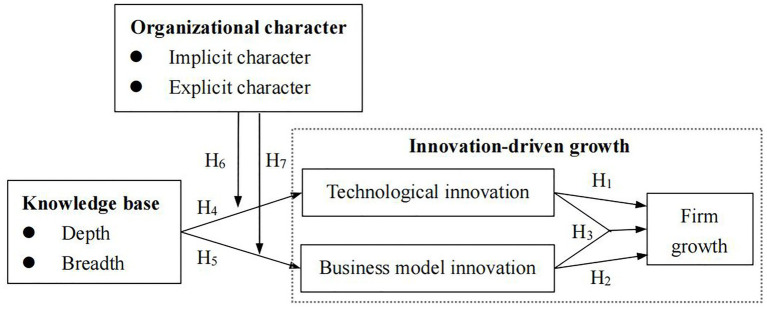
Purpose:On the background of innovation-driven growth strategy of the Chinese government, this study aims to explore the impact of the knowledge base on innovation-driven growth of a firm, which is moderated by organizational character. Design/methodology/approach:Based on the data of 965 Chinese listed companies, some hypotheses were tested using the method of hierarchical regression analysis. Findings:Organizational growth relies on both technological and business model innovations and their interactive effect. Knowledge base, both breadth and depth, makes a positive impact on the innovation-driven growth of an enterprise. In the impacting mechanism, an explicit organizational character not only has direct positive effects on business model innovation, it also strengthens the effect of knowledge breadth on business model innovation. On the contrary, an implicit organizational character is not significantly related to innovation. Research limitations/implications:In order to achieve growth, enterprises are suggested to adopt such dual innovation strategy, led by technological innovation and supplemented with business model innovation, which is supported by the integrated management of intangible resources, deep and broad knowledge, and explicit organizational character. Originality/value:A new theoretical framework of organizational innovation-driven growth was proposed. The realization paths of innovation-driven growth were explored. The idea of collaborative governance between the knowledge base and organizational character was raised.
Overview
The claims and statistics of this paper haven’t been checked yet.
Run the check — free, no account needed. It reads the open-access text and checks the sources it cites.
Integrity signals
Registry
Cites
Statistics
Figures
Verification
Claims the paper makes
The claims and statistics of this paper haven’t been checked yet.
Run the check — free, no account needed. It reads the open-access text and checks the sources it cites.
Self-check
Percentages, sums and reported differences re-computed from the paper’s own numbers.
The self-check needs the paper’s full text.
Citations
Cites
The fit between product market strategy and business model: implications for firm performance
Zott, C., & Amit, R. (2008) · Strategic Management Journal · doi:10.1002/smj.642 · Cited by 1,731
Research works printed but not linked: 83
- Ahlstrom, 2010, Innovation and growth: how business contributes to society, Acad. Manag. Perspect., 24, 11, 10.5465/amp.24.3.11 · DOI
- An, 2021, The match between business model design and knowledge base in firm growth: from a knowledge-based view
- Azar, 2017, Organizational innovation, technological innovation, and export performance: the effects of innovation radicalness and extensiveness, Int. Bus. Rev., 26, 324, 10.1016/j.ibusrev.2016.09.002 · DOI
- Boh, 2014, Balancing breadth and depth of expertise for innovation: a 3M story, Res. Policy, 43, 349, 10.1016/j.respol.2013.10.009 · DOI
- Bottazzi, 2001, Innovation and corporate growth in the evolution of the drug industry, Int. J. Ind. Organ., 19, 1161, 10.1016/S0167-7187(01)00068-6 · DOI
- Bridges, 2000, The Character of Organizations: Using Personality Type in Organization Development
- Byun, 2018, Technological innovation strategy: how do technology life cycles change by technological area, Tech. Anal. Strat. Manag., 30, 98, 10.1080/09537325.2017.1297397 · DOI
- Caloghirou, 2018, How do employee training and knowledge stocks affect product innovation?, Econ. Innov. New Technol., 27, 343, 10.1080/10438599.2017.1362796 · DOI
- Camisón, 2014, Organizational innovation as an enabler of technological innovation capabilities and firm performance, J. Bus. Res., 67, 2891, 10.1016/j.jbusres.2012.06.004 · DOI
- Carayannopoulos, 2010, External knowledge sourcing in biotechnology through acquisition versus alliance: a KBV approach, Res. Policy, 39, 254, 10.1016/j.respol.2009.12.005 · DOI
- Chatterjee, 2021, Does data-driven culture impact innovation and performance of a firm? An empirical examination, 10.1007/s10479-020-03887-z · DOI · Paper page
- Chen, 2012, The effects of related and unrelated technological diversification on innovation performance and corporate growth in the Taiwan’s semiconductor industry, Scientometrics, 92, 117, 10.1007/s11192-012-0720-y · DOI
- 2020, China Statistical Yearbook 2019
- Costa, 1992, Normal personality assessment in clinical practice: the NEO personality inventory, Psychol. Assess., 4, 5, 10.1037/1040-3590.4.1.5 · DOI · Paper page
- Dalgic, 2021, Innovation and firm growth: Turkish manufacturing and services SMEs
- Davies, 2004, A corporate character scale to assess employee and customer views of organization reputation, Corp. Reput. Rev., 7, 125, 10.1057/palgrave.crr.1540216 · DOI
- Estrada, 2016, Coopetition and product innovation performance: the role of internal knowledge sharing mechanisms and formal knowledge protection mechanisms, Ind. Mark. Manag., 100, 56, 10.1016/j.indmarman.2015.11.013 · DOI
- Fang, 2020, China’s rising IQ (innovation quotient) and growth: firm-level evidence, J. Dev. Econ., 147, 102561, 10.1016/j.jdeveco.2020.102561 · DOI
- Fiorentino, 2020, The early growth of start-ups: innovation matters. Evidence from Italy, 10.1108/EJIM-02-2020-0057 · DOI
- Gerdoçi, 2018, Business model design and firm performance: evidence of interactive effects from a developing economy, Eur. J. Innov. Manag., 21, 315, 10.1108/EJIM-02-2017-0012 · DOI
- Geuens, 2009, A new measure of brand personality, Int. J. Res. Mark., 26, 97, 10.1016/j.ijresmar.2008.12.002 · DOI
- Gifford, 1992, Innovation, firm size and growth in a centralized organization, RAND J. Econ., 23, 284, 10.2307/2555989 · DOI
- Grillitsch, 2017, Knowledge base combinations and innovation performance in Swedish regions, Econ. Geogr., 93, 458, 10.1080/00130095.2016.1154442 · DOI
- Heide, 1994, Interorganizational governance in marketing channels, J. Mark., 58, 71, 10.1177/002224299405800106 · DOI
- Holahan, 2014, Product development as core competence: how formal product development practices differ for radical, more innovative, and incremental product innovations, J. Prod. Innov. Manag., 31, 329, 10.1111/jpim.12098 · DOI
- Hu, 2012, Business model innovation, technological innovation and firm performance: an empirical study of listed companies on the GEM, Sci. Tech. Progress Policy, 29, 95, 10.3969/j.issn.1001-7348.2012.03.023 · DOI
- Hu, 2014, Linking business models with technological innovation performance through organizational learning, Eur. Manag. J., 32, 587, 10.1016/j.emj.2013.10.009 · DOI
- Huarng, 2020, Knowledge, business, and innovation: economies and sustainability of future growth, J. Bus. Res., 112, 236, 10.1016/j.jbusres.2020.03.022 · DOI
- Hussain, 2016, Intellectual property appropriation strategy and its impact on innovation performance, Int. J. Innov. Manag., 20, 1650016, 10.1142/S136391961650016X · DOI
- Ibidunni, 2020, Knowledge transfer and innovation performance of small and medium enterprises (SMEs): an informal economy analysis, Heliyon, 6, e04740, 10.1016/j.heliyon.2020.e04740 · DOI
- Jiang, 2020, Technology breadth, technology depth and knowledge transfer, Stud. Sci. Sci., 38, 1638, 10.16192/j.cnki.1003-2053.2020.09.012 · DOI
- Jin, 2015, A study of the relationship between the knowledge base and the innovation performance under the organizational slack regulating, Manag. Decis., 53, 2202, 10.1108/MD-05-2014-0253 · DOI
- Jin, 2018, Knowledge source strategy and enterprise innovation performance: dynamic analysis based on machine learning, Tech. Anal. Strat. Manag., 30, 71, 10.1080/09537325.2017.1286011 · DOI
- Kang, 2016, Five dimensions of brand personality traits in sport, Sport Manage. Rev., 19, 441, 10.1016/j.smr.2016.01.004 · DOI
- Kobarg, 2019, More is not always better: effects of collaboration breadth and depth on radical and incremental innovation performance at the project level, Res. Policy, 48, 1, 10.1016/j.respol.2018.07.014 · DOI
- Li, 2018, The path to innovation: the antecedent perspective of intellectual capital and organizational character, Front. Psychol., 9, 2445, 10.3389/fpsyg.2018.02445 · DOI
- Lin, 2011, Managerial incentives, CEO characteristics and corporate innovation in China’s private sector, J. Comp. Econ., 39, 176, 10.1016/j.jce.2009.12.001 · DOI
- Liu, 2019, A new innovation system in new economy environment - The contradiction and unity of technology innovation and business model innovation, Sci. Tech. Progress Policy, 36, 9
- Lodh, 2015, Technological breadth and depth of knowledge in innovation: the role of mergers and acquisitions in biotech, Ind. Corp. Chang., 24, 383, 10.1093/icc/dtu013 · DOI
- Mina, 2014, Open service innovation and the firm’s search for external knowledge, Res. Policy, 43, 853, 10.1016/j.respol.2013.07.004 · DOI
- Moore, 2005, Corporate character, Bus. Ethics Q., 15, 659, 10.5840/beq200515446 · DOI
- Moore, 2015, Corporate character, corporate virtues, Bus. Ethics: Eur. Rev., 24, S99, 10.1111/beer.12100 · DOI
- Ng, 2010, Psychological contract breaches, organizational commitment, and innovation-related behaviors: a latent growth modeling approach, J. Appl. Psychol., 95, 744, 10.1037/a0018804 · DOI
- Osiyevskyy, 2015, Business model design and innovation in the process of the expansion and growth of global enterprises, 115
- Penrose, 2002, The Growth of the Firm: The Legacy of Edith Penrose
- Prabhu, 2005, The impact of acquisitions on innovation: poison pill, placebo, or tonic?, J. Mark., 69, 114, 10.1509/jmkg.69.1.114.55514 · DOI
- Rantala, 2018, The effect of sustainability in the adoption of technological, service, and business model innovations, J. Clean. Prod., 172, 46, 10.1016/j.jclepro.2017.10.009 · DOI
- Resnick, 2003, Character is foundation of firm’s reputation, US Bank., 113, 24
- Roper, 2015, Knowledge stocks, knowledge flows and innovation: evidence from matched patents and innovation panel data, Res. Policy, 44, 1327, 10.1016/j.respol.2015.03.003 · DOI
- Rosca, 2017, Business models for sustainable innovation - An empirical analysis of frugal products and services, J. Clean. Prod., 162, S133, 10.1016/j.jclepro.2016.02.050 · DOI
- Roy, 2016, Knowledge, firm boundaries, and innovation: mitigating the incumbent’s curse during radical technological change, Strateg. Manag. J., 37, 835, 10.1002/smj.2357 · DOI
- Ruiz-Moreno, 2016, Quality management and administrative innovation as firms’ capacity to adapt to their environment, Total Qual. Manag. Bus. Excell., 27, 48, 10.1080/14783363.2014.941718 · DOI
- Schumpeter, 1912, The Theory of Economic Development
- Shi, 2020, Managing open innovation from a knowledge flow perspective: the roles of embeddedness and network inertia in collaboration networks, 10.1108/EJIM-07-2019-0200 · DOI
- Shi, 2018, The impact of technological innovation on product quality: the moderating role of firm size, Total Qual. Manag. Bus. Excell., 29, 746, 10.1080/14783363.2016.1233810 · DOI
- Slaughter, 2004, Personality trait inferences about organizations: development of a measure and assessment of construct validity, J. Appl. Psychol., 89, 85, 10.1037/0021-9010.89.1.85 · DOI
- Snihur, 2019, Searching for innovation: product, process, and business model innovations and search behavior in established firms, Long Range Plan., 52, 305, 10.1016/j.lrp.2018.05.003 · DOI
- Sun, 2021, User-driven supply chain business model innovation: the role of dynamic capabilities, 10.1002/csr.2128 · DOI
- Sundstrom, 2021, Market-oriented business model for SMEs’ disruptive innovations internationalization, 10.1108/MIP-10-2019-0527 · DOI
- Sung, 2018, Building knowledge stock and facilitating knowledge flow through human resource management practices toward firm innovation, Hum. Resour. Manag., 57, 1429, 10.1002/hrm.21915 · DOI
- Tamayo-Torres, 2016, Organizational learning and innovation as sources of strategic fit, Ind. Manag. Data Syst., 116, 1445, 10.1108/IMDS-12-2015-0518 · DOI
- Terjesen, 2017, In search of process innovations: the role of search depth, search breadth, and the industry environment, J. Manag., 43, 1421, 10.1177/0149206315575710 · DOI
- Triguero, 2018, Inbound open innovative strategies and eco-innovation in the Spanish food and beverage industry, SCP, 15, 49, 10.1016/j.spc.2018.04.002 · DOI
- Uhlaner, 2013, Disentangling the effects of organizational capabilities, innovation and firm size on SME sales growth, Small Bus. Econ., 41, 581, 10.1007/s11187-012-9455-7 · DOI
- Vakili, 2021, Organizing for innovation: a contingency view on innovative team configuration, 10.1002/smj.3264 · DOI
- Wan, 2021, Optimal growth through innovation, investment, and labor, Eur. Econ. Rev., 132, 103644, 10.1016/j.euroecorev.2020.103644 · DOI
- Wang, 2020, How S&T connectivity supports innovation-driven development: an analysis of China’s cooperation networks in high and new technology fields, Asian J. Technol. Innov., 29, 1, 10.1080/19761597.2020.1792783 · DOI
- Wei, 2014, The fit between technological innovation and business model design for firm growth: evidence from China, R&D Manag., 44, 288, 10.1111/radm.12069 · DOI
- Weng, 2017, The impact of exploration and exploitation learning on organisational innovativeness among hospitals: an open innovation view, Tech. Anal. Strat. Manag., 29, 119, 10.1080/09537325.2016.1210120 · DOI
- Wieland, 2014, Moral character formation, leadership excellence and corporate character, 48
- Wu, 2019, From incubation to mass entrepreneurship: the analysis of transformation of technology incubators under the entrepreneurship and innovation policies, Stud. Sci. Sci., 37, 1626, 10.16192/j.cnki.1003-2053.2019.09.011 · DOI
- Wu, 2016, Encouraging or refusing employee innovation: the choice of company innovation policy, Sci. Res. Manage., 37, 45, 10.19571/j.cnki.1000-2995.2016.06.006 · DOI
- Xiao, 2020, Achieving sustainable competitive advantage through intellectual capital and corporate character: the mediating role of innovation, Problemy Ekorozwoju, 15, 33, 10.35784/pe.2020.1.04 · DOI
- Xu, 2015, Balancing the two knowledge dimensions in innovation efforts: an empirical examination among pharmaceutical firms, J. Prod. Innov. Manag., 32, 610, 10.1111/jpim.12234 · DOI
- Ye, 2019, The interplay of external ties and internal knowledge base: implications for radical innovation in China’s university spin-offs, Chin. Manag. Stud., 13, 778, 10.1108/CMS-06-2018-0551 · DOI
- Yi, 2020, Business model innovations in China: a focus on value propositions, Bus. Horiz., 63, 787, 10.1016/j.bushor.2020.07.002 · DOI
- Yu, 2017, Knowledge creation process and sustainable competitive advantage: the role of technological innovation capabilities, Sustainability, 9, 2280, 10.3390/su9122280 · DOI
- Yuan, 2018, Research on structural changes in outsourced technology in Chinese businesses in the context of innovation-driven development, China Soft Sci., 39
- Yun, 2015, Knowledge strategy and business model conditions for sustainable growth of SMEs, J. Sci. Tech. Policy Manage., 6, 246, 10.1108/JSTPM-01-2015-0002 · DOI
- Zeb, 2021, The competing value framework model of organizational culture, innovation and performance, Bus. Process. Manag. J., 27, 658, 10.1108/BPMJ-11-2019-0464 · DOI
- Zhang, 2017, Exploratory orientation, business model innovation and new venture growth, Sustainability, 10, 1, 10.3390/su10010056 · DOI
- Zhen, 2021, Nexus of digital organizational culture, capabilities, organizational readiness, and innovation: investigation of SMEs operating in the digital economy, Sustainability, 13, 720, 10.3390/su13020720 · DOI
- Zhou, 2019, How to dance together? Performance impact of interaction between service business model innovation and technological innovation, Sci. Tech. Progress Policy, 36, 92, 10.6049/kjjbydc.2019050328 · DOI
Cited by
Sorted by citations
Urbanovič, M., & Holubčík, M. (2026) · Systems · doi:10.3390/systems14030245 · Cited by 9
Metadata
- Authors
- Yu, D., & Yan, H.
- Affiliations
- Nanchang University (CN)
- Corresponding author
- Yu, Dengke
- ORCID
- Yu, Dengke
- Venue
- Frontiers in Psychology
- Publisher
- Frontiers Media SA
- Published
- 2021-05-25
- Volume
- 12
- Pages
- 663317-663317
- ISSN
- 1664-1078 (ISSN-L)
- PMC
- PMC8185048
- OpenAlex
- W3165372172
- Cited by
- 22
- References
- 1
- Citations by year
- 2026: 7 · 2025: 1 · 2024: 4 · 2023: 7 · 2022: 3
- FWCI
- 3.12
- Type
- journal article
- Language
- en
- Open access
- gold
- doi.org
- Licence
- Locations
- Frontiers in Psychology (publishedVersion, cc-by)
- PubMed Central (publishedVersion, cc-by)
- PubMed (publishedVersion)
- DOAJ (DOAJ: Directory of Open Access Journals) (submittedVersion, cc-by-sa)
- Funders
- National Natural Science Foundation of China (71962021)
- Topics
- Social Sciences › Business, Management and Accounting › Strategy and Management › Innovation and Knowledge Management
- Social Sciences › Business, Management and Accounting › Strategy and Management › Business Strategies and Innovation
- Social Sciences › Economics, Econometrics and Finance › Economics and Econometrics › Firm Innovation and Growth
- Keywords
- knowledge base, innovation-driven development, organizational character, business model innovation, technological innovation, knowledge breadth, depth of knowledge, intangible resources, Chinese listed companies
About these checks
Registry, retraction, Cites and statistics results are computed, not judged, with one exception: a printed reference that no index lists is read once by a model before it counts as a citation error. Claims are extracted by a model and kept only when their quote appears verbatim in the text; each cited source is then checked, with a model’s help, for whether it says what the claim relies on. Those verdicts can be wrong — read the claim’s quote and the cited source before relying on one.
Statistics and arithmetic are recomputed, not judged.
Confidence bands are shown only for fields calibrated on our annotated test set. None is calibrated yet, so no band is shown.
What counts as a claim ›How we measure confidence ›How we check this ›
Are you an author, or do you see a problem with this page? Request a review
How to cite
Cite CoChat for the checks on this page, and the paper for its own findings.
- This page
- CoChat. (2026). Citation check: Relationship Between Knowledge Base and Innovation-Driven Growth: Moderated by Organizational Character. https://app.cochat.ai/papers/10.3389/fpsyg.2021.663317
- The paper
- Yu, D., & Yan, H. (2021). Relationship Between Knowledge Base and Innovation-Driven Growth: Moderated by Organizational Character. Frontiers in Psychology. https://doi.org/10.3389/fpsyg.2021.663317
