

Which outcome variables are associated with psychological inflexibility/flexibility for chronic pain patients? A three level meta-analysis
Open accessThe DOI matches its Crossref record; 91 of the 91 references it cites were found in a registry or an index.
Abstract
The psychological flexibility model can be seen as a basis for an integrated and progressive psychological approach to chronic pain management. Some researchers suggest that psychological flexibility and inflexibility represent distinct processes and constructs. This meta-analysis is the first to provide a summary estimate of the overall effect size for the relationship between psychological (in)flexibility and common outcomes among chronic pain patients. The research protocol was registered in the International Prospective Register of Systematic Reviews (PROSPERO, https://www.crd.york.ac.uk/PROSPERO/), registration number CRD42021285705. Four databases were searched (PsycINFO; PubMed; Web of Science, CINAHL) along with reference lists. Thirty-six cross-sectional studies were included (7,779 participants). Meta-analyses (random effects model) indicated a significant medium negative association between psychological flexibility and pain intensity or functional impairment. The present study also indicated a significant small to medium association between psychological inflexibility and pain intensity, a nearly large association between psychological inflexibility and functional impairment as well as the quality of life, and a large association between psychological inflexibility and anxiety/depression. Due to the limited number of included studies, the relationship between risk behavior and psychological inflexibility may not be significant. Types of countries and instruments measuring psychological inflexibility may explain part of the heterogeneity. These findings may carry significant implications for chronic pain patients regarding the potential relationship between psychological inflexibility or flexibility and these outcomes. It may consequently form the basis for more robust testing of causal and manipulable relationships. Systematic review registration: https://www.crd.york.ac.uk/PROSPERO/, identifier: CRD42021285705.
Overview
The claims and statistics of this paper haven’t been checked yet.
Free: it reads the open-access text and checks the first 5 claims that cite a source we can check. Create a free account to check every claim.
Integrity signals
Registry
Cites
Statistics
Figures
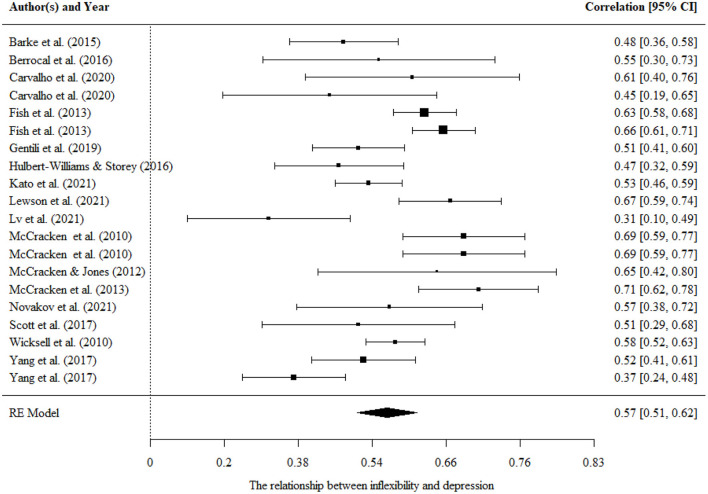
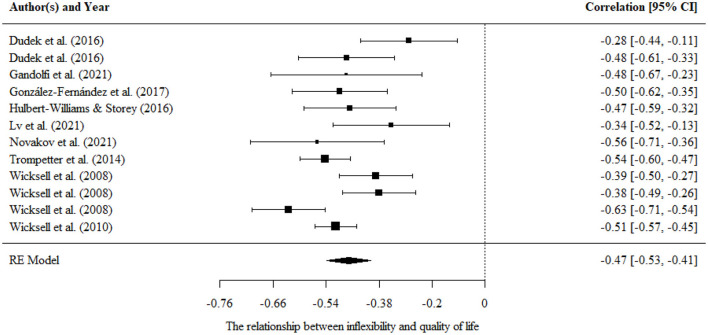
Verification
Claims the paper makes
The claims and statistics of this paper haven’t been checked yet.
Free: it reads the open-access text and checks the first 5 claims that cite a source we can check. Create a free account to check every claim.
Claims other papers make about this one
Each is checked against this paper’s own text: does it say what the citing paper says it does?
The source backs part of the claim, not all of it — or backs it for a different population, condition or comparison.
In the citing paper
“Existing meta-analyses suggest that psychological flexibility is positively related to individuals' mental health and adaptive behaviors and negatively related to individuals' negative emotional affect and problematic behaviors (37–39).”
From Psychological mechanism of acceptance and commitment therapy and rational emotive behavior therapy for treating hoarding: Evidence from randomized controlled trials (2023) · cites this paper as [39]
Experimental — accuracy not yet measured
Self-check
Percentages, sums and reported differences re-computed from the paper’s own numbers.
The self-check needs the paper’s full text.
Citations
Cites
R: A Language and Environment for Statistical Computing
R Core Team (2025) · doi:10.32614/r.manuals · Cited by 352,181
Conducting Meta-Analyses in R with the metafor Package
Viechtbauer, W. (2010) · Journal of Statistical Software · doi:10.18637/jss.v036.i03 · Cited by 20,464 · cited 2×
“2 (R Core Team, 2016) with the packages metafor and meta (Viechtbauer, 2010).”
MethodInfluentialDuval, S., & Tweedie, R. (2000) · Biometrics · doi:10.1111/j.0006-341x.2000.00455.x · Cited by 14,099 · cited 1×
“If publication bias were to be found, trim and fill analyses were performed to provide an adjusted average effect size (Duval and Tweedie, 2000) to correct.”
Method(2000) · Cited by 9,198
Acceptance and commitment therapy: model, processes and outcomes
Hayes, S. C., Luoma, J. B., Bond, F. W., Masuda, A., & Lillis, J. (2006) · Behaviour Research and Therapy · doi:10.1016/j.brat.2005.06.006 · Cited by 6,587 · cited 2×
“In contrast, the opposite six dimensions constitute psychological inflexibility: lack of present moment awareness, lack of contact with values, inaction, self-as-content, fusion, and experiential avoidance (Hayes et al., 2006; Ding and Zheng, 2022).”
BackgroundThe PRISMA 2020 statement: An updated guideline for reporting systematic reviews
Page, M. J., McKenzie, J. E., Bossuyt, P. M., Boutron, I., Hoffmann, T. C., Mulrow, C. D., Shamseer, L., Tetzlaff, J. M., Akl, E. A., Brennan, S. E., et al. (2021) · Journal of Clinical Epidemiology · doi:10.1016/j.jclinepi.2021.03.001 · Cited by 4,265 · cited 1×
“The meta-analysis was reported following the Preferred Reporting Items for Systematic Reviews and Meta-analyses (PRISMA) statement (Page et al., 2021).”
MethodBond, F. W., Hayes, S. C., Baer, R. A., Carpenter, K. M., Guenole, N., Orcutt, H. K., Waltz, T., & Zettle, R. D. (2011) · Behavior Therapy · doi:10.1016/j.beth.2011.03.007 · Cited by 3,950 · cited 14×
“Inflexibility AAQ-II Depression HADS-Depression 0.63 44.07 79.54 535 Inflexibility AAQ-II Anxiety HADS-anxiety 0.71 45.07 Inflexibility AAQ-II Dysfunction BPI-functional impairment 0.38 47.07 Inflexibility AAQ-II Pain intensity BPI 0.19 47.07 Inflexibility PIPS Depression HADS-Depression 0.66 44.07 Inflexibility PIPS…”
InfluentialDoing Meta-Analysis with R: A Hands-On Guide
Harrer, M., Cuijpers, P., Furukawa, T. A., & Ebert, D. D. (2021) · doi:10.1201/9781003107347 · Cited by 1,850 · cited 2×
“There was no significant difference between the two-level and three-level models, so we used the results of the twolevel model according to Occam’s razor (Harrer et al., 2021).”
MethodCheung, M. W.-L. (2014) · Psychological Methods · doi:10.1037/a0032968 · Cited by 1,342 · cited 2×
“This model can explore three sources of variance: sampling variance of the observed effect sizes (Level 1), the variance between effect sizes from the same study (Level 2), and variance between studies (Cheung, 2014; Ding and Zheng, 2022).”
BackgroundMethodFitting three-level meta-analytic models in R: A step-by-step tutorial
Assink, M., & Wibbelink, C. J. M. (2016) · The Quantitative Methods for Psychology · doi:10.20982/tqmp.12.3.p154 · Cited by 1,330 · cited 2×
“In addition, heterogeneity was also tested using the 75% rule (Assink and Carlijn, 2016), which contends that heterogeneity can be considered substantial if <75% of the overall variance can be attributed to level 1.”
BackgroundMethod
Research works printed but not linked: 1
- Higgins J. Thomas J. Chandler J. Cumpston M. Li T. Page M.. (2022). Cochrane Handbook for Systematic Reviews of Interventions version 6.3. Cochrane. Available online at: www.training.cochrane.org/handbook (accessed October 12, 2022).
Cited by
Psychological Flexibility, Chronic Pain, and Health
McCracken, L. M. (2024) · Annual Review of Psychology · doi:10.1146/annurev-psych-020223-124335 · Cited by 69
Fang, S., Ding, D., Ji, P., Huang, M., & Hu, K. (2022) · International Journal of Environmental Research and Public Health · doi:10.3390/ijerph192416519 · Cited by 33
“Our method took advantage of the ACT approach [50], as it specifically includes the cognitive defusion intervention, with special sessions to improve participants’ psychological flexibility (see below).”
MethodSelf-citationRajkumar, R. (2023) · Frontiers in Pain Research · doi:10.3389/fpain.2023.1189432 · Cited by 22
“The cognitive styles of individuals with these pain disorders also appear to differ from those of healthy controls in certain key aspects, such as reduced flexibility (37) and exaggerated ideas or beliefs regarding the causes or likely consequences of their pain (38).”
BackgroundFang, S., Ding, D., Zhang, R., & Huang, M. (2023) · Frontiers in Public Health · doi:10.3389/fpubh.2023.1084467 · Cited by 25
“Therefore, enhancing psychological flexibility is a primary mechanism by which evidencebased psychotherapies produce adaptive behavioral change and related outcomes (39, 109, 110).”
BackgroundSelf-citationOutlining a novel psychometric model of mental flexibility and affect dynamics
Borghesi, F., Chirico, A., & Cipresso, P. (2023) · Frontiers in Psychology · doi:10.3389/fpsyg.2023.1183316 · Cited by 18
Metadata
- Authors
- Fang, S., & Ding, D.
- Affiliations
- Anhui Normal University (CN)
- Corresponding author
- Fang, Shuanghu
- Venue
- Frontiers in Psychology
- Publisher
- Frontiers Media SA
- Published
- 2022-12-06
- Volume
- 13
- Pages
- 1069748-1069748
- ISSN
- 1664-1078 (ISSN-L)
- PMC
- PMC9767366
- OpenAlex
- W4311633706
- Cited by
- 34
- References
- 91
- Citations by year
- 2026: 5 · 2025: 12 · 2024: 8 · 2023: 8 · 2022: 1
- FWCI
- 1.21
- Type
- journal article
- Language
- en
- Open access
- gold
- doi.org
- Licence
- Locations
- Frontiers in Psychology (publishedVersion, cc-by)
- PubMed Central (publishedVersion, cc-by)
- PubMed (publishedVersion)
- DOAJ (DOAJ: Directory of Open Access Journals) (submittedVersion, cc-by-sa)
- Funders
- Anhui Provincial Department of Education
- Jilin Office of Philosophy and Social Science
- Topics
- Social Sciences › Psychology › Clinical Psychology › Mindfulness and Compassion Interventions
- Health Sciences › Health Professions › Physical Therapy, Sports Therapy and Rehabilitation › Musculoskeletal pain and rehabilitation
- Health Sciences › Medicine › Pediatrics, Perinatology and Child Health › Pediatric Pain Management Techniques
- Keywords
- psychological flexibility, psychological inflexibility, chronic pain, pain intensity, functional disability, quality of life, anxiety, depression, risk-taking, outcome variables
About these checks
Registry, retraction, Cites and statistics results are computed, not judged, with one exception: a printed reference that no index lists is read once by a model before it counts as a citation error. Claims are extracted by a model and kept only when their quote appears verbatim in the text; each cited source is then checked, with a model’s help, for whether it says what the claim relies on. Those verdicts can be wrong — read the claim’s quote and the cited source before relying on one.
Statistics and arithmetic are recomputed, not judged.
Confidence bands are shown only for fields calibrated on our annotated test set. None is calibrated yet, so no band is shown.
What counts as a claim ›How we measure confidence ›How we check this ›
Are you an author, or do you see a problem with this page? Request a review
Data sources
Bibliographic data: Semantic Scholar, OpenAlex, Crossref.
Contains information from the Semantic Scholar Academic Graph Datasets, made available under the ODC Attribution License (ODC-BY 1.0).
Semantic Scholar’s data is described in: Kinney, R., et al. (2023). The Semantic Scholar Open Data Platform. arXiv:2301.10140.
