

The DOI matches its Crossref record; 57 of the 58 references it cites were found in a registry or an index.
Gender differences in artificial intelligence: the role of artificial intelligence anxiety
Open accessAbstract
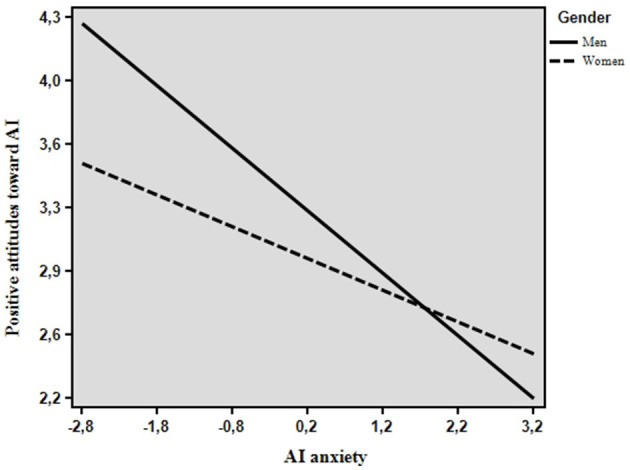
Introduction: Artificial intelligence (AI) is having a significant impact on people's lives. Despite the benefits associated with this technological advancement, there may be gender-related inequalities in accessing and using AI systems. The present study aimed to test gender differences in factors likely to influence AI adoption, in particular, the moderating role of gender in the relationship between AI anxiety and positive attitudes toward AI. Method: Participants were 335 adults (52.2% women; mean age = 29.96, SD = 13.88) who filled in an online self-report anonymous questionnaire. To test the hypotheses, both a MANOVA and a moderation model were adopted. Results: Results revealed significant gender differences in AI adoption dimensions, with women reporting higher AI anxiety, lower positive attitudes toward AI, lower use of AI, and lower perceived knowledge of AI. A significant negative relationship was found between AI anxiety and positive attitudes toward AI. An interaction between gender and AI anxiety was found: At low levels of anxiety, women showed lower levels of positive attitudes toward AI than men, while at high levels of AI anxiety, gender differences were less evident. Discussion: These findings suggest that AI anxiety works as a “gender differences leveler.” The present study contributes to expanding knowledge about gender differences in technology, which will underpin practical interventions for reducing the gender digital gap. Limitations and future research directions are discussed.
Overview
The claims and statistics of this paper haven’t been checked yet.
Run the check — free, no account needed. It reads the open-access text and checks the sources it cites.
Integrity signals
Registry
Cites
Statistics
Figures
Verification
Claims the paper makes
The claims and statistics of this paper haven’t been checked yet.
Run the check — free, no account needed. It reads the open-access text and checks the sources it cites.
Claims other papers make about this one
Each is checked against this paper’s own text: does it say what the citing paper says it does?
The source backs part of the claim, not all of it — or backs it for a different population, condition or comparison.
In the citing paper
“Prior technology-acceptance research suggested that gender may shape how users evaluate new technologies, including the relative importance of perceived usefulness, perceived ease of use, and social influence [121].”
From Advancing Undergraduate Student Mental Healthcare of Social Anxiety Disorder: Evaluating the Acceptance of AR-Assisted Cognitive Behavioral Therapy Through TAM-Based Constructs. (2026) · cites this paper as [121]
Experimental — accuracy not yet measured
Self-check
Percentages, sums and reported differences re-computed from the paper’s own numbers.
The self-check needs the paper’s full text.
Citations
Cites
Perceived usefulness, perceived ease of use, and user acceptance of information technology
Davis, F. D. (1989) · MIS Quarterly · doi:10.2307/249008 · Cited by 68,483 · cited 2×
“Our results are in line with and expand the Technology Acceptance Model (TAM; Davis, 1989).”
Hayes, A. F. (2018) · Communication Monographs · doi:10.1080/03637751.2017.1352100 · Cited by 3,516 · cited 1×
“Then, we used PROCESS macro for SPSS v. 4.2 (Hayes, 2018), adopting model 1 to test the moderating role of gender in the relationship between AI anxiety and positive attitudes toward AI.”
InfluentialKaplan, A., & Haenlein, M. (2019) · Business Horizons · doi:10.1016/j.bushor.2018.08.004 · Cited by 3,140
Cuddy, A. J. C., Fiske, S. T., & Glick, P. (2008) · Advances in experimental social psychology · doi:10.1016/s0065-2601(07)00002-0 · Cited by 2,682
Gefen, D., & Straub, D. W. (1997) · MIS Quarterly · doi:10.2307/249720 · Cited by 2,292
A Proposal for the Dartmouth Summer Research Project on Artificial Intelligence, August 31, 1955
McCarthy, J., Minsky, M., Rochester, N., et al. (2006) · The AI Magazine · doi:10.1609/aimag.v27i4.1904 · Cited by 2,029
The forthcoming artificial intelligence (AI) revolution: Its impact on society and firms
Makridakis, S. (2017) · Futures · doi:10.1016/j.futures.2017.03.006 · Cited by 1,866 · cited 1×
“AI can be seen as one of the most transformative technological advances of the 21st century, significantly impacting various dimensions of human life (Makridakis, 2017).”
Empirical validation of affect, behavior, and cognition as distinct components of attitude.
Breckler, S. J. (1984) · Journal of Personality and Social Psychology · doi:10.1037/0022-3514.47.6.1191 · Cited by 1,593 · cited 2×
“Attitudes are shaped by several psychological factors, such as beliefs, emotions, prior experience, and knowledge of the social object (Breckler, 1984; Eagly and Chaiken, 2007; Park and Woo, 2022; Asio and Gadia, 2024).”
Prentice, D. A., & Carranza, E. (2002) · Psychology of Women Quarterly · doi:10.1111/1471-6402.t01-1-00066 · Cited by 1,501
Wang, M., & Degol, J. L. (2016) · Educational Psychology Review · doi:10.1007/s10648-015-9355-x · Cited by 1,418
Research works printed but not linked: 6
- Carrasco, 2019, The citizen's perspective on the use of AI in government.
- 2016, Gender and Digital Agenda
- 2013, Women Active in the ICT Sector
- 2012, Women in ICT. Brussels: Policy Department C - Citizens' Rights and Constitutional Affairs
- Haines, 2016, The times they are a-changing… or are they not? A comparison of gender stereotypes, 1983–2014, Psychol. Women Q., 40, 353, 10.1177/036168431663408 · DOI
- Soper, 2013, Interaction!
Cited by
Sorted by citations
Toward agentic AI: User acceptance of a deeply personalized AI super assistant (AISA)
Hasselwander, M., Sunio, V., Lah, O., & Mogaji, E. (2025) · Journal of Retailing and Consumer Services · doi:10.1016/j.jretconser.2025.104620 · Cited by 25
Kinskofer, F., & Tulis, M. (2025) · Frontiers in Education · doi:10.3389/feduc.2025.1677827 · Cited by 17
AI FoMO (fear of missing out) in the workplace
Méndez-Suárez, M., Ćukušić, M., & Pašalić, I. N. (2025) · Technology in Society · doi:10.1016/j.techsoc.2025.103052 · Cited by 22
Maghanoy, J. M., Tahil, M. T., Sulasula, J., Vallejo, R. G., Dumagay, A. H., & Alieto, E. O. (2025) · Lecture notes on data engineering and communications technologies · doi:10.1007/978-3-031-98476-1_40 · Cited by 11
Not Ready for AI? Exploring Teachers’ Negative Attitudes Toward Artificial Intelligence
Țîru, L. G., Gherheș, V., Stoicov, I., & Stanici, M. (2025) · Societies · doi:10.3390/soc15120337 · Cited by 15
“This finding may relate to research suggesting that perceptions of algorithm accuracy and organizational responsibility depend more on professional experience and exposure to practical applications of AI than on socio-demographic factors [33,63,64].”
Xia, Q., Yang, Y., Weng, X., SAGNAK, H. Ç., Cheng, W. S. W., & Chiu, T. K. F. (2025) · Journal of Computers in Education · doi:10.1007/s40692-025-00373-y · Cited by 14
“This pattern also consistent with prior studies suggesting that male often perform positive attitude and confidence in technically complex or research-focused tasks (Guillén-Gámez et al., 2021; Russo et al., 2025).”
When AI Joins the Negotiation Table: Evaluating AI as a Moderator
Kobiella, C., Isroilov, U., & Schmidt, A. (2025) · ACM Conference on Conversational User Interfaces (CUI) · doi:10.1145/3719160.3736630 · Cited by 9
“Recent research shows that women tend to report higher anxiety and lower trust toward AI tools, while men generally express more comfort and positive attitudes [49].”
Teke, B. (2025) · Interactive Learning Environments · doi:10.1080/10494820.2025.2559930 · Cited by 12
“Some studies (e.g. Russo et al., 2025) currently attempt to explain gender differences by gender-based socialisation processes.”
Santos-Guevara, A., Gutierrez, O. A., Martínez-Huerta, H., Chavarría-Garza, W. X., & Azuela, J. A. (2026) · Education Sciences · doi:10.3390/educsci16020184 · Cited by 11
Tian, J., & Zhang, R. (2026) · Humanities and Social Sciences Communications · doi:10.1057/s41599-026-07153-8 · Cited by 18
“…that male students and academics often report more positive attitudes toward AI, lower AI-related anxiety, and higher usage of generative AI tools than female students, who tend to approach AI with greater caution (Russo et al., 2025; Tang et al., 2025; Kwakye et al., 2025; Iddrisu et al., 2025).”
Kemp, E., Bui, M., Tangari, A. H., & Zhang, X. (2025) · Journal of Consumer Marketing · doi:10.1108/jcm-01-2025-7472 · Cited by 7
Walsh, G., Stogiannos, N., Botwe, B. O., McHugh, K., Spurge, A., Potts, B., Gibson, C., Tam, W., O’Sullivan, C., Quinsten, A. S., et al. (2025) · Frontiers in Digital Health · doi:10.3389/fdgth.2025.1603511 · Cited by 7
Alkabaa, A. S., & Alamri, N. M. H. (2025) · Computer Applications in Engineering Education · doi:10.1002/cae.70110 · Cited by 6
“This substantial finding is aligned with the studies of [84, 90].”
Artificial intelligence dependency in college students: a critical narrative review
He, X., Li, S., Cha, R., Wang, L., Shen, Y., Wu, R., Wu, L., Gong, X., & Liu, J. (2026) · Frontiers in Psychology · doi:10.3389/fpsyg.2026.1808268 · Cited by 8
“Women also report lower perceived AI knowledge and higher AI-related anxiety (Russo et al., 2025).”
Lyimo, N. N., Fue, K. G., Materu, S. F., Kilatu, N. C., & Telemala, J. P. (2025) · Frontiers in Artificial Intelligence · doi:10.3389/frai.2025.1597727 · Cited by 6
Humanizing AI in Service Workplaces: Exploring Supervisor Support as a Moderator in HPWSs
Atoyebi, T. A., & Sopuru, J. C. (2025) · Sustainability · doi:10.3390/su17177892 · Cited by 9
Yoo, J. (2025) · Behaviour and Information Technology · doi:10.1080/0144929x.2025.2581857 · Cited by 6
“Contemporary evidence shows systematic gender differences in AI adoption and related attitudes, warranting its inclusion as a covariate (Humlum and Vestergaard 2025; Russo et al. 2025; Tang et al. 2025).”
Mohamed, A. M., Emran, A. Q., Abdelrady, A. H., & Deen, A. A. M. M. A. E. (2026) · Frontiers in Education · doi:10.3389/feduc.2026.1762707 · Cited by 4
“Anxiety may serve to reduce attitudinal dierences due to gender dierences leveling at high anxiety rates (Russo et al., 2025).”
InfluentialDai, Y., Chen, C., Lin, Z., Qin, J., & Guo, Y. (2026) · Computers & Education · doi:10.1016/j.compedu.2026.105641 · Cited by 4
ElBarazi, A. S., Mohamed, H., & Nasser, R. (2026) · Healthcare · doi:10.3390/healthcare14091247 · Cited by 5
“However, concerns regarding personal data security and institutional access to personal information remain significant barriers [84,99], reflecting broader global patterns in privacy-related apprehensions [100,101].”
From lecture hall to clinic: dental students’ AI readiness and anxiety across educational stages
Çakan, K. N., & İpek, İ. (2025) · BMC Medical Education · doi:10.1186/s12909-025-08181-9 · Cited by 3
Evaluating the morality of violence against robots
Archer, J., Wilks, M., & Sommer, K. (2025) · Scientific Reports · doi:10.1038/s41598-025-24875-y · Cited by 3
Fang, X., & Mo, Z. (2026) · Frontiers in Psychology · doi:10.3389/fpsyg.2026.1740535 · Cited by 3
Ibrahim, F., Telle, N.-T., Lauckner, M., Karl, J. A., & Daseking, M. (2026) · Computers in Human Behavior Reports · doi:10.1016/j.chbr.2026.101003 · Cited by 4
Maheux, A. J., Maes, C., & Buck, B. (2026) · Journal of Adolescent Health · doi:10.1016/j.jadohealth.2026.03.014 · Cited by 3
Alieto, E. O., Dumagay, A. H., Eijansantos, A. M., Estigoy, E. B., Vallejo, R. G., & Serdenia, J. R. C. (2025) · Information systems engineering and management · doi:10.1007/978-3-032-05306-0_11 · Cited by 5
Coelho, G. L. D. H., Monteiro, R. P., Vilar, R., Baptista, V. M. P. D. S., & Hanel, P. H. P. (2025) · Trends in Psychology · doi:10.1007/s43076-025-00473-9 · Cited by 3
Torricelli, P., Torricelli, C., Bertelli, B., Sandi, M., & Pecchi, A. (2025) · Frontiers in Artificial Intelligence · doi:10.3389/frai.2025.1624789 · Cited by 2
“One example is the work by Russo et al. (2025), in which the authors explore gender-related differences in access to and use of AI, and in particular AI-related anxiety.”
Yixiao, S. O. N. G., Zeng, M., & Tao, S. U. (2026) · Advances in Psychological Science · doi:10.3724/sp.j.1042.2026.0461 · Cited by 3
Boda, K., Matuz, A., Almási, R., & Csathó, Á. (2026) · Acta Psychologica · doi:10.1016/j.actpsy.2026.106400 · Cited by 3
Brailo, V., López‐Pintor, R. M., Harte, M., Rogulj, A. A., Juras, D. V., Škrinjar, I., Diniz Freitas, M., Posse, M. J. L., Monteiro, L. M. C., Silva, L. M., et al. (2026) · Oral Diseases · doi:10.1111/odi.70225 · Cited by 2
“Furthermore, Russo et al. (2025) reported that men exhibit lower levels of AI anxiety, greater usage, and more positive attitudes towards AI compared with women, factors that foster greater confidence and trust in AI-based tools.”
Gao, H., & Sridhar, S. (2026) · Customer Needs and Solutions · doi:10.1007/s40547-026-00163-2 · Cited by 2
Exploring Artificial Intelligence Anxiety Among Basic School Teachers in Ghana
Arthur, F., Boateng, E., Opoku, E., Gyedu, F. O., Asare-Bediako, S., Quayson, E., Salifu, I., Attom, E. R., & Nortey, S. A. (2026) · SAGE Open · doi:10.1177/21582440251410713 · Cited by 4
“For example, a recent study by Russo et al. (2025) revealed notable gender disparities in AI adoption, with women exhibiting greater AI anxiety, less positive attitudes towards AI, reduced AI usage, and diminished perceived AI knowledge.”
Spor Bilimleri Öğrencilerinin Yapay Zekâ Tutumları ile Spor Farkındalığı Düzeylerinin İncelenmesi
İNAN, H. (2025) · Journal of Global Sport and Education Research · doi:10.55142/jogser.1715410 · Cited by 2
Üniversite Öğrencilerinde Yapay Zeka Kaygısının Akademik Erteleme Davranışına Etkisi
Siler, S. G., & Turan, A. H. (2025) · Sakarya Üniversitesi İşletme Enstitüsü Dergisi · doi:10.47542/sauied.1720449 · Cited by 1
Ersözlü, M. (2025) · Educational Gerontology · doi:10.1080/03601277.2025.2592818 · Cited by 1
Platz, J. J., Bryan, D. S., Naunheim, K. S., & Ferguson, M. K. (2025) · JTCVS Open · doi:10.1016/j.xjon.2025.101559 · Cited by 1
“6,7 Because CT surgery already exhibits significant gender disparities in workforce composition, remuneration, and leadership roles, such differences may further impact AI acceptance and gender inequity.”
More Talk Than Touch: Chinese Art Educators and the Overwhelming Discourse of AI in Higher Education
Tadesse, E., Fu, S., & Diankun, J. (2026) · European Journal of Education · doi:10.1111/ejed.70408 · Cited by 1
Güner, Ö., & Aydın, M. S. (2026) · BMC Medical Education · doi:10.1186/s12909-026-08754-2 · Cited by 1
Öztürk, E. U., & Ilıman, E. (2026) · Doğuş Üniversitesi Dergisi · doi:10.31671/doujournal.1817098 · Cited by 1
Alfuqaha, O. A., Msall, K. A., & Abdelrahman, R. M. (2026) · Education Sciences · doi:10.3390/educsci16040506 · Cited by 3
“Regarding other demographic factors in our study, none of them predicted AI-HSB, while previous studies found that women and younger individuals had higher levels of AI adoption (Russo et al., 2025).”
Who cares about artificial intelligence? Human and artificial voices in audiobooks
Schwabe, A., Kosch, L., Stocker, G., & Boomgaarden, H. G. (2026) · Computers in Human Behavior Reports · doi:10.1016/j.chbr.2026.101068 · Cited by 1
Sørensen, N. L., Bruun, N. H., Merrild, C. H., Moeslund, T. B., Kidholm, K., & Thomsen, J. L. (2026) · Scandinavian Journal of Primary Health Care · doi:10.1080/02813432.2026.2667990 · Cited by 1
“…while most GPs in Denmark are female (61.3%); however, a majority of male respondents in this study also scored higher on factors related to innovativeness, which might explain the higher sample size among male GPs, as a higher interest in ai is observed in the male population in general [28].”
InfluentialWomen in Science and Technology: Generative AI as a Tool for Gender Equality in STEM Education
Miština, J. (2026) · Studies in computational intelligence · doi:10.1007/978-3-032-16157-4_9 · Cited by 1
Yang, M., & Yang, W. (2026) · Acta Psychologica · doi:10.1016/j.actpsy.2026.107132 · Cited by 2
Taşçı, S. (2026) · Journal of Educational Technology and Online Learning · doi:10.31681/jetol.1823794 · Cited by 1
Kim, J., Spence, P. R., & Kelly, S. E. (2026) · Interactive Learning Environments · doi:10.1080/10494820.2026.2667455 · Cited by 2
Rifaat, S., AlNassar, A., AlQuraishi, A., Alqahtani, N. A., Wafai, T., Farooqi, F. A., Gaffar, B. O., & Taymour, N. (2026) · Frontiers in Oral Health · doi:10.3389/froh.2026.1794097 · Cited by 2
Andrés-Sánchez, J., & Torres-Coronas, T. (2026) · Quality & Quantity · doi:10.1007/s11135-026-02916-6 · Cited by 1
“Taken together, these findings suggest that the gender effect observed in our study may reflect not only a sociodemographic difference per se, but also unequal trajec - tories of familiarity, confidence, and risk framing in relation to GenAI (Russo et al. 2025).”
Cammà, C., Amenta, L., Battaglia, S., Celsa, C., Cirrincione, G., Contino, S., Corso, P. P., Dio, S. D., Maria, G. D., Enea, M., et al. (2026) · Frontiers in Psychology · doi:10.3389/fpsyg.2026.1861001 · Cited by 1
Özkan, Z., & Eyı, S. (2026) · BMC Medical Education · doi:10.1186/s12909-026-09778-4 · Cited by 2
“For example, [40] found that women reported higher AI anxiety and lower perceived AI knowledge and AI use in an Italian sample, whereas Asio and Sardina [6] reported that gender did not significantly moderate the relationship between AI self-competency and AI anxiety among higher education students…”
Olurinola, O., Akintola, O. A., & Olugbade, D. (2026) · Computers and Education Open · doi:10.1016/j.caeo.2026.100401 · Cited by 1
Zeng, Q., Zhang, S., Hu, J., Wu, Y., Yang, M., & Hu, Y. (2026) · Frontiers in Public Health · doi:10.3389/fpubh.2026.1918134 · Cited by 1
Joo, E., Ma, O., Woolley, T., & Haleagrahara, N. (2026) · International Medical Education · doi:10.3390/ime5030089 · Cited by 1
Technology Adoption Frameworks in Agriculture: A Comparative and Contextual Analysis
Mapande, F. V., & Zuva, T. (2026) · Lecture notes in networks and systems · doi:10.1007/978-3-032-38812-4_18 · Cited by 1
Ibrahim, F., Telle, N. T., Lauckner, M., Karl, J. A., & Daseking, M. (2025) · SSRN Electronic Journal · doi:10.2139/ssrn.5954583 · Cited by 1
Zhou, Z., Zhou, Y., Ouyang, B., Man, S. S., & Chan, A. H. S. (2026) · Healthcare · doi:10.3390/healthcare14131978
“Prior technology-acceptance research suggested that gender may shape how users evaluate new technologies, including the relative importance of perceived usefulness, perceived ease of use, and social influence [121].”
Use of AI for Health Purposes and Its Association with Anxiety Among U.S. College StudentsPreprint
Akter, T. (2025) · SocArXiv (OSF Preprints) · doi:10.31235/osf.io/cvtq6_v1
Tutan, N. S., & Şanlıer, N. (2025) · Journal of Advanced Studies in Health Science and Obesity · doi:10.51271/jashso.34
Would You Let AI Be Your Boss? Turing and Weberian Thresholds in AI AcceptabilityPreprint
Lee, S. Y., Puranam, P., & Mai, K. M. (2025) · SSRN Electronic Journal · doi:10.2139/ssrn.5750102
AI-Powered academic search systems: An exploratory study from the perspective of academics in LIS
Ramzy, M., & Zakaria, M. S. (2025) · Information Development · doi:10.1177/02666669251403163
Kinoshita, S., Furukawa, S., Ikkatai, Y., & Yokoyama, H. (2025) · International Journal of Human-Computer Interaction · doi:10.1080/10447318.2025.2596861
“…pointed out that women’s aversion to AI stems from fears that it will threaten their economic status by automating repetitive, routine tasks traditionally performed by women, as well as anxieties about complex technologies like AI due to low female participation in STEM fields (Russo et al., 2025).”
Serdenia, J. R. C. (2025) · EthAIca · doi:10.56294/ai2025443
Choosing your companion: How locus of control shapes responses to AI vs. real pets
Gong, S. (2026) · Journal of Retailing and Consumer Services · doi:10.1016/j.jretconser.2025.104702
Escobar, J. N. P., Cabezas, A. V. V., Machado, M. E. Z., & Brito, G. F. E. (2026) · Perspectivas Sociales y Administrativas. · doi:10.61347/psa.v4i1.130
Revealing While Solving: Exploring the Strategy of Service-Oriented Self-Disclosure of AI Chatbots
Yang, M., & Rau, P. P. (2026) · International Journal of Human-Computer Interaction · doi:10.1080/10447318.2026.2621280
“Additionally, women may be more emotionally selective, hold higher standards for authenticity in relational contexts (Kislev, 2023) and report greater AI-related anxiety (Russo et al., 2025).”
How gender norms shape preference: the role of counter-stereotypes
Cho, H., Lee, H., & Suh, M. (2026) · Social Influence · doi:10.1080/15534510.2026.2629038
Jose, J., Jose, B. J., & Sheidi, A. S. A. A. (2026) · Discover Artificial Intelligence · doi:10.1007/s44163-025-00786-9 · Cited by 1
Sebopelo, P., & Chukwuma, N. N. (2026) · Review of Artificial Intelligence in Education · doi:10.37497/rev.artif.intell.educ.v7ii.78
Agarwal, K., Balakumar, N. S., & Ragul, L. (2026) · Advances in computational intelligence and robotics book series · doi:10.4018/979-8-3373-6623-4.ch011
Teknolojik Spor Ürünleri Bağımlılığı ve Yapay Zeka Tutumu: Spor Bilimleri Öğrencilerinden Kanıtlar
Kusan, M., & Atasoy, F. S. (2026) · Yalova Üniversitesi spor bilimleri dergisi. · doi:10.70007/yalovaspor.1862727
Köse, N. (2026) · Türk Eğitim Bilimleri Dergisi · doi:10.37217/tebd.1782832 · Cited by 1
Gender perspectives: Artificial intelligence in academic practice
Slijepčević, M., Šević, N. P., & Šević, A. (2026) · Research in Pedagogy · doi:10.5937/istrped2601099s
Kılıç, S. (2026) · Ömer Halisdemir Üniversitesi İktisadi ve İdari Bilimler Fakültesi Dergisi · doi:10.25287/ohuiibf.1721842
Factors Associated with AI Use in a Norwegian Sample
Thorp, S. O., Rimol, L. M., Fleten, M. K., & Hoel, S. K. B. (2026) · Behavioral Sciences · doi:10.3390/bs16040537
“These disparities are not necessarily reducible to occupational exposure alone and may also reflect differences in confidence, anxiety, norms, and access to relevant training opportunities (Aldasoro et al., 2024; Chien & Kim, 2024; Conde-Ruiz et al., 2024; Rana et al., 2024; Russo et al., 2025).”
Muchowe, R. M., Mkandatsama, P., & Rajlal, A. (2026) · Cogent Education · doi:10.1080/2331186x.2026.2652193
Alexa, Make Me a Sandwich: The Function of Gender in the Burgeoning AI Industry (2016–2025)
Simonds, M. (2026) · IntechOpen eBooks · doi:10.5772/intechopen.1013403
Allayl, M., & Bahari, G. (2026) · Journal of Multidisciplinary Healthcare · doi:10.2147/jmdh.s598736
“This is consistent with Russo et al 28 who found that women experience significantly higher levels of anxiety regarding AI compared to men, which negatively affects their willingness to use these technologies.”
Effects of digital leadership on the attitudes of manager nurses toward AI: A cross-sectional study
Er, F., & Hanci, N. (2026) · Work · doi:10.1177/10519815261446635
Lorenzo, G., Cerdán-Chacón, A., & Lorenzo-Lledó, . (2025) · De Gruyter eBooks · doi:10.1515/9783112206393-009
Online Learning Self-Efficacy, AI Anxiety, and Digital Well-Being in Engineering Students
Al-Nasa’h, M., Al-Tarawneh, L., AlQaralleh, E. A., Allabadi, N., Ghaith, S. M., & Aldalahmeh, S. A. (2026) · International Journal of Online and Biomedical Engineering (iJOE) · doi:10.3991/ijoe.v22i05.59863
Women Worry, Men Adopt: How Gendered Perceptions Shape the Use of Generative AIPreprint
Stephany, F., & Duszynski, J. (2026) · Research Square · doi:10.21203/rs.3.rs-9304693/v1
Palmedo, M., Lutes, B., & Safner, R. (2026) · Work and Occupations · doi:10.1177/07308884261447535 · Cited by 1
Adigun, O. T. (2026) · Education and Information Technologies · doi:10.1007/s10639-026-14031-y
“…that higher response obtained from male sign language interpret - ers can be linked to values attributed to dynamics, application, and use of artificial intelligence which have male dominance as found in the studies of Møgelvang et al. ( 2024 ), Otis et al. ( 2024 ), and Russo et al. ( 2025 ) (Fig.”
Zhong, Q., Lei, L., 李天兰, Lam, L. T.-M., & Wan, L. (2026) · Acta Psychologica · doi:10.1016/j.actpsy.2026.107209
Çakici, H. B., & Dolu, İ. (2026) · AJIT-e Academic Journal of Information Technology · doi:10.5824/ajite.2026.02.003.x
I Want an Assistant: Generative AI, Women’s Leadership, and the Redistribution of Invisible Labor
Kostihová, M., & Makarevitch, I. (2026) · Merits · doi:10.3390/merits6020017
“Women also report higher GenAI anxiety, less positive attitudes toward GenAI, and lower perceived knowledge of AI systems, suggesting that adoption is shaped not only by access, but by the affective and interpretive conditions under which the technology is encountered [46].”
Miranda, J. P. P., Salac, M. B. M., Boltron, W., Rivera, J. G., Castro, M. A., Parreño, E. B., & Mallari, C. S. (2026) · International Conference on Information and Education Technology (ICIET) · doi:10.1109/iciet69664.2026.11561595
“[11] and [12] both found that female university students express greater concern about AI’s effects on their independent learning than male students, though the underlying reasons remain under investigation.”
Preservice Teachers' Artificial Intelligence Competence: A Network and Latent Profile Analyses
Acquah, B. Y. S., Arthur, F., Gyedu, F. O., Quayson, E., Boateng, E., Quaye, S. A., & Nortey, S. A. (2026) · European Journal of Education · doi:10.1111/ejed.70735 · Cited by 3
Intawong, K., Ariya, P., Khanchai, S., Thongthip, P., & Puritat, K. (2026) · TechTrends · doi:10.1007/s11528-026-01201-5
“Research highlights significant differences in how males and females engage with AI-driven systems, influenced by factors such as anthropomorphic design, interaction styles, trust, and anxiety toward AI (Mahmood & Huang, 2024; Pelau et al., 2021; Russo et al., 2025).”
Maksimenko, A. A., Cruz-Cárdenas, J., Zabelina, E., Kurapov, S., & Pevneva, A. N. (2026) · Vysshee Obrazovanie v Rossii = Higher Education in Russia · doi:10.31992/0869-3617-2026-35-6-102-126
Kaya, B., & Önder, F. C. (2026) · Journal of Technology in Behavioral Science · doi:10.1007/s41347-026-00638-y
Lım, W. (2026) · Journal of Musculoskeletal Science and Technology · doi:10.29273/jmst.2026.10.1.43
What Do Canadians Think About Mental Health Clinicians Collaborating with AI?
Kambari, Y., Prassinos, A.-M., Mandatori, A., Fujita, E., & Rodrigo, A. H. (2026) · Communications in computer and information science · doi:10.1007/978-3-032-30833-7_26
Kim, C., & Kim, Y.-M. (2026) · Journal of Digital Contents Society · doi:10.9728/dcs.2026.27.6.1585
Zhou, Z., Geracitano, J., Hatoum, S., Yu, F., & Khairat, S. (2026) · International Journal of Medical Informatics · doi:10.1016/j.ijmedinf.2026.106609
Merwin, E. R., Hammack, J. S., Riera‐Gomez, L., Keebler, J. R., Engeberg, E. D., & Wilcox, T. (2026) · Computers in Human Behavior Artificial Humans · doi:10.1016/j.chbah.2026.100356
A study on the influencing factors of perceived artificial intelligence substitution risk
Xing, X., Dai, H., Zhou, Y., Lan, Z., Wu, X., Jiang, J., & Cao, L. (2026) · Acta Psychologica · doi:10.1016/j.actpsy.2026.107441 · Cited by 2
“…their structurally disadvantaged position in the labor market, such as occupational segregation and a relatively higher proportion of informal employment (International Labour Organization, 2017; Nedelkoska & Quintini, 2018), may amplify sensitivity to sub-stitution risks (Russo et al., 2025).”
Whose Values? Demographic Influences on Perceptions of Conversational AI Value Alignment
Sadek, M., & Mougenot, C. (2026) · ACM Conference on Conversational User Interfaces (CUI) · doi:10.1145/3816046.3816265 · Cited by 1
Gender effects on ChatGPT usage knowledge and adoption challenges among MBA students
Delina, G., Kumar, M., Bh, R., & Paul, G. R. (2026) · Discover Education · doi:10.1007/s44217-026-01845-8
“Gender differences as a factor influencing knowledge, challenges and willingness to use/engage with ChatGPT Structural and socio-cultural inequalities create gendered barriers to AI knowledge and usage [45].”
Metadata
- Authors
- Russo, C., Romano, L., Clemente, D., Iacovone, L., Gladwin, T. E., & Panno, A.
- Affiliations
- European University of Rome (IT)
- University of Chieti-Pescara (IT)
- Institute for Globally Distributed Open Research and Education (SE)
- Corresponding author
- Russo, Claudia
- Panno, Angelo
- Venue
- Frontiers in Psychology
- Publisher
- Frontiers Media SA
- Published
- 2025-05-06
- Volume
- 16
- Pages
- 1559457-1559457
- ISSN
- 1664-1078 (ISSN-L)
- PMC
- PMC12089128
- OpenAlex
- W4410133492
- Cited by
- 126
- References
- 58
- Citations by year
- 2026: 94 · 2025: 32
- FWCI
- 227.49
- Type
- journal article
- Language
- en
- Open access
- gold
- doi.org
- Licence
- Locations
- Frontiers in Psychology (publishedVersion, cc-by)
- PubMed Central (publishedVersion, cc-by)
- PubMed (publishedVersion)
- DOAJ (DOAJ: Directory of Open Access Journals) (submittedVersion, cc-by-sa)
- Topics
- Social Sciences › Gender Studies › Gender and Technology in Education
- Social Sciences › Decision Sciences › Information Systems and Management › Technology Adoption and User Behaviour
- Physical Sciences › Computer Science › Artificial Intelligence › Ethics and Social Impacts of AI
- Keywords
- AI anxiety, gender differences, attitudes toward AI, artificial intelligence adoption, technology acceptance, gender digital divide, moderating effect of gender
About these checks
Registry, retraction, Cites and statistics results are computed, not judged, with one exception: a printed reference that no index lists is read once by a model before it counts as a citation error. Claims are extracted by a model and kept only when their quote appears verbatim in the text; each cited source is then checked, with a model’s help, for whether it says what the claim relies on. Those verdicts can be wrong — read the claim’s quote and the cited source before relying on one.
Statistics and arithmetic are recomputed, not judged.
Confidence bands are shown only for fields calibrated on our annotated test set. None is calibrated yet, so no band is shown.
What counts as a claim ›How we measure confidence ›How we check this ›
Are you an author, or do you see a problem with this page? Request a review
