

The DOI matches its Crossref record; 57 of the 58 references it cites were found in a registry or an index.
Gender differences in artificial intelligence: the role of artificial intelligence anxiety
Open accessAbstract
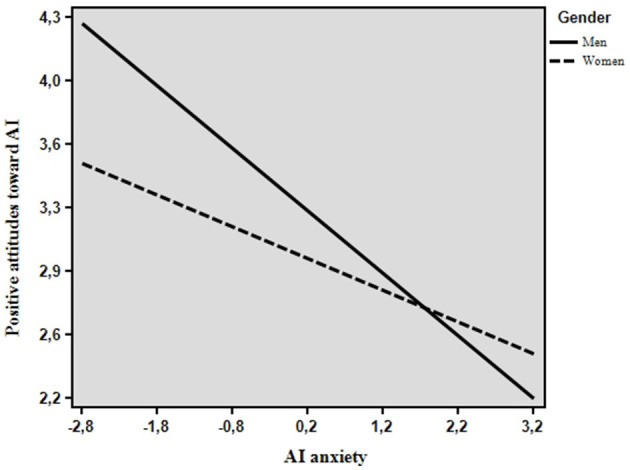
Introduction: Artificial intelligence (AI) is having a significant impact on people's lives. Despite the benefits associated with this technological advancement, there may be gender-related inequalities in accessing and using AI systems. The present study aimed to test gender differences in factors likely to influence AI adoption, in particular, the moderating role of gender in the relationship between AI anxiety and positive attitudes toward AI. Method: Participants were 335 adults (52.2% women; mean age = 29.96, SD = 13.88) who filled in an online self-report anonymous questionnaire. To test the hypotheses, both a MANOVA and a moderation model were adopted. Results: Results revealed significant gender differences in AI adoption dimensions, with women reporting higher AI anxiety, lower positive attitudes toward AI, lower use of AI, and lower perceived knowledge of AI. A significant negative relationship was found between AI anxiety and positive attitudes toward AI. An interaction between gender and AI anxiety was found: At low levels of anxiety, women showed lower levels of positive attitudes toward AI than men, while at high levels of AI anxiety, gender differences were less evident. Discussion: These findings suggest that AI anxiety works as a “gender differences leveler.” The present study contributes to expanding knowledge about gender differences in technology, which will underpin practical interventions for reducing the gender digital gap. Limitations and future research directions are discussed.
Overview
The claims and statistics of this paper haven’t been checked yet.
Run the check — free, no account needed. It reads the open-access text and checks the sources it cites.
Integrity signals
Registry
Cites
Statistics
Figures
Verification
Claims the paper makes
The claims and statistics of this paper haven’t been checked yet.
Run the check — free, no account needed. It reads the open-access text and checks the sources it cites.
Claims other papers make about this one
Each is checked against this paper’s own text: does it say what the citing paper says it does?
The source backs part of the claim, not all of it — or backs it for a different population, condition or comparison.
In the citing paper
“Prior technology-acceptance research suggested that gender may shape how users evaluate new technologies, including the relative importance of perceived usefulness, perceived ease of use, and social influence [121].”
From Advancing Undergraduate Student Mental Healthcare of Social Anxiety Disorder: Evaluating the Acceptance of AR-Assisted Cognitive Behavioral Therapy Through TAM-Based Constructs. (2026) · cites this paper as [121]
Experimental — accuracy not yet measured
Self-check
Percentages, sums and reported differences re-computed from the paper’s own numbers.
The self-check needs the paper’s full text.
Citations
Cites
Perceived usefulness, perceived ease of use, and user acceptance of information technology
Davis, F. D. (1989) · MIS Quarterly · doi:10.2307/249008 · Cited by 68,483 · cited 2×
“Our results are in line with and expand the Technology Acceptance Model (TAM; Davis, 1989).”
Hayes, A. F. (2018) · Communication Monographs · doi:10.1080/03637751.2017.1352100 · Cited by 3,516 · cited 1×
“Then, we used PROCESS macro for SPSS v. 4.2 (Hayes, 2018), adopting model 1 to test the moderating role of gender in the relationship between AI anxiety and positive attitudes toward AI.”
InfluentialKaplan, A., & Haenlein, M. (2019) · Business Horizons · doi:10.1016/j.bushor.2018.08.004 · Cited by 3,140
Cuddy, A. J. C., Fiske, S. T., & Glick, P. (2008) · Advances in experimental social psychology · doi:10.1016/s0065-2601(07)00002-0 · Cited by 2,682
Gefen, D., & Straub, D. W. (1997) · MIS Quarterly · doi:10.2307/249720 · Cited by 2,292
A Proposal for the Dartmouth Summer Research Project on Artificial Intelligence, August 31, 1955
McCarthy, J., Minsky, M., Rochester, N., et al. (2006) · The AI Magazine · doi:10.1609/aimag.v27i4.1904 · Cited by 2,029
The forthcoming artificial intelligence (AI) revolution: Its impact on society and firms
Makridakis, S. (2017) · Futures · doi:10.1016/j.futures.2017.03.006 · Cited by 1,866 · cited 1×
“AI can be seen as one of the most transformative technological advances of the 21st century, significantly impacting various dimensions of human life (Makridakis, 2017).”
Empirical validation of affect, behavior, and cognition as distinct components of attitude.
Breckler, S. J. (1984) · Journal of Personality and Social Psychology · doi:10.1037/0022-3514.47.6.1191 · Cited by 1,593 · cited 2×
“Attitudes are shaped by several psychological factors, such as beliefs, emotions, prior experience, and knowledge of the social object (Breckler, 1984; Eagly and Chaiken, 2007; Park and Woo, 2022; Asio and Gadia, 2024).”
Prentice, D. A., & Carranza, E. (2002) · Psychology of Women Quarterly · doi:10.1111/1471-6402.t01-1-00066 · Cited by 1,501
Wang, M., & Degol, J. L. (2016) · Educational Psychology Review · doi:10.1007/s10648-015-9355-x · Cited by 1,418
Research works printed but not linked: 6
- Carrasco, 2019, The citizen's perspective on the use of AI in government.
- 2016, Gender and Digital Agenda
- 2013, Women Active in the ICT Sector
- 2012, Women in ICT. Brussels: Policy Department C - Citizens' Rights and Constitutional Affairs
- Haines, 2016, The times they are a-changing… or are they not? A comparison of gender stereotypes, 1983–2014, Psychol. Women Q., 40, 353, 10.1177/036168431663408 · DOI
- Soper, 2013, Interaction!
Cited by
Sorted by citations
Toward agentic AI: User acceptance of a deeply personalized AI super assistant (AISA)
Hasselwander, M., Sunio, V., Lah, O., & Mogaji, E. (2025) · Journal of Retailing and Consumer Services · doi:10.1016/j.jretconser.2025.104620 · Cited by 25
Kinskofer, F., & Tulis, M. (2025) · Frontiers in Education · doi:10.3389/feduc.2025.1677827 · Cited by 17
AI FoMO (fear of missing out) in the workplace
Méndez-Suárez, M., Ćukušić, M., & Pašalić, I. N. (2025) · Technology in Society · doi:10.1016/j.techsoc.2025.103052 · Cited by 22
Maghanoy, J. M., Tahil, M. T., Sulasula, J., Vallejo, R. G., Dumagay, A. H., & Alieto, E. O. (2025) · Lecture notes on data engineering and communications technologies · doi:10.1007/978-3-031-98476-1_40 · Cited by 11
Not Ready for AI? Exploring Teachers’ Negative Attitudes Toward Artificial Intelligence
Țîru, L. G., Gherheș, V., Stoicov, I., & Stanici, M. (2025) · Societies · doi:10.3390/soc15120337 · Cited by 15
“This finding may relate to research suggesting that perceptions of algorithm accuracy and organizational responsibility depend more on professional experience and exposure to practical applications of AI than on socio-demographic factors [33,63,64].”
Metadata
- Authors
- Russo, C., Romano, L., Clemente, D., Iacovone, L., Gladwin, T. E., & Panno, A.
- Affiliations
- European University of Rome (IT)
- University of Chieti-Pescara (IT)
- Institute for Globally Distributed Open Research and Education (SE)
- Corresponding author
- Russo, Claudia
- Panno, Angelo
- Venue
- Frontiers in Psychology
- Publisher
- Frontiers Media SA
- Published
- 2025-05-06
- Volume
- 16
- Pages
- 1559457-1559457
- ISSN
- 1664-1078 (ISSN-L)
- PMC
- PMC12089128
- OpenAlex
- W4410133492
- Cited by
- 126
- References
- 58
- Citations by year
- 2026: 94 · 2025: 32
- FWCI
- 227.49
- Type
- journal article
- Language
- en
- Open access
- gold
- doi.org
- Licence
- Locations
- Frontiers in Psychology (publishedVersion, cc-by)
- PubMed Central (publishedVersion, cc-by)
- PubMed (publishedVersion)
- DOAJ (DOAJ: Directory of Open Access Journals) (submittedVersion, cc-by-sa)
- Topics
- Social Sciences › Gender Studies › Gender and Technology in Education
- Social Sciences › Decision Sciences › Information Systems and Management › Technology Adoption and User Behaviour
- Physical Sciences › Computer Science › Artificial Intelligence › Ethics and Social Impacts of AI
- Keywords
- AI anxiety, gender differences, attitudes toward AI, artificial intelligence adoption, technology acceptance, gender digital divide, moderating effect of gender
About these checks
Registry, retraction, Cites and statistics results are computed, not judged, with one exception: a printed reference that no index lists is read once by a model before it counts as a citation error. Claims are extracted by a model and kept only when their quote appears verbatim in the text; each cited source is then checked, with a model’s help, for whether it says what the claim relies on. Those verdicts can be wrong — read the claim’s quote and the cited source before relying on one.
Statistics and arithmetic are recomputed, not judged.
Confidence bands are shown only for fields calibrated on our annotated test set. None is calibrated yet, so no band is shown.
What counts as a claim ›How we measure confidence ›How we check this ›
Are you an author, or do you see a problem with this page? Request a review
