

The DOI matches its Crossref record; 80 of the 80 references it cites were found in a registry or an index; 28 of the 99 sources its claims cite were checked for support.
Cognitive offloading through digital tools and its relationship with critical thinking, task persistence, and learning depth
Open accessAbstract
Introduction: The increasing reliance on digital tools in university classrooms has raised concerns about cognitive offloading and its potential implications for students' learning processes. Drawing on social cognitive theory, this study investigates how cognitive offloading through digital tools relates to critical thinking, task persistence, and learning depth. It further examines whether cognitive self-efficacy functions as a mediating mechanism linking cognitive offloading to these learning outcomes. Methods: Data were collected through in-person surveys from undergraduate students enrolled in Chinese universities. Covariance-based structural equation modeling (CB-SEM) was employed to analyze the data. The study first assessed the reliability and validity of the measurement model and then tested the hypothesized mediation framework by comparing competing structural models. Results: The results show that cognitive offloading is positively associated with cognitive self-efficacy. In turn, cognitive self-efficacy significantly predicts higher levels of critical thinking, task persistence, and learning depth. After accounting for cognitive self-efficacy, the direct effects of cognitive offloading on learning outcomes were reduced. Specifically, cognitive self-efficacy fully mediates the relationship between cognitive offloading and task persistence, and partially mediates the relationships between cognitive offloading and both critical thinking and learning depth. Discussion: These findings extend the literature by integrating cognitive offloading with self-efficacy theory, highlighting the psychological mechanism through which digital tool use can support meaningful learning outcomes. The study suggests that when students develop stronger cognitive self-efficacy, cognitive offloading through digital tools may facilitate deeper engagement and persistence in learning tasks. Implications are discussed for aligning digital tool use with pedagogical practices that promote critical thinking and deep learning in higher education.
Overview
CoChat Summary
TL;DR
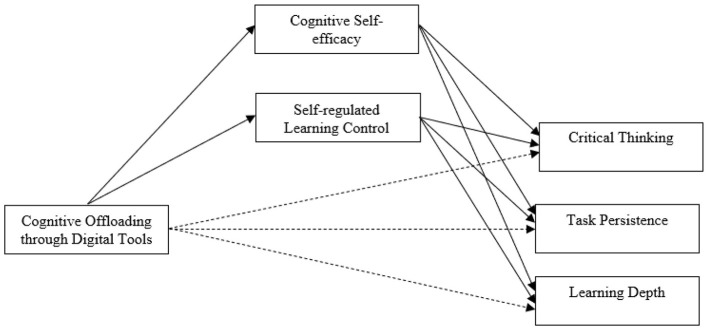
In a survey of 468 Chinese undergraduates analyzed with covariance-based SEM, cognitive offloading through digital tools was positively linked to cognitive self-efficacy and self-regulated learning control, which in turn predicted critical thinking, task persistence, and learning depth. Indirect effects through both mediators were significant, with cognitive self-efficacy reported as fully mediating task persistence and partially mediating critical thinking and learning depth.
Key findings
- Cognitive offloading was positively associated with cognitive self-efficacy (β = 0.31, p = 0.000) and self-regulated learning control (β = 0.27, p = 0.000).
- Cognitive self-efficacy predicted critical thinking (β = 0.41), task persistence (β = 0.36), and learning depth (β = 0.33), all p = 0.000; self-regulated learning control also predicted critical thinking (β = 0.29), task persistence (β = 0.34), and learning depth (β = 0.31), all p = 0.000.
- Indirect effects via cognitive self-efficacy were significant for critical thinking [β = 0.13, 95% CI (0.06, 0.21)], task persistence [β = 0.11, 95% CI (0.05, 0.19)], and learning depth [β = 0.10, 95% CI (0.04, 0.18)]. Indirect effects via self-regulated learning control were also significant for critical thinking [β = 0.08, 95% CI (0.03, 0.15)], task persistence [β = 0.09, 95% CI (0.04, 0.16)], and learning depth [β = 0.08, 95% CI (0.03, 0.14)].
- In the direct-effects-only model, cognitive offloading was associated with critical thinking (β = 0.25, p = 0.000), task persistence (β = 0.19, p = 0.002), and learning depth (β = 0.23, p = 0.000); in the mediation model, these direct paths were reduced and non-significant in Table 4 (critical thinking β = 0.09, p = 0.093; task persistence β = 0.06, p = 0.226; learning depth β = 0.08, p = 0.136).
Methods
- In-person survey of undergraduate students in mainland China; 600 students approached, 512 questionnaires returned, and 468 retained after screening. Stratified random sampling was used across public universities and disciplines.
- Measures were adapted from previously validated instruments, translated into Chinese with back-translation, and rated on a five-point Likert scale. Controls included gender, age, academic year, academic discipline, and prior academic performance.
- Covariance-based structural equation modeling in AMOS was used, including a six-factor confirmatory factor analysis and comparison of competing structural models. Mediation was tested with bias-corrected bootstrap procedures using 5,000 resamples; Harman’s single-factor test showed the first unrotated factor accounted for 32.6% of variance.
Limitations
- The paper states that the cross-sectional design restricts causal inferences, self-reported measures may introduce common method bias, and the Chinese university sample may limit generalizability; it also calls for longitudinal, experimental, behavioral, and cross-cultural research.
- Evident from the text: the mediation/direct-effect reporting is inconsistent—Table 4 shows all direct paths from cognitive offloading to the three outcomes as non-significant in the mediation model, whereas the abstract and discussion describe full mediation for task persistence and partial mediation for critical thinking and learning depth.
Model-written summary. Check it against the paper before relying on it.
Integrity signals
Registry
Cites
Statistics
Figures
Verification
Claims the paper makes
17 Valid · 3 Not valid · 36 Not checked · 60 Own results and interpretations
The cited sources support only part of this claim — read each source’s verdict below.
In the paper
“Empirical studies have shown that learners who effectively integrate digital tools into their study routines demonstrate higher levels of metacognitive awareness and learning regulation, particularly in complex or information-rich contexts (Chang et al., 2023; Chiu, 2023; Lee and Hwang, 2022).”
§ Cognitive offloading through digital tools and its relationship with critical thinking, task persistence, and learning depth > Literature review and hypotheses > Linking cognitive offloading through digital tools with self-regulated learning
What the sources say
- Partly supportedcites Chang et al., 2023 sourceExperimental — accuracy not yet measured
Section 3.1 proposes that digital tools offering feedback and learning-process data may support self-regulated learning and metacognitive monitoring. Section 3.3 similarly describes how chatbot interactions could develop learners’ self-awareness and regulation. The paper does not establish the claimed empirical comparison—higher levels among learners who integrate digital tools into their study routines—or the qualification about complex or information-rich contexts. The indexed passages provide no page numbers. (LLM, conf=0.86)
- Not checked — no full text of the sourcecites Chiu, 2023 source
- Could not verifycites Lee and Hwang, 2022 sourceExperimental — accuracy not yet measured
The Introduction discusses digital textbooks, engagement, and digital literacy, while Section 4.2 measures pre-service teachers’ technological readiness and perceived pedagogical benefits. Searches for metacognitive awareness, learning regulation, and self-regulated learning found no passage linking effective digital-tool use to those outcomes, including in complex or information-rich contexts. The available passages have no page numbers. (LLM, conf=0.75)
boostedstates an association- Asserted: passes — The authors put it forward as true.
- Checkable: passes — It can be checked against evidence.
- Load-bearing: passes — The paper’s conclusions depend on it.
- Based: passes — The paper gives a reason why it holds.
- Partly supported
The cited sources support only part of this claim — read each source’s verdict below.
In the paper
“Empirical evidence has shown that students who strategically use digital supports often report higher confidence in managing academic tasks, especially in complex learning environments (Wahn et al., 2023; Zou et al., 2025).”
§ Cognitive offloading through digital tools and its relationship with critical thinking, task persistence, and learning depth > Literature review and hypotheses > Linking cognitive offloading through digital tools with cognitive self-efficacy
What the sources say
- Partly supportedcites Wahn et al., 2023 sourceExperimental — accuracy not yet measured
The Methods (Participants; page unavailable) identify the participants as university students, and the Discussion (page unavailable) reports that offloading part of a tracking task to a computer improved accuracy. The paper does not report higher confidence in managing academic tasks or examine complex learning environments; those are unsupported extensions of its findings. (LLM, conf=0.83)
- Not checked — no full text of the sourcecites Zou et al., 2025 source
boostedstates an association- Asserted: passes — The authors put it forward as true.
- Checkable: passes — It can be checked against evidence.
- Load-bearing: passes — The paper’s conclusions depend on it.
- Based: passes — The paper gives a reason why it holds.
- Partly supported
The cited sources support only part of this claim — read each source’s verdict below.
In the paper
“In addition, studies in online and blended learning contexts demonstrate that the benefits of technology use for learning are contingent on learners' self-regulatory capacity rather than on tool availability alone (Eggers et al., 2021; Lobos et al., 2024; Stebner et al., 2022).”
§ Cognitive offloading through digital tools and its relationship with critical thinking, task persistence, and learning depth > Literature review and hypotheses > Self-regulated learning control as a mediating variable
What the sources say
- Supportedcites Eggers et al., 2021 sourceExperimental — accuracy not yet measured
The Introduction (page not available) says blended learning places greater demands on students’ self-regulation and reports indications that students lacking self-regulated learning strategies cannot learn successfully online. The Abstract (page not available) adds that students’ active use of those strategies depends heavily on teachers’ actions, supporting the point that access to tools alone is insufficient. (LLM, conf=0.88)
- Supportedcites Lobos et al., 2024 sourceExperimental — accuracy not yet measured
Section 4.2 says that although digital technologies offer learning opportunities, students may not benefit equally because some lack the skills needed to use them successfully, including self-regulated learning skills. The conclusion also emphasizes students’ self-management and autonomy in blended learning. This supports the claim that access to tools alone is insufficient. (LLM, conf=0.90)
- Partly supportedcites Stebner et al., 2022 sourceExperimental — accuracy not yet measured
In “The present study” and “Metacognitive skill transfer resulting in content knowledge acquisition (RQ 2)” (pages unavailable), the paper describes a computer-based learning task and reports that metacognitive training benefited content knowledge acquisition under a near-transfer condition. This supports the importance of self-regulatory skills, but the study does not examine online or blended learning or compare learners’ skills with tool availability alone. (LLM, conf=0.84)
boostedstates a possible cause- Asserted: passes — The authors put it forward as true.
- Checkable: passes — It can be checked against evidence.
- Load-bearing: passes — The paper’s conclusions depend on it.
- Based: passes — The paper gives a reason why it holds.
- Supported
The cited sources support only part of this claim — read each source’s verdict below.
In the paper
“Complementing these findings, systematic reviews of technology-enhanced and immersive learning environments have noted that existing research tends to emphasize technological features and pedagogical innovations while offering limited insight into the psychological mechanisms that shape learners' engagement, regulation, and deep learning processes (Bizami et al., 2023).”
§ Cognitive offloading through digital tools and its relationship with critical thinking, task persistence, and learning depth > Introduction
What the sources say
- Partly supportedcites Bizami et al., 2023 sourceExperimental — accuracy not yet measured
Split into 2 atoms — 0 confirmed, 2 partially supported, 0 disputed, 0 misattributed, 0 unverifiable. Expand the claim to see per-atom verdicts.
plain- Asserted: passes — The authors put it forward as true.
- Checkable: passes — It can be checked against evidence.
- Load-bearing: passes — The paper’s conclusions depend on it.
- Based: passes — The paper gives a reason why it holds.
- Partly supported
The cited sources support only part of this claim — read each source’s verdict below.
In the paper
“Prior studies have primarily examined cognitive offloading from a cognitive and functional perspective, emphasizing its role in reducing memory demands, altering information retention, or redistributing cognitive load (Skulmowski and Xu, 2022; Sun et al., 2025).”
§ Cognitive offloading through digital tools and its relationship with critical thinking, task persistence, and learning depth > Introduction
What the sources say
- Partly supportedcites Skulmowski and Xu, 2022 sourceExperimental — accuracy not yet measured
The 1998 Cognitive Load Theory Model section says instructional design can reduce extraneous load to preserve limited mental capacity, and Summary and Implications discusses effects on retention and transfer. But these passages concern cognitive load in learning materials, not cognitive offloading; they do not establish that prior offloading studies primarily examined memory demands, retention, or load redistribution. (LLM, conf=0.79)
- Not checked — no full text of the sourcecites Sun et al., 2025 source
plain- Asserted: passes — The authors put it forward as true.
- Checkable: passes — It can be checked against evidence.
- Load-bearing: passes — The paper’s conclusions depend on it.
- Based: passes — The paper gives a reason why it holds.
- Partly supported
70 more claims · 6 with their cited sources checked
Create a free account to see all 116 claims and every source verdict.
- It may state two separate claims as one. 24
- Probably not a substantial claim. 21
- The quote only partly states this claim. 2
Self-check
Percentages, sums and reported differences re-computed from the paper’s own numbers.
Each contradiction between two passages listed here was confirmed by an independent check.
Rated major: it would touch a result — a value a result rests on, reported and recomputed p-values on opposite sides of the significance level, two passages that conflict with no sign which is right, or a cited work retracted before this paper was published.
In the paper
§ Cognitive offloading through digital tools and its relationship with critical thinking, task persistence, and learning depth > Results
“while its effects on critical thinking (β = 0.12, p = 0.043) and learning depth (β = 0.10, p = 0.082) were substantially reduced.”
§ Cognitive offloading through digital tools and its relationship with critical thinking, task persistence, and learning depth > Results
“| Cognitive offloading → Critical thinking | 0.25 | 4.11 | 0.000 | 0.09 | 1.68 | 0.093 |”
Rated major: it would touch a result — a value a result rests on, reported and recomputed p-values on opposite sides of the significance level, two passages that conflict with no sign which is right, or a cited work retracted before this paper was published.
In the paper
§ Cognitive offloading through digital tools and its relationship with critical thinking, task persistence, and learning depth > Results
“Taken together, these findings indicate partial mediation for critical thinking and learning depth, where both direct and indirect effects were present, and full mediation for task persistence, where the direct effect became non-significant once cognitive self-efficacy was included in the model.”
§ Cognitive offloading through digital tools and its relationship with critical thinking, task persistence, and learning depth > Results
“| Cognitive offloading → Critical thinking | 0.25 | 4.11 | 0.000 | 0.09 | 1.68 | 0.093 | | Cognitive offloading → Task persistence | 0.19 | 3.09 | 0.002 | 0.06 | 1.21 | 0.226 | | Cognitive offloading → Learning depth | 0.23 | 3.78 | 0.000 | 0.08 | 1.49 | 0.136 |”
Citations
Cites
Evaluating structural equation models with unobservable variables and measurement error
Fornell, C., & Larcker, D. F. (1981) · Journal of Marketing Research · doi:10.1177/002224378101800104 · Cited by 109,190 · cited 2×
“This pattern satisfies the Fornell-Larcker criterion and confirms that the constructs are empirically distinct despite their theoretically related nature (Fornell and Larcker, 1981).”
InfluentialHu, L., & Bentler, P. M. (1999) · Structural Equation Modeling A Multidisciplinary Journal · doi:10.1080/10705519909540118 · Cited by 108,788
Baron, R. M., & Kenny, D. A. (1986) · Journal of Personality and Social Psychology · doi:10.1037/0022-3514.51.6.1173 · Cited by 91,532 · cited 1×
“This attenuation pattern is consistent with mediation logic in structural equation modeling, whereby the inclusion of a theoretically meaningful mediator explains variance previously attributed to direct effects (Baron and Kenny, 1986; Kline, 2016).”
Podsakoff, P. M., MacKenzie, S. B., Lee, J.-Y., & Podsakoff, N. P. (2003) · Journal of Applied Psychology · doi:10.1037/0021-9010.88.5.879 · Cited by 82,194
When to Use and How to Report the Results of PLS-SEM
Hair, J. F., Risher, J. J., Sarstedt, M., & Ringle, C. M. (2019) · European Business Review · doi:10.1108/ebr-11-2018-0203 · Cited by 27,541
Motivational and self-regulated learning components of classroom academic performance.
Pintrich, P. R., & De Groot, E. V. (1990) · Journal of Educational Psychology · doi:10.1037/0022-0663.82.1.33 · Cited by 8,332
Grit: perseverance and passion for long-term goals
Duckworth, A. L., Peterson, C., Matthews, M. D., & Kelly, D. R. (2007) · Journal of Personality and Social Psychology · doi:10.1037/0022-3514.92.6.1087 · Cited by 6,911 · cited 1×
“The scale emphasized consistency of effort and resistance to disengagement, drawing on prior FrontiersinPsychology 06 frontiersin.org conceptualizations of persistence as a core motivational and behavioral outcome in learning settings (Duckworth et al., 2007; Credé et al., 2017).”
Zimmerman, B. J. (2000) · Handbook of Self-Regulation · doi:10.1016/b978-012109890-2/50031-7 · Cited by 6,069 · cited 3×
“Within learning environments, cognitive self-efficacy has been shown to predict higher levels of effort, persistence, and strategic engagement, particularly when tasks demand sustained cognitive involvement (Zimmerman, 2000).”
InfluentialByrne, B. M. (2013) · doi:10.4324/9780203805534 · Cited by 4,016
Wolf, E. J., Harrington, K. M., Clark, S. L., & Miller, M. W. (2013) · Educational and Psychological Measurement · doi:10.1177/0013164413495237 · Cited by 3,931 · cited 1×
“Given the adequate sample size relative to model complexity, the use of AMOS provides sufficient statistical power and stable parameter estimation for examining the hypothesized relationships in higher education research contexts (Boomsma and Hoogland, 2001; Wolf et al., 2013).”
Research works printed but not linked: 11
- Bandura, 1997, Self-Efficacy: The Exercise of Control
- Biggs, 1987, Student Approaches to Learning and Studying
- Boomsma, 2001, “The robustness of LISREL modeling revisited,”, 139
- Brislin, 1980, “Translation and content analysis of oral and written material,”, Handbook of Cross-Cultural Psychology: Methodology, 389
- Entwistle, 2015, Understanding Student Learning
- Facione, 1990, Critical Thinking: A Statement of Expert Consensus for Purposes of Educational Assessment and Instruction
- Hayes, 2018, Introduction to Mediation, Moderation, and Conditional Process Analysis: A Regression-Based Approach
- Kline, 2016, Principles and Practice of Structural Equation Modeling, 4th Edn.
- Mohanraj, 2024, “Defining the potentials of self-regulated learning through digital environments: a theoretical perspective,”, 110
- Saleh, 2022, Digital learning tools (institutional-open) and their relationship to educational self-effectiveness and achievement in online learning environments, Przestrz. Społecz., 22, 226
- Skulmowski, 2022, Understanding cognitive load in digital and online learning: a new perspective on extraneous cognitive load, Educ. Psychol. Rev., 34, 171, 10.1007/s10648-021-09624-7 · DOI · Paper page
Cited by
Si, S., Qi, Y., Xu, J., & Qi, X. (2026) · Journal of Intelligence · doi:10.3390/jintelligence14070116 · Cited by 22
“Cognitive offloading refers to the use of external tools or agents to reduce the cognitive demands of a task (Wang, 2026).”
Bolatimi, O. S., Ricky-Okine, C., Bolatimi, F. E., Agbesi, C. C. M., Martey, F., Bolatimi, O. R., Peter, A., & Kwaku, E. O. (2026) · Discover Artificial Intelligence · doi:10.1007/s44163-026-02082-6
“The concept of cognitive offloading, externalising mental effort to digital tools, has become a central concern, as excessive reliance on AI may bypass the “productive struggle” necessary to build the “cognitive musculature” required for independent problem-solving [18, 62, 48].”
Bu, Y., zhang, Z., Wang, S., & Li, Y. (2026) · Research Square · doi:10.21203/rs.3.rs-10212076/v1
Singh, M. I., Pradhan, S., Naveen, S., & Vinod, L. (2026) · Discover Education · doi:10.1007/s44217-026-02090-9
“However, the same literature also warns that excessive reliance can weaken critical thinking, persistence, and independent learning [1, 3, 23, 27, 35, 58, 66].”
Kronbach, G., Hidayat, A., & Wulandarı, M. (2026) · Cogent Psychology · doi:10.1080/23311908.2026.2715699
Metadata
- Authors
- Wang, J.
- Affiliations
- Chengdu University of Technology (CN)
- Corresponding author
- Wang, Jian
- Venue
- Frontiers in Psychology
- Publisher
- Frontiers Media SA
- Published
- 2026-03-12
- Volume
- 17
- Pages
- 1781101-1781101
- ISSN
- 1664-1078 (ISSN-L)
- PMC
- PMC13017817
- OpenAlex
- W7135046672
- Cited by
- 10
- References
- 77
- Citations by year
- 2026: 10
- FWCI
- 140.55
- Type
- journal article
- Language
- en
- Open access
- gold
- doi.org
- Licence
- Locations
- Frontiers in Psychology (publishedVersion, cc-by)
- PubMed Central (publishedVersion, cc-by)
- PubMed (publishedVersion)
- DOAJ (DOAJ: Directory of Open Access Journals) (submittedVersion, cc-by-sa)
- Funders
- National Natural Science Foundation of China (21805017)
- Natural Science Foundation of Sichuan Province (2025ZNSFSC0344)
- Topics
- Social Sciences › Psychology › Developmental and Educational Psychology › Educational Strategies and Epistemologies
- Social Sciences › Psychology › Developmental and Educational Psychology › Innovative Teaching and Learning Methods
- Social Sciences › Psychology › Experimental and Cognitive Psychology › Visual and Cognitive Learning Processes
- Keywords
- cognitive offloading, digital tools, cognitive self-efficacy, critical thinking, task persistence, social cognitive theory, mediation, higher education, undergraduate students, deep learning
About these checks
Registry, retraction, Cites and statistics results are computed, not judged, with one exception: a printed reference that no index lists is read once by a model before it counts as a citation error. Claims are extracted by a model and kept only when their quote appears verbatim in the text; each cited source is then checked, with a model’s help, for whether it says what the claim relies on. Those verdicts can be wrong — read the claim’s quote and the cited source before relying on one.
The claim verdicts this report counts are experimental: their accuracy is not yet measured.
A language model drew the claims from the paper on 2026-09-30, under version 3 of the claim definition (model deepseek-v4.1-flash, prompt extract-v3).
A second model labelled each claim on 2026-09-30 (model jev-1.13-20260917, definition revision gold-guideline-v0.2).
Cited sources are checked with a language model’s help (gpt-6-sol).
Statistics and arithmetic are recomputed, not judged.
Confidence bands are shown only for fields calibrated on our annotated test set. None is calibrated yet, so no band is shown.
What counts as a claim ›How we measure confidence ›How we check this ›
Are you an author, or do you see a problem with this page? Request a review
How to cite
Cite CoChat for the checks on this page, and the paper for its own findings.
- This page
- CoChat. (2026). Citation check: Cognitive offloading through digital tools and its relationship with critical thinking, task persistence, and learning depth. https://app.cochat.ai/papers/10.3389/fpsyg.2026.1781101
- The paper
- Wang, J. (2026). Cognitive offloading through digital tools and its relationship with critical thinking, task persistence, and learning depth. Frontiers in Psychology. https://doi.org/10.3389/fpsyg.2026.1781101
Data sources
Bibliographic data: Semantic Scholar, OpenAlex, Crossref.
Contains information from the Semantic Scholar Academic Graph Datasets, made available under the ODC Attribution License (ODC-BY 1.0).
Semantic Scholar’s data is described in: Kinney, R., et al. (2023). The Semantic Scholar Open Data Platform. arXiv:2301.10140.
