

The DOI matches its Crossref record; 4 of the 4 references it cites were found in a registry or an index.
Differential impact of the COVID-19 pandemic on primary care utilization related to common mental disorders in four European countries: A retrospective observational study
Abstract
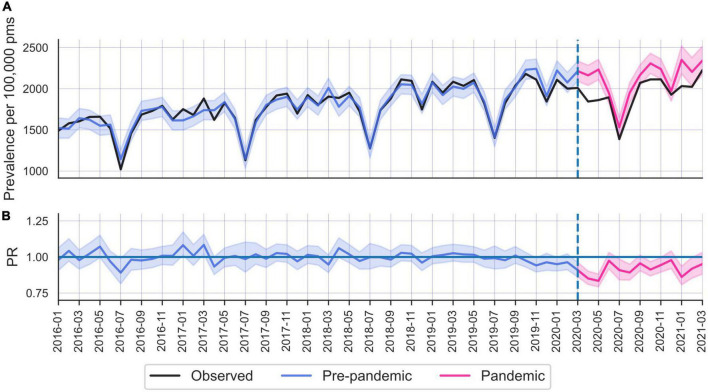
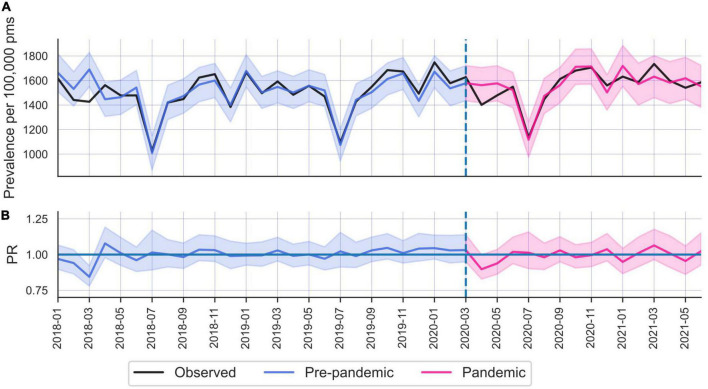
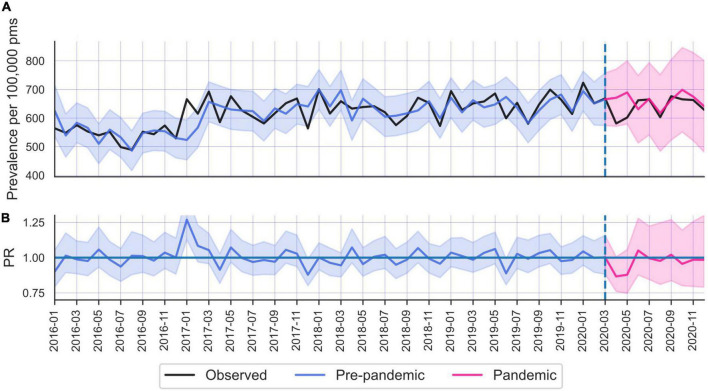
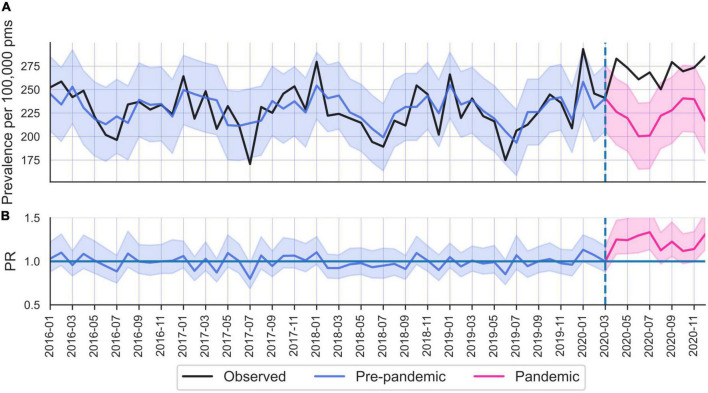
Background: The COVID-19 pandemic is commonly believed to have increased common mental disorders (CMD, i.e., depression and anxiety), either directly due to COVID-19 contractions (death of near ones or residual conditions), or indirectly by increasing stress, economic uncertainty, and disruptions in daily life resulting from containment measure. Whereas studies reporting on initial changes in self-reported data frequently have reported increases in CMD, pandemic related changes in CMD related to primary care utilization are less well known. Analyzing time series of routinely and continuously sampled primary healthcare data from Sweden, Norway, Netherlands, and Latvia, we aimed to characterize the impact of the pandemic on CMD recorded prevalence in primary care. Furthermore, by relating these changes to country specific time-trajectories of two classes of containment measures, we evaluated the differential impact of containment strategies on CMD rates. Specifically, we wanted to test whether school restrictions would preferentially affect age groups corresponding to those of school children or their parents. Methods: For the four investigated countries, we collected time-series of monthly counts of unique CMD patients in primary healthcare from the year 2015 (or 2017) until 2021. Using pre-pandemic timepoints to train seasonal Auto Regressive Integrated Moving Average (ARIMA) models, we predicted healthcare utilization during the pandemic. Discrepancies between observed and expected time series were quantified to infer pandemic related changes. To evaluate the effects of COVID-19 measures on CMD related primary care utilization, the predicted time series were related to country specific time series of levels of social distancing and school restrictions. Results: In all countries except Latvia there was an initial (April 2020) decrease in CMD care prevalence, where largest drops were found in Sweden (Prevalence Ratio, PR = 0.85; 95% CI 0.81–0.90), followed by Netherlands (0.86; 95% CI 0.76–1.02) and Norway (0.90; 95% CI 0.83–0.98). Latvia on the other hand experienced increased rates (1.25; 95% CI 1.08–1.49). Whereas PRs in Norway and Netherlands normalized during the latter half of 2020, PRs stayed low in Sweden and elevated in Latvia. The overall changes in PR during the pandemic year 2020 was significantly changed only for Sweden (0.91; 95% CI 0.90–0.93) and Latvia (1.20; 95% CI 1.14–1.26). Overall, the relationship between containment measures and CMD care prevalence were weak and non-significant. In particular, we could not observe any relationship of school restriction to CMD care prevalence for the age groups best corresponding to school children or their parents. Conclusion: Common mental disorders prevalence in primary care decreased during the initial phase of the COVID-19 pandemic in all countries except from Latvia, but normalized in Norway and Netherlands by the latter half of 2020. The onset of the pandemic and the containment strategies were highly correlated within each country, limiting strong conclusions on whether restriction policy had any effects on mental health. Specifically, we found no evidence of associations between school restrictions and CMD care prevalence. Overall, current results lend no support to the common belief that the pandemic severely impacted the mental health of the general population as indicated by healthcare utilization, apart from in Latvia. However, since healthcare utilization is affected by multiple factors in addition to actual need, future studies should combine complementary types of data to better understand the mental health impacts of the pandemic.
Overview
The claims and statistics of this paper haven’t been checked yet.
Run the check — free, no account needed. It reads the open-access text and checks the sources it cites.
Integrity signals
Registry
Cites
Statistics
Figures
Verification
Claims the paper makes
The claims and statistics of this paper haven’t been checked yet.
Run the check — free, no account needed. It reads the open-access text and checks the sources it cites.
Claims other papers make about this one
Each is checked against this paper’s own text: does it say what the citing paper says it does?
In the citing paper
“Ironically, mobility restrictions and social distancing reduced engagement with mental health services; many avoided healthcare facilities, causing reported cases of some disorders to appear artificially lower (Duden et al., 2022;Flodin et al., 2023).”
From Effectiveness Of Narrative Therapy In Addressing Psychological Challenges: A Systematic Review Of Randomised Controlled Trials (2026) · cites this paper as Flodin et al., 2023
Self-check
Percentages, sums and reported differences re-computed from the paper’s own numbers.
The self-check needs the paper’s full text.
Citations
Cites
Santomauro, D. F., Mantilla Herrera, A. M., Shadid, J., Zheng, P., Ashbaugh, C., Pigott, D. M., Abbafati, C., Adolph, C., Amlag, J. O., Aravkin, A. Y., et al. (2021) · The Lancet · doi:10.1016/s0140-6736(21)02143-7 · Cited by 5,444 · cited 1×
“Hence, there is strong evidence that at least parts of the declines in CMD care prevalence are driven by care avoidance during the pandemic rather than decreased needs, particularly given that early evidence suggested a global increase of CMD prevalence by about 25% (34).”
BackgroundCOVID-19 pandemic and mental health consequences: Systematic review of the current evidence
Vindegaard, N., & Benros, M. E. (2020) · Brain, Behavior, and Immunity · doi:10.1016/j.bbi.2020.05.048 · Cited by 3,221
Pierce, M., McManus, S., Hope, H., Hotopf, M., Ford, T., Hatch, S. L., John, A., Kontopantelis, E., Webb, R. T., Wessely, S., et al. (2021) · The Lancet Psychiatry · doi:10.1016/s2215-0366(21)00151-6 · Cited by 387
Research works printed but not linked: 30
- Pfefferbaum, 2020, Mental health and the covid-19 pandemic., N Engl J Med., 383, 510, 10.1056/NEJMp2008017 · DOI · Paper page
- Holmes, 2020, Multidisciplinary research priorities for the COVID-19 pandemic: a call for action for mental health science., Lancet Psychiatry., 7, 547, 10.1016/S2215-0366(20)30168-1 · DOI · Paper page
- Varga, 2021, Loneliness, worries, anxiety, and precautionary behaviours in response to the COVID-19 pandemic: a longitudinal analysis of 200,000 Western and Northern Europeans., Lancet Region Health Eur., 2, 100020, 10.1016/j.lanepe.2020.100020 · DOI
- Chen, 2022, Impact of COVID-19 pandemic on mental health and health behaviors in Swedish adolescents., Scand J Public Health., 50, 26, 10.1177/14034948211021724 · DOI
- Pierce, 2020, Says who? The significance of sampling in mental health surveys during COVID-19., Lancet Psychiatry., 7, 567, 10.1016/S2215-0366(20)30237-6 · DOI · Paper page
- Flodin, Swedish Burden of Disease Database
- England, 2017, RCGP Position Statement on Mental Health in Primary Care–September 2017.
- Carr, 2021, Effects of the COVID-19 pandemic on primary care-recorded mental illness and self-harm episodes in the UK: a population-based cohort study., Lancet Public Health., 6, e124, 10.1016/S2468-2667(20)30288-7 · DOI
- Bohlken, 2021, Effect of the COVID-19 pandemic on stress, anxiety, and depressive disorders in German primary care: a cross-sectional study., J Psychiatr Res., 143, 43, 10.1016/j.jpsychires.2021.08.016 · DOI
- Hvide, 2022, COVID-19 and mental health: a longitudinal population study from Norway., Eur J Epidemiol., 37, 167, 10.1007/s10654-021-00836-3 · DOI
- Raventós, 2022, Impact of the COVID-19 pandemic on diagnoses of common mental health disorders in adults in Catalonia, Spain: a population-based cohort study., BMJ Open., 12, e057866, 10.1136/bmjopen-2021-057866 · DOI
- Hansen, 2021, The effect of the March 2020 COVID-19 lockdown on national psychiatric contacts in Denmark: an interrupted time series analysis., Brain Behav., 11, e2264, 10.1002/brb3.2264 · DOI
- Chow, 2021, Impact of the first COVID-19 outbreak on mental health service utilisation at a Dutch mental health centre: retrospective observational study., BJPsych Open., 7, e213, 10.1192/bjo.2021.1049 · DOI
- de Beurs, 2022, Impact of COVID-19 social distancing measures on routine mental health care provision and treatment outcome for common mental disorders in the Netherlands., Clin Psychol Psychother., 29, 1342, 10.1002/cpp.2713 · DOI
- 2022, The KUHR-Database.
- 2022, Atïauja Izmantot Pacienta Datus Pçtîjumâ.
- 2022, Ansökan om Registeruttag Från Vårdregister.
- 2022, Datauttag för Forskning.
- 2022, Stockholm Center for Health Data.
- 2022, Samrådsgrupp Kvalitetsregister, Vårdinformationssystem Och Beredning (S-KVB).
- 2022, Nivel Primary Care Database.
- Kubinec, 2021, Statistically Validated Indices for COVID-19 Public Health Policies
- Williams, 2020, Diagnosis of physical and mental health conditions in primary care during the COVID-19 pandemic: a retrospective cohort study., Lancet Public Health., 5, e543, 10.1016/S2468-2667(20)30201-2 · DOI
- Rancans, 2020, Prevalence of major depression and associated correlates in Latvian primary care population: results from the national research program BIOMEDICINE 2014–2017., Nord J Psychiatry., 74, 60, 10.1080/08039488.2019.1668961 · DOI
- Kursīte, 2022, A mixed-method study on the provision of remote consultations for non-communicable disease patients during the first wave of the COVID-19 pandemic in Latvia: lessons for the future., BMC Health Serv Res., 22, 263, 10.1186/s12913-022-07634-x · DOI
- Savilahti, 2021, Adolescent psychiatric outpatient care rapidly switched to remote visits during the COVID-19 pandemic., BMC Psychiatry., 21, 586, 10.1186/s12888-021-03580-w · DOI
- Patel, 2021, Impact of the COVID-19 pandemic on remote mental healthcare and prescribing in psychiatry: an electronic health record study., BMJ Open., 11, e046365, 10.1136/bmjopen-2020-046365 · DOI
- Zhu, 2022, Trends in outpatient mental health services use before and during the COVID-19 pandemic., Health Aff (Millwood)., 41, 573, 10.1377/hlthaff.2021.01297 · DOI
- Splinter, 2021, Prevalence and determinants of healthcare avoidance during the COVID-19 pandemic: a population-based cross-sectional study., PLoS Med., 18, e1003854, 10.1371/journal.pmed.1003854 · DOI
- Bekele, 2022, The effect of the COVID-19 pandemic on the social inequalities of health care use in Hungary: a nationally representative cross-sectional study., Int J Environ Res Public Health., 19, 2258, 10.3390/ijerph19042258 · DOI
Cited by
Sorted by citations
Permatasari, D. P., Windarwati, H. D., & Lestari, R. (2026) · Indigenous: Jurnal Ilmiah Psikologi · doi:10.23917/indigenous.v11i1.13778
Metadata
- Authors
- Flodin, P., Sörberg Wallin, A., Tarantino, B., Cerchiello, P., Mladá, K., Kuklová, M., Kondrátová, L., Parimbelli, E., Osika, W., Hollander, A.-C., & Dalman, C.
- Venue
- Frontiers in Psychiatry
- Publisher
- Frontiers Media SA
- Published
- 2023-01-09
- Volume
- 13
- ISSN
- 1664-0640
- PMC
- PMC9868724
- Cited by
- 6
- References
- 4
About these checks
Registry, retraction, Cites and statistics results are computed, not judged, with one exception: a printed reference that no index lists is read once by a model before it counts as a citation error. Claims are extracted by a model and kept only when their quote appears verbatim in the text; each cited source is then checked, with a model’s help, for whether it says what the claim relies on. Those verdicts can be wrong — read the claim’s quote and the cited source before relying on one.
Statistics and arithmetic are recomputed, not judged.
Confidence bands are shown only for fields calibrated on our annotated test set. None is calibrated yet, so no band is shown.
What counts as a claim ›How we measure confidence ›How we check this ›
Are you an author, or do you see a problem with this page? Request a review
How to cite
Cite CoChat for the checks on this page, and the paper for its own findings.
- This page
- CoChat. (2026). Citation check: Differential impact of the COVID-19 pandemic on primary care utilization related to common mental disorders in four European countries: A retrospective observational study. https://app.cochat.ai/papers/10.3389/fpsyt.2022.1045325
- The paper
- Flodin, P., Sörberg Wallin, A., Tarantino, B., Cerchiello, P., Mladá, K., Kuklová, M., Kondrátová, L., Parimbelli, E., Osika, W., Hollander, A.-C., & Dalman, C. (2023). Differential impact of the COVID-19 pandemic on primary care utilization related to common mental disorders in four European countries: A retrospective observational study. Frontiers in Psychiatry. https://doi.org/10.3389/fpsyt.2022.1045325
