

The Collaborative Assessment and Management of Suicidality compared to enhanced treatment as usual for inpatients who are suicidal: A randomized controlled trial
Open accessThe DOI matches its Crossref record; 68 of the 68 references it cites were found in a registry or an index.
Abstract
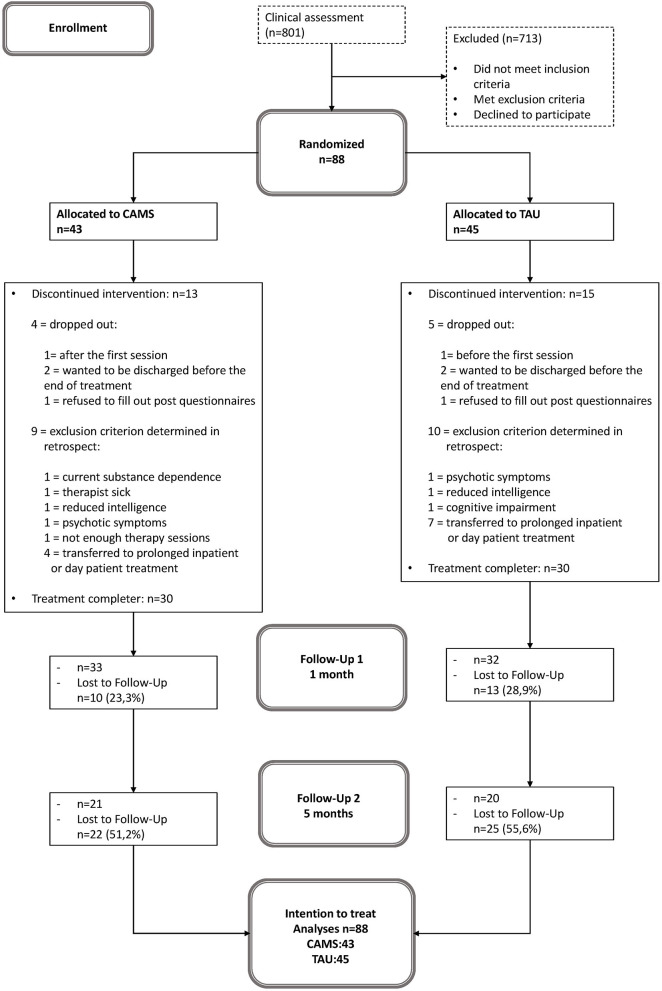
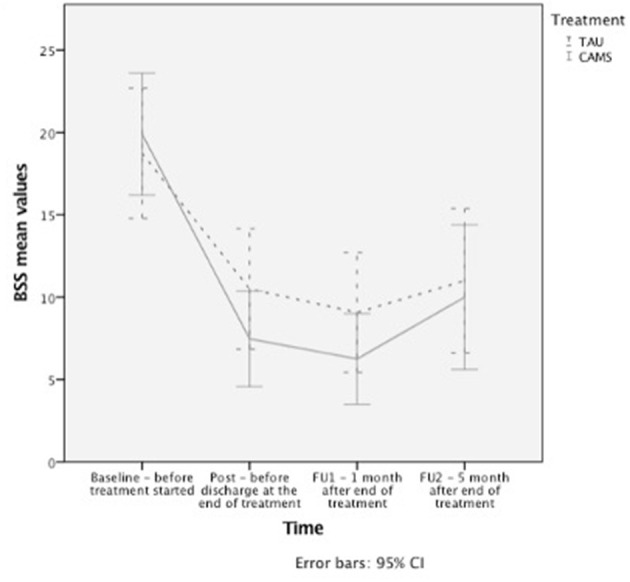
Background: Although use of inpatient crisis hospital intervention for suicide risk is common, the evidence for inpatient treatments that reduce suicidal thoughts and behaviors is remarkably limited. To address this need, this novel feasibility pilot randomized controlled trial compared the use of the Collaborative Assessment and Management of Suicidality (CAMS) to enhanced treatment as usual (E-TAU) within a standard acute inpatient mental health care setting. Objectives: We hypothesized that CAMS would be more effective than E-TAU in reducing suicidal thoughts and behaviors. As secondary outcomes we also investigated depressive symptoms, general symptom burden, reasons for living, and quality of the therapeutic relationship. Methods: All patients were admitted due to acute suicidal thoughts or behaviors. They were randomly assigned to CAMS (n = 43) or E-TAU (n = 45) and assessed at four time points (admission, discharge, 1 month and 5 months after discharge). We used mixed-effects models, effect sizes, and reliable change analyses to compare improvements across and between treatment groups over time. Results: Intent-to-treat analyses of 88 participants [mean age 32.1, SD = 13.5; n = 47 (53%) females] showed that both groups improved over time across all outcome measures with no significant between-group differences in terms of change in suicidal ideation, depression, reasons for living, and distress. However, CAMS showed larger effect sizes across all measures; for treatment completers CAMS patients showed significant improvement in suicidal ideation (p = 0.01) in comparison to control patients. CAMS patients rated the therapeutic relationship significantly better (p = 0.02) than E-TAU patients and were less likely to attempt suicide within 4 weeks after discharge (p = 0.05). Conclusions: CAMS and E-TAU were both effective in reducing suicidal thoughts and symptom distress. Within this feasibility RCT the pattern of results was generally supportive of CAMS suggesting that inpatient use of CAMS is both feasible and promising. However, our preliminary results need further replication within well-powered multi-site randomized controlled trials. Trial registration: DRKS-ID/ICTRP-ID: DRKS00013727. The trial was retrospectively registered in the German Clinical Trials Register, registration code/ DRKS-ID: DRKS00013727 on 12.01.2018 and also in the International Clinical Trials Registry Platform of the World Health Organization (identical registration code).
Overview
The claims and statistics of this paper haven’t been checked yet.
Free: it reads the open-access text and checks the first 5 claims that cite a source we can check. Create a free account to check every claim.
Integrity signals
Registry
Cites
Statistics
Figures
Verification
Claims the paper makes
The claims and statistics of this paper haven’t been checked yet.
Free: it reads the open-access text and checks the first 5 claims that cite a source we can check. Create a free account to check every claim.
Claims other papers make about this one
Each is checked against this paper’s own text: does it say what the citing paper says it does?
The source backs part of the claim, not all of it — or backs it for a different population, condition or comparison.
In the citing paper
“CAMS patients also rated the therapeutic relationship significantly better (p < 0.02) than E-TAU patients as a secondary outcome.”
From The use of CAMS and DBT to effectively treat patients who are suicidal (2024) · cites this paper as [19]
Experimental — accuracy not yet measuredThe source backs part of the claim, not all of it — or backs it for a different population, condition or comparison.
In the citing paper
“Importantly, in terms of another primary outcome measure, patients treated by CAMS were significantly less likely to make a suicide attempt compared to control patients within the high-risk post-discharge period 4 weeks after they were discharged (p = 0.05).”
From The use of CAMS and DBT to effectively treat patients who are suicidal (2024) · cites this paper as [19]
Experimental — accuracy not yet measuredThe cited source says what the claim attributes to it.
In the citing paper
“The RCT included 88 inpatients who were acutely suicidal and admitted to a psychiatric inpatient hospital setting in Bielefeld, Germany. Results showed that both groups improved over time across all primary and secondary outcome measures.”
From The use of CAMS and DBT to effectively treat patients who are suicidal (2024) · cites this paper as [19]
The cited source says what the claim attributes to it.
In the citing paper
“Patients receiving CAMS showed notably larger effect sizes across all measures.”
From The use of CAMS and DBT to effectively treat patients who are suicidal (2024) · cites this paper as [19]
The cited source says what the claim attributes to it.
In the citing paper
“For treatment completers, CAMS patients showed significant improvement on the primary outcome measure of suicidal ideation (p = 0.01) in comparison to control patients”
From The use of CAMS and DBT to effectively treat patients who are suicidal (2024) · cites this paper as [19]
Self-check
Percentages, sums and reported differences re-computed from the paper’s own numbers.
The self-check needs the paper’s full text.
Citations
Cites
Hao (2015) · doi:10.1002/14651858 · Cited by 11,321
Power failure: why small sample size undermines the reliability of neuroscience
Button, K. S., Ioannidis, J. P. A., Mokrysz, C., Nosek, B. A., Flint, J., Robinson, E. S. J., & Munafò, M. R. (2013) · Nature Reviews Neuroscience · doi:10.1038/nrn3475 · Cited by 7,641
(1997) · American Psychiatric Press eBooks · Cited by 3,056
Suicide prevention strategies revisited: 10-year systematic review
Zalsman, G., Hawton, K., Wasserman, D., van Heeringen, K., Arensman, E., Sarchiapone, M., Carli, V., Höschl, C., Barzilay, R., Balazs, J., et al. (2016) · The Lancet Psychiatry · doi:10.1016/s2215-0366(16)30030-x · Cited by 1,765
The alliance in adult psychotherapy: A meta-analytic synthesis
Flückiger, C., Del Re, A. C., Wampold, B. E., & Horvath, A. O. (2018) · Psychotherapy · doi:10.1037/pst0000172 · Cited by 1,763
Bateman, A., & Fonagy, P. (1999) · American Journal of Psychiatry · doi:10.1176/ajp.156.10.1563 · Cited by 1,416
Epidemiology of suicide and the psychiatric perspective
Bachmann, S. (2018) · International Journal of Environmental Research and Public Health · doi:10.3390/ijerph15071425 · Cited by 1,377
Cognitive Therapy for the Prevention of Suicide Attempts: A Randomized Controlled Trial
Brown, G. K., Ten Have, T., Henriques, G. R., Xie, S. X., Hollander, J. E., & Beck, A. T. (2005) · JAMA · doi:10.1001/jama.294.5.563 · Cited by 1,045
Hautzinger, M., Keller, F., & Kühner, C. (2006) · Cited by 732
Linehan, M. M., Korslund, K. E., Harned, M. S., Gallop, R. J., Lungu, A., Neacsiu, A. D., McDavid, J., Comtois, K. A., & Murray-Gregory, A. M. (2015) · JAMA Psychiatry · doi:10.1001/jamapsychiatry.2014.3039 · Cited by 714
Research works printed but not linked: 11
- Bryan CJ Rudd MD. Brief Cognitive-Behavioral Therapy for Suicide Prevention. New York: Guilford Publication (2018).
- Huh D Jobes DA Comtois KA Kerbrat AH Chalker SA Gutierrez PM. The collaborative assessment and management of suicidality (CAMS) versus enhanced care as usual (E-CAU) with suicidal soldiers: Moderator analyses from a randomized controlled trial. Mil Psychol. (2018) 30: 495– 506. 10.1080/00332747.2017.1354607 29466107 · DOI · Paper page
- First MB Spitzer RL Gibbon M Williams JB. Structured Clinical Interview for DSM-IV-TR Axis I Disorders: SCID-I, Research Version. New York: Biometrics Research, New York State Psychiatric Institute (2002).
- Wittchen HU Zaudig M Fydrich T. Skid. Strukturiertes klinisches Interview für DSM-IV Achse I und II Handanweisung Hogrefe. Göttingen: Hogrefe (1997).
- Lehrl S. Mehrfachwahl-Wortschatz-Intelligenztest MWT-B. 5 unveränderte. Auflage Balingen: Spitta Verlag (2005).
- Beck AT Steer RA. Manual for the Beck Scale for Suicide Ideation. San Antonio: Psychological Corporation (1991).
- Brown GK. A Review of Suicide Assessment Measures for Intervention Research With Adults and Older Adults. Bethesda: National Institute of Mental Health (2001).
- Beck AT Steer RA Brown GK. Manual for the Beck Depression Inventory-II. San Antonio: Psychological Corporation (1996).
- Franke GH. Mini-SCL Mini Symptom-Checkliste – Deutsches Manual. Göttingen: Hogrefe (2016).
- Klauer KJ. Handbuch Kognitives Training. Göttingen: Hogrefe (2001).
- Nie N Hull C Bent D. IBM Statistical Package for the Social Sciences. (SPSS Version 20). Chicago: Computer Software (2011).
Cited by
Brief Cognitive Behavioral Therapy for Suicidal Inpatients: A Randomized Clinical Trial
Diefenbach, G. J., Lord, K. A., Stubbing, J., Rudd, M. D., Levy, H. C., Worden, B. L., Sain, K. S., Bimstein, J. G., Rice, T. B., Everhardt, K., et al. (2024) · JAMA Psychiatry · doi:10.1001/jamapsychiatry.2024.2349 · Cited by 77
Al‐Halabí, S., & Fonseca‐Pedrero, E. (2024) · Psicothema · doi:10.7334/psicothema2024.341 · Cited by 47
“Finally, the clinical intervention known as Collaborative Assessment and Management of Suicidality (CAMS) has received empirical support, although it has not yet reached the level of recommendation of the previous two treatments (Santel et al., 2023).”
BackgroundThe use of CAMS and DBT to effectively treat patients who are suicidal
Jobes, D. A., & Rizvi, S. L. (2024) · Frontiers in Psychiatry · doi:10.3389/fpsyt.2024.1354430 · Cited by 8
Self-citationZero Suicide – What About “Treat”?
Grumet, J. G., & Jobes, D. A. (2024) · Crisis · doi:10.1027/0227-5910/a000958 · Cited by 10
Self-citationDiefenbach, G. J., Collett, S., Black, S., Rudd, M. D., Gueorguieva, R. V., & Tolin, D. F. (2025) · General Hospital Psychiatry · doi:10.1016/j.genhosppsych.2025.01.007 · Cited by 11
O’Neill, J. C., O’Callaghan, E. T., Sullivan, S., & Winsberg, M. E. (2023) · Healthcare · doi:10.3390/healthcare11243158 · Cited by 10
“CAMS has been studied in seven randomized controlled trials (RCTs), and in a recent meta-analysis, CAMS was found to have outperformed alternative interventions in significantly reducing suicidal ideation and depression and increasing hope [36,38–44].”
MethodA Patient-Centered Approach for Assessing Suicidal Risk
Jobes, D. A., Chambers, W. I., & Maclellan, A. (2025) · Psychiatric Annals · doi:10.3928/00485713-20251023-02 · Cited by 3
Self-citationKearns, J. C., Straud, C. L., Stanley, I. H., Sloan, D. M., Fina, B. A., Young‐McCaughan, S., Tyler, H. C., Kaplan, A. M., Blankenship, A. E., Schrader, C. C., et al. (2025) · Suicide and Life-Threatening Behavior · doi:10.1111/sltb.70008 · Cited by 5
Reilly-Harrington, N. A., Falcone, T., Jobes, D. A., Deisz, C., Flannery, C., Wolf, A., Hu, B., & Anand, A. (2024) · Contemporary Clinical Trials · doi:10.1016/j.cct.2024.107777 · Cited by 3
Self-citationBlalock, K., Pistorello, J., Rizvi, S. L., Seeley, J. R., Kassing, F., Sinclair, J. S., Oshin, L. A., Gallop, R., Fry, C. M., Snyderman, T., et al. (2025) · JMIR Research Protocols · doi:10.2196/68441 · Cited by 2
“…to control care [51], performed similarly to DBT in terms of reductions in nonsuicidal self-injury (NSSI) and SAs [52], lowered risk of SA following discharge from an inpatient setting compared to TAU [53], and reduced SI and depression more than TAU in a university student population [49].”
Self-citationLockman, J. D., Pisani, A. R., Angerer, B. P., Graham, A. C., Henry, J., & Lloyd, F. (2025) · Suicide and Life-Threatening Behavior · doi:10.1111/sltb.70021 · Cited by 1
“…Collaborative Assessment and Management of Suicide) require between 6 weeks and 2 years of treatment to yield desired effects on suicidal behaviors, and ultra-brief versions of these treatments (i.e., 1–2 sessions) with established effectiveness do not exist (Santel et al. 2023; McNeil 2020).”
Gerner, J. L., Mandel, A. A., Tucker, R. P., & Jobes, D. A. (2025) · British Journal of Clinical Psychology · doi:10.1111/bjc.70006 · Cited by 2
Self-citationSuicide and suicidal behaviors: insight into clinical challenges and preventive measures
Pompili, M., Berardis, D. D., Dell’Osso, B. M., Forte, A. M., Innamorati, M., Rogante, E., Sarli, G., Serafini, G., & Amore, M. (2025) · Expert Review of Neurotherapeutics · doi:10.1080/14737175.2025.2542764 · Cited by 5
“Several retrospective studies, open trials, quasi-experimental studies, and RCTs have assessed the effectiveness of CAMS, showing a reduction in STBs, and an improvement in reasons for living compared to the TAU group [190–193].”
Managing the chronically suicidal patient: A pragmatic approach
Pakalessy, A., Fatmawati, K. A., Prabhasuari, I. A. M., & Rahmawati, E. D. (2024) · Death Studies · doi:10.1080/07481187.2024.2381326 · Cited by 1
“Hospitalization may effectively to reduce symptoms, but the period following discharge remains a high-risk time for suicide death (Santel et al., 2023).”
Telepsychiatry: Advancing Mental Health Support through Evolving ParadigmsPreprint
Mehdiratta, N., Kalita, S., Ashokkumar, C., & Mehdiratta, R. (2023) · PsyArXiv (OSF Preprints) · doi:10.31234/osf.io/vua9x
Koban, C., & Teismann, T. (2024) · Nervenheilkunde · doi:10.1055/a-2234-1111
Suicide Risk—A Specific Intervention Target
Green, K. L., Jager‐Hyman, S., & Oquendo, M. A. (2024) · JAMA Psychiatry · doi:10.1001/jamapsychiatry.2024.2273
Bayliss, P., Richardson, T. H., Bell, L., Galavan, E., Rutland-Lawes, J., Nowell, C., Osafo, M., & Jobes, D. A. (2025) · Crisis · doi:10.1027/0227-5910/a001006 · Cited by 1
Self-citationPsychosocial interventions targeting suicidality within inpatient psychiatry: a scoping review
Olarte‐Godoy, J., Halladay, J. E., Jack, S. M., Cleverley, K., McGillion, M. H., Gehrke, P., Peacock, J., & Links, P. S. (2025) · Journal of Mental Health · doi:10.1080/09638237.2025.2585196 · Cited by 1
de Winter, R. F. P., Paauw, C., de Groot, M., & Jobes, D. A. (2026) · doi:10.1007/978-90-368-3172-7_8
Self-citationMy Approach to Psychotherapy: A Journey and Personal Reflections
Jobes, D. A. (2026) · Journal of Contemporary Psychotherapy · doi:10.1007/s10879-026-09738-5
Self-citation
Metadata
- Authors
- Santel, M., Neuner, F., Berg, M., Steuwe, C., Jobes, D. A., Driessen, M., & Beblo, T.
- Affiliations
- Bielefeld University (DE)
- Catholic University of America (US)
- Corresponding author
- Santel, Miriam
- Venue
- Frontiers in Psychiatry
- Publisher
- Frontiers Media SA
- Published
- 2023-03-02
- Volume
- 14
- Pages
- 1038302-1038302
- ISSN
- 1664-0640 (ISSN-L)
- PMC
- PMC10017970
- OpenAlex
- W4322772932
- Cited by
- 21
- References
- 68
- Citations by year
- 2026: 2 · 2025: 9 · 2024: 8 · 2023: 2
- FWCI
- 6.10
- Type
- journal article
- Language
- en
- Open access
- gold
- doi.org
- Licence
- Locations
- Frontiers in Psychiatry (publishedVersion, cc-by)
- PubMed Central (publishedVersion, cc-by)
- PubMed (publishedVersion)
- DOAJ (DOAJ: Directory of Open Access Journals) (submittedVersion, cc-by-sa)
- Publikationen an der Universität Bielefeld (Universität Bielefeld) (submittedVersion, cc-by)
- Topics
- Social Sciences › Psychology › Clinical Psychology › Suicide and Self-Harm Studies
- Social Sciences › Psychology › Clinical Psychology › Psychiatric care and mental health services
- Social Sciences › Psychology › Clinical Psychology › Psychotherapy Techniques and Applications
- Keywords
- Collaborative Assessment and Management of Suicidality, CAMS, suicidality, suicidal ideation, suicide attempts, psychiatric inpatient care, therapeutic relationship, reasons for living, depressive symptoms, symptom burden, feasibility, suicide prevention, hospital readmission, quality of life
About these checks
Registry, retraction, Cites and statistics results are computed, not judged, with one exception: a printed reference that no index lists is read once by a model before it counts as a citation error. Claims are extracted by a model and kept only when their quote appears verbatim in the text; each cited source is then checked, with a model’s help, for whether it says what the claim relies on. Those verdicts can be wrong — read the claim’s quote and the cited source before relying on one.
Statistics and arithmetic are recomputed, not judged.
Confidence bands are shown only for fields calibrated on our annotated test set. None is calibrated yet, so no band is shown.
What counts as a claim ›How we measure confidence ›How we check this ›
Are you an author, or do you see a problem with this page? Request a review
Data sources
Bibliographic data: Semantic Scholar, OpenAlex, Crossref.
Contains information from the Semantic Scholar Academic Graph Datasets, made available under the ODC Attribution License (ODC-BY 1.0).
Semantic Scholar’s data is described in: Kinney, R., et al. (2023). The Semantic Scholar Open Data Platform. arXiv:2301.10140.
