

Therapeutic effect of psilocybin in addiction: A systematic review
Open accessThe DOI matches its Crossref record; 41 of the 41 references it cites were found in a registry or an index.
Abstract
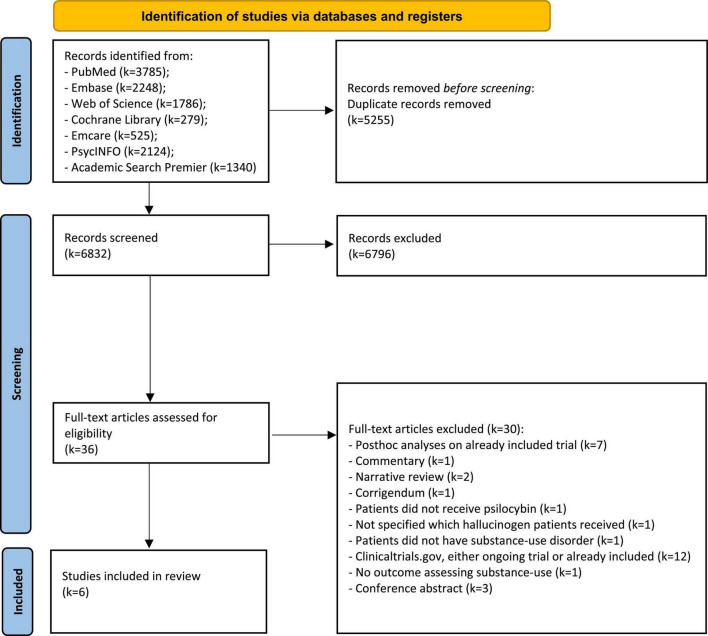
Background: Psychedelic-assisted therapy [e.g., with lysergic acid diethylamide (LSD)] has shown promising results as treatment for substance use disorders (SUDs). Previous systematic reviews assessing the efficacy of psilocybin in SUDs only included clinical trials conducted in the last 25 years, but they may have missed clinical trials assessing the efficacy of psilocybin that were conducted before the 1980s, given much research has been done with psychedelics in the mid-20th century. In this systematic review, we specifically assessed the efficacy of psilocybin in patients with a SUD or non-substance-related disorder with no publication date restrictions in our search strategy. Methods: A systematic literature search was performed according to Preferred Reporting Items for Systematic reviews and Meta-Analysis (PRISMA) guidelines from the earliest published manuscript up to September 2, 2022, in seven electronic databases, including clinical trials in patients with a SUD or non-substance-related disorder evaluating the efficacy of psilocybin. Results: A total of four studies (six articles, of which two articles were long-term follow-up results from the same trial) were included in this systematic review. Psilocybin-assisted therapy was administered to n = 151 patients in a dose ranging from 6 to 40 mg. Three studies focused on alcohol use disorder, and one study on tobacco use disorder. In a pilot study (n = 10), the percentage of heavy drinking days decreased significantly between baseline and weeks 5–12 (mean difference of 26.0, 95% CI = 8.7–43.2, p = 0.008). In another single-arm study (n = 31), 32% (10/31) became completely abstinent from alcohol (mean duration of follow-up 6 years). In a double-blind, placebo-controlled randomized controlled trial (RCT, n = 95), the percentage of heavy drinking days during the 32-week double-blind period was significantly lower for psilocybin compared to placebo (mean difference of 13.9, 95% CI = 3.0–24.7, p = 0.01). In a pilot study (n = 15), the 7-day point prevalence of smoking abstinence at 26 weeks was 80% (12/15), and at 52 weeks 67% (10/15). Conclusion: Only one RCT and three small clinical trials were identified assessing the efficacy of psilocybin combined with some form of psychotherapy in patients with alcohol and tobacco use disorder. All four clinical trials indicated a beneficial effect of psilocybin-assisted therapy on SUD symptoms. Larger RCTs in patients with SUDs need to evaluate whether psilocybin-assisted therapy is effective in patients with SUD.
Overview
The claims and statistics of this paper haven’t been checked yet.
Free: it reads the open-access text and checks the first 5 claims that cite a source we can check. Create a free account to check every claim.
Integrity signals
Registry
Cites
Statistics
Figures
Verification
Claims the paper makes
The claims and statistics of this paper haven’t been checked yet.
Free: it reads the open-access text and checks the first 5 claims that cite a source we can check. Create a free account to check every claim.
Claims other papers make about this one
Each is checked against this paper’s own text: does it say what the citing paper says it does?
The source backs part of the claim, not all of it — or backs it for a different population, condition or comparison.
In the citing paper
“We enrolled 27% of those pre-screened, which is comparable with similar studies of PAT for addiction [15,25,51] and treatment-resistant depression [52,53].”
From Psilocybin‐assisted psychotherapy for methamphetamine use disorder: A pilot open‐label safety and feasibility study. (2025) · cites this paper as [51]
Experimental — accuracy not yet measuredThe cited source says what the claim attributes to it.
In the citing paper
“Prior studies of PAT for substance use disorders have found similarly positive efficacy signals [51].”
From Psilocybin‐assisted psychotherapy for methamphetamine use disorder: A pilot open‐label safety and feasibility study. (2025) · cites this paper as [51]
Self-check
Percentages, sums and reported differences re-computed from the paper’s own numbers.
The self-check needs the paper’s full text.
Citations
Cites
RoB 2: a revised tool for assessing risk of bias in randomised trials
Sterne, J. A. C., Savović, J., Page, M. J., Elbers, R. G., Blencowe, N. S., Boutron, I., Cates, C. J., Cheng, H.-Y., Corbett, M. S., Eldridge, S. M., et al. (2019) · BMJ · doi:10.1136/bmj.l4898 · Cited by 34,787
ROBINS-I: a tool for assessing risk of bias in non-randomised studies of interventions
Sterne, J. A., Hernán, M. A., Reeves, B. C., Savović, J., Berkman, N. D., Viswanathan, M., Henry, D., Altman, D. G., Ansari, M. T., Boutron, I., et al. (2016) · BMJ · doi:10.1136/bmj.i4919 · Cited by 20,329
The PRISMA 2020 statement: an updated guideline for reporting systematic reviews
Page, M. J., McKenzie, J. E., Bossuyt, P. M., Boutron, I., Hoffmann, T. C., Mulrow, C. D., Shamseer, L., Tetzlaff, J. M., Akl, E. A., Brennan, S. E., et al. (2021) · Systematic Reviews · doi:10.1186/s13643-021-01626-4 · Cited by 13,874
Degenhardt, L., Charlson, F., Ferrari, A., Santomauro, D., Erskine, H., Mantilla-Herrara, A., Whiteford, H., Leung, J., Naghavi, M., Griswold, M., et al. (2018) · The Lancet Psychiatry · doi:10.1016/s2215-0366(18)30337-7 · Cited by 1,572
Psilocybin-assisted treatment for alcohol dependence: A proof-of-concept study
Bogenschutz, M. P., Forcehimes, A. A., Pommy, J. A., Wilcox, C. E., Barbosa, P., & Strassman, R. J. (2015) · Journal of Psychopharmacology · doi:10.1177/0269881114565144 · Cited by 1,151
Pilot study of the 5-HT 2A R agonist psilocybin in the treatment of tobacco addiction
Johnson, M. W., Garcia-Romeu, A., Cosimano, M. P., & Griffiths, R. R. (2014) · Journal of Psychopharmacology · doi:10.1177/0269881114548296 · Cited by 914 · cited 8×
“(29, 30) was included assessing the efficacy of psilocybin-assisted therapy in n = 15 patients who met the following criteria: smoking ≥10 cigarettes per day, being healthy as determined by medical interview, multiple unsuccessful past quit attempts, and the desire to quit smoking.”
BackgroundInfluentialBogenschutz, M. P., Ross, S., Bhatt, S., Baron, T., Forcehimes, A. A., Laska, E., Mennenga, S. E., O’Donnell, K., Owens, L. T., Podrebarac, S., et al. (2022) · JAMA Psychiatry · doi:10.1001/jamapsychiatry.2022.2096 · Cited by 711
Long-term follow-up of psilocybin-facilitated smoking cessation
Johnson, M. W., Garcia-Romeu, A., & Griffiths, R. R. (2017) · The American Journal of Drug and Alcohol Abuse · doi:10.3109/00952990.2016.1170135 · Cited by 696
Lysergic acid diethylamide (LSD) for alcoholism: meta-analysis of randomized controlled trials
Krebs, T. S., & Johansen, P.-Ø. (2012) · Journal of Psychopharmacology · doi:10.1177/0269881112439253 · Cited by 583
Cannabis use and cannabis use disorder
Connor, J. P., Stjepanović, D., Le Foll, B., Hoch, E., Budney, A. J., & Hall, W. D. (2021) · Nature Reviews Disease Primers · doi:10.1038/s41572-021-00247-4 · Cited by 552 · cited 1×
“It is less clear why no clinical trials in cannabis use disorder are currently conducted as it is the most common drug use disorder worldwide, especially among youth (42).”
Background
Research works printed but not linked: 1
- Albuquerque Fortes J. Psilocybin and chronic alcoholism. Arquivos Coordenadoria Saude Mental Estado Sao Paulo. (1966) 32: 5– 129.
Cited by
Items 101–126 of 126
Bahceci, D., Siefried, K. J., Steele, M., Harrod, M., Bell, G., Barratt, M. J., Nicholas, C. R. N., Rodgers, A., Hendricks, P. S., Stauffer, C. S., et al. (2025) · Drug and Alcohol Dependence · doi:10.1016/j.drugalcdep.2025.112699 · Cited by 1
Potencial terapéutico de la psilocibina en neuropsiquiatría: una revisión narrativa
Faccini-Durán, G. (2025) · Acta neurológica colombiana · doi:10.22379/anc.v41i3.1922 · Cited by 2
Gushken, F., Fidalgo, T. M., & Tardelli, V. S. (2025) · Journal of Addiction Medicine · doi:10.1097/adm.0000000000001580
Patent review: existing, new, and potential pharmacological agents from mushrooms
Banerjee, P., Mandhare, A., & Waghmare, S. (2025) · Exploration of Medicine · doi:10.37349/emed.2025.1001357
Efficacy and Safety of Psychoactive Tryptamines in Addiction: A Systematic Review
van der Meer, P. B., Schukking, N., Dik, M., van Reemst, A., Fuentes, J. J., Kaptein, A. A., Schoones, J. W., Verboeket, S. O., de Waal, M. M., Goudriaan, A. E., et al. (2025) · Psychedelic Medicine · doi:10.1177/28314425251364182
Self-citationVéliz‐García, Ó., & Domic‐Siede, M. (2025) · Journal of Psychedelic Studies · doi:10.1556/2054.2025.00454
Hepburn, H., Ellenbroek, B. A., & Youn, J. (2025) · Psychedelics · doi:10.1016/j.psyche.2025.100005
The Potential Therapeutic Effects of MEAI in the Treatment of Alcohol Use Disorder
Ekhlasi, M., Frytz, A., & Nia, A. B. (2025) · Current Addiction Reports · doi:10.1007/s40429-025-00700-4
“Other studies also supported the beneficial effects of psilocybin for treating AUD [ 30, 31].”
Hosford, S., & Austin-Robillard, H. (2025) · Contemporary Family Therapy · doi:10.1007/s10591-025-09766-8 · Cited by 2
“…on a range substances of abuse (e.g., alcohol, nicotine, opioids, cocaine, and other amphetamines) that demonstrate significant changes in use (van der Meer, et al., 2023) For example, Johnson et al. (2017) reported that 67% of participants confirm smoking abstinence 12-and 30-months…”
Toscano, M. O., Civardi, S. C., & Durbano, F. (2025) · Pharmaceutical science. · doi:10.5772/intechopen.1014070
Psilocybin reporting in media (PRiMe) for the treatment of depression
Brar, G., Burke, T., Gribben, A. D., Harrington, C., Thuery, G., & Kelly, J. R. (2025) · Irish Journal of Psychological Medicine · doi:10.1017/ipm.2025.10142
“The latter is likely due to psilocybin ’ s negligible addictive effects, in addition to it being investigated for its potential as a treatment for addiction disorders (Bogenschutz et al. 2022; Johnson et al. 2014; Reiser et al. 2025; van der Meer et al. 2023).”
Psychedelics as a Therapeutic Opportunity or Threat: A Narrative Review
Liszka, P., Ogorek, A., Olejnik-Chlewicka, K. M., Puchalski, K. R., Zasiadła, M., Patrzykąt, K. M., Perediatkiewicz, J., Urbański, W., Łuczak, P. M., & Brodowski, J. (2025) · Cureus · doi:10.7759/cureus.99942
“…into randomised controlled trials assessing the efficacy of psilocybin in individuals with major depression, as well as studies on psilocybin in different forms of addiction and clinical trials of MDMA-assisted therapy in patients with moderate-to-severe post-traumatic stress disorder [7-9].”
Penzenstadler, L. E., Brakha, T. A., & ZULLINO, D. F. (2026) · Suchttherapie · doi:10.1055/a-2599-1389
“Während aktuelle Übersichten methodische Heterogenität und Verblindungsprobleme betonen [5–7], rückt die Frage nach der Wirksamkeit von PAP bei Patient:innen mit komplexen komorbi-den Profilen zunehmend in den Fokus.”
van Dalen, F., Tap, S. C., Venema, S. D., Schellekens, Schoevers, R. A., & Spoelstra, S. K. (2026) · Journal of Psychoactive Drugs · doi:10.1080/02791072.2026.2685514
Bray, E., Glatfelter, G. C., Maitland, A. D., Gonzalez, N. R., Walther, D. M., Yacoub, J., Baumann, M. H., & von Salm, J. L. (2026) · ACS Omega · doi:10.1021/acsomega.6c02996
The purpose of the psychosocial protocol in the psychedelic-assisted therapy: A scoping review
Ferreira, F. G. D. P., Fernandes, J. A. B., Filev, R., da Silveira, D. X., & Fidalgo, T. M. (2026) · Journal of Psychopharmacology · doi:10.1177/02698811261453850
Sjöström, D. K., Rybäck, O. S., Claesdotter‐Knutsson, E., Kajonius, P., Sondén, O. J., Carlbring, P., Björkstrand, J., & Movahed, P. (2026) · PLoS ONE · doi:10.1371/journal.pone.0352246
“…trials have demonstrated that psilocybin interventions may produce rapid and sustained improvements in conditions often characterized by high levels of psychological rigidity and treatment resistance, such as depression [19–22], death related anxiety [23–27], and substance use disorders [28,29].”
Koning, E., Richard, J., & Keshen, A. R. (2026) · International Journal of Eating Disorders · doi:10.1002/eat.70164
Psychedelics and Reward Processing: Before and After the 1970 Controlled Substances Act
Lifshitz, D. J., Sawaya, M. F., & Murnane, K. S. (2026) · Psychedelic Medicine · doi:10.1177/28314425261472614
Wang, Z., Daily, J. E., & Adams, D. R. (2026) · Research Square · doi:10.21203/rs.3.rs-10120004/v1
Rohrmoser, B., & Koslowski, M. (2026) · Elsevier eBooks · doi:10.1016/b978-3-437-21293-2.00014-9
Anghel, T., Cojocaru, A., Hogea, L., Costea, I., Marinca, A., Dumache, R., Nussbaum, L. A., & Trăilă, I.-A. (2026) · Journal of Clinical Medicine · doi:10.3390/jcm15166228
“A systematic review published in 2023 further highlighted consistent therapeutic signals across studies investigating psychedelic-assisted interventions in addiction medicine [44].”
Klassische Halluzinogene in der Behandlung von Suchterkrankungen – Ein narrativer Überblick
Kippe, Y. D., Poppe, C. J., Repantis, D., & Majić, T. (2026) · Suchttherapie · doi:10.1055/a-2596-8400
Lovell, T. N., James, P. B., Hodgins, S. L., Noya, S. J., Arner, P., & Bobadilla, A. (2026) · Journal of Psychopharmacology · doi:10.1177/02698811261478613
Civardi, S. C., Besana, F., Durbano, F., Toscano, M. O. M., Raffone, F., Dell’Osso, B. M., & Olivola, M. (2026) · Frontiers in Psychiatry · doi:10.3389/fpsyt.2026.1858319
“As far as psychiatric diseases are concerned, psilocybin has shown promising potential in the treatment of obsessive-compulsive disorder (38), alcohol and substance use disorders (39, 40), anxiety and depression linked to terminal cancer (41, 42) and, above all, severe depressive disorder (43, 44).”
The New Mexico Medical Psilocybin Act and current trends in the United States psychedelic policy
Borbón, D. (2026) · Psychedelics · doi:10.1016/j.psyche.2026.100043
Metadata
- Authors
- van der Meer, P. B., Fuentes, J. J., Kaptein, A. A., Schoones, J. W., de Waal, M. M., Goudriaan, A. E., Kramers, K., Schellekens, A., Somers, M., Bossong, M. G., & Batalla, A.
- Affiliations
- Universitat Autònoma de Barcelona (ES)
- Leiden University Medical Center (NL)
- Radboud University Medical Center (NL)
- University Medical Center Utrecht (NL)
- ORCID
- Venue
- Frontiers in Psychiatry
- Publisher
- Frontiers Media SA
- Published
- 2023-02-09
- Volume
- 14
- Pages
- 1134454-1134454
- ISSN
- 1664-0640 (ISSN-L)
- PMC
- PMC9947277
- OpenAlex
- W4319765908
- Cited by
- 127
- References
- 41
- Citations by year
- 2026: 20 · 2025: 44 · 2024: 51 · 2023: 12
- FWCI
- 6.43
- Type
- journal article
- Language
- en
- Open access
- gold
- doi.org
- Licence
- Locations
- Frontiers in Psychiatry (publishedVersion, cc-by)
- PubMed Central (publishedVersion, cc-by)
- PubMed (publishedVersion)
- Pure Amsterdam UMC (publishedVersion, cc-by)
- Repositori digital de la UPF (Universitat Pompeu Fabra) (acceptedVersion, cc-by)
- Dipòsit Digital de Documents de la UAB (Universitat Autònoma de Barcelona) (submittedVersion, cc-by)
- Radboud Repository (Radboud University) (submittedVersion)
- Radboud Repository (Radboud University) (submittedVersion, other-oa)
- DOAJ (DOAJ: Directory of Open Access Journals) (submittedVersion, cc-by-sa)
- Utrecht University Repository (Utrecht University) (submittedVersion, other-oa)
- Topics
- Social Sciences › Psychology › Clinical Psychology › Psychedelics and Drug Studies
- Health Sciences › Medicine › Epidemiology › Substance Abuse Treatment and Outcomes
- Social Sciences › Health › Religion, Spirituality, and Psychology
- Keywords
- psilocybin, psychedelic therapy, substance use disorders, alcoholism, tobacco use disorder, smoking abstinence, alcohol abstinence, heavy drinking days, long-term follow-up, treatment efficacy, dose-response relationship, adverse effects, anxiety
About these checks
Registry, retraction, Cites and statistics results are computed, not judged, with one exception: a printed reference that no index lists is read once by a model before it counts as a citation error. Claims are extracted by a model and kept only when their quote appears verbatim in the text; each cited source is then checked, with a model’s help, for whether it says what the claim relies on. Those verdicts can be wrong — read the claim’s quote and the cited source before relying on one.
Statistics and arithmetic are recomputed, not judged.
Confidence bands are shown only for fields calibrated on our annotated test set. None is calibrated yet, so no band is shown.
What counts as a claim ›How we measure confidence ›How we check this ›
Are you an author, or do you see a problem with this page? Request a review
Data sources
Bibliographic data: Semantic Scholar, OpenAlex, Crossref.
Contains information from the Semantic Scholar Academic Graph Datasets, made available under the ODC Attribution License (ODC-BY 1.0).
Semantic Scholar’s data is described in: Kinney, R., et al. (2023). The Semantic Scholar Open Data Platform. arXiv:2301.10140.
