

The DOI matches its Crossref record; 45 of the 46 references it cites were found in a registry or an index.
Worldwide Prevalence of Intimate Partner Violence in Pregnancy. A Systematic Review and Meta-Analysis
Open accessAbstract
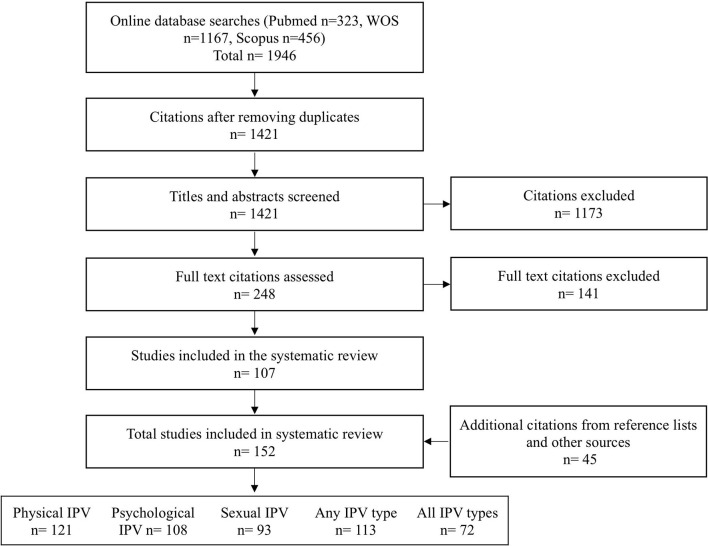
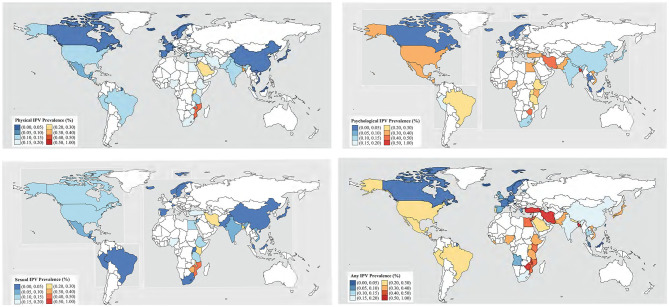
Background: Intimate partner violence (IPV) affects outcomes of mothers and their offspring. This systematic review collated the worldwide literature on the prevalence rates of different types of IPV in pregnancy. Methods: Two reviewers independently identified cross sectional and cohort studies of IPV prevalence in pregnancy in online databases (PubMed, WOS and Scopus), selected and extracted data [participants' country, study quality, measurement tool (validation and purpose) and rates of IPV in pregnancy]. We considered a high quality study if it had a prospective design, an adequate sampling method, a sample size estimation, a response rate > 90%, a contemporary ascertainment of IPV in the index pregnancy, and a well-developed detailed IPV tool. We performed random effects meta-analysis and explored reasons for heterogeneity of rates. Results: One hundred fifty-five studies were included, of which 44 (28%) met two-thirds of the quality criteria. Worldwide prevalence of physical (126 studies, 220,462 participants), psychological (113 studies, 189,630 participants) and sexual (98 studies, 155,324 participants) IPV in pregnancy was 9.2% (95% CI 7.7–11.1%, I 2 95.9%), 18.7% (15.1–22.9%, I 2 98.2%), 5.5% (4.0–7.5%, I 2 93.4%), respectively. Where several types of IPV were reported combined, the prevalence of any kind of IPV (118 studies, 124,838 participants) was 25.0% (20.3, 30.5%, I 2 98.6%). IPV rates varied within and between continents, being the highest in Africa and the lowest in Europe ( p < 0.001). Rates also varied according to measurement purpose, being higher for diagnosis than for screening, in physical ( p = 0.022) and sexual ( p = 0.014) IPV. Conclusions: IPV prevalence in pregnancy varies across countries, with one-quarter of mothers exposed on average globally. Routine systematic antenatal detection should be applied worldwide. Systematic Review Registration: identifier: CRD42020176131.
Overview
The claims and statistics of this paper haven’t been checked yet.
Run the check — free, no account needed. It reads the open-access text and checks the sources it cites.
Integrity signals
Registry
Cites
Statistics
Figures
Verification
Claims the paper makes
The claims and statistics of this paper haven’t been checked yet.
Run the check — free, no account needed. It reads the open-access text and checks the sources it cites.
Claims other papers make about this one
Each is checked against this paper’s own text: does it say what the citing paper says it does?
The cited source doesn’t support the claim as written.
In the citing paper
“Their lower estimates for this type of IPV might be explained by the fact that the authors measured physical IPV during pregnancy but reported it as lifetime (Román-Gálvez et al., 2021).”
From Global Prevalence and Mental Health Outcomes of Intimate Partner Violence Among Women: A Systematic Review and Meta-Analysis (2024) · cites this paper as Román-Gálvez et al., 2021
Checked by a reasoning model — may be wrong.
Experimental — accuracy not yet measuredThe cited source says what the claim attributes to it.
In the citing paper
“The prevalence rates of physical IPV in pregnancy ranged from 0.7% to 55.1% across 126 studies.”
From Global Prevalence and Mental Health Outcomes of Intimate Partner Violence Among Women: A Systematic Review and Meta-Analysis (2024) · cites this paper as Román-Gálvez et al., 2021
The cited source says what the claim attributes to it.
In the citing paper
“For example, the study by Román-Gálvez et al. (2021) reporting global prevalence rates of IPV in pregnancy, recorded a 9.2% pooled estimate for physical IPV.”
From Global Prevalence and Mental Health Outcomes of Intimate Partner Violence Among Women: A Systematic Review and Meta-Analysis (2024) · cites this paper as Román-Gálvez et al., 2021
Self-check
Percentages, sums and reported differences re-computed from the paper’s own numbers.
The self-check needs the paper’s full text.
Citations
Cites
The Measurement of Observer Agreement for Categorical Data
Landis, J. R., & Koch, G. G. (1977) · Biometrics · doi:10.2307/2529310 · Cited by 81,148
Liberati, A., Altman, D. G., Tetzlaff, J., Mulrow, C., Gøtzsche, P. C., Ioannidis, J. P. A., Clarke, M., Devereaux, P. J., Kleijnen, J., & Moher, D. (2009) · PLoS Medicine · doi:10.1371/journal.pmed.1000100 · Cited by 28,164
Liberati, A., Altman, D. G., Tetzlaff, J., Mulrow, C., Gotzsche, P. C., Ioannidis, J. P. A., Clarke, M., Devereaux, P. J., Kleijnen, J., & Moher, D. (2009) · BMJ · doi:10.1136/bmj.b2700 · Cited by 17,648
Garcia-Moreno, C., Jansen, H. A., Ellsberg, M., Heise, L., & Watts, C. H. (2006) · The Lancet · doi:10.1016/s0140-6736(06)69523-8 · Cited by 3,176
Transformations Related to the Angular and the Square Root
Freeman, M. F., & Tukey, J. W. (1950) · The Annals of Mathematical Statistics · doi:10.1214/aoms/1177729756 · Cited by 2,665
Hunter, J. P., Saratzis, A., Sutton, A. J., Boucher, R. H., Sayers, R. D., & Bown, M. J. (2014) · Journal of Clinical Epidemiology · doi:10.1016/j.jclinepi.2014.03.003 · Cited by 786
Latthe, P. M., Latthe, M., Say, L., Gülmezoglu, M., & Khan, K. S. (2006) · BMC Public Health · doi:10.1186/1471-2458-6-177 · Cited by 764
Self-citationIntimate partner violence during pregnancy: analysis of prevalence data from 19 countries
Devries, K. M., Kishor, S., Johnson, H., Stöckl, H., Bacchus, L., García‐Moreno, C., & Watts, C. H. (2010) · Reproductive Health Matters · doi:10.1016/s0968-8080(10)36533-5 · Cited by 505
Kennedy, A. C., & Prock, K. A. (2018) · Trauma, Violence, & Abuse · doi:10.1177/1524838016673601 · Cited by 471
Partner violence during pregnancy: prevalence, effects, screening, and management
Bailey, B. (2010) · International Journal of Women s Health · doi:10.2147/ijwh.s8632 · Cited by 269
Research works printed but not linked: 3
- 2021, Catálogo de instrumentos para cribado y frecuencia del maltrato físico psicológico y sexual
- Stata, 2019, 2019
- 2021, Violence Against Women Prevalence Estimates 2018. Global, Regional and National Prevalence Estimates for Intimate Partner Violence Against Women and Global and Regional Prevalence Estimates for Non-partner Sexual Violence Against Women
Cited by
Sorted by citations
White, S. J., Sin, J., Sweeney, A., Salisbury, T., Wahlich, C., Montesinos Guevara, C. M., Gillard, S., Brett, E., Allwright, L., Iqbal, N., et al. (2024) · Trauma, Violence, & Abuse · doi:10.1177/15248380231155529 · Cited by 465
Postpartum Depression—Identifying Risk and Access to Intervention
Gopalan, P. R., Spada, M. L., Shenai, N., Brockman, I., Keil, M. A., Livingston, S., Moses‐Kolko, E. L., Nichols, N., O’Toole, K. S., Quinn, B., et al. (2022) · Current Psychiatry Reports · doi:10.1007/s11920-022-01392-7 · Cited by 86
Belay, H. G., Arage, G., Ayele, A. D., Kassa, B. G., Mihretie, G. N., Meseret, L., & Worke, M. D. (2022) · PLoS ONE · doi:10.1371/journal.pone.0275836 · Cited by 37
Peinado‐Molina, R. A., Martínez‐Vázquez, S., Martínez‐Galiano, J. M., Rivera‐Izquierdo, M., Khan, K. S., & Ibáñez, N. C. (2024) · International Journal of Gynecology & Obstetrics · doi:10.1002/ijgo.15719 · Cited by 32
Self-citationHuldani, H., Abdelbasset, W. K., Jasim, S. A., Suksatan, W., Jalil, A. T., Thangavelu, L. P., Mustafa, Y. F., & Karami, M. (2022) · Women & Health · doi:10.1080/03630242.2022.2096755 · Cited by 30
Metadata
- Authors
- Román-Gálvez, R. M., Martín-Peláez, S., Fernández-Félix, B. M., Zamora, J., Khan, K. S., & Bueno-Cavanillas, A.
- Affiliations
- Andalusian Health Service (ES)
- Instituto de Salud Carlos III (ES)
- Universidad de Granada (ES)
- Venue
- Frontiers in Public Health
- Publisher
- Frontiers Media SA
- Published
- 2021-08-30
- Volume
- 9
- Pages
- 738459-738459
- ISSN
- 2296-2565 (ISSN-L)
- PMC
- PMC8435609
- OpenAlex
- W3198050589
- Cited by
- 162
- References
- 46
- Citations by year
- 2026: 43 · 2025: 40 · 2024: 40 · 2023: 26 · 2022: 13
- FWCI
- 2.17
- Type
- journal article
- Language
- en
- Open access
- gold
- doi.org
- Licence
- Locations
- Frontiers in Public Health (publishedVersion, cc-by)
- PubMed Central (publishedVersion, cc-by)
- PubMed (publishedVersion)
- University of Birmingham Research Portal (University of Birmingham) (acceptedVersion, cc-by)
- Institutional Repository of the University of Granada (University of Granada) (submittedVersion, cc-by)
- DOAJ (DOAJ: Directory of Open Access Journals) (submittedVersion, cc-by-sa)
- RISalud Institutional Health Repository of Andalucía (submittedVersion, cc-by)
- Funders
- Universidad de Granada
- Topics
- Social Sciences › Health › Intimate Partner and Family Violence
- Health Sciences › Medicine › Public Health, Environmental and Occupational Health › Maternal Mental Health During Pregnancy and Postpartum
- Health Sciences › Medicine › Geriatrics and Gerontology › Elder Abuse and Neglect
- Keywords
- intimate partner violence, pregnancy, prevalence, physical violence, psychological violence, sexual violence, IPV screening, antenatal detection, maternal health, global variation
- MeSH terms
- Intimate Partner Violence, Cross-Sectional Studies, Female, Humans, Mothers, Pregnancy, Prospective Studies, Prevalence
About these checks
Registry, retraction, Cites and statistics results are computed, not judged, with one exception: a printed reference that no index lists is read once by a model before it counts as a citation error. Claims are extracted by a model and kept only when their quote appears verbatim in the text; each cited source is then checked, with a model’s help, for whether it says what the claim relies on. Those verdicts can be wrong — read the claim’s quote and the cited source before relying on one.
Statistics and arithmetic are recomputed, not judged.
Confidence bands are shown only for fields calibrated on our annotated test set. None is calibrated yet, so no band is shown.
What counts as a claim ›How we measure confidence ›How we check this ›
Are you an author, or do you see a problem with this page? Request a review
