

The DOI matches its Crossref record; 7 of the 7 references it cites were found in a registry or an index.
Generative artificial intelligence (GenAI) use and dependence: an approach from behavioral economics
Abstract
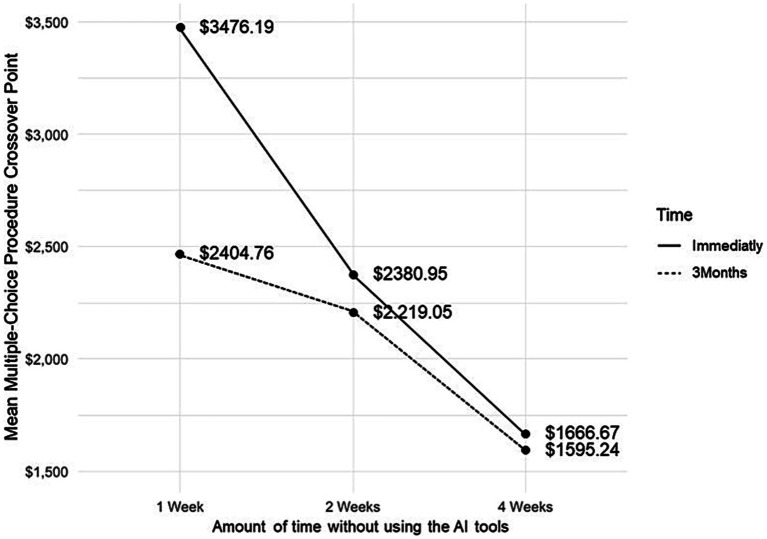
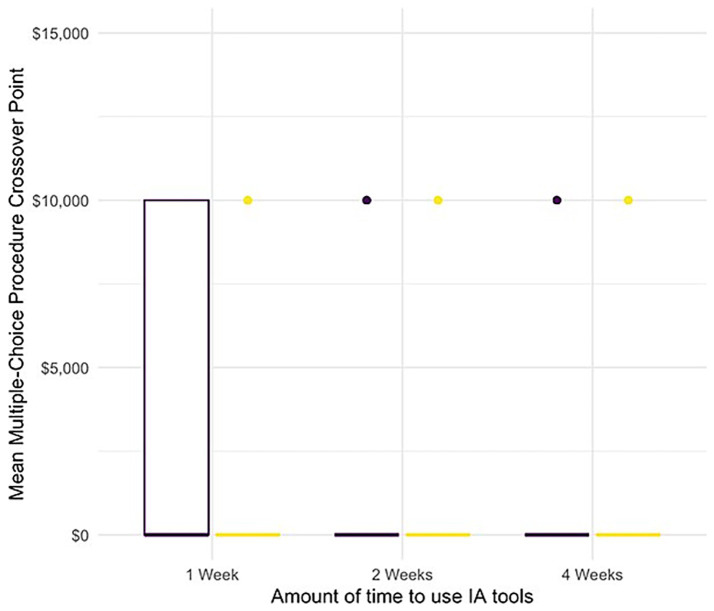
Objective: This study aims to explore the perceived dependence on Generative Artificial Intelligence (GenAI) tools among young adults and examine the relative reinforcing value of AI chatbots use compared to monetary rewards, applying a behavioral economics approach. Participants/methods: A total of 420 university students from Bogotá, Colombia, participated in an online survey. The study employed a Multiple Choice Procedure (MCP) to assess the relative reinforcement between different durations of GenAI use (1, 2, and 4 weeks) and monetary rewards, which varied in amount and delay. Additionally, an adapted AI Dependence Scale evaluated levels of dependence on AI tools. Data analysis included repeated measures ANOVA to examine the effects of reward magnitude and delay on choices, and correlations to assess the relationship between perceived dependence and reinforcement values. Results: Participants reported low average dependence on AI tools (mean AI Dependence Scale score = 65.6), with no significant gender differences. MCP findings indicated significant differences in crossover points across varying durations or delays for AI chatbots use, suggesting a higher relative value of use for the option to use AI chatbots immediately. The average reinforcement value for AI use versus monetary rewards did significantly vary with reward magnitude. On the other hand, significant differences were found in the levels of perceived dependence on AI, according to the average daily time of AI tool use. Conclusion: The results suggest that young adults exhibit low perceived dependence on GenAI tools but show differential reinforcement values based on usage duration or delay conditions. This behavioral economics approach provides novel insights into decision-making patterns related to AI chatbots use, emphasizing the need for further research to understand the psychological and social factors influencing dependence on AI technologies.
Overview
The claims and statistics of this paper haven’t been checked yet.
Run the check — free, no account needed. It reads the open-access text and checks the sources it cites.
Integrity signals
Registry
Cites
Statistics
Figures
Verification
Claims the paper makes
The claims and statistics of this paper haven’t been checked yet.
Run the check — free, no account needed. It reads the open-access text and checks the sources it cites.
Claims other papers make about this one
Each is checked against this paper’s own text: does it say what the citing paper says it does?
The cited source says what the claim attributes to it.
In the citing paper
“More recent studies on generative AI and AI companions further suggest that anthropomorphic interaction, emotional responsiveness, and friend-like communication are associated with stronger emotional attachment and dependency-related outcomes (Hu et al., 2023; Robayo-Pinzon et al., 2025).”
From When loneliness amplifies the risk of problematic emotional dependence: perceived anthropomorphism and basic psychological need satisfaction in AI companion use (2026) · cites this paper as Robayo-Pinzon et al., 2025
Self-check
Percentages, sums and reported differences re-computed from the paper’s own numbers.
The self-check needs the paper’s full text.
Citations
Cites
Holland, G., & Tiggemann, M. (2016) · Body Image · doi:10.1016/j.bodyim.2016.02.008 · Cited by 1,395
The association between social media use and sleep disturbance among young adults
Levenson, J. C., Shensa, A., Sidani, J. E., Colditz, J. B., & Primack, B. A. (2016) · Preventive Medicine · doi:10.1016/j.ypmed.2016.01.001 · Cited by 447
Clinical Implications of Reinforcement as a Determinant of Substance Use Disorders
Higgins, S. T., Heil, S. H., & Lussier, J. P. (2004) · Annual Review of Psychology · doi:10.1146/annurev.psych.55.090902.142033 · Cited by 393
Association between Facebook addiction, self-esteem and life satisfaction: A cross-sectional study
Błachnio, A., Przepiorka, A., & Pantic, I. (2016) · Computers in Human Behavior · doi:10.1016/j.chb.2015.10.026 · Cited by 387
Zhang, L., & Xu, J. (2025) · The Internet and Higher Education · doi:10.1016/j.iheduc.2024.100978 · Cited by 168
Sun, J., Liu, Q., & Yu, S. (2019) · Computers in Human Behavior · doi:10.1016/j.chb.2018.08.032 · Cited by 161
Sherer, J., & Levounis, P. (2022) · Current Psychiatry Reports · doi:10.1007/s11920-022-01351-2 · Cited by 42 · cited 1×
“This category encompasses disorders related to online gambling, shopping, and, more recently, social media network (SMN) addiction (12).”
Research works printed but not linked: 37
- Doğan, 2025, AI in higher education: risks and opportunities from the academician perspective, Eur J Educ, 60, e12863, 10.1111/ejed.12863 · DOI
- Maphosa, 2023, Artificial intelligence in higher education: a bibliometric analysis and topic modeling approach, Appl Artif Intell, 37, 10.1080/08839514.2023.2261730 · DOI
- Zhang, 2024, Do you have AI dependency? The roles of academic self-efficacy, academic stress, and performance expectations on problematic AI usage behavior, Int J Educ Technol High Educ, 21, 34, 10.1186/s41239-024-00467-0 · DOI · Paper page
- Khanna, 2015, A study of today’s a.I. Through Chatbots and rediscovery of machine intelligence. Int J u- e- Serv, Sci Technol, 8, 277, 10.14257/ijunesst.2015.8.7.28 · DOI · Paper page
- Huang, 2024, Exploring the effect of attachment on technology addiction to generative AI Chatbots: a structural equation modeling analysis, Int J Hum Comput Interact, 41, 9440, 10.1080/10447318.2024.2426029 · DOI · Paper page
- Turel, 2011, Integrating technology addiction and use: an empirical investigation of online auction users, MIS Q, 35, 1043, 10.2307/41409972 · DOI · Paper page
- Şahin, 2017, The predictive level of social media addiction for life satisfaction: a study on university students, Turk Online J Educ Technol, 16, 120
- Dalvi-Esfahani, 2020, Social media addiction and empathy: moderating impact of personality traits among high school students, Telemat Info, 2021, 101516, 10.1016/j.tele.2020.101516 · DOI
- Pillai, 2024, Students’ adoption of AI-based teacher-bots (T-bots) for learning in higher education, Inf Technol People, 37, 328, 10.1108/ITP-02-2021-0152 · DOI · Paper page
- Hyde, 2024, Tools or fools: are we educating managers or creating tool-dependent robots?, J Manag Educ, 48, 708, 10.1177/10525629241230357 · DOI
- Acuff, 2018, Applying behavioral economic theory to problematic internet use: an initial investigation, Psychol Addict Behav, 32, 846, 10.1037/adb0000404 · DOI
- West, 2021, Problematic smartphone use: the role of reward processing, depressive symptoms and self-control, Addict Behav, 122, 107015, 10.1016/j.addbeh.2021.107015 · DOI
- Robayo-Pinzon, 2021, Does excessive use of smartphones and apps make us more impulsive? An approach from behavioural economics, Heliyon, 7, e06104, 10.1016/j.heliyon.2021.e06104 · DOI
- Bickel, 2014, The behavioral economics of substance use disorders: reinforcement pathologies and their repair, Annu Rev Clin Psychol, 10, 641, 10.1146/annurev-clinpsy-032813-153724 · DOI · Paper page
- Benson, 2009, Effects of reinforcer magnitude and alternative reinforcer delay on preference for alcohol during a multiple-choice procedure, Drug Alcohol Depend, 100, 161, 10.1016/j.drugalcdep.2008.09.005 · DOI
- Griffiths, 1993, Multiple-choice procedure: an efficient approach for investigating drug reinforcement in humans, Behav Pharmacol, 4, 3, 10.1097/00008877-199302000-00001 · DOI
- Griffiths, 1996, Validation of the multiple-choice procedure for investigating drug reinforcement in humans, Exp Clin Psychopharmacol, 4, 97, 10.1037/1064-1297.4.1.97 · DOI
- Amlung, 2014, Understanding the effects of stress and alcohol cues on motivation for alcohol via behavioral economics, Alcohol Clin Exp Res, 38, 1780, 10.1111/acer.12423 · DOI
- Madden, 2010, A delay-discounting primer, 11, 10.1037/12069-001 · DOI
- Yi, 2006, The combined effects of delay and probability in discounting, Behav Process, 73, 149, 10.1016/j.beproc.2006.05.001 · DOI
- Macedo, 2022, Delay discounting in aging: the influence of cognitive and psychological variables, Behav Neurosci, 136, 392, 10.1037/bne0000518 · DOI
- Gershman, 2020, Rationally inattentive intertemporal choice, Nat Commun, 11, 1, 10.1038/s41467-020-16852-y · DOI
- Prelec, 1991, Decision making over time and under uncertainty: a common approach, Manag Sci, 37, 770, 10.1287/mnsc.37.7.770 · DOI
- Arfer, 2015, The predictive accuracy of intertemporal-choice models, Br J Math Stat Psychol, 68, 326, 10.1111/bmsp.12049 · DOI
- Foxall, 2012, When loss rewards: the near-miss effect in slot machine gambling, Anal Gambl Behav, 6, 5
- Billieux, 2012, Problematic use of the mobile phone: a literature review and a pathways model, Curr Psychiatr Rev, 8, 299, 10.2174/157340012803520522 · DOI · Paper page
- Robayo-Pinzon, 2023, Social media sites users’ choice between utilitarian and informational reinforcers assessed using temporal discounting, Front Public Health, 11, 960321, 10.3389/fpubh.2023.960321 · DOI
- Mohamed, 2025, Facebook addiction among medical students: prevalence and consequences, Middle East Curr Psychiatry, 32, 7, 10.1186/s43045-025-00501-5 · DOI
- Yang, 2025, I tweet, therefore I am: a systematic review on social media use and disorders of the social brain, BMC Psychiatry, 25, 95, 10.1186/s12888-025-06528-6 · DOI
- Li, 2025, The longitudinal relationships of problematic social media use, self-transcendence values and school adaptation: a two-wave study, BMC Psychol, 13, 67, 10.1186/s40359-025-02356-1 · DOI
- Bassett, 2020, Initial validation of the multiple-choice procedure for measuring video game playing, Addict Res Theory, 28, 314, 10.1080/16066359.2019.1650350 · DOI
- Butler, 2018, Using the multiple-choice procedure to measure the relative reinforcing efficacy of gambling: initial validity evidence among college students, J Gambl Stud, 34, 513, 10.1007/s10899-017-9716-0 · DOI
- Tutgun-ünal, 2015, Development of the social media addiction scale, AJIT-e Bilişim Teknol Online Derg, 6, 51, 10.5824/1309-1581.2015.4.004.x · DOI
- Buono, 2017, Delay discounting of video game players: comparison of time duration among gamers, Cyberpsychol Behav Soc Netw, 20, 104, 10.1089/cyber.2016.0451 · DOI
- Correia, 2006, Use of a multiple-choice procedure with college student drinkers, Psychol Addict Behav, 20, 445, 10.1037/0893-164X.20.4.445 · DOI
- Krishnamurti, 2020, Spending money to make change: association of methamphetamine abstinence and voucher spending among contingency management pilot participants in South Africa, J Subst Abus Treat, 112, 60, 10.1016/j.jsat.2020.01.014 · DOI
- Foxall, 2016, Addiction as consumer choice: Exploring the cognitive dimension, 222, 10.4324/9780203794876 · DOI
Cited by
Sorted by citations
Liu, T., Shih, R.-M., Luo, T., & Jin, S. (2026) · Frontiers in Psychology · doi:10.3389/fpsyg.2026.1900817
Metadata
- Authors
- Robayo-Pinzon, O., Rojas-Berrio, S., Camargo, J. E., & Foxall, G. R.
- Venue
- Frontiers in Public Health
- Publisher
- Frontiers Media SA
- Published
- 2025-08-06
- Volume
- 13
- ISSN
- 2296-2565
- PMC
- PMC12364812
- Cited by
- 19
- References
- 7
About these checks
Registry, retraction, Cites and statistics results are computed, not judged, with one exception: a printed reference that no index lists is read once by a model before it counts as a citation error. Claims are extracted by a model and kept only when their quote appears verbatim in the text; each cited source is then checked, with a model’s help, for whether it says what the claim relies on. Those verdicts can be wrong — read the claim’s quote and the cited source before relying on one.
Statistics and arithmetic are recomputed, not judged.
Confidence bands are shown only for fields calibrated on our annotated test set. None is calibrated yet, so no band is shown.
What counts as a claim ›How we measure confidence ›How we check this ›
Are you an author, or do you see a problem with this page? Request a review
How to cite
Cite CoChat for the checks on this page, and the paper for its own findings.
- This page
- CoChat. (2026). Citation check: Generative artificial intelligence (GenAI) use and dependence: an approach from behavioral economics. https://app.cochat.ai/papers/10.3389/fpubh.2025.1634121
- The paper
- Robayo-Pinzon, O., Rojas-Berrio, S., Camargo, J. E., & Foxall, G. R. (2025). Generative artificial intelligence (GenAI) use and dependence: an approach from behavioral economics. Frontiers in Public Health. https://doi.org/10.3389/fpubh.2025.1634121
