

Sex and gender affect immune aging
Open accessThe DOI matches its Crossref record; 101 of the 102 references it cites were found in a registry or an index.
Abstract
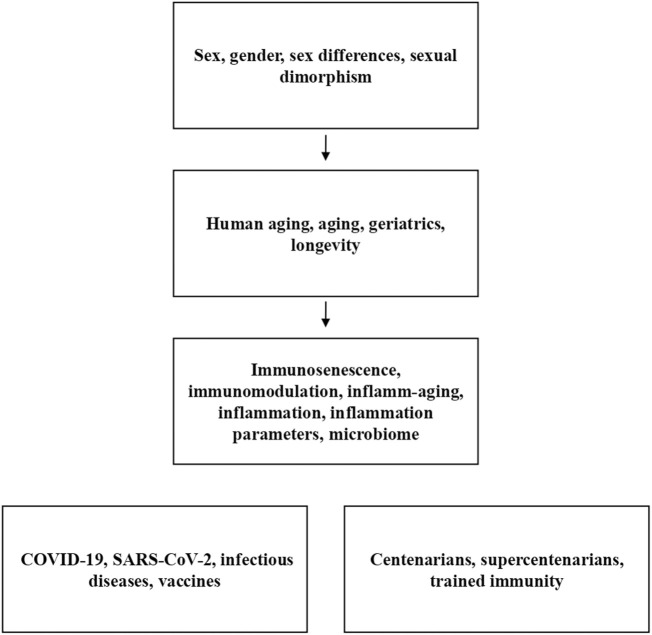
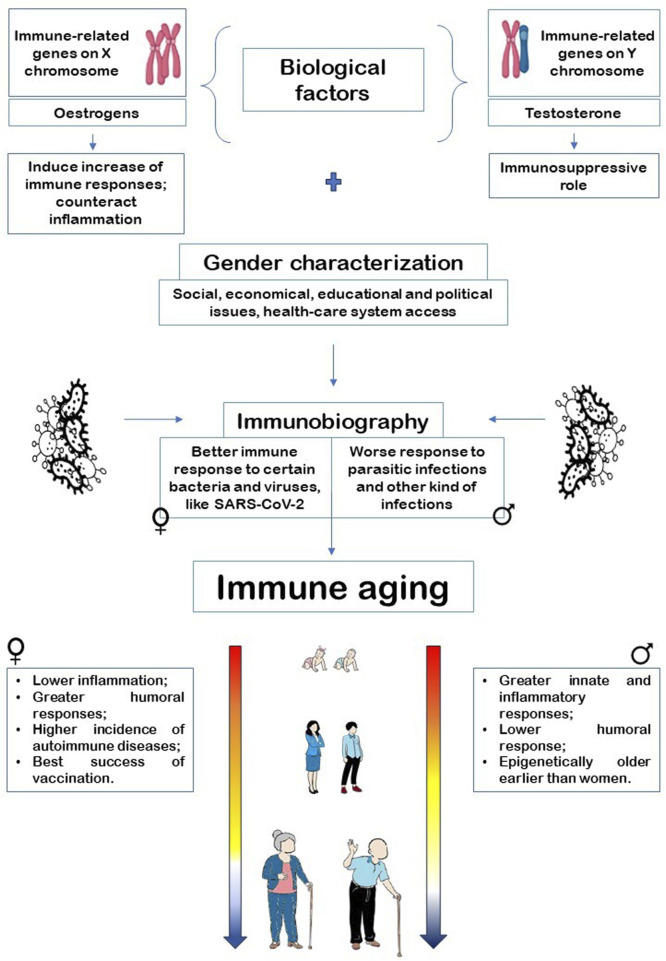
The proposed review aims to elucidate the intricate interplay between biological factors (sex differences) and socially constructed factors (gender differences) in the context of immune aging. While the influence of biological differences between men and women on various aspects of immune responses has long been recognized, it is crucial to acknowledge that gender, encompassing the social and cultural roles and expectations associated with being male or female, also significantly shapes these processes. Gender can either accelerate immune aging or promote longevity. By recognizing the impact of both biological and social factors, this work seeks to offer a comprehensive understanding of why men and women may experience divergent trajectories in immune aging and varying outcomes in terms of longevity. Discrepancies in perceived roles of the sexes, both within families and at work, contribute to differing patterns of antigen exposure. Additionally, variations in micronutrient intake and access to preventive healthcare facilities may exist. Health promotion knowledge often correlates with educational attainment, which is unequally represented between males and females in many cultures and across generations in the Western world. In countries without a universal healthcare system, access to healthcare relies on family prioritization strategies to cope with economic constraints, potentially limiting access to specific treatments and affecting immune responses negatively. As a result, both biological factors and social and behavioral factors associated with gender contribute to disparities in immune responses, susceptibility to infections, autoimmune diseases, and vaccine responses among older individuals. However, as demonstrated by the COVID-19 pandemic, older females exhibit greater resilience to infections than older males. Given the crucial role of the immune system in achieving longevity, it is not surprising that women live longer than men, and the number of female centenarians surpasses that of male centenarians.
Overview
The claims and statistics of this paper haven’t been checked yet.
Free: it reads the open-access text and checks the first 5 claims that cite a source we can check. Create a free account to check every claim.
Integrity signals
Registry
Cites
Statistics
Figures
Verification
Claims the paper makes
The claims and statistics of this paper haven’t been checked yet.
Free: it reads the open-access text and checks the first 5 claims that cite a source we can check. Create a free account to check every claim.
Claims other papers make about this one
Each is checked against this paper’s own text: does it say what the citing paper says it does?
The source backs part of the claim, not all of it — or backs it for a different population, condition or comparison.
In the citing paper
“Older adults demonstrate higher concentrations of circu lating inflammatory mediators, constituting a low-level chronic in flammatory state coupled with diminished cell-mediated immunity, termed 'inflammaging ' (Franceschi et al., 2000; Costagliola et al., 2021; Calabr ` o et al., 2023).”
From Gene Therapy-Associated Uveitis (GTAU): Understanding and mitigating the adverse immune response in retinal gene therapy (2025) · cites this paper as Calabrò et al., 2023
Experimental — accuracy not yet measuredThe cited source says what the claim attributes to it.
In the citing paper
“Women may also undergo changes associated with immunose nescence and inflammaging more gradually than men (Calabr ` o et al., 2023), widening potential differences in older age brackets.”
From Gene Therapy-Associated Uveitis (GTAU): Understanding and mitigating the adverse immune response in retinal gene therapy (2025) · cites this paper as Calabrò et al., 2023
The cited source says what the claim attributes to it.
In the citing paper
“Differences in immune function and responses to both foreign and self antigens between males and females have been reported (Klein and Flanagan, 2016; Calabr ` o et al., 2023).”
From Gene Therapy-Associated Uveitis (GTAU): Understanding and mitigating the adverse immune response in retinal gene therapy (2025) · cites this paper as Calabrò et al., 2023
In the citing paper
“Sex hormones, incomplete activation of immune-associated genes on the X chromosome, and the Xist ribonucleoprotein complex are contributors to sex differences in immune responses,13,14,15”
From Characterization of the ocular inflammatory response to AAV reveals divergence by sex and age (2025) · cites this paper as [14]
In the citing paper
“Recognizing that immune responses are divergent according to age and sex,13,14 tolerance for maintaining homeostasis after AAV-mediated alterations to the ocular immune threshold will also differ according to patient background immune status.”
From Characterization of the ocular inflammatory response to AAV reveals divergence by sex and age (2025) · cites this paper as [14]
Self-check
Percentages, sums and reported differences re-computed from the paper’s own numbers.
The self-check needs the paper’s full text.
Citations
Cites
Hoffmann, M., Kleine-Weber, H., Schroeder, S., Krüger, N., Herrler, T., Erichsen, S., Schiergens, T. S., Herrler, G., Wu, N.-H., Nitsche, A., et al. (2020) · Cell · doi:10.1016/j.cell.2020.02.052 · Cited by 20,286
Sex differences in immune responses
Klein, S. L., & Flanagan, K. L. (2016) · Nature Reviews Immunology · doi:10.1038/nri.2016.90 · Cited by 6,370 · cited 2×
“As discussed earlier, biological factors such as hormones and non-biological factors like lifestyle, which includes nutrition, can in fl uence the epigenetic signature, altering the accessibility of chromatin associated with immune-related genes (Klein and Flanagan, 2016; Shepherd et al., 2021).”
BackgroundCharacteristics of SARS-CoV-2 and COVID-19
Hu, B., Guo, H., Zhou, P., & Shi, Z.-L. (2021) · Nature Reviews Microbiology · doi:10.1038/s41579-020-00459-7 · Cited by 5,291
The cytokine storm and COVID-19
Hu, B., Huang, S., & Yin, L. (2021) · Journal of Medical Virology · doi:10.1002/jmv.26232 · Cited by 1,655 · cited 1×
“The last hallmark of the older immune system, in fl ammaging, associated with increased production of pro-in fl ammatory cytokines, acute phase proteins, and oxidative stress, potentiates the virus-induced cytokine storm responsible for severe lung disease (Hu et al., 2021b).”
BackgroundSex differences in immune responses that underlie COVID-19 disease outcomes
Takahashi, T., Ellingson, M. K., Wong, P., Israelow, B., Lucas, C., Klein, J., Silva, J., Mao, T., Oh, J. E., Tokuyama, M., et al. (2020) · Nature · doi:10.1038/s41586-020-2700-3 · Cited by 1,459
Inflammation and aging: signaling pathways and intervention therapies
Li, X., Li, C., Zhang, W., Wang, Y., Qian, P., & Huang, H. (2023) · Signal Transduction and Targeted Therapy · doi:10.1038/s41392-023-01502-8 · Cited by 1,443
Genetic evidence equating SRY and the testis-determining factor
Berta, P., Hawkins, J. B., Sinclair, A. H., Taylor, A., Griffiths, B. L., Goodfellow, P. N., & Fellous, M. (1990) · Nature · doi:10.1038/348448a0 · Cited by 982
The Xs and Y of immune responses to viral vaccines
Klein, S. L., Jedlicka, A., & Pekosz, A. (2010) · The Lancet Infectious Diseases · doi:10.1016/s1473-3099(10)70049-9 · Cited by 815
How sex and age affect immune responses, susceptibility to infections, and response to vaccination
Giefing‐Kröll, C., Berger, P., Lepperdinger, G., & Grubeck‐Loebenstein, B. (2015) · Aging Cell · doi:10.1111/acel.12326 · Cited by 761
Aiello, A., Farzaneh, F., Candore, G., Caruso, C., Davinelli, S., Gambino, C. M., Ligotti, M. E., Zareian, N., & Accardi, G. (2019) · Frontiers in Immunology · doi:10.3389/fimmu.2019.02247 · Cited by 693 · cited 3×
“Furthermore, latent chronic viral infections, like human cytomegalovirus (HCMV) infection, are considered potent triggers of immunosenescence hallmarks, as they lead to an increase in memory cells (Aiello et al., 2019).”
BackgroundInfluentialSelf-citation
Research works printed but not linked: 1
- Plebani M. Lippi G. (2022). Sex and gender differences in COVID-19: a narrative review. Italian J. Gender-Specific Med. 8, 37953. 10.1723/0000.37953 · doi:10.1723/0000.37953
Cited by
Emerging insights in senescence: pathways from preclinical models to therapeutic innovations
Mansfield, L., Ramponi, V., Gupta, K., Stevenson, T., Mathew, A. B., Barinda, A. J., Herbstein, F., & Morsli, S. (2024) · npj Aging · doi:10.1038/s41514-024-00181-1 · Cited by 88
Zinc deficiency as possible link between immunosenescence and age-related diseases
Schulz, M. T., & Rink, L. (2025) · Immunity & Ageing · doi:10.1186/s12979-025-00511-1 · Cited by 56
“Soci-etal norms and behaviors may lead to differences in life-style, access to healthcare, and exposure to chronic stress, all of which impact the immune system over time [120].”
Sex and Gender Differences in Liver Fibrosis: Pathomechanisms and Clinical Outcomes
Jamalinia, M., Lonardo, A., & Weiskirchen, R. (2024) · Fibrosis · doi:10.70322/fibrosis.2024.10006 · Cited by 50
“These differences in diet lead to variations in antigen exposure and micronutrient intake, contributing to different immune aging trajectories and longevity-associated outcomes [93].”
Advancing multiple sclerosis management in older adults
van der Walt, A., Strijbis, E. M. M., Bridge, F., Coetzee, T., Graves, J., Brownlee, W. J., Butzkueven, H., Marrie, R. A., Hua, L. H., Lampe, A., et al. (2025) · Nature Reviews Neurology · doi:10.1038/s41582-025-01115-5 · Cited by 46
Caldarelli, M., Rio, P., Marrone, A., Giambra, V., Gasbarrini, A., Gambassi, G., & Cianci, R. (2024) · Biomedicines · doi:10.3390/biomedicines12081716 · Cited by 48
Influence of biological sex on neuroinflammatory dynamics in the aging brain
Müller, L., Benedetto, S. D., & Müller, V. (2025) · Frontiers in Aging Neuroscience · doi:10.3389/fnagi.2025.1670175 · Cited by 43
“…immune function, and hormonal signaling emerge from a multifaceted interplay among genetic, epigenetic, endocrine, and environmental influences (Kundakovic and Tickerhoof, 2024; Bhattacharya et al., 2024; Marrocco et al., 2020; McCarthy et al., 2017; Calabro et al., 2023; Ruigrok et al., 2014).”
Purdy, R., John, M., Bray, A., Clare, A. J., Copland, D. A., Chan, Y. K., Henderson, R. H., Nerinckx, F., Leroy, B. P., Yang, P., et al. (2025) · Progress in Retinal and Eye Research · doi:10.1016/j.preteyeres.2025.101354 · Cited by 24
Mechanistic insights and biomarker discovery in immune cell aging and age-associated diseases
Upadhyay, P., Suhail, A., Khanal, P., & Kumar, S. (2025) · Frontiers in Immunology · doi:10.3389/fimmu.2025.1637191 · Cited by 32
“Emerging evidence suggests that sex hormones can in fl uence the degree of immune senescence, with notable differences observed between males and females as they age, potentially leading to disparities in disease susceptibility and progression among the sexes (54).”
Age- and sex-associated differences in immune cell populations
Gheitasi, R., Baumgart, S., Roell, D., Rose, N., Watzl, C., Dudziak, D., Andreas, N., Makarewicz, O., Drube, S., Schnizer, C., et al. (2025) · iScience · doi:10.1016/j.isci.2025.113092 · Cited by 27
“7,25,33 The main observations of our study were age-and sex-impact on the composition of lymphocyte subpopulations, while granulocytes remained unaffected.”
Characterization of the ocular inflammatory response to AAV reveals divergence by sex and age
Clare, A. J., Langer, P. M., Ward, A., Chan, Y. K., Dick, A. D., & Copland, D. A. (2025) · Molecular Therapy · doi:10.1016/j.ymthe.2025.01.028 · Cited by 19
Cantero, J. L., Atienza, M., Sastre, I., & Bullido, M. J. (2024) · Alzheimer s Research & Therapy · doi:10.1186/s13195-024-01437-4 · Cited by 19
“Moreover, the study sample has twice more females than males, which may impact results given the unquestionable role of gender in the development and outcomes of immune responses [64, 65].”
BackgroundThe role of interferon signaling in neurodegeneration and neuropsychiatric disorders
Sirkis, D. W., Oddi, A. P., Jonson, C., Bonham, L. W., Hoang, P. T., & Yokoyama, J. S. (2024) · Frontiers in Psychiatry · doi:10.3389/fpsyt.2024.1480438 · Cited by 17
Thome, A. D., Wang, J., Atassi, F., Thonhoff, J. R., Faridar, A., Zhao, W., Beers, D. R., Lai, E. C., & Appel, S. H. (2025) · Frontiers in Immunology · doi:10.3389/fimmu.2025.1571074 · Cited by 19
“Patient sex differences are a biological variable that affects the immune system, whether that be its function or potential dysfunction in disease-associated patient monocytes (64 – 66).”
Sex and Gender in Ageing and Longevity: Highlights from an International Course
Candore, G., Accardi, G., Aiello, A., Baggio, G., Bellini, T., Calabrese, V., Carreca, A. P., Carreca, I. U., Masucci, A., Cattaneo, M., et al. (2024) · Translational Medicine UniSa · doi:10.37825/2239-9747.1049 · Cited by 19
“…gender in the social sense (linked to education and social conventions) on the existing differences between men and women in terms of the etiopathogenesis and pathophysiology of diseases and their prevention, clinical phenotype, therapeutic approach, prognosis, psychological and social impact [1].”
BackgroundInfluentialSelf-citationTrombetta, C. M., Accardi, G., Aiello, A., Calabrò, A., Caruso, C., Ligotti, M. E., Marchi, S., Montomoli, E., Neto, M. M., Temperton, N. J., et al. (2024) · Immunity & Ageing · doi:10.1186/s12979-024-00450-3 · Cited by 18
Self-citationA researcher's guide to studying sex differences in immune aging
Baker, C., Kim, M., & Benayoun, B. A. (2025) · Trends in Molecular Medicine · doi:10.1016/j.molmed.2025.01.005 · Cited by 16
Systemic inflammation and menopausal symptomatology: insights from postmenopausal women
Körpe, B., Köse, C., & Keskin, H. L. (2024) · Menopause The Journal of The North American Menopause Society · doi:10.1097/gme.0000000000002433 · Cited by 10
Understanding sex and gender disparities in COVID-19 mortality: a narrative review beyond biology
Lemarchand, P., Pape, M., & Schwarz, J. (2025) · Biology of Sex Differences · doi:10.1186/s13293-025-00762-z · Cited by 12
Aikawa, N. E., Ribeiro, A. C. D. M., Pasoto, S. G., Kupa, L. D. V. K., Seguro, L. P. C., Assad, A. P. L., Borba, E. F., Saad, C. G. S., Yuki, E. F. N., Andrade, D. C. O., et al. (2026) · The Lancet Rheumatology · doi:10.1016/s2665-9913(25)00313-3 · Cited by 12
Manna, P. R., Yang, S., Manna, C., Waters, H., Islam, M. A., Reddy, A. P., Rawat, P., & Reddy, P. H. (2024) · Neuroscience & Biobehavioral Reviews · doi:10.1016/j.neubiorev.2024.105969 · Cited by 8
From Elixirs to Geroscience: A Historical and Molecular Perspective on Anti-Aging Medicine
Nicoletti, G. R. P., Mangano, K., Nicoletti, F., & Cavalli, E. (2025) · Molecules · doi:10.3390/molecules30244728 · Cited by 9
“Large-scale epigenetic and proteomic studies have further revealed sex-specific signatures of inflammaging, with men exhibiting earlier and more pronounced activation of pro-inflammatory cytokine networks such as IL-6 and TNF-α [207,208].”
Gender-differences in imaging phenotypes of osteoarthritis in the osteoarthritis initiative
Kreutzinger, V., Ziegeler, K., Joseph, G. B., Lynch, J. A., Lane, N. E., McCulloch, C. E., Nevitt, M. C., & Link, T. M. (2025) · Scientific Reports · doi:10.1038/s41598-025-90782-x · Cited by 6
“Other studies have reported higher inflammatory activity in women with OA 30 and there are well-established gender differences in levels of inflammation in a wide array of autoimmune diseases 31,32 .”
Peripheral and central elevation of IL-8 in patients with Huntington’s disease
Fung, J. N., Lee, J. D., Adam, R. J., O’Sullivan, J. D., & Woodruff, T. M. (2025) · Molecular Immunology · doi:10.1016/j.molimm.2025.02.003 · Cited by 6
Dinice, L., Esposito, G., Cacciamani, A., Balzamino, B. O., Cosimi, P., Cafiero, C., Ripandelli, G., & Micera, A. (2024) · International Journal of Molecular Sciences · doi:10.3390/ijms25147732 · Cited by 5
Calabrò, A., Aiello, A., Montomoli, E., Pawelec, G., Trombetta, C. M., & Caruso, C. (2026) · Exploration of Immunology · doi:10.37349/ei.2026.1003244 · Cited by 4
Self-citationMid-life: a critical window for intervention during aging
de Carvalho, E. L. (2025) · doi:10.32948/ajsep.2025.01.08 · Cited by 5
Costantino, M., Giudice, V., Moccia, G., Ragozzino, M., Calabrese, S., Caiazzo, F., Beatrice, M., Longanella, W., Caruccio, S., Iacuzzo, C., et al. (2025) · Pathogens · doi:10.3390/pathogens14020195 · Cited by 4
“Sex-related differences in immune responses are principally caused by sex hormones and genetic/epigenetic mechanisms that modulate immune system composition and functions [12,42–44].”
Liu, R.-D., Liu, M.-J., Wang, C.-D., Tao, Z., & Hu, G. (2025) · Epigenetics · doi:10.1080/15592294.2025.2541248 · Cited by 4
Calabrò, A., Pawelec, G., Caruso, C., & Trombetta, C. M. (2025) · Elsevier eBooks · doi:10.1016/b978-0-443-27398-8.00002-2 · Cited by 3
Self-citationMonittola, F., Masini, S., Montanari, M., Nasoni, M. G., Bianchi, M., Matteis, R. D., Ricci, A., Ligi, D., Luchetti, F., Canonico, B., et al. (2025) · Communications Biology · doi:10.1038/s42003-025-08765-7 · Cited by 6
“Please see changes within “Establishment of an in vitro model of senescent human macrophages” first paragraph of the Result section.”
The problem with one-size-fits-all medicine: biological sex and the aging immune system
Baker, C., Ansere, V. A., Sanqui, C. I., & Benayoun, B. A. (2026) · PLOS Biology · doi:10.1371/journal.pbio.3003763 · Cited by 3
Hernández-Suárez, L., Egiguren-Ortiz, J., Díez-Martín, E., Fernández, R., Etxebarria, A., Astigarraga, E., Miguélez, C., Ramirez‐Garcia, A., & Barreda‐Gómez, G. (2024) · International Journal of Molecular Sciences · doi:10.3390/ijms25042025 · Cited by 3
“Many autoimmune conditions like SLE, SjS, and type 1 diabetes exhibit a higher prevalence in females compared to males [26–29].”
BackgroundCaruso, C., Accardi, G., Aiello, A., & Candore, G. (2024) · Elsevier eBooks · doi:10.1016/b978-0-128-24465-4.00029-6 · Cited by 3
Self-citationHealthy aging and aging-related kidney diseases: lessons from centenarians
Yamamoto, S., Arai, Y., Kosaka, T., Matsumoto, M., Yamada, R., Yoshikawa, T., & Yanagita, M. (2025) · Clinical Kidney Journal · doi:10.1093/ckj/sfaf284 · Cited by 3
“In addition, interestingly, genetic factors may lead to differences in the development and outcome of immune responses in men and women [47 ].”
Harris, C., Nisar, M. A., Amamoo, R., Patel, R., Martin, P. M., Jadeja, R. N., & Thounaojam, M. C. (2026) · Experimental Eye Research · doi:10.1016/j.exer.2026.111094 · Cited by 3
Sex differences in a Brazilian sample of patients with inflammatory bowel disease
Pascholatto, K. A., dos Santos, L. C. C., Skare, T. L., Ramos, O., & Nisihara, R. (2024) · Revista da Associação Médica Brasileira · doi:10.1590/1806-9282.20240963 · Cited by 3
“Also, sexual hormones such as testosterone have immunosuppressive effects, while estrogens seem to be responsible for higher immune responses in women 8 .”
InfluentialXu, H., Huang, Y., Zhao, N., Hu, H., & Cao, D. (2025) · BMC Cancer · doi:10.1186/s12885-025-14342-2 · Cited by 5
“The above differences may be linked to immunose-nescence and sex-related immune differences [20–22].”
Autoimmune diseases of older people are influenced by sex and gender
Candore, G., Zarcone, R., & Calabrò, A. (2025) · Elsevier eBooks · doi:10.1016/b978-0-443-27398-8.00015-0 · Cited by 2
Self-citationBehringer, V., & Deimel, C. (2025) · American Journal of Primatology · doi:10.1002/ajp.70081 · Cited by 2
“Females and males often differ in the prevalence, severity, and pathogenesis of infectious, autoimmune, and age ‐ related diseases (Calabrò et al. 2023; Klein 2008; Nunn et al. 2009).”
Advanced immunology in aging population: unveiling the complexities of vaccine responsiveness
Han, Y., Huang, Y., Zhou, Y., He, W., Luo, G., Yang, L., Chen, Y., Zhu, Y., Jiang, W., Xiao, C., et al. (2025) · Frontiers in Aging · doi:10.3389/fragi.2025.1682763 · Cited by 3
IMMUNOLOGICAL DIFFERENCES IN NONSPECIFIC ULCERATIVE COLITIS IN MEN AND WOMEN
Yaremko, O. V., Peleno, R. A., & Chaban, M. (2025) · Fìzìologìčnij žurnal · doi:10.15407/fz71.05.065 · Cited by 1
Aging-linked systemic lipid signature is reprogrammed by caloric restriction in rhesus monkeys
Elhassan, S. I. A., Clark, J. P., Kuang, D., Rhoads, T. W., Colman, R. J., Coon, J. J., Anderson, R. M., & Overmyer, K. A. (2025) · Molecular Systems Biology · doi:10.1038/s44320-025-00177-3 · Cited by 2
“These differences have been attributed to hormonal regulation, immune function, and metabolic pathways (Calabrò et al, 2023; Pomatto et al, 2018; Santos-Marcos et al, 2023).”
Brode, P. E., Claus, M., Getzmann, S., Golka, K., Hengstler, J. G., Reinders, J., Wascher, E., Watzl, C., & Gajewski, P. D. (2025) · Biomolecules · doi:10.3390/biom16010055 · Cited by 2
RAMUTH, S., Carvalho, R. L., Moscogliato, R. Z., Rossi, M., Nali, L. H. D. S., Colombo-Souza, P., do AMARAL, J. B., Furtado, G. E., de Brito, T. R. P., & Bachi, A. L. L. (2026) · Frontiers in Aging · doi:10.3389/fragi.2025.1699767 · Cited by 2
Gasmi, M., Torabinasab, K., Williams‐Hooker, R., Marsigliante, S., & Muscella, A. (2026) · Physiological Reports · doi:10.14814/phy2.70682 · Cited by 4
“Evidence on sex differences in lymphocyte decline and inflammation is also emerging but remains inconclusive, with many studies underpowered to detect gender-specific effects (Calabrò et al., 2023; Ghaab et al., 2024).”
Xu, T., Qiu, X., Hang, Q., Qi, X., Mei, H., Guo, J., Zheng, Y., Ji, M., Xu, Q., & Wu, B. (2026) · The Journals of Gerontology Series A · doi:10.1093/gerona/glag079 · Cited by 1
Calabrò, A., Accardi, G., Aiello, A., Zarcone, R., & Candore, G. (2026) · Exploration of Immunology · doi:10.37349/ei.2026.1003241 · Cited by 1
Self-citationBridging aging and colorectal cancer: synergistic roles of inflammaging and immunosenescence
Zaongo, S. D., Yang, Q., Han, M., Xi, T., Luo, Z., Wang, X., Yang, J., & Ouyang, J. (2026) · Frontiers in Immunology · doi:10.3389/fimmu.2026.1792954 · Cited by 2
“Indeed, as suggested by Calabro et al. (117), sex may in fl uence immunosenescence via hormonal, genetic, and socio-cultural factors (differences in lifestyle and environmental exposure) that shape immune responses differently in men and women.”
Dankl, D., Bruno, R. R., Beil, M., Flaatten, H., Kelm, M., Sigal, S., Szczeklik, W., Elhadi, M., Joannidis, M., Koköfer, A., et al. (2026) · European Journal of Internal Medicine · doi:10.1016/j.ejim.2026.106986 · Cited by 1
Kumar, S. S., Chapman, E. D., Becktel, D. A., Whitman, S. A., Crumpacker, R. H., Zbesko, J. C., Berchtold, D., Dames, C., Cuartero, M. I., García‐Culebras, A., et al. (2026) · Experimental Neurology · doi:10.1016/j.expneurol.2026.115878 · Cited by 1
Role of sex and gender in aging and longevity: An introduction
Candore, G., Aiello, A., & Caruso, C. (2025) · Elsevier eBooks · doi:10.1016/b978-0-443-27398-8.00001-0 · Cited by 1
Self-citationTrombetta, C. M., Accardi, G., Aiello, A., Calabrò, A., Caruso, C., Ligotti, M. E., Marchi, S., Montomoli, E., Neto, M. M., Temperton, N. J., et al. (2024) · Research Square · doi:10.21203/rs.3.rs-4400123/v1 · Cited by 1
Self-citationGoulmamine, S., & Chew, S. (2026) · Biology of Sex Differences · doi:10.1186/s13293-026-00889-7 · Cited by 1
“Emerging data also suggest that immune aging trajectories diverge between sexes with significant influences via genetics, past infections, and lifestyle, challenging the one-size-fits-all models of immunosenescence [6].”
Delgado, C. (2024) · BMJ · doi:10.1136/bmj.q2535
Allergic diseases: Differences related to sex and gender and age
Lorenzo, G. D., Melluso, M., Seidita, A., & Bona, D. D. (2025) · Elsevier eBooks · doi:10.1016/b978-0-443-27398-8.00017-4
Role of genetics and hormones in the differences in longevity between men and women
Ciaglia, E., Altucci, L., Chianese, U., Lopardo, V., Montella, F., & Puca, A. A. (2025) · Elsevier eBooks · doi:10.1016/b978-0-443-27398-8.00014-9
Laboratory parameters in male and female older people
Scola, L., Bellia, C., & Lio, D. (2025) · Elsevier eBooks · doi:10.1016/b978-0-443-27398-8.00010-1
Role of sex and gender in aging and longevity: State of the art and future perspectives
Candore, G., Accardi, G., Marcon, G., & Caruso, C. (2025) · Elsevier eBooks · doi:10.1016/b978-0-443-27398-8.00020-4 · Cited by 1
Self-citationThe role of sex and gender in the proinflammatory status in aging and longevity
Witkowski, J. M., Fülöp, T., & Bryl, E. (2025) · Elsevier eBooks · doi:10.1016/b978-0-443-27398-8.00018-6
Antwi-Boasiako, C., Dimitstein, O., Chehade, S., Farshadi, F., Hier, M., Mascarella, M. A., Mlynarek, A., Alaoui‐Jamali, M. A., & da Silva, S. D. (2025) · Clinical & Experimental Metastasis · doi:10.1007/s10585-025-10363-0
“Males often exhibit greater exposure to carcinogens such as tobacco and alcohol [2, 3] and may have distinct inflammatory profiles, including elevated levels of pro-inflammatory cytokines (e.g., IL-6, TNF-α) [ 39, 40], which are associated with worse outcomes.”
Trombetta, C. M., Accardi, G., Aiello, A., Calabrò, A., Caruso, C., Ligotti, M. E., Marchi, S., Montomoli, E., Neto, M. M., Temperton, N. J., et al. (2024) · Figshare · doi:10.6084/m9.figshare.26739957
Self-citationMohiaddin, H., Mosanya, C. H., Lawson, C. A., Khunti, K. K., Wood, A., Squire, I. B., McCann, G. P., Damluji, A. A., Buccheri, S., Alkhouli, M. A., et al. (2026) · The Lancet Regional Health - Europe · doi:10.1016/j.lanepe.2026.101612
“31 This may provide females with a greater capacity to withstand the acute inflammatory storm of a myocardial infarction.”
Alsharrah, D., & Jadavji, T. (2026) · Canadian Journal of Infectious Diseases and Medical Microbiology · doi:10.1155/cjid/9586294
Li, Q.-M., Ge, X.-X., Wen, T.-J., Zhang, L.-W., Liu, H.-Y., Shi, X.-W., Liu, L., Gong, T., Wu, Q., & Gao, S. (2026) · Ageing Research Reviews · doi:10.1016/j.arr.2026.103238 · Cited by 1
UNAEZE, C. H., & Joshua, O. L. U. (2026) · International Journal of Biosafety Biosecurity and Bioscience Innovations · doi:10.36108/ijbbb/6202.40.0110
“This indicates consistent immunosuppression with gender variability in which the females show greater WBC suppression (Calabro et al ., 2023).”
Disease burden trends of older adult acute myeloid leukemia (1990–2021): A population-based study
Xu, Z., Yan, X., Sun, Y., Wang, J., Wang, Z., Tang, S., Li, T., Sheng, L., & Ouyang, G. (2026) · Journal of Geriatric Oncology · doi:10.1016/j.jgo.2026.103084
Aung, S., Phyu, S. E., Giribabu, N., & Salleh, N. (2026) · Biogerontology · doi:10.1007/s10522-026-10482-5
Yao, L., Fang, H., He, S., Wang, J., & Jin, X. (2026) · Journal of Immunology Research · doi:10.1155/jimr/3532462
COVID-19, immunity, and vaccination: unravelling the interplay of sex, gender, age, and the exposome
Calabrò, A., Accardi, G., Montomoli, E., Pawelec, G., Trombetta, C. M., & Caruso, C. (2026) · Exploration of Immunology · doi:10.37349/ei.2026.1003268 · Cited by 1
Self-citationCaruso, C., Accardi, G., Aiello, A., Calabrò, A., Puleo, C., Zarcone, R., & Candore, G. (2026) · International Journal of Molecular Sciences · doi:10.3390/ijms27188420
“[12,76,80,97,107,108]”
Self-citationSirtuin signaling as therapeutic targets of immunosenescence
Calabrò, A., Accardi, G., Aiello, A., Caruso, C., Galimberti, D., Puleo, C., Zarcone, R., & Candore, G. (2026) · Expert Opinion on Therapeutic Targets · doi:10.1080/14728222.2026.2737637
“This heterogeneity, including sex-and gender-related differences [4], makes it unlikely that a single pharmacological strategy will be equally effective across populations.”
Self-citation
Metadata
- Authors
- Calabrò, A., Accardi, G., Aiello, A., Caruso, C., & Candore, G.
- Affiliations
- University of Palermo (IT)
- Corresponding author
- Caruso, Calogero
- Candore, Giuseppina
- Venue
- Frontiers in Aging
- Publisher
- Frontiers Media SA
- Published
- 2023-11-28
- Volume
- 4
- Pages
- 1272118-1272118
- ISSN
- 2673-6217 (ISSN-L)
- PMC
- PMC10715058
- OpenAlex
- W4389090530
- Cited by
- 71
- References
- 102
- Citations by year
- 2026: 22 · 2025: 33 · 2024: 16
- FWCI
- 3.51
- Type
- journal article
- Language
- en
- Open access
- gold
- doi.org
- Licence
- Locations
- Frontiers in Aging (publishedVersion, cc-by)
- PubMed Central (publishedVersion, cc-by)
- PubMed (publishedVersion)
- DOAJ (DOAJ: Directory of Open Access Journals) (submittedVersion, cc-by-sa)
- Nova Science Publishers (Nova Science Publishers, Inc.) (submittedVersion, other-oa)
- Funders
- European Commission (2020 ID 848, HORIZON2020)
- Università degli Studi di Palermo
- Topics
- Health Sciences › Medicine › Public Health, Environmental and Occupational Health › Sex and Gender in Healthcare
- Social Sciences › Sociology and Political Science › Gender, Health, and Social Inequality
- Life Sciences › Biochemistry, Genetics and Molecular Biology › Aging › Genetics, Aging, and Longevity in Model Organisms
- Keywords
- immunosenescence, sex differences, gender differences, longevity, sex differences in aging, antigen exposure, micronutrient intake, health care access, educational attainment, infection susceptibility, autoimmune disease, vaccine response, COVID-19 pandemic, social determinants of health
About these checks
Registry, retraction, Cites and statistics results are computed, not judged, with one exception: a printed reference that no index lists is read once by a model before it counts as a citation error. Claims are extracted by a model and kept only when their quote appears verbatim in the text; each cited source is then checked, with a model’s help, for whether it says what the claim relies on. Those verdicts can be wrong — read the claim’s quote and the cited source before relying on one.
Statistics and arithmetic are recomputed, not judged.
Confidence bands are shown only for fields calibrated on our annotated test set. None is calibrated yet, so no band is shown.
What counts as a claim ›How we measure confidence ›How we check this ›
Are you an author, or do you see a problem with this page? Request a review
Data sources
Bibliographic data: Semantic Scholar, OpenAlex, Crossref.
Contains information from the Semantic Scholar Academic Graph Datasets, made available under the ODC Attribution License (ODC-BY 1.0).
Semantic Scholar’s data is described in: Kinney, R., et al. (2023). The Semantic Scholar Open Data Platform. arXiv:2301.10140.
