

Sex and gender affect immune aging
Open accessThe DOI matches its Crossref record; 101 of the 102 references it cites were found in a registry or an index.
Abstract
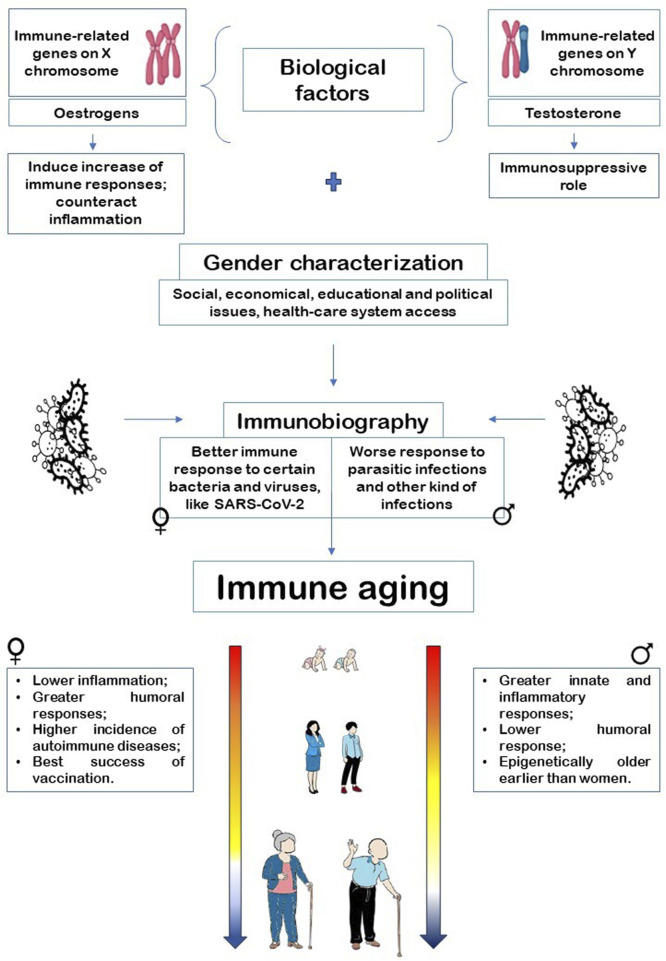
The proposed review aims to elucidate the intricate interplay between biological factors (sex differences) and socially constructed factors (gender differences) in the context of immune aging. While the influence of biological differences between men and women on various aspects of immune responses has long been recognized, it is crucial to acknowledge that gender, encompassing the social and cultural roles and expectations associated with being male or female, also significantly shapes these processes. Gender can either accelerate immune aging or promote longevity. By recognizing the impact of both biological and social factors, this work seeks to offer a comprehensive understanding of why men and women may experience divergent trajectories in immune aging and varying outcomes in terms of longevity. Discrepancies in perceived roles of the sexes, both within families and at work, contribute to differing patterns of antigen exposure. Additionally, variations in micronutrient intake and access to preventive healthcare facilities may exist. Health promotion knowledge often correlates with educational attainment, which is unequally represented between males and females in many cultures and across generations in the Western world. In countries without a universal healthcare system, access to healthcare relies on family prioritization strategies to cope with economic constraints, potentially limiting access to specific treatments and affecting immune responses negatively. As a result, both biological factors and social and behavioral factors associated with gender contribute to disparities in immune responses, susceptibility to infections, autoimmune diseases, and vaccine responses among older individuals. However, as demonstrated by the COVID-19 pandemic, older females exhibit greater resilience to infections than older males. Given the crucial role of the immune system in achieving longevity, it is not surprising that women live longer than men, and the number of female centenarians surpasses that of male centenarians.
Overview
The claims and statistics of this paper haven’t been checked yet.
Free: it reads the open-access text and checks the first 5 claims that cite a source we can check. Create a free account to check every claim.
Integrity signals
Registry
Cites
Statistics
Figures
Verification
Claims the paper makes
The claims and statistics of this paper haven’t been checked yet.
Free: it reads the open-access text and checks the first 5 claims that cite a source we can check. Create a free account to check every claim.
Claims other papers make about this one
Each is checked against this paper’s own text: does it say what the citing paper says it does?
The source backs part of the claim, not all of it — or backs it for a different population, condition or comparison.
In the citing paper
“Older adults demonstrate higher concentrations of circu lating inflammatory mediators, constituting a low-level chronic in flammatory state coupled with diminished cell-mediated immunity, termed 'inflammaging ' (Franceschi et al., 2000; Costagliola et al., 2021; Calabr ` o et al., 2023).”
From Gene Therapy-Associated Uveitis (GTAU): Understanding and mitigating the adverse immune response in retinal gene therapy (2025) · cites this paper as Calabrò et al., 2023
Experimental — accuracy not yet measuredThe cited source says what the claim attributes to it.
In the citing paper
“Women may also undergo changes associated with immunose nescence and inflammaging more gradually than men (Calabr ` o et al., 2023), widening potential differences in older age brackets.”
From Gene Therapy-Associated Uveitis (GTAU): Understanding and mitigating the adverse immune response in retinal gene therapy (2025) · cites this paper as Calabrò et al., 2023
The cited source says what the claim attributes to it.
In the citing paper
“Differences in immune function and responses to both foreign and self antigens between males and females have been reported (Klein and Flanagan, 2016; Calabr ` o et al., 2023).”
From Gene Therapy-Associated Uveitis (GTAU): Understanding and mitigating the adverse immune response in retinal gene therapy (2025) · cites this paper as Calabrò et al., 2023
In the citing paper
“Sex hormones, incomplete activation of immune-associated genes on the X chromosome, and the Xist ribonucleoprotein complex are contributors to sex differences in immune responses,13,14,15”
From Characterization of the ocular inflammatory response to AAV reveals divergence by sex and age (2025) · cites this paper as [14]
In the citing paper
“Recognizing that immune responses are divergent according to age and sex,13,14 tolerance for maintaining homeostasis after AAV-mediated alterations to the ocular immune threshold will also differ according to patient background immune status.”
From Characterization of the ocular inflammatory response to AAV reveals divergence by sex and age (2025) · cites this paper as [14]
Self-check
Percentages, sums and reported differences re-computed from the paper’s own numbers.
The self-check needs the paper’s full text.
Citations
Cites
Hoffmann, M., Kleine-Weber, H., Schroeder, S., Krüger, N., Herrler, T., Erichsen, S., Schiergens, T. S., Herrler, G., Wu, N.-H., Nitsche, A., et al. (2020) · Cell · doi:10.1016/j.cell.2020.02.052 · Cited by 20,286
Sex differences in immune responses
Klein, S. L., & Flanagan, K. L. (2016) · Nature Reviews Immunology · doi:10.1038/nri.2016.90 · Cited by 6,370 · cited 2×
“As discussed earlier, biological factors such as hormones and non-biological factors like lifestyle, which includes nutrition, can in fl uence the epigenetic signature, altering the accessibility of chromatin associated with immune-related genes (Klein and Flanagan, 2016; Shepherd et al., 2021).”
BackgroundCharacteristics of SARS-CoV-2 and COVID-19
Hu, B., Guo, H., Zhou, P., & Shi, Z.-L. (2021) · Nature Reviews Microbiology · doi:10.1038/s41579-020-00459-7 · Cited by 5,291
The cytokine storm and COVID-19
Hu, B., Huang, S., & Yin, L. (2021) · Journal of Medical Virology · doi:10.1002/jmv.26232 · Cited by 1,655 · cited 1×
“The last hallmark of the older immune system, in fl ammaging, associated with increased production of pro-in fl ammatory cytokines, acute phase proteins, and oxidative stress, potentiates the virus-induced cytokine storm responsible for severe lung disease (Hu et al., 2021b).”
BackgroundSex differences in immune responses that underlie COVID-19 disease outcomes
Takahashi, T., Ellingson, M. K., Wong, P., Israelow, B., Lucas, C., Klein, J., Silva, J., Mao, T., Oh, J. E., Tokuyama, M., et al. (2020) · Nature · doi:10.1038/s41586-020-2700-3 · Cited by 1,459
Inflammation and aging: signaling pathways and intervention therapies
Li, X., Li, C., Zhang, W., Wang, Y., Qian, P., & Huang, H. (2023) · Signal Transduction and Targeted Therapy · doi:10.1038/s41392-023-01502-8 · Cited by 1,443
Genetic evidence equating SRY and the testis-determining factor
Berta, P., Hawkins, J. B., Sinclair, A. H., Taylor, A., Griffiths, B. L., Goodfellow, P. N., & Fellous, M. (1990) · Nature · doi:10.1038/348448a0 · Cited by 982
The Xs and Y of immune responses to viral vaccines
Klein, S. L., Jedlicka, A., & Pekosz, A. (2010) · The Lancet Infectious Diseases · doi:10.1016/s1473-3099(10)70049-9 · Cited by 815
How sex and age affect immune responses, susceptibility to infections, and response to vaccination
Giefing‐Kröll, C., Berger, P., Lepperdinger, G., & Grubeck‐Loebenstein, B. (2015) · Aging Cell · doi:10.1111/acel.12326 · Cited by 761
Aiello, A., Farzaneh, F., Candore, G., Caruso, C., Davinelli, S., Gambino, C. M., Ligotti, M. E., Zareian, N., & Accardi, G. (2019) · Frontiers in Immunology · doi:10.3389/fimmu.2019.02247 · Cited by 693 · cited 3×
“Furthermore, latent chronic viral infections, like human cytomegalovirus (HCMV) infection, are considered potent triggers of immunosenescence hallmarks, as they lead to an increase in memory cells (Aiello et al., 2019).”
BackgroundInfluentialSelf-citationFurman, D., Hejblum, B. P., Simon, N., Jojic, V., Dekker, C. L., Thiébaut, R., Tibshirani, R. J., & Davis, M. M. (2014) · Proceedings of the National Academy of Sciences · doi:10.1073/pnas.1321060111 · Cited by 673
Sexual Dimorphism in Innate Immunity
Jaillon, S., Berthenet, K., & Garlanda, C. (2019) · Clinical Reviews in Allergy & Immunology · doi:10.1007/s12016-017-8648-x · Cited by 639 · cited 1×
“This, in turn, implies a higher incidence of autoimmune disease manifestation in women than in men (Jaillon et al., 2019).”
BackgroundAustad, S. N., & Fischer, K. E. (2016) · Cell Metabolism · doi:10.1016/j.cmet.2016.05.019 · Cited by 593
Sexual-dimorphism in human immune system aging
Márquez, E. J., Chung, C.-H., Marches, R., Rossi, R. J., Nehar-Belaid, D., Eroglu, A., Mellert, D. J., Kuchel, G. A., Banchereau, J., & Ucar, D. (2020) · Nature Communications · doi:10.1038/s41467-020-14396-9 · Cited by 584 · cited 7×
“The gradual decline in hormones, guided by sex, has a signi fi cant impact on the aging immune system (Márquez et al., 2020), primarily because immune cells possess estrogen receptors that can in fl uence downstream immune-in fl ammatory pathways, such as the nuclear factor kappa-light-chain-enhancer…”
BackgroundMethodInfluentialSex Hormones Determine Immune Response
Taneja, V. (2018) · Frontiers in Immunology · doi:10.3389/fimmu.2018.01931 · Cited by 583 · cited 1×
“…have receptors on both innate and adaptive immune cells, with estrogen receptors being found on B cells, T cells, dendritic cells (DCs), macrophages, and NK cells, while androgen receptors are present on T and B lymphocytes (Carrega and Ferlazzo, 2012; Gie fi ng-Kröll et al., 2015; Taneja, 2018).”
BackgroundAging of the Immune System. Mechanisms and Therapeutic Targets
Weyand, C. M., & Goronzy, J. J. (2016) · Annals of the American Thoracic Society · doi:10.1513/annalsats.201602-095aw · Cited by 550 · cited 1×
“Starting from the sixth decade of life, the human immune system undergoes signi fi cant age-related changes that progressively lead to a state known as immunosenescence (Weyand and Goronzy, 2016).”
BackgroundTLR7 Ligands Induce Higher IFN-α Production in Females
Berghöfer, B., Frommer, T., Haley, G., Fink, L., Bein, G., & Hackstein, H. (2006) · The Journal of Immunology · doi:10.4049/jimmunol.177.4.2088 · Cited by 480 · cited 1×
“Furthermore, as discussed in the previous paragraphs, TLR-7 is more expressed in female immune cells, leading to increased production of type 1 IFNs through TLR-7 ligands (Berghöfer et al., 2006).”
BackgroundThe influence of sex and gender on the immune response
Oertelt-Prigione, S. (2012) · Autoimmunity Reviews · doi:10.1016/j.autrev.2011.11.022 · Cited by 459 · cited 6×
“For example, the transmission of sexually transmitted diseases is faster in women who use oral contraceptives than in men, particularly in the case of HIV infection (Oertelt-Prigione, 2012; Addo and Altfel, 2014).”
BackgroundInfluentialTrained immunity — basic concepts and contributions to immunopathology
Ochando, J., Mulder, W. J. M., Madsen, J. C., Netea, M. G., & Duivenvoorden, R. (2023) · Nature Reviews Nephrology · doi:10.1038/s41581-022-00633-5 · Cited by 453
The aging gut microbiome and its impact on host immunity
Bosco, N., & Noti, M. (2021) · Genes & Immunity · doi:10.1038/s41435-021-00126-8 · Cited by 413 · cited 2×
“…have shown that transplanting a young microbiome into aging models has positive effects on immunosenescence markers, which include reducing in fl ammation and preserving the immune system function, regulation of antigen-speci fi c T-cell responses, and antibody production (Bosco and Noti, 2021).”
BackgroundGender medicine: effects of sex and gender on cardiovascular disease manifestation and outcomes
Regitz-Zagrosek, V., & Gebhard, C. (2023) · Nature Reviews Cardiology · doi:10.1038/s41569-022-00797-4 · Cited by 386
Sexual Dimorphism in Innate Immunity: The Role of Sex Hormones and Epigenetics
Shepherd, R., Cheung, A. S., Pang, K., Saffery, R., & Novakovic, B. (2021) · Frontiers in Immunology · doi:10.3389/fimmu.2020.604000 · Cited by 304 · cited 2×
“As discussed earlier, biological factors such as hormones and non-biological factors like lifestyle, which includes nutrition, can in fl uence the epigenetic signature, altering the accessibility of chromatin associated with immune-related genes (Klein and Flanagan, 2016; Shepherd et al., 2021).”
BackgroundThe Milieu Intérieur Consortium, Patin, E., Hasan, M., Bergstedt, J., Rouilly, V., Libri, V., Urrutia, A., Alanio, C., Scepanovic, P., Hammer, C., et al. (2018) · Nature Immunology · doi:10.1038/s41590-018-0049-7 · Cited by 296
Franceschi, C., Salvioli, S., Garagnani, P., de Eguileor, M., Monti, D., & Capri, M. (2017) · Frontiers in Immunology · doi:10.3389/fimmu.2017.00982 · Cited by 290
Autoimmune Disease in Women: Endocrine Transition and Risk Across the Lifespan
Desai, M. K., & Brinton, R. D. (2019) · Frontiers in Endocrinology · doi:10.3389/fendo.2019.00265 · Cited by 273 · cited 1×
“Additionally, the activity of regulatory T cells is enhanced by high progesterone levels, often leading to the remission of autoimmune diseases (McCarthy, 2000; Desai and Brinton, 2019).”
BackgroundA human circulating immune cell landscape in aging and COVID-19
Zheng, Y., Liu, X., Le, W., Xie, L., Li, H., Wen, W., Wang, S., Ma, S., Huang, Z., Ye, J., et al. (2020) · Protein & Cell · doi:10.1007/s13238-020-00762-2 · Cited by 270
Social, behavioral, and biological factors, and sex differences in mortality
Rogers, R. G., Everett, B. G., Onge, J. M. S., & Krueger, P. M. (2010) · Demography · doi:10.1353/dem.0.0119 · Cited by 264
Huang, Z., Chen, B., Liu, X., Li, H., Xie, L., Gao, Y., Duan, R., Li, Z., Zhang, J., Zheng, Y., et al. (2021) · Proceedings of the National Academy of Sciences · doi:10.1073/pnas.2023216118 · Cited by 247
Age related human T cell subset evolution and senescence
Li, M., Yao, D., Zeng, X., Kasakovski, D., Zhang, Y., Chen, S., Zha, X., Li, Y., & Xu, L. (2019) · Immunity & Ageing · doi:10.1186/s12979-019-0165-8 · Cited by 230
Gender medicine: a task for the third millennium
Baggio, G., Corsini, A., Floreani, A., Giannini, S., & Zagonel, V. (2013) · Clinical Chemistry and Laboratory Medicine (CCLM) · doi:10.1515/cclm-2012-0849 · Cited by 223
Inheritance of coronary artery disease in men: an analysis of the role of the Y chromosome
Charchar, F. J., Bloomer, L. D., Barnes, T. A., Cowley, M. J., Nelson, C. P., Wang, Y., Denniff, M., Debiec, R., Christofidou, P., Nankervis, S., et al. (2012) · The Lancet · doi:10.1016/s0140-6736(11)61453-0 · Cited by 215
Nutritional Interventions for Elderly and Considerations for the Development of Geriatric Foods
Kaur, D., Rasane, P., Singh, J., Kaur, S., Kumar, V., Mahato, D. K., Dey, A., Dhawan, K., & Kumar, S. (2019) · Current Aging Science · doi:10.2174/1874609812666190521110548 · Cited by 208
(2012) · Metabolic and Endocrine Physiology · doi:10.1201/b16175-5 · Cited by 205
Slower immune system aging in women versus men in the Japanese population
Hirokawa, K., Utsuyama, M., Hayashi, Y., Kitagawa, M., Makinodan, T., & Fulop, T. (2013) · Immunity & Ageing · doi:10.1186/1742-4933-10-19 · Cited by 204
Horowitz, J. E., Kosmicki, J. A., Damask, A., Sharma, D., Roberts, G. H. L., Justice, A. E., Banerjee, N., Coignet, M. V., Yadav, A., Leader, J. B., et al. (2022) · Nature Genetics · doi:10.1038/s41588-021-01006-7 · Cited by 202
Natural killer cell distribution and trafficking in human tissues
Carrega, P., & Ferlazzo, G. (2012) · Frontiers in Immunology · doi:10.3389/fimmu.2012.00347 · Cited by 201
Influence of sex differences on microRNA gene regulation in disease
Sharma, S., & Eghbali, M. (2014) · Biology of Sex Differences · doi:10.1186/2042-6410-5-3 · Cited by 201
Gender-Specific Impact of Sex Hormones on the Immune System
Sciarra, F., Campolo, F., Franceschini, E., Carlomagno, F., & Venneri, M. (2023) · International Journal of Molecular Sciences · doi:10.3390/ijms24076302 · Cited by 191
Ageing of the gut microbiome: Potential influences on immune senescence and inflammageing
Conway, J., & A Duggal, N. (2021) · Ageing Research Reviews · doi:10.1016/j.arr.2021.101323 · Cited by 188
The sex with the reduced sex chromosome dies earlier: a comparison across the tree of life
Xirocostas, Z. A., Everingham, S. E., & Moles, A. T. (2020) · Biology Letters · doi:10.1098/rsbl.2019.0867 · Cited by 173
Sexual Dimorphism and Gender in Infectious Diseases
Gay, L., Melenotte, C., Lakbar, I., Mezouar, S., Devaux, C., Raoult, D., Bendiane, M.-K., Leone, M., & Mège, J.-L. (2021) · Frontiers in Immunology · doi:10.3389/fimmu.2021.698121 · Cited by 171 · cited 2×
“Androgens and progesterone play immunosuppressive roles in men, which can lead to increased mortality from infections (Gay et al., 2021).”
BackgroundThe Y chromosome: a blueprint for men’s health?
Maan, A. A., Eales, J., Akbarov, A., Rowland, J., Xu, X., Jobling, M. A., Charchar, F. J., & Tomaszewski, M. (2017) · European Journal of Human Genetics · doi:10.1038/ejhg.2017.128 · Cited by 165 · cited 4×
“This may also play a role in the differentiation of monocytes into macrophages, a process implicated in the formation of atherosclerotic plaques (Maan et al., 2017).”
BackgroundInfluentialSex-Based Differences in HIV Type 1 Pathogenesis
Addo, M. M., & Altfeld, M. (2014) · Journal of Infectious Diseases · doi:10.1093/infdis/jiu175 · Cited by 162
The immune system and microbiome in pregnancy
Fuhler, G. M. (2020) · Best Practice & Research Clinical Gastroenterology · doi:10.1016/j.bpg.2020.101671 · Cited by 160 · cited 1×
“However, this shift can also make individuals more susceptible to infectious diseases, such as Spanish in fl uenza (Restifo, 2000; Fuhler, 2020).”
BackgroundFlu: The Story of the Great Influenza Pandemic of 1918 and the Search for the Virus that Caused It
Restifo, N. P. (2000) · Nature Medicine · doi:10.1038/71463 · Cited by 153 · cited 2×
“…and higher incidence of infections during pregnancy Carrega and Ferlazzo (2012 Progesterone Induction of higher susceptibility to Spanish fl u in women Restifo (2000) Higher infection incidence in men Austad and Bartke (2015); Gay et al. (2021)…”
BackgroundSex Differences in Longevity and in Responses to Anti-Aging Interventions: A Mini-Review
Austad, S. N., & Bartke, A. (2016) · Gerontology · doi:10.1159/000381472 · Cited by 151 · cited 3×
“It is a well-established fact that men who undergo castration tend to live longer than men with normal levels of male hormones (Austad and Bartke, 2015).”
BackgroundAlcalde-Rubio, L., Hernández‐Aguado, I., Parker, L. A., Vergara, E. B., & Chilet‐Rosell, E. (2020) · International Journal for Equity in Health · doi:10.1186/s12939-020-01283-4 · Cited by 145
Aging and sex hormones in males
Decaroli, M. C., & Rochira, V. (2017) · Virulence · doi:10.1080/21505594.2016.1259053 · Cited by 144 · cited 1×
“Furthermore, hormone supplementation in women may slow down the negative effects of sex dimorphism on immunity, whereas testosterone supplementation is not recommended for men (Decaroli and Rochira, 2017).”
BackgroundLu, R. J., Taylor, S., Contrepois, K., Kim, M., Bravo, J. I., Ellenberger, M., Sampathkumar, N. K., & Benayoun, B. A. (2021) · Nature Aging · doi:10.1038/s43587-021-00086-8 · Cited by 126
Baratchian, M., McManus, J. M., Berk, M. P., Nakamura, F., Mukhopadhyay, S., Xu, W., ERZURUM, S. C., Drazba, J. A., Peterson, J. W., Klein, E. A., et al. (2021) · Scientific Reports · doi:10.1038/s41598-021-90491-1 · Cited by 122 · cited 1×
“ACE2 is, indeed, an X chromosome – encoded gene that is downregulated by estrogens, while TMPRSS2 is regulated by androgen receptor signaling (Baratchian et al., 2021).”
BackgroundSex‐specific aging in animals: Perspective and future directions
Bronikowski, A. M., Meisel, R. P., Biga, P. R., Walters, J. R., Mank, J. E., Larschan, E., Wilkinson, G. S., Valenzuela, N., Conard, A. M., de Magalhães, J. P., et al. (2022) · Aging Cell · doi:10.1111/acel.13542 · Cited by 120
X-Chromosome Inactivation and Related Diseases
Sun, Z., Fan, J., & Wang, Y. (2022) · Genetics Research · doi:10.1155/2022/1391807 · Cited by 114 · cited 1×
“This may contribute to the higher incidence of autoimmune diseases in women and lower activation of the immune system in men who inherit only one X chromosome from their mother, which is not subject to silencing (Flanagan, 2014; Sun et al., 2022).”
Backgroundvan der Sluis, R. M., Cham, L. B., Gris‐Oliver, A., Gammelgaard, K. R., Pedersen, J. G., Idorn, M., Ahmadov, U., Sánchez-Hernández, S., Cémalovic, E., Godsk, S. H., et al. (2022) · The EMBO Journal · doi:10.15252/embj.2021109622 · Cited by 110
Sex bias in lymphocytes: Implications for autoimmune diseases
Dodd, K. C., & Menon, M. (2022) · Frontiers in Immunology · doi:10.3389/fimmu.2022.945762 · Cited by 108 · cited 2×
“During pregnancy, there is a shift from a T helper 1 (Th1) immune response toward a Th2 response (Asaba et al., 2015; Dodd and Menon, 2022).”
BackgroundPhenotypic and functional alterations of monocyte subsets with aging
Cao, Y., Fan, Y., Li, F., Hao, Y., Kong, Y., Chen, C., Hao, X., Han, D., Li, G., Wang, Z., et al. (2022) · Immunity & Ageing · doi:10.1186/s12979-022-00321-9 · Cited by 95
Sex, gender and immunosenescence: a key to understand the different lifespan between men and women?
Caruso, C., Accardi, G., Virruso, C., & Candore, G. (2013) · Immunity & Ageing · doi:10.1186/1742-4933-10-20 · Cited by 92
Self-citationSex-differences in COVID-19 associated excess mortality is not exceptional for the COVID-19 pandemic
Nielsen, J. O., Nørgaard, S. K., Lanzieri, G., Vestergaard, L. S., & Moelbak, K. (2021) · Scientific Reports · doi:10.1038/s41598-021-00213-w · Cited by 92 · cited 1×
“Concluding this paragraph, the results of a study analyzing differences in excess mortality between the two sexes in 27 European countries, covering the seasons from 2016/2017 to 2019/2020, is considered (Nielsen et al., 2021).”
BackgroundTieri, P., Grignolio, A., Zaikin, A., Mishto, M., Remondini, D., Castellani, G. C., & Franceschi, C. (2010) · Theoretical Biology and Medical Modelling · doi:10.1186/1742-4682-7-32 · Cited by 87
Thompson, E. E., Nicodemus‐Johnson, J., Kim, K. W., Gern, J. E., Jackson, D. J., Lemanske, R. F., & Ober, C. (2018) · Clinical Epigenetics · doi:10.1186/s13148-018-0491-2 · Cited by 86
Sex differences in disease risk from reported genome-wide association study findings
Liu, L. Y., Schaub, M. A., Sirota, M., & Butte, A. J. (2012) · Human Genetics · doi:10.1007/s00439-011-1081-y · Cited by 82
The “gender gap” in autoimmune disease
McCarthy, M. (2000) · The Lancet · doi:10.1016/s0140-6736(05)74535-9 · Cited by 82 · cited 1×
“Additionally, the activity of regulatory T cells is enhanced by high progesterone levels, often leading to the remission of autoimmune diseases (McCarthy, 2000; Desai and Brinton, 2019).”
BackgroundInnate and Adaptive Immunity in Aging and Longevity: The Foundation of Resilience
Moskalev, A., Stambler, I., & Caruso, C. (2020) · Aging and Disease · doi:10.14336/ad.2020.0603 · Cited by 79
Self-citationWhat microRNAs could tell us about the human X chromosome
Di Palo, A., Siniscalchi, C., Salerno, M., Russo, A., Gravholt, C. H., & Potenza, N. (2020) · Cellular and Molecular Life Sciences · doi:10.1007/s00018-020-03526-7 · Cited by 75
Spach, K. M., Blake, M., Bunn, J. Y., McElvany, B., Noubade, R., Blankenhorn, E. P., & Teuscher, C. (2009) · The Journal of Immunology · doi:10.4049/jimmunol.0803200 · Cited by 71
The influence of sex and gender domains on COVID-19 cases and mortality
Tadiri, C. P., Gisinger, T., Kautzky‐Willer, A., Kublickiene, K. R., Herrero, M. T., Raparelli, V., Pilote, L., & Norris, C. M. (2020) · Canadian Medical Association Journal · doi:10.1503/cmaj.200971 · Cited by 71
Schuurhof, A., Bont, L., Siezen, C. L. E., Hodemaekers, H. M., van Houwelingen, H. C., Kimman, T. G., Hoebee, B., Kimpen, J. L. L., & Janssen, R. (2010) · Pediatric Pulmonology · doi:10.1002/ppul.21229 · Cited by 67
The genetic basis of severe combined immunodeficiency and its variants
Dalal, I., & Tasher (2012) · The Application of Clinical Genetics · doi:10.2147/tacg.s18693 · Cited by 65
Gender Differences in Inflammatory Processes Could Explain Poorer Prognosis for Males
Casimir, G. J. A., & Duchateau, J. (2011) · Journal of Clinical Microbiology · doi:10.1128/jcm.02096-10 · Cited by 64
The Effects of Androgens on T Cells: Clues to Female Predominance in Autoimmune Liver Diseases?
Henze, L., Schwinge, D., & Schramm, C. (2020) · Frontiers in Immunology · doi:10.3389/fimmu.2020.01567 · Cited by 63
Raparelli, V., Norris, C. M., Bender, U., Herrero, M. T., Kautzky‐Willer, A., Kublickiene, K. R., Emam, K. E., & Pilote, L. (2021) · BMJ Global Health · doi:10.1136/bmjgh-2021-005413 · Cited by 63
Oghumu, S., Varikuti, S., Stock, J. C., Volpedo, G., Saljoughian, N., Terrazas, C. A., & Satoskar, A. R. (2019) · The Journal of Immunology · doi:10.4049/jimmunol.1800931 · Cited by 58
Centenarians as a model to discover genetic and epigenetic signatures of healthy ageing
Puca, A. A., Spinelli, C., Accardi, G., Villa, F., & Caruso, C. (2018) · Mechanisms of Ageing and Development · doi:10.1016/j.mad.2017.10.004 · Cited by 57
Self-citationAn immunologist’s guide to immunosenescence and its treatment
Caruso, C., Ligotti, M. E., Accardi, G., Aiello, A., & Candore, G. (2022) · Expert Review of Clinical Immunology · doi:10.1080/1744666x.2022.2106217 · Cited by 55
Self-citationEstrogen receptor signal in regulation of B cell activation during diverse immune responses
Asaba, J., Bandyopadhyay, M., Kindy, M. S., & Dasgupta, S. (2015) · The International Journal of Biochemistry & Cell Biology · doi:10.1016/j.biocel.2015.08.012 · Cited by 50
Sex-Related Differences in Innate and Adaptive Immune Responses to SARS-CoV-2
Agrawal, S., Salazar, J. V., Tran, T. M., & Agrawal, A. (2021) · Frontiers in Immunology · doi:10.3389/fimmu.2021.739757 · Cited by 50
Ligotti, M. E., Aiello, A., Accardi, G., Aprile, S., Bonura, F., Bulati, M., Gervasi, F., Giammanco, G. M., Pojero, F., Zareian, N., et al. (2021) · Clinical & Experimental Immunology · doi:10.1111/cei.13606 · Cited by 48
Self-citationThe Role of Immunogenetics in COVID-19
Pojero, F., Candore, G., Caruso, C., Bona, D. D., Groneberg, D. A., Ligotti, M. E., Accardi, G., & Aiello, A. (2021) · International Journal of Molecular Sciences · doi:10.3390/ijms22052636 · Cited by 44 · cited 1×
“Other in fl uencing factors could be the environment, which encompasses exposure to xenobiotics and multiple pathogens, and the genetics of immune responses (Ligotti et al., 2021b; Pojero et al., 2021).”
BackgroundSelf-citationSex and gender influence on immunity and autoimmunity
Lahita, R. G. (2023) · Frontiers in Immunology · doi:10.3389/fimmu.2023.1142723 · Cited by 44 · cited 1×
“This contributes to the in fl ammatory process and hormone release, such as estrogen (Lahita, 2023).”
BackgroundAiello, A., Accardi, G., Aprile, S., Caldarella, R., Carru, C., Ciaccio, M., Vivo, I. D., Gambino, C. M., Ligotti, M. E., Vasto, S., et al. (2021) · Aging and Disease · doi:10.14336/ad.2021.0226 · Cited by 42
Self-citationWhy does gender matter for immunization?
Tracey, G., Olivia, B., Jean, M., Megan, H., & Singh, S. (2022) · Vaccine · doi:10.1016/j.vaccine.2022.11.071 · Cited by 40 · cited 1×
“In conclusion, gender has an impact on immunization both on the demand side, through health-seeking behaviors, and on the supply side of healthcare service (Tracey et al., 2022).”
BackgroundAiello, A., Ligotti, M. E., Garnica, M., Accardi, G., Calabrò, A., Pojero, F., Arasanz, H., Bocanegra, A., Blanco, E., Chocarro, L., et al. (2022) · International Journal of Molecular Sciences · doi:10.3390/ijms23179880 · Cited by 37
Self-citationSexual dimorphism in biomedical research: a call to analyse by sex
Flanagan, K. L. (2014) · Transactions of the Royal Society of Tropical Medicine and Hygiene · doi:10.1093/trstmh/tru079 · Cited by 35 · cited 2×
“By contrast, males tend to have a better response to vaccines against yellow fever, pneumococcal polysaccharide, and meningococcal A and C (Flanagan, 2014).”
BackgroundGisinger, T., Azizi, Z., Alipour, P., Harreiter, J., Raparelli, V., Kublickiene, K. R., Herrero, M. T., Norris, C. M., Emam, K. E., Pilote, L., et al. (2023) · Frontiers in Public Health · doi:10.3389/fpubh.2023.1090541 · Cited by 35
Immunoceuticals: Harnessing Their Immunomodulatory Potential to Promote Health and Wellness
Tieu, S., Charchoglyan, A., Wagter-Lesperance, L., Karimi, K., Bridle, B. W., Karrow, N. A., & Mallard, B. A. (2022) · Nutrients · doi:10.3390/nu14194075 · Cited by 34
Ligotti, M. E., Accardi, G., Aiello, A., Aprile, S., Calabrò, A., Caldarella, R., Caruso, C., Ciaccio, M., Corsale, A. M., Dieli, F., et al. (2023) · Clinical & Experimental Immunology · doi:10.1093/cei/uxad074 · Cited by 34
Self-citationKutch, I. C., & Fedorka, K. M. (2015) · Proceedings of the Royal Society B Biological Sciences · doi:10.1098/rspb.2015.1301 · Cited by 32
Role of Sex and Age in Fatal Outcomes of COVID-19: Women and Older Centenarians Are More Resilient
Caruso, C., Marcon, G., Accardi, G., Aiello, A., Calabrò, A., Ligotti, M. E., Tettamanti, M., Franceschi, C., & Candore, G. (2023) · International Journal of Molecular Sciences · doi:10.3390/ijms24032638 · Cited by 31
Self-citationIntralocus sexual conflict can resolve the male-female health-survival paradox
Archer, C. R., Recker, M., Duffy, E., & Hosken, D. J. (2018) · Nature Communications · doi:10.1038/s41467-018-07541-y · Cited by 28
Vitamin D and the Immune System in Menopause: A Review
Min, J., Jo, H., Chung, Y., Song, J. Y., Kim, M.-J., & Kim, J.-H. (2021) · Journal of Menopausal Medicine · doi:10.6118/jmm.21011 · Cited by 27 · cited 1×
“By contrast, menopause has a negative impact on immune function and is associated with an increased susceptibility of menopausal women to autoimmune disorders (Min et al., 2021).”
BackgroundLigotti, M. E., Pojero, F., Accardi, G., Aiello, A., Caruso, C., Duro, G., & Candore, G. (2021) · Frontiers in Cell and Developmental Biology · doi:10.3389/fcell.2021.725606 · Cited by 26
Self-citationCentenarians exposed to the Spanish flu in their early life better survived to COVID-19
Poulain, M., Chambre, D., & Pes, G. M. (2021) · Aging · doi:10.18632/aging.203577 · Cited by 26
Accelerated DNA methylation changes in middle-aged men define sexual dimorphism in human lifespans
Xiao, F., Chen, X., He, Y., & Kong, Q. (2018) · Clinical Epigenetics · doi:10.1186/s13148-018-0573-1 · Cited by 25
Accardi, G., Aprile, S., Candore, G., Caruso, C., Cusimano, R., Cristaldi, L., Bona, D. D., Duro, G., Galimberti, D., Gambino, C. M., et al. (2019) · Current Pharmaceutical Design · doi:10.2174/1381612825666190313115233 · Cited by 24
Self-citationCentenarians born before 1919 are resistant to COVID-19
Caruso, C., Accardi, G., Aiello, A., Calabrò, A., Ligotti, M. E., & Candore, G. (2022) · Aging Clinical and Experimental Research · doi:10.1007/s40520-022-02287-6 · Cited by 24 · cited 2×
“However, the surprising resistance to COVID-19 that has characterized a large number of Belgian and Italian centenarians is noteworthy (Poulain et al., 2021; Caruso et al., 2023a).”
BackgroundSelf-citationLigotti, M. E., Accardi, G., Aiello, A., Calabrò, A., Caruso, C., Corsale, A. M., Dieli, F., Simone, M. D., Meraviglia, S., & Candore, G. (2023) · Clinical & Experimental Immunology · doi:10.1093/cei/uxad132 · Cited by 24
Self-citationGarnica, M., Aiello, A., Ligotti, M. E., Accardi, G., Arasanz, H., Bocanegra, A., Blanco, E., Calabrò, A., Chocarro, L., Echaide, M., et al. (2022) · International Journal of Molecular Sciences · doi:10.3390/ijms23179797 · Cited by 21
Self-citationLigotti, M. E., Accardi, G., Aiello, A., Calabrò, A., Caruso, C., Corsale, A. M., Dieli, F., Simone, M. D., Meraviglia, S., & Candore, G. (2023) · Translational Medicine UniSa · doi:10.37825/2239-9747.1041 · Cited by 21
Self-citationTrevisan, C., Raparelli, V., Malara, A., Abbatecola, A. M., Noale, M., Palmieri, A., Fedele, G., Lonardo, A. D., Leone, P., Schiavoni, I., et al. (2023) · Internal and Emergency Medicine · doi:10.1007/s11739-023-03283-y · Cited by 19
Caruso, C., & Vasto, S. (2016) · Encyclopedia of Immunobiology · doi:10.1016/b978-0-12-374279-7.19003-4 · Cited by 18 · cited 1×
“This sexual dimorphism in the immune response means that women are more resistant to infections but have a higher incidence of autoimmune diseases than men, however the relevance of autoimmune disorders for lifespan is negligible (Caruso and Vasto, 2016; Hoffmann et al., 2020).”
BackgroundSelf-citationButtenschoen, J., & Mattner, J. (2021) · Cellular and Molecular Immunology · doi:10.1038/s41423-020-00624-1 · Cited by 11
Genetics: A molecular approach
Mathew, M. K. (1993) · Journal of Genetics · doi:10.1007/bf02933034 · Cited by 4 · cited 1×
“Conversely, the absence of this gene, due to the lack of a Y chromosome, leads to the development of female gonads (Berta et al., 1990; Russell, 2013).”
Background
Research works printed but not linked: 1
- Plebani M. Lippi G. (2022). Sex and gender differences in COVID-19: a narrative review. Italian J. Gender-Specific Med. 8, 37953. 10.1723/0000.37953 · doi:10.1723/0000.37953
Cited by
Emerging insights in senescence: pathways from preclinical models to therapeutic innovations
Mansfield, L., Ramponi, V., Gupta, K., Stevenson, T., Mathew, A. B., Barinda, A. J., Herbstein, F., & Morsli, S. (2024) · npj Aging · doi:10.1038/s41514-024-00181-1 · Cited by 88
Zinc deficiency as possible link between immunosenescence and age-related diseases
Schulz, M. T., & Rink, L. (2025) · Immunity & Ageing · doi:10.1186/s12979-025-00511-1 · Cited by 56
“Soci-etal norms and behaviors may lead to differences in life-style, access to healthcare, and exposure to chronic stress, all of which impact the immune system over time [120].”
Sex and Gender Differences in Liver Fibrosis: Pathomechanisms and Clinical Outcomes
Jamalinia, M., Lonardo, A., & Weiskirchen, R. (2024) · Fibrosis · doi:10.70322/fibrosis.2024.10006 · Cited by 50
“These differences in diet lead to variations in antigen exposure and micronutrient intake, contributing to different immune aging trajectories and longevity-associated outcomes [93].”
Advancing multiple sclerosis management in older adults
van der Walt, A., Strijbis, E. M. M., Bridge, F., Coetzee, T., Graves, J., Brownlee, W. J., Butzkueven, H., Marrie, R. A., Hua, L. H., Lampe, A., et al. (2025) · Nature Reviews Neurology · doi:10.1038/s41582-025-01115-5 · Cited by 46
Caldarelli, M., Rio, P., Marrone, A., Giambra, V., Gasbarrini, A., Gambassi, G., & Cianci, R. (2024) · Biomedicines · doi:10.3390/biomedicines12081716 · Cited by 48
Metadata
- Authors
- Calabrò, A., Accardi, G., Aiello, A., Caruso, C., & Candore, G.
- Affiliations
- University of Palermo (IT)
- Corresponding author
- Caruso, Calogero
- Candore, Giuseppina
- Venue
- Frontiers in Aging
- Publisher
- Frontiers Media SA
- Published
- 2023-11-28
- Volume
- 4
- Pages
- 1272118-1272118
- ISSN
- 2673-6217 (ISSN-L)
- PMC
- PMC10715058
- OpenAlex
- W4389090530
- Cited by
- 71
- References
- 102
- Citations by year
- 2026: 22 · 2025: 33 · 2024: 16
- FWCI
- 3.51
- Type
- journal article
- Language
- en
- Open access
- gold
- doi.org
- Licence
- Locations
- Frontiers in Aging (publishedVersion, cc-by)
- PubMed Central (publishedVersion, cc-by)
- PubMed (publishedVersion)
- DOAJ (DOAJ: Directory of Open Access Journals) (submittedVersion, cc-by-sa)
- Nova Science Publishers (Nova Science Publishers, Inc.) (submittedVersion, other-oa)
- Funders
- European Commission (2020 ID 848, HORIZON2020)
- Università degli Studi di Palermo
- Topics
- Health Sciences › Medicine › Public Health, Environmental and Occupational Health › Sex and Gender in Healthcare
- Social Sciences › Sociology and Political Science › Gender, Health, and Social Inequality
- Life Sciences › Biochemistry, Genetics and Molecular Biology › Aging › Genetics, Aging, and Longevity in Model Organisms
- Keywords
- immunosenescence, sex differences, gender differences, longevity, sex differences in aging, antigen exposure, micronutrient intake, health care access, educational attainment, infection susceptibility, autoimmune disease, vaccine response, COVID-19 pandemic, social determinants of health
About these checks
Registry, retraction, Cites and statistics results are computed, not judged, with one exception: a printed reference that no index lists is read once by a model before it counts as a citation error. Claims are extracted by a model and kept only when their quote appears verbatim in the text; each cited source is then checked, with a model’s help, for whether it says what the claim relies on. Those verdicts can be wrong — read the claim’s quote and the cited source before relying on one.
Statistics and arithmetic are recomputed, not judged.
Confidence bands are shown only for fields calibrated on our annotated test set. None is calibrated yet, so no band is shown.
What counts as a claim ›How we measure confidence ›How we check this ›
Are you an author, or do you see a problem with this page? Request a review
Data sources
Bibliographic data: Semantic Scholar, OpenAlex, Crossref.
Contains information from the Semantic Scholar Academic Graph Datasets, made available under the ODC Attribution License (ODC-BY 1.0).
Semantic Scholar’s data is described in: Kinney, R., et al. (2023). The Semantic Scholar Open Data Platform. arXiv:2301.10140.
