

Automated feedback and writing: a multi-level meta-analysis of effects on students' performance
Open accessThe DOI matches its Crossref record; 102 of the 103 references it cites were found in a registry or an index, and 1 are not checked yet.
Abstract
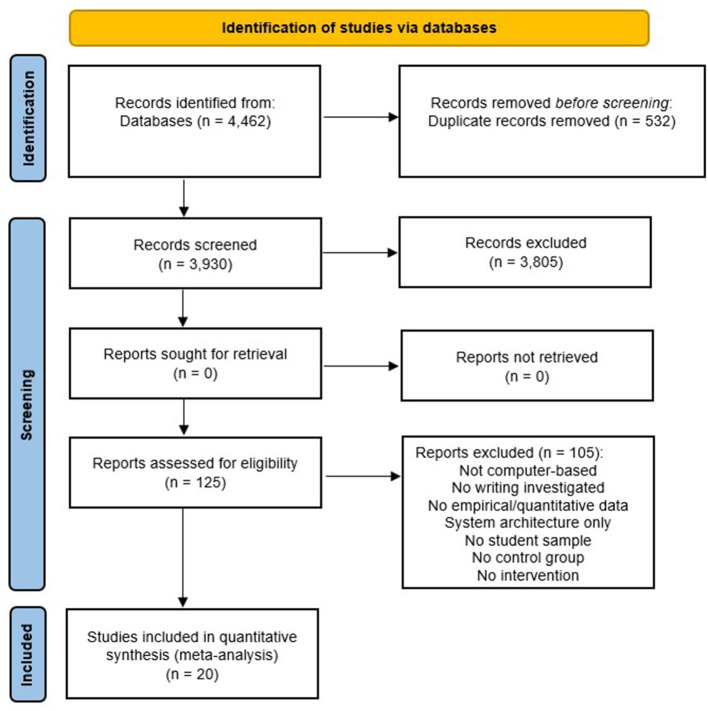
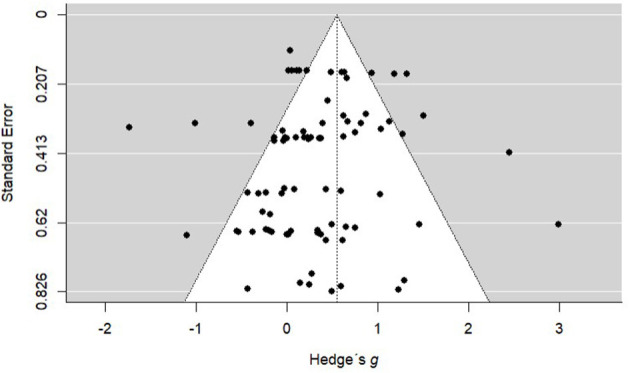
Introduction: Adaptive learning opportunities and individualized, timely feedback are considered to be effective support measures for students' writing in educational contexts. However, the extensive time and expertise required to analyze numerous drafts of student writing pose a barrier to teaching. Automated writing evaluation (AWE) tools can be used for individual feedback based on advances in Artificial Intelligence (AI) technology. A number of primary (quasi-)experimental studies have investigated the effect of AWE feedback on students' writing performance. Methods: This paper provides a meta-analysis of the effectiveness of AWE feedback tools. The literature search yielded 4,462 entries, of which 20 studies ( k = 84; N = 2, 828) met the pre-specified inclusion criteria. A moderator analysis investigated the impact of the characteristics of the learner, the intervention, and the outcome measures. Results: Overall, results based on a three-level model with random effects show a medium effect ( g = 0.55) of automated feedback on students' writing performance. However, the significant heterogeneity in the data indicates that the use of automated feedback tools cannot be understood as a single consistent form of intervention. Even though for some of the moderators we found substantial differences in effect sizes, none of the subgroup comparisons were statistically significant. Discussion: We discuss these findings in light of automated feedback use in educational practice and give recommendations for future research.
Overview
The claims and statistics of this paper haven’t been checked yet.
Free: it reads the open-access text and checks the first 5 claims that cite a source we can check. Create a free account to check every claim.
Integrity signals
Registry
Cites
Statistics
Figures
Verification
Claims the paper makes
The claims and statistics of this paper haven’t been checked yet.
Free: it reads the open-access text and checks the first 5 claims that cite a source we can check. Create a free account to check every claim.
Claims other papers make about this one
Each is checked against this paper’s own text: does it say what the citing paper says it does?
The source backs part of the claim, not all of it — or backs it for a different population, condition or comparison.
In the citing paper
“More recent research into the effectiveness of LLM-based generative AI in enhancing student performance on revised assignments has produced mixed results.”
From Generative AI and Essay Writing: Impacts of Automated Feedback on Revision Performance and Engagement (2024) · cites this paper as Fleckenstein et al., 2023
Experimental — accuracy not yet measured
Self-check
Percentages, sums and reported differences re-computed from the paper’s own numbers.
The self-check needs the paper’s full text.
Citations
Cites
Preferred reporting items for systematic reviews and meta-analyses: the PRISMA Statement.
(2009) · PubMed Central · Cited by 44,859
Preferred reporting items for systematic reviews and meta-analyses: The PRISMA statement
Moher, D., Liberati, A., Tetzlaff, J., Altman, D. G., & the PRISMA Group* (2009) · Annals of Internal Medicine · doi:10.7326/0003-4819-151-4-200908180-00135 · Cited by 37,554
Quantifying heterogeneity in a meta‐analysis
Higgins, J. P. T., & Thompson, S. G. (2002) · Statistics in Medicine · doi:10.1002/sim.1186 · Cited by 36,763 · cited 1×
“In addition to the estimate of τ 2 , the Q -test for heterogeneity (Cochran, 1954) and the τ 2 statistic (Higgins and Thompson, 2002) are reported.”
MethodConducting Meta-Analyses in R with the metafor Package
Viechtbauer, W. (2010) · Journal of Statistical Software · doi:10.18637/jss.v036.i03 · Cited by 20,464 · cited 1×
“The analysis was carried out using R (version 4.1.2; R Core Team, 2021) and the metafor package (Viechtbauer, 2010) to perform the meta-analyses.”
MethodInfluentialHattie, J., & Timperley, H. (2007) · Review of Educational Research · doi:10.3102/003465430298487 · Cited by 12,905 · cited 1×
“…effect on learner performance when it is given in a timely manner when it clarifies the gap between current performance and learning goal, when it reduces cognitive load, and when it is task-related, specific, and detailed (Mory, 2004; Hattie and Timperley, 2007; Shute, 2008; Black and Wiliam, 2009).”
Background(2000) · Cited by 9,198
Zawacki-Richter, O., Marín, V. I., Bond, M., & Gouverneur, F. (2019) · International Journal of Educational Technology in Higher Education · doi:10.1186/s41239-019-0171-0 · Cited by 7,242
Distribution Theory for Glass's Estimator of Effect Size and Related Estimators
Hedges, L. V. (1981) · Journal of Educational Statistics · doi:10.2307/1164588 · Cited by 5,695 · cited 1×
“Therefore, all Cohen’s d values were converted into Hedges’ g , which is an unbiased estimator that takes into account the sample sizes (Hedges, 1981): To verbally classify the effect sizes, we used a heuristic derived from the distribution of effects in this research field.”
MethodThe combination of estimates from different experiments
Cochran, W. G. (1954) · Biometrics · doi:10.2307/3001666 · Cited by 5,380 · cited 2×
“In addition to the estimate of τ 2 , the Q -test for heterogeneity (Cochran, 1954) and the τ 2 statistic (Higgins and Thompson, 2002) are reported.”
MethodShute, V. J. (2008) · Review of Educational Research · doi:10.3102/0034654307313795 · Cited by 4,631 · cited 1×
“…effect on learner performance when it is given in a timely manner when it clarifies the gap between current performance and learning goal, when it reduces cognitive load, and when it is task-related, specific, and detailed (Mory, 2004; Hattie and Timperley, 2007; Shute, 2008; Black and Wiliam, 2009).”
Background
Research works printed but not linked: 2
- Hattie J. (2009). The black box of tertiary assessment: An impending revolution. Tertiary Assess. High. Educ. Stud. Outcomes 259, 275.
- * Lin M. P. C. Chang D. (2020). Enhancing post-secondary writers' writing skills with a chatbot. J. Educ. Technol. Soc. 23, 78– 92.
Cited by
Meyer, J., Jansen, T., Schiller, R., Liebenow, L. W., Steinbach, M., Horbach, A., & Fleckenstein, J. (2024) · Computers and Education: Artificial Intelligence · doi:10.1016/j.caeai.2023.100199 · Cited by 311
Self-citationThe Rise of Artificial Intelligence in Educational Measurement: Opportunities and Ethical Challenges
Bulut, O., & Beiting-Parrish, M. (2024) · Chinese/English Journal of Educational Measurement and Evaluation · doi:10.59863/miql7785 · Cited by 126
Nazaretsky, T., Mejia-Domenzain, P., Swamy, V., Frej, J., & Käser, T. (2025) · Computers and Education: Artificial Intelligence · doi:10.1016/j.caeai.2025.100368 · Cited by 96
Yan, D., & Zhang, S. (2024) · Humanities and Social Sciences Communications · doi:10.1057/s41599-024-03543-y · Cited by 90
“Hence, there has been a long-standing pursuit to improve AWE systems in providing individualized and effective AWCF for language learners (Fleckenstein et al. 2023).”
Wiboolyasarin, W., Wiboolyasarin, K., Suwanwihok, K., Jinowat, N., & Muenjanchoey, R. (2024) · Computers and Education: Artificial Intelligence · doi:10.1016/j.caeai.2024.100228 · Cited by 68
Metadata
- Authors
- Fleckenstein, J., Liebenow, L. W., & Meyer, J.
- Affiliations
- University of Hildesheim (DE)
- Leibniz Institute for Science and Mathematics Education (DE)
- Corresponding author
- Fleckenstein, Johanna
- Venue
- Frontiers in Artificial Intelligence
- Publisher
- Frontiers Media SA
- Published
- 2023-07-03
- Volume
- 6
- Pages
- 1162454-1162454
- ISSN
- 2624-8212 (ISSN-L)
- PMC
- PMC10351274
- OpenAlex
- W4382940101
- Cited by
- 145
- References
- 102
- Citations by year
- 2026: 74 · 2025: 49 · 2024: 19 · 2023: 3
- FWCI
- 8.80
- Type
- journal article
- Language
- en
- Open access
- gold
- doi.org
- Licence
- Locations
- Frontiers in Artificial Intelligence (publishedVersion, cc-by)
- PubMed Central (publishedVersion, cc-by)
- PubMed (publishedVersion)
- DOAJ (DOAJ: Directory of Open Access Journals) (submittedVersion, cc-by-sa)
- Funders
- Bundesministerium für Bildung und Forschung
- Topics
- Social Sciences › Education › Student Assessment and Feedback
- Social Sciences › Education › Artificial Intelligence in Education
- Physical Sciences › Computer Science › Artificial Intelligence › Intelligent Tutoring Systems and Adaptive Learning
- Keywords
- automated writing evaluation, automated feedback, student writing performance, writing instruction, artificial intelligence in education, adaptive learning, personalized feedback, moderator analysis, effect size heterogeneity
About these checks
Registry, retraction, Cites and statistics results are computed, not judged, with one exception: a printed reference that no index lists is read once by a model before it counts as a citation error. Claims are extracted by a model and kept only when their quote appears verbatim in the text; each cited source is then checked, with a model’s help, for whether it says what the claim relies on. Those verdicts can be wrong — read the claim’s quote and the cited source before relying on one.
Statistics and arithmetic are recomputed, not judged.
Confidence bands are shown only for fields calibrated on our annotated test set. None is calibrated yet, so no band is shown.
What counts as a claim ›How we measure confidence ›How we check this ›
Are you an author, or do you see a problem with this page? Request a review
How to cite
Cite CoChat for the checks on this page, and the paper for its own findings.
- This page
- CoChat. (2026). Citation check: Automated feedback and writing: a multi-level meta-analysis of effects on students' performance. https://app.cochat.ai/papers/10.3389/frai.2023.1162454
- The paper
- Fleckenstein, J., Liebenow, L. W., & Meyer, J. (2023). Automated feedback and writing: a multi-level meta-analysis of effects on students' performance. Frontiers in Artificial Intelligence. https://doi.org/10.3389/frai.2023.1162454
Data sources
Bibliographic data: Semantic Scholar, OpenAlex, Crossref.
Contains information from the Semantic Scholar Academic Graph Datasets, made available under the ODC Attribution License (ODC-BY 1.0).
Semantic Scholar’s data is described in: Kinney, R., et al. (2023). The Semantic Scholar Open Data Platform. arXiv:2301.10140.
