

Automated feedback and writing: a multi-level meta-analysis of effects on students' performance
Open accessThe DOI matches its Crossref record; 102 of the 103 references it cites were found in a registry or an index, and 1 are not checked yet.
Abstract
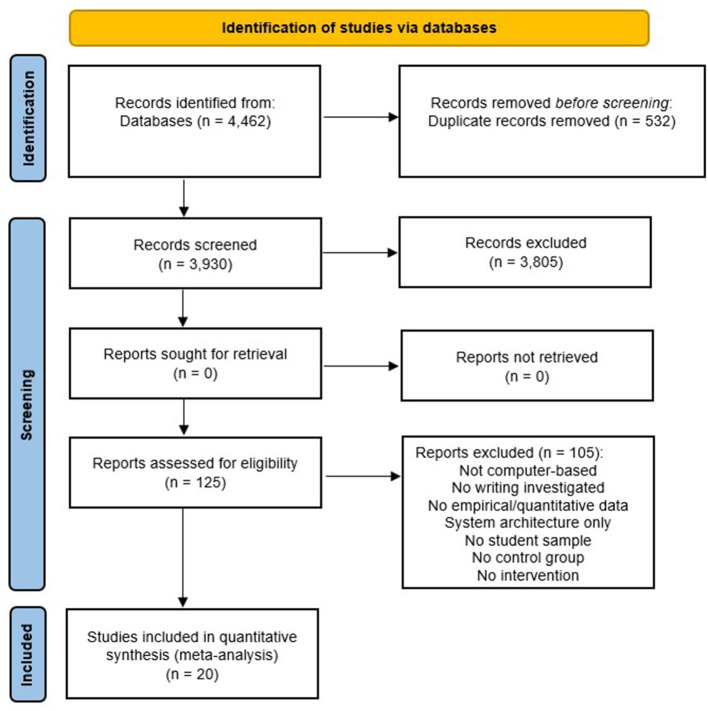
Introduction: Adaptive learning opportunities and individualized, timely feedback are considered to be effective support measures for students' writing in educational contexts. However, the extensive time and expertise required to analyze numerous drafts of student writing pose a barrier to teaching. Automated writing evaluation (AWE) tools can be used for individual feedback based on advances in Artificial Intelligence (AI) technology. A number of primary (quasi-)experimental studies have investigated the effect of AWE feedback on students' writing performance. Methods: This paper provides a meta-analysis of the effectiveness of AWE feedback tools. The literature search yielded 4,462 entries, of which 20 studies ( k = 84; N = 2, 828) met the pre-specified inclusion criteria. A moderator analysis investigated the impact of the characteristics of the learner, the intervention, and the outcome measures. Results: Overall, results based on a three-level model with random effects show a medium effect ( g = 0.55) of automated feedback on students' writing performance. However, the significant heterogeneity in the data indicates that the use of automated feedback tools cannot be understood as a single consistent form of intervention. Even though for some of the moderators we found substantial differences in effect sizes, none of the subgroup comparisons were statistically significant. Discussion: We discuss these findings in light of automated feedback use in educational practice and give recommendations for future research.
Overview
The claims and statistics of this paper haven’t been checked yet.
Free: it reads the open-access text and checks the first 5 claims that cite a source we can check. Create a free account to check every claim.
Integrity signals
Registry
Cites
Statistics
Figures
Verification
Claims the paper makes
The claims and statistics of this paper haven’t been checked yet.
Free: it reads the open-access text and checks the first 5 claims that cite a source we can check. Create a free account to check every claim.
Claims other papers make about this one
Each is checked against this paper’s own text: does it say what the citing paper says it does?
The source backs part of the claim, not all of it — or backs it for a different population, condition or comparison.
In the citing paper
“More recent research into the effectiveness of LLM-based generative AI in enhancing student performance on revised assignments has produced mixed results.”
From Generative AI and Essay Writing: Impacts of Automated Feedback on Revision Performance and Engagement (2024) · cites this paper as Fleckenstein et al., 2023
Experimental — accuracy not yet measured
Self-check
Percentages, sums and reported differences re-computed from the paper’s own numbers.
The self-check needs the paper’s full text.
Citations
Cites
Preferred reporting items for systematic reviews and meta-analyses: the PRISMA Statement.
(2009) · PubMed Central · Cited by 44,859
Preferred reporting items for systematic reviews and meta-analyses: The PRISMA statement
Moher, D., Liberati, A., Tetzlaff, J., Altman, D. G., & the PRISMA Group* (2009) · Annals of Internal Medicine · doi:10.7326/0003-4819-151-4-200908180-00135 · Cited by 37,554
Quantifying heterogeneity in a meta‐analysis
Higgins, J. P. T., & Thompson, S. G. (2002) · Statistics in Medicine · doi:10.1002/sim.1186 · Cited by 36,763 · cited 1×
“In addition to the estimate of τ 2 , the Q -test for heterogeneity (Cochran, 1954) and the τ 2 statistic (Higgins and Thompson, 2002) are reported.”
MethodConducting Meta-Analyses in R with the metafor Package
Viechtbauer, W. (2010) · Journal of Statistical Software · doi:10.18637/jss.v036.i03 · Cited by 20,464 · cited 1×
“The analysis was carried out using R (version 4.1.2; R Core Team, 2021) and the metafor package (Viechtbauer, 2010) to perform the meta-analyses.”
MethodInfluentialHattie, J., & Timperley, H. (2007) · Review of Educational Research · doi:10.3102/003465430298487 · Cited by 12,905 · cited 1×
“…effect on learner performance when it is given in a timely manner when it clarifies the gap between current performance and learning goal, when it reduces cognitive load, and when it is task-related, specific, and detailed (Mory, 2004; Hattie and Timperley, 2007; Shute, 2008; Black and Wiliam, 2009).”
Background(2000) · Cited by 9,198
Zawacki-Richter, O., Marín, V. I., Bond, M., & Gouverneur, F. (2019) · International Journal of Educational Technology in Higher Education · doi:10.1186/s41239-019-0171-0 · Cited by 7,242
Distribution Theory for Glass's Estimator of Effect Size and Related Estimators
Hedges, L. V. (1981) · Journal of Educational Statistics · doi:10.2307/1164588 · Cited by 5,695 · cited 1×
“Therefore, all Cohen’s d values were converted into Hedges’ g , which is an unbiased estimator that takes into account the sample sizes (Hedges, 1981): To verbally classify the effect sizes, we used a heuristic derived from the distribution of effects in this research field.”
MethodThe combination of estimates from different experiments
Cochran, W. G. (1954) · Biometrics · doi:10.2307/3001666 · Cited by 5,380 · cited 2×
“In addition to the estimate of τ 2 , the Q -test for heterogeneity (Cochran, 1954) and the τ 2 statistic (Higgins and Thompson, 2002) are reported.”
MethodShute, V. J. (2008) · Review of Educational Research · doi:10.3102/0034654307313795 · Cited by 4,631 · cited 1×
“…effect on learner performance when it is given in a timely manner when it clarifies the gap between current performance and learning goal, when it reduces cognitive load, and when it is task-related, specific, and detailed (Mory, 2004; Hattie and Timperley, 2007; Shute, 2008; Black and Wiliam, 2009).”
BackgroundDeveloping the theory of formative assessment
Black, P., & Wiliam, D. (2009) · Educational Assessment, Evaluation and Accountability · doi:10.1007/s11092-008-9068-5 · Cited by 3,301 · cited 1×
“…effect on learner performance when it is given in a timely manner when it clarifies the gap between current performance and learning goal, when it reduces cognitive load, and when it is task-related, specific, and detailed (Mory, 2004; Hattie and Timperley, 2007; Shute, 2008; Black and Wiliam, 2009).”
BackgroundInterpretation of random effects meta-analyses
Riley, R. D., Higgins, J. P. T., & Deeks, J. J. (2011) · BMJ · doi:10.1136/bmj.d549 · Cited by 2,884 · cited 1×
“, τ 2 > 0, regardless of the results of the Q-test), a prediction interval for the true effect is provided (Riley et al., 2011).”
BackgroundInternational Standard Classification of Education, ISCED 1997
UNESCO United Nations Educational, S. A. C. O. (2003) · Advances in Cross-National Comparison · doi:10.1007/978-1-4419-9186-7_10 · Cited by 2,351 · cited 1×
“A basic aim of educational systems worldwide is to teach students to become competent writers; however, evidence suggests that while some students may achieve this goal, not all do (National Center for Educational Statistics, 2012, 2017; Graham and Rijlaarsdam, 2016).”
BackgroundEstimating effect sizes from pretest-posttest-control group designs
Morris, S. B. (2008) · Organizational Research Methods · doi:10.1177/1094428106291059 · Cited by 2,133 · cited 3×
“Morris (2008) recommended an effect size calculation based on the mean pre-post change in the treatment group minus the mean pre-post change in the control group, divided by the pooled pre-test standard deviation.”
MethodResultInfluentialRobust variance estimation in meta‐regression with dependent effect size estimates
Hedges, L. V., Tipton, E., & Johnson, M. C. (2010) · Research Synthesis Methods · doi:10.1002/jrsm.5 · Cited by 2,086
Bias and Efficiency of Meta-Analytic Variance Estimators in the Random-Effects Model
Viechtbauer, W. (2005) · Journal of Educational and Behavioral Statistics · doi:10.3102/10769986030003261 · Cited by 1,699 · cited 2×
“, τ 2), was estimated using the restricted maximum-likelihood estimator (Viechtbauer, 2005).”
MethodCheung, M. W.-L. (2014) · Psychological Methods · doi:10.1037/a0032968 · Cited by 1,342 · cited 1×
“…sizes of the included studies by applying a three-level model with random effects to take into account that several studies of our meta-analysis reported more than one effect size (Geeraert et al., 2004; Konstantopoulos, 2011; Cheung, 2014; Van den Noortgate et al., 2015; Assink and Wibbelink, 2016).”
MethodFitting three-level meta-analytic models in R: A step-by-step tutorial
Assink, M., & Wibbelink, C. J. M. (2016) · The Quantitative Methods for Psychology · doi:10.20982/tqmp.12.3.p154 · Cited by 1,330 · cited 1×
“We combined the effect sizes of the included studies by applying a three-level model with random effects to take into account that several studies of our meta-analysis reported more than one effect size (Geeraert et al., 2004; Konstantopoulos, 2011; Cheung, 2014; Van den Noortgate et al., 2015; Assink and Wibbelink, 2…”
MethodInterpreting Effect Sizes of Education Interventions
Kraft, M. (2019) · Annenberg Institute for School Reform at Brown University · doi:10.26300/8pjp-2z74 · Cited by 1,286
Interpreting effect sizes of education interventions
Kraft, M. A. (2020) · Educational Researcher · doi:10.3102/0013189x20912798 · Cited by 1,281 · cited 1×
“…meta-analysis: effects smaller than the 33rd were described as small, effects between the 33rd and 67th percentiles were described as medium, and effects greater than the 67th percentile were described as large (see Kraft, 2020, for a discussion on how to classify effect sizes; Jansen et al., 2022).”
BackgroundThe Power of Feedback Revisited: A Meta-Analysis of Educational Feedback Research
Wisniewski, B., Zierer, K., & Hattie, J. (2020) · Frontiers in Psychology · doi:10.3389/fpsyg.2019.03087 · Cited by 1,199 · cited 1×
“In other learning contexts, the type of feedback has been shown to moderate effectiveness (Van der Kleij et al., 2015; Wisniewski et al., 2020; Mertens et al., 2022).”
BackgroundAn open source machine learning framework for efficient and transparent systematic reviews
van de Schoot, R., de Bruin, J., Schram, R., Zahedi, P., de Boer, J., Weijdema, F., Kramer, B., Huijts, M., Hoogerwerf, M., Ferdinands, G., et al. (2021) · Nature Machine Intelligence · doi:10.1038/s42256-020-00287-7 · Cited by 1,157
Three-level meta-analysis of dependent effect sizes
Van den Noortgate, W., López-López, J. A., Marín-Martínez, F., & Sánchez-Meca, J. (2013) · Behavior Research Methods · doi:10.3758/s13428-012-0261-6 · Cited by 1,130
Regression Methods to Detect Publication and Other Bias in Meta‐Analysis
Sterne, J. A. C., & Egger, M. (2005) · Publication Bias in Meta‐Analysis · doi:10.1002/0470870168.ch6 · Cited by 826 · cited 2×
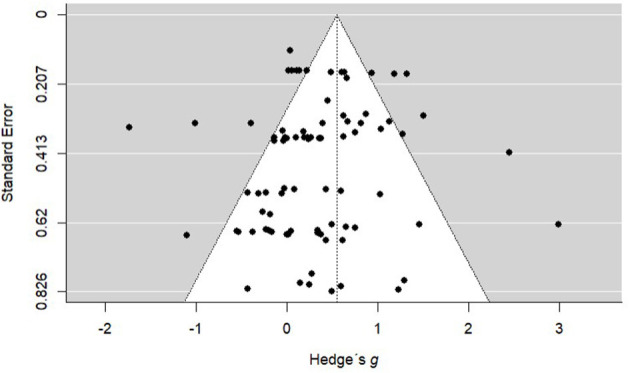
“The regression test (Sterne and Egger, 2005), using the standard error of the observed outcomes as a predictor, is used to check for funnel plot asymmetry.”
MethodEffect sizes for research: A broad practical approach.
Grissom, R. J., & Kim, J. J. (2005) · Cited by 732
Van der Kleij, F. M., Feskens, R. C. W., & Eggen, T. J. H. M. (2015) · Review of Educational Research · doi:10.3102/0034654314564881 · Cited by 714
A Revised Writer(s)-Within-Community Model of Writing
Graham, S. (2018) · Educational Psychologist · doi:10.1080/00461520.2018.1481406 · Cited by 590 · cited 1×
“Writing skills are influenced by a variety of factors (Graham, 2018).”
BackgroundWriting to Read: A Meta-Analysis of the Impact of Writing and Writing Instruction on Reading
Graham, S., & Hebert, M. (2011) · Harvard Educational Review · doi:10.17763/haer.81.4.t2k0m13756113566 · Cited by 563 · cited 1×
“Despite these positive findings, process-oriented feedback, in particular, is rarely used by teachers in the classroom as it requires a lot of time and effort (Graham and Hebert, 2011).”
BackgroundFixed effects and variance components estimation in three-level meta-analysis
Konstantopoulos, S. (2011) · Research Synthesis Methods · doi:10.1002/jrsm.35 · Cited by 521 · cited 1×
“…sizes of the included studies by applying a three-level model with random effects to take into account that several studies of our meta-analysis reported more than one effect size (Geeraert et al., 2004; Konstantopoulos, 2011; Cheung, 2014; Van den Noortgate et al., 2015; Assink and Wibbelink, 2016).”
MethodChanging How Writing Is Taught
Graham, S. (2019) · Review of Research in Education · doi:10.3102/0091732x18821125 · Cited by 502 · cited 3×
“Graham (2019) reviewed 28 studies on writing instruction at school, identifying major indicators of inadequacy, including the insufficient instructional time devoted to writing (Brindle et al., 2015) and the absence of the use of digital tools for writing (Coker et al., 2016; Strobl et al., 2019;…”
BackgroundMory, E. H. (2013) · doi:10.4324/9781410609519-40 · Cited by 494 · cited 1×
“…effect on learner performance when it is given in a timely manner when it clarifies the gap between current performance and learning goal, when it reduces cognitive load, and when it is task-related, specific, and detailed (Mory, 2004; Hattie and Timperley, 2007; Shute, 2008; Black and Wiliam, 2009).”
BackgroundMeta-analysis of multiple outcomes: a multilevel approach
Van den Noortgate, W., López-López, J. A., Marín-Martínez, F., & Sánchez-Meca, J. (2015) · Behavior Research Methods · doi:10.3758/s13428-014-0527-2 · Cited by 450
Tipton, E., & Pustejovsky, J. E. (2015) · Journal of Educational and Behavioral Statistics · doi:10.3102/1076998615606099 · Cited by 362 · cited 1×
“If a study reported multiple effect sizes from the same sample that could not be treated as independent from each other, we accounted for this non-independence by using the cluster-robust inference method (also called robust variance estimation; RVE; Sidik and Jonkman, 2006; Hedges et al., 2010; Tipton and Pustejovsky…”
MethodFormative Assessment and Writing: A Meta-Analysis
Graham, S., Hebert, M., & Harris, K. R. (2015) · The Elementary School Journal · doi:10.1086/681947 · Cited by 340
Making the Most of College: Students Speak Their Minds
Light, R. J. (2001) · Harvard University Press eBooks · doi:10.4159/9780674417502 · Cited by 334
Digital support for academic writing: A review of technologies and pedagogies
Strobl, C., Ailhaud, E., Benetos, K., Devitt, A., Kruse, O., Proske, A., & Rapp, C. (2019) · Computers & Education · doi:10.1016/j.compedu.2018.12.005 · Cited by 298 · cited 3×
“Review articles have either looked at the use of digital technologies in writing instruction in general (Williams and Beam, 2019; Al-Wasy, 2020) or focused on tools and how they work rather than their effectiveness (Allen et al., 2016; Strobl et al., 2019; Deeva et al., 2021).”
BackgroundWilson, J., & Czik, A. (2016) · Computers & Education · doi:10.1016/j.compedu.2016.05.004 · Cited by 297 · cited 1×
“Thus, whenever pre-test values were available, they were considered in addition to the post-test values (also see Lipsey and Wilson, 2001; Wilson, 2016; Lüdecke, 2019).”
MethodThe Effects of Writing on Learning in Science, Social Studies, and Mathematics: A Meta-Analysis
Graham, S., Kiuhara, S. A., & MacKay, M. (2020) · Review of Educational Research · doi:10.3102/0034654320914744 · Cited by 292 · cited 1×
“Shortcomings in writing skills can thus hinder personal, academic, and professional success (Freedman et al., 2016; Graham et al., 2020).”
BackgroundDeeva, G., Bogdanova, D., Serral, E., Snoeck, M., & De Weerdt, J. (2021) · Computers & Education · doi:10.1016/j.compedu.2020.104094 · Cited by 289 · cited 1×
“Review articles have either looked at the use of digital technologies in writing instruction in general (Williams and Beam, 2019; Al-Wasy, 2020) or focused on tools and how they work rather than their effectiveness (Allen et al., 2016; Strobl et al., 2019; Deeva et al., 2021).”
BackgroundThe effects of computer-generated feedback on the quality of writing
Stevenson, M., & Phakiti, A. (2014) · Assessing Writing · doi:10.1016/j.asw.2013.11.007 · Cited by 275 · cited 1×
“Especially for writing complex and long texts, the evidence of the effectiveness of automated feedback has been described heterogeneously (Stevenson and Phakiti, 2014; McNamara et al., 2015; Strobl et al., 2019).”
BackgroundLink, S., Mehrzad, M., & Rahimi, M. (2022) · Computer Assisted Language Learning · doi:10.1080/09588221.2020.1743323 · Cited by 275
A hierarchical classification approach to automated essay scoring
McNamara, D. S., Crossley, S. A., Roscoe, R. D., Allen, L. K., & Dai, J. (2015) · Assessing Writing · doi:10.1016/j.asw.2014.09.002 · Cited by 241
Geeraert, L., Van den Noortgate, W., Grietens, H., & Onghena, P. (2004) · Child Maltreatment · doi:10.1177/1077559504264265 · Cited by 237 · cited 1×
“We combined the effect sizes of the included studies by applying a three-level model with random effects to take into account that several studies of our meta-analysis reported more than one effect size (Geeraert et al., 2004; Konstantopoulos, 2011; Cheung, 2014; Van den Noortgate et al., 2015; Assink and Wibbelink, 2…”
MethodZhu, M., Liu, O. L., & Lee, H.-S. (2020) · Computers & Education · doi:10.1016/j.compedu.2019.103668 · Cited by 229
Trends in Research on Writing as a Learning Activity
Klein, P. D., & Boscolo, P. (2016) · Journal of Writing Research · doi:10.17239/jowr-2016.07.03.01 · Cited by 226
Shermis, M. D. (2014) · Assessing Writing · doi:10.1016/j.asw.2013.04.001 · Cited by 224 · cited 3×
“In terms of reliability and validity, many studies have come up with satisfactory results in this regard (Shermis, 2014; Rupp et al., 2019; Latifi and Gierl, 2021).”
BackgroundTechnology and writing: Review of research
Williams, C., & Beam, S. (2019) · Computers & Education · doi:10.1016/j.compedu.2018.09.024 · Cited by 207 · cited 2×
“Review articles have either looked at the use of digital technologies in writing instruction in general (Williams and Beam, 2019; Al-Wasy, 2020) or focused on tools and how they work rather than their effectiveness (Allen et al.”
BackgroundSummary Street: Interactive Computer Support for Writing
Wade-Stein, D., & Kintsch, E. (2004) · Cognition and Instruction · doi:10.1207/s1532690xci2203_3 · Cited by 203
Wang, Y.-J., Shang, H.-F., & Briody, P. (2013) · Computer Assisted Language Learning · doi:10.1080/09588221.2012.655300 · Cited by 185
esc: Effect Size Computation for Meta Analysis
Lüdecke, D. (2018) · Zenodo (CERN European Organization for Nuclear Research) · doi:10.5281/zenodo.1249218 · Cited by 184
Third and fourth grade teacher’s classroom practices in writing: a national survey
Brindle, M., Graham, S., Harris, K. R., & Hebert, M. (2016) · Reading and Writing · doi:10.1007/s11145-015-9604-x · Cited by 178 · cited 1×
“Graham (2019) reviewed 28 studies on writing instruction at school, identifying major indicators of inadequacy, including the insufficient instructional time devoted to writing (Brindle et al., 2015) and the absence of the use of digital tools for writing (Coker et al.”
BackgroundAutomated Writing Evaluation and Feedback: Multiple Metrics of Efficacy
Wilson, J., & Roscoe, R. D. (2020) · Journal of Educational Computing Research · doi:10.1177/0735633119830764 · Cited by 176
esc: Effect Size Computation for Meta Analysis
Lüdecke, D. (2018) · Zenodo (CERN European Organization for Nuclear Research) · doi:10.5281/zenodo.1249217 · Cited by 175
When “the state of the art” is counting words
Perelman, L. (2014) · Assessing Writing · doi:10.1016/j.asw.2014.05.001 · Cited by 166 · cited 1×
“Moreover, both human and machine ratings can be affected by judgment bias in that certain text features are disproportionately included in the judgments (Perelman, 2014; Fleckenstein et al., 2020a,b).”
BackgroundMethods for second order meta-analysis and illustrative applications
Schmidt, F. L., & Oh, I.-S. (2013) · Organizational Behavior and Human Decision Processes · doi:10.1016/j.obhdp.2013.03.002 · Cited by 151 · cited 1×
“The purpose of a second-order meta-analysis is to estimate the proportion of the variance in meta-analytic effect sizes across multiple first-order meta-analyses attributable to second-order sampling error and to use this information to improve the accuracy of estimation for each first-order meta-analytic estimate (Sc…”
MethodRobust variance estimation for random effects meta-analysis
Sidik, K., & Jonkman, J. N. (2006) · Computational Statistics & Data Analysis · doi:10.1016/j.csda.2005.07.019 · Cited by 138
Nunes, A., Cordeiro, C., Limpo, T., & Castro, S. L. (2022) · Journal of Computer Assisted Learning · doi:10.1111/jcal.12635 · Cited by 124 · cited 1×
“More recent systematic reviews on the effectiveness of AWE feedback provided an overview of the relevant empirical studies and identified research gaps (Nunes et al., 2021; Fleckenstein et al., 2023).”
BackgroundThe impact of online automated feedback on students' reflective journal writing in an EFL course
Cheng, G. (2017) · The Internet and Higher Education · doi:10.1016/j.iheduc.2017.04.002 · Cited by 121
The Effectiveness of Automated Writing Evaluation on Writing Quality: A Meta-Analysis
Zhai, N., & Ma, X. (2023) · Journal of Educational Computing Research · doi:10.1177/07356331221127300 · Cited by 115
Writing instruction in first grade: an observational study
Coker, D. L., Farley-Ripple, E. N., Jackson, A. F., Wen, H., MacArthur, C. A., & Jennings, A. S. (2015) · Reading and Writing · doi:10.1007/s11145-015-9596-6 · Cited by 113 · cited 1×
“, 2015) and the absence of the use of digital tools for writing (Coker et al., 2016; Strobl et al., 2019; Williams and Beam, 2019).”
BackgroundZhai, N., & Ma, X. (2022) · Computer Assisted Language Learning · doi:10.1080/09588221.2021.1897019 · Cited by 111 · cited 1×
“Two very recent meta-analyses have examined the effect of AWE systems on writing performance (Zhai and Ma, 2021; Ngo et al., 2022).”
BackgroundMertens, U., Finn, B., & Lindner, M. A. (2022) · Journal of Educational Psychology · doi:10.1037/edu0000764 · Cited by 110 · cited 1×
“In other learning contexts, the type of feedback has been shown to moderate effectiveness (Van der Kleij et al., 2015; Wisniewski et al., 2020; Mertens et al., 2022).”
BackgroundWriting education around the globe: introduction and call for a new global analysis
Graham, S., & Rijlaarsdam, G. (2016) · Reading and Writing · doi:10.1007/s11145-016-9640-1 · Cited by 109 · cited 1×
“A basic aim of educational systems worldwide is to teach students to become competent writers; however, evidence suggests that while some students may achieve this goal, not all do (National Center for Educational Statistics, 2012, 2017; Graham and Rijlaarsdam, 2016).”
BackgroundTeaching Writing in a Digital and Global Age: Toward Access, Learning, and Development for All
Freedman, S. W., Hull, G., Higgs, J., & Booten, K. (2016) · American Educational Research Association eBooks · doi:10.3102/978-0-935302-48-6_23 · Cited by 107 · cited 1×
“Shortcomings in writing skills can thus hinder personal, academic, and professional success (Freedman et al., 2016; Graham et al., 2020).”
BackgroundPalermo, C., & Thomson, M. M. (2018) · Contemporary Educational Psychology · doi:10.1016/j.cedpsych.2018.07.002 · Cited by 107
Hockly, N. (2019) · ELT Journal · doi:10.1093/elt/ccy044 · Cited by 106 · cited 1×
“Based on these text features, they can assign scores to new texts and provide feedback to the writer (AWE feedback; Hegelheimer et al., 2016; Hockly, 2018).”
BackgroundDoes Automated Feedback Help Students Learn to Write?
Kellogg, R. T., Whiteford, A. P., & Quinlan, T. (2010) · Journal of Educational Computing Research · doi:10.2190/ec.42.2.c · Cited by 88
The effectiveness of automated writing evaluation in EFL/ESL writing: a three-level meta-analysis
Ngo, T. T.-N., Chen, H. H.-J., & Lai, K. K.-W. (2024) · Interactive Learning Environments · doi:10.1080/10494820.2022.2096642 · Cited by 81 · cited 1×
“Two very recent meta-analyses have examined the effect of AWE systems on writing performance (Zhai and Ma, 2021; Ngo et al., 2022).”
Background(2016) · Grantee Submission · Cited by 79
Jansen, T., Meyer, J., Wigfield, A., & Möller, J. (2022) · Psychological Bulletin · doi:10.1037/bul0000354 · Cited by 77
Self-citationAn Empirical Study on the Artificial Intelligence Writing Evaluation System in China CET
Lu, X. (2019) · Big Data · doi:10.1089/big.2018.0151 · Cited by 77
Latifi, S., & Gierl, M. J. (2020) · Language Testing · doi:10.1177/0265532220929918 · Cited by 77
Assessing Text-Based Writing of Low-Skilled College Students
Perin, D., & Lauterbach, M. (2018) · International Journal of Artificial Intelligence in Education · doi:10.1007/s40593-016-0122-z · Cited by 65 · cited 1×
“Various studies have demonstrated the quality of AWE assessment (Shermis, 2014; Perin and Lauterbach, 2018; Rupp et al., 2019; Zawacki-Richter et al., 2019).”
BackgroundIs a Long Essay Always a Good Essay? The Effect of Text Length on Writing Assessment
Fleckenstein, J., Meyer, J., Jansen, T., Keller, S., & Köller, O. (2020) · Frontiers in Psychology · doi:10.3389/fpsyg.2020.562462 · Cited by 61
Self-citationFleckenstein, J., Keller, S., Krüger, M., Tannenbaum, R. J., & Köller, O. (2019) · Assessing Writing · doi:10.1016/j.asw.2019.100420 · Cited by 59
Self-citationAutomated writing evaluation in an EFL setting: Lessons from China
Tang, J., & Rich, C. S. (2017) · The JALT CALL Journal · doi:10.29140/jaltcall.v13n2.215 · Cited by 56
EssayCritic: Writing to learn with a knowledge-based design critiquing system
Mørch, A. I., Engeness, I., Cheng, V., Cheung, W. K., & Wong, K. C. K. (2017) · Educational Technology & Society · Cited by 52
Teachers’ judgements of students’ foreign-language achievement
Zhu, M., & Urhahne, D. (2014) · European Journal of Psychology of Education · doi:10.1007/s10212-014-0225-6 · Cited by 49 · cited 1×
“Assessing complex language performance as a necessary basis of individual feedback is a key challenge for teachers (Zhu and Urhahne, 2015; Fleckenstein et al., 2018).”
BackgroundKeller, S. D., Fleckenstein, J., Krüger, M., Köller, O., & Rupp, A. A. (2020) · Journal of Second Language Writing · doi:10.1016/j.jslw.2019.100700 · Cited by 47
Self-citationAutomated Essay Scoring at Scale: A Case Study in Switzerland and Germany
Rupp, A. A., Casabianca, J. M., Krüger, M., Keller, S., & Köller, O. (2019) · ETS Research Report Series · doi:10.1002/ets2.12249 · Cited by 46 · cited 2×
“In terms of reliability and validity, many studies have come up with satisfactory results in this regard (Shermis, 2014; Rupp et al., 2019; Latifi and Gierl, 2021).”
BackgroundReview of automated writing evaluation systems
Zhang, S. (2021) · Journal of China Computer-Assisted Language Learning · doi:10.1515/jccall-2021-2007 · Cited by 42 · cited 1×
“Especially high-stakes standardized tests like the Graduate Record Exam (GRE) and the Test of English as a Foreign Language (TOEFL) have been using AWE technology for an automatic evaluation of students’ writing (Zhang, 2021).”
MethodMind the gap! Automated concept map feedback supports students in writing cohesive explanations.
Lachner, A., Burkhart, C., & Nückles, M. (2017) · Journal of Experimental Psychology: Applied · doi:10.1037/xap0000111 · Cited by 41
Correnti, R. J., Matsumura, L. C., Wang, E. L., Litman, D. J., & Zhang, H. (2022) · Computers and Education Open · doi:10.1016/j.caeo.2022.100084 · Cited by 41 · cited 1×
“AWE technology is utilized in a variety of educational contexts (Correnti et al., 2022), mainly for summative assessment purposes.”
BackgroundHassanzadeh, M., & Fotoohnejad, S. (2021) · Journal of Computer Assisted Learning · doi:10.1111/jcal.12587 · Cited by 40
Reynolds, B. L., Kao, C.-W., & Huang, Y.-Y. (2021) · The Asia-Pacific Education Researcher · doi:10.1007/s40299-021-00597-3 · Cited by 39
The impact of computer‐based instruction on the development of EFL learners' writing skills
Zaini, A., & Mazdayasna, G. (2015) · Journal of Computer Assisted Learning · doi:10.1111/jcal.12100 · Cited by 38
Ferdinands, G. (2021) · Multivariate Behavioral Research · doi:10.1080/00273171.2020.1853501 · Cited by 37 · cited 2×
“This procedure has been shown to reduce the number of abstracts to be screened to 40% while retaining a detection rate of 95% of the relevant publications (Ferdinands, 2021).”
BackgroundJansen, T., Vögelin, C., Machts, N., Keller, S., Köller, O., & Möller, J. (2021) · Teaching and Teacher Education · doi:10.1016/j.tate.2020.103216 · Cited by 35
The effect of two forms of computer-automated metalinguistic corrective feedback
Gao, J., & Ma, S. (2019) · Language learning & technology · doi:10.64152/10125/44683 · Cited by 34
The effects of a theory‐based summary writing tool on students' summary writing
Chew, C. S., Idris, N. B., Loh, E. F., Wu, W. V., Chua, Y. P., & Bimba, A. T. (2019) · Journal of Computer Assisted Learning · doi:10.1111/jcal.12349 · Cited by 31
Teachers’ Judgement Accuracy Concerning CEFR Levels of Prospective University Students
Fleckenstein, J., Leucht, M., & Köller, O. (2018) · Language Assessment Quarterly · doi:10.1080/15434303.2017.1421956 · Cited by 31 · cited 1×
“Assessing complex language performance as a necessary basis of individual feedback is a key challenge for teachers (Zhu and Urhahne, 2015; Fleckenstein et al., 2018).”
BackgroundSelf-citationValidity and Automated Scoring
Bennett, R. E., & Zhang, M. (2015) · Routledge eBooks · doi:10.4324/9781315871493-8 · Cited by 28
The effectiveness of integrating technology in EFL/ESL writing: a meta-analysis
Al-Wasy, B. Q. (2020) · Interactive Technology and Smart Education · doi:10.1108/itse-03-2020-0033 · Cited by 26 · cited 2×
“Review articles have either looked at the use of digital technologies in writing instruction in general (Williams and Beam, 2019; Al-Wasy, 2020) or focused on tools and how they work rather than their effectiveness (Allen et al., 2016; Strobl et al., 2019; Deeva et al., 2021).”
BackgroundMcCarthy, K. S., Roscoe, R. D., Likens, A. D., & McNamara, D. S. (2019) · Lecture notes in computer science · doi:10.1007/978-3-030-23204-7_23 · Cited by 25
Experimental Evidence on the Effectiveness of Automated Essay Scoring in Teacher Education Cases
Riedel, E., Dexter, S. L., Scharber, C., & Doering, A. (2006) · Journal of Educational Computing Research · doi:10.2190/u552-m54q-5771-m677 · Cited by 25
Burkhart, C., Lachner, A., & Nückles, M. (2020) · PLoS ONE · doi:10.1371/journal.pone.0235209 · Cited by 22 · cited 1×
“With respect to segmenting and analyzing texts, experts tend to make coding errors, whereas with respect to recognizing relationships between concepts, human raters have been shown to be superior to technology (Burkhart et al., 2020).”
BackgroundSouvignier, E., & Hasselhorn, M. (2018) · Zeitschrift für Erziehungswissenschaft · doi:10.1007/s11618-018-0839-6 · Cited by 19 · cited 1×
“…and AWE Formative assessment serves to provide individualized learning support through a combination of (1) (standardized) learning progress evaluation, (2) individual task-related feedback, and (3) adaptive support for learners (Souvignier and Hasselhorn, 2018; Böhme and Munser-Kiefer, 2020).”
BackgroundAutomated Writing Evaluation in Language Teaching: Theory, Development, and Application
Hegelheimer, V. H., Dursun, A., & Li, Z. (2016) · CALICO Journal · doi:10.1558/cj.v33i1.29251 · Cited by 17
Empirische Arbeit: Das Schülerinventar ASSET zur Beurteilung von Schülerarbeiten im Fach Englisch
Jansen, T., Vögelin, C., Machts, N., Keller, S., & Møller, J. (2019) · Psychologie in Erziehung und Unterricht · doi:10.2378/peu2019.art21d · Cited by 17
Böhme, R., & Munser-Kiefer, M. (2020) · MedienPädagogik Zeitschrift für Theorie und Praxis der Medienbildung · doi:10.21240/mpaed/jb17/2020.05.17.x · Cited by 9 · cited 1×
“Formative assessment serves to provide individualized learning support through a combination of (1) (standardized) learning progress evaluation, (2) individual task-related feedback, and (3) adaptive support for learners (Souvignier and Hasselhorn, 2018; Böhme and Munser-Kiefer, 2020).”
BackgroundFleckenstein, J., Zimmermann, F., Köller, O., & Møller, J. (2015) · Frontline Learning Research · doi:10.14786/flr.v3i2.162 · Cited by 9 · cited 1×
“62; Hattie, 2022) but is also consistent with teachers’ professional beliefs (Fleckenstein et al., 2015).”
ResultSelf-citationDigitale Schreibförderung im Bildungskontext: Ein systematisches Review
Fleckenstein, J., Reble, R., Meyer, J., Jansen, T., Liebenow, L. W., Møller, J., & Köller, O. (2023) · Edition ZfE · doi:10.1007/978-3-658-37895-0_1 · Cited by 7
Self-citationFormative writing assessment for change – introduction to the special issue
Skar, G. B. U., Graham, S., & Rijlaarsdam, G. (2022) · Assessment in Education Principles Policy and Practice · doi:10.1080/0969594x.2022.2089488 · Cited by 5 · cited 1×
“Writing is a fundamental, versatile, and complex skill (Graham, 2019; Skar et al., 2022) that is required in a variety of contexts.”
Background
Research works printed but not linked: 2
- Hattie J. (2009). The black box of tertiary assessment: An impending revolution. Tertiary Assess. High. Educ. Stud. Outcomes 259, 275.
- * Lin M. P. C. Chang D. (2020). Enhancing post-secondary writers' writing skills with a chatbot. J. Educ. Technol. Soc. 23, 78– 92.
Cited by
Meyer, J., Jansen, T., Schiller, R., Liebenow, L. W., Steinbach, M., Horbach, A., & Fleckenstein, J. (2024) · Computers and Education: Artificial Intelligence · doi:10.1016/j.caeai.2023.100199 · Cited by 311
Self-citationThe Rise of Artificial Intelligence in Educational Measurement: Opportunities and Ethical Challenges
Bulut, O., & Beiting-Parrish, M. (2024) · Chinese/English Journal of Educational Measurement and Evaluation · doi:10.59863/miql7785 · Cited by 126
Nazaretsky, T., Mejia-Domenzain, P., Swamy, V., Frej, J., & Käser, T. (2025) · Computers and Education: Artificial Intelligence · doi:10.1016/j.caeai.2025.100368 · Cited by 96
Yan, D., & Zhang, S. (2024) · Humanities and Social Sciences Communications · doi:10.1057/s41599-024-03543-y · Cited by 90
“Hence, there has been a long-standing pursuit to improve AWE systems in providing individualized and effective AWCF for language learners (Fleckenstein et al. 2023).”
Wiboolyasarin, W., Wiboolyasarin, K., Suwanwihok, K., Jinowat, N., & Muenjanchoey, R. (2024) · Computers and Education: Artificial Intelligence · doi:10.1016/j.caeai.2024.100228 · Cited by 68
Metadata
- Authors
- Fleckenstein, J., Liebenow, L. W., & Meyer, J.
- Affiliations
- University of Hildesheim (DE)
- Leibniz Institute for Science and Mathematics Education (DE)
- Corresponding author
- Fleckenstein, Johanna
- Venue
- Frontiers in Artificial Intelligence
- Publisher
- Frontiers Media SA
- Published
- 2023-07-03
- Volume
- 6
- Pages
- 1162454-1162454
- ISSN
- 2624-8212 (ISSN-L)
- PMC
- PMC10351274
- OpenAlex
- W4382940101
- Cited by
- 145
- References
- 102
- Citations by year
- 2026: 74 · 2025: 49 · 2024: 19 · 2023: 3
- FWCI
- 8.80
- Type
- journal article
- Language
- en
- Open access
- gold
- doi.org
- Licence
- Locations
- Frontiers in Artificial Intelligence (publishedVersion, cc-by)
- PubMed Central (publishedVersion, cc-by)
- PubMed (publishedVersion)
- DOAJ (DOAJ: Directory of Open Access Journals) (submittedVersion, cc-by-sa)
- Funders
- Bundesministerium für Bildung und Forschung
- Topics
- Social Sciences › Education › Student Assessment and Feedback
- Social Sciences › Education › Artificial Intelligence in Education
- Physical Sciences › Computer Science › Artificial Intelligence › Intelligent Tutoring Systems and Adaptive Learning
- Keywords
- automated writing evaluation, automated feedback, student writing performance, writing instruction, artificial intelligence in education, adaptive learning, personalized feedback, moderator analysis, effect size heterogeneity
About these checks
Registry, retraction, Cites and statistics results are computed, not judged, with one exception: a printed reference that no index lists is read once by a model before it counts as a citation error. Claims are extracted by a model and kept only when their quote appears verbatim in the text; each cited source is then checked, with a model’s help, for whether it says what the claim relies on. Those verdicts can be wrong — read the claim’s quote and the cited source before relying on one.
Statistics and arithmetic are recomputed, not judged.
Confidence bands are shown only for fields calibrated on our annotated test set. None is calibrated yet, so no band is shown.
What counts as a claim ›How we measure confidence ›How we check this ›
Are you an author, or do you see a problem with this page? Request a review
Data sources
Bibliographic data: Semantic Scholar, OpenAlex, Crossref.
Contains information from the Semantic Scholar Academic Graph Datasets, made available under the ODC Attribution License (ODC-BY 1.0).
Semantic Scholar’s data is described in: Kinney, R., et al. (2023). The Semantic Scholar Open Data Platform. arXiv:2301.10140.
