

Automated feedback and writing: a multi-level meta-analysis of effects on students' performance
Open accessThe DOI matches its Crossref record; 102 of the 103 references it cites were found in a registry or an index, and 1 are not checked yet.
Abstract
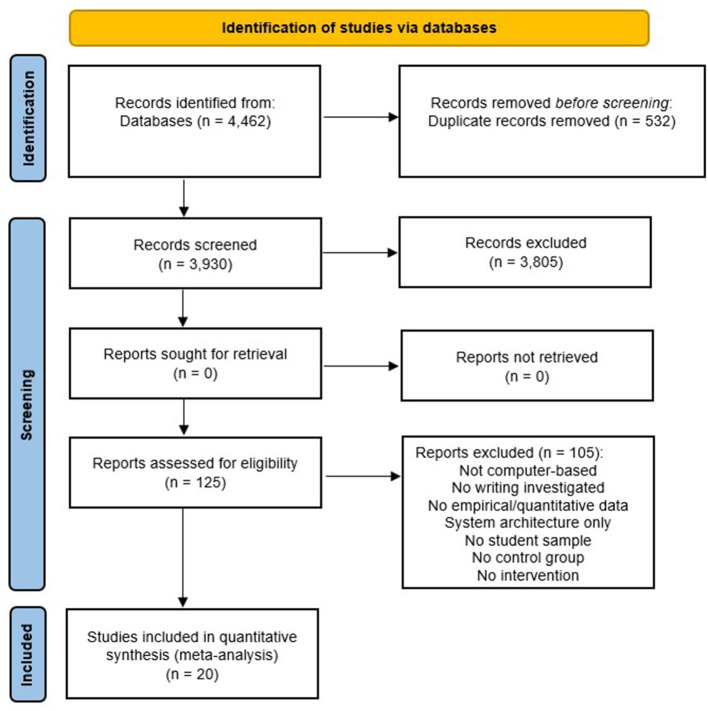
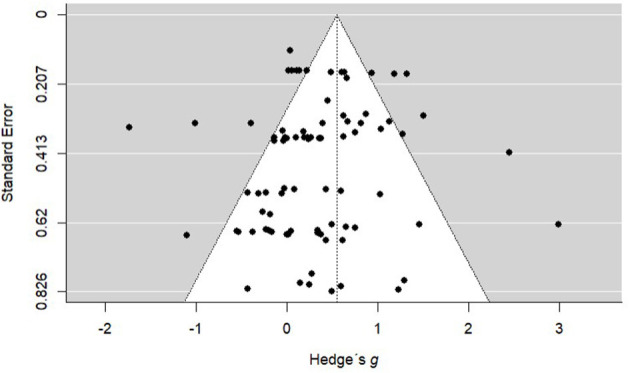
Introduction: Adaptive learning opportunities and individualized, timely feedback are considered to be effective support measures for students' writing in educational contexts. However, the extensive time and expertise required to analyze numerous drafts of student writing pose a barrier to teaching. Automated writing evaluation (AWE) tools can be used for individual feedback based on advances in Artificial Intelligence (AI) technology. A number of primary (quasi-)experimental studies have investigated the effect of AWE feedback on students' writing performance. Methods: This paper provides a meta-analysis of the effectiveness of AWE feedback tools. The literature search yielded 4,462 entries, of which 20 studies ( k = 84; N = 2, 828) met the pre-specified inclusion criteria. A moderator analysis investigated the impact of the characteristics of the learner, the intervention, and the outcome measures. Results: Overall, results based on a three-level model with random effects show a medium effect ( g = 0.55) of automated feedback on students' writing performance. However, the significant heterogeneity in the data indicates that the use of automated feedback tools cannot be understood as a single consistent form of intervention. Even though for some of the moderators we found substantial differences in effect sizes, none of the subgroup comparisons were statistically significant. Discussion: We discuss these findings in light of automated feedback use in educational practice and give recommendations for future research.
Overview
The claims and statistics of this paper haven’t been checked yet.
Free: it reads the open-access text and checks the first 5 claims that cite a source we can check. Create a free account to check every claim.
Integrity signals
Registry
Cites
Statistics
Figures
Verification
Claims the paper makes
The claims and statistics of this paper haven’t been checked yet.
Free: it reads the open-access text and checks the first 5 claims that cite a source we can check. Create a free account to check every claim.
Claims other papers make about this one
Each is checked against this paper’s own text: does it say what the citing paper says it does?
The source backs part of the claim, not all of it — or backs it for a different population, condition or comparison.
In the citing paper
“More recent research into the effectiveness of LLM-based generative AI in enhancing student performance on revised assignments has produced mixed results.”
From Generative AI and Essay Writing: Impacts of Automated Feedback on Revision Performance and Engagement (2024) · cites this paper as Fleckenstein et al., 2023
Experimental — accuracy not yet measured
Self-check
Percentages, sums and reported differences re-computed from the paper’s own numbers.
The self-check needs the paper’s full text.
Citations
Cites
Preferred reporting items for systematic reviews and meta-analyses: the PRISMA Statement.
(2009) · PubMed Central · Cited by 44,859
Preferred reporting items for systematic reviews and meta-analyses: The PRISMA statement
Moher, D., Liberati, A., Tetzlaff, J., Altman, D. G., & the PRISMA Group* (2009) · Annals of Internal Medicine · doi:10.7326/0003-4819-151-4-200908180-00135 · Cited by 37,554
Quantifying heterogeneity in a meta‐analysis
Higgins, J. P. T., & Thompson, S. G. (2002) · Statistics in Medicine · doi:10.1002/sim.1186 · Cited by 36,763 · cited 1×
“In addition to the estimate of τ 2 , the Q -test for heterogeneity (Cochran, 1954) and the τ 2 statistic (Higgins and Thompson, 2002) are reported.”
MethodConducting Meta-Analyses in R with the metafor Package
Viechtbauer, W. (2010) · Journal of Statistical Software · doi:10.18637/jss.v036.i03 · Cited by 20,464 · cited 1×
“The analysis was carried out using R (version 4.1.2; R Core Team, 2021) and the metafor package (Viechtbauer, 2010) to perform the meta-analyses.”
MethodInfluentialHattie, J., & Timperley, H. (2007) · Review of Educational Research · doi:10.3102/003465430298487 · Cited by 12,905 · cited 1×
“…effect on learner performance when it is given in a timely manner when it clarifies the gap between current performance and learning goal, when it reduces cognitive load, and when it is task-related, specific, and detailed (Mory, 2004; Hattie and Timperley, 2007; Shute, 2008; Black and Wiliam, 2009).”
Background(2000) · Cited by 9,198
Zawacki-Richter, O., Marín, V. I., Bond, M., & Gouverneur, F. (2019) · International Journal of Educational Technology in Higher Education · doi:10.1186/s41239-019-0171-0 · Cited by 7,242
Distribution Theory for Glass's Estimator of Effect Size and Related Estimators
Hedges, L. V. (1981) · Journal of Educational Statistics · doi:10.2307/1164588 · Cited by 5,695 · cited 1×
“Therefore, all Cohen’s d values were converted into Hedges’ g , which is an unbiased estimator that takes into account the sample sizes (Hedges, 1981): To verbally classify the effect sizes, we used a heuristic derived from the distribution of effects in this research field.”
MethodThe combination of estimates from different experiments
Cochran, W. G. (1954) · Biometrics · doi:10.2307/3001666 · Cited by 5,380 · cited 2×
“In addition to the estimate of τ 2 , the Q -test for heterogeneity (Cochran, 1954) and the τ 2 statistic (Higgins and Thompson, 2002) are reported.”
MethodShute, V. J. (2008) · Review of Educational Research · doi:10.3102/0034654307313795 · Cited by 4,631 · cited 1×
“…effect on learner performance when it is given in a timely manner when it clarifies the gap between current performance and learning goal, when it reduces cognitive load, and when it is task-related, specific, and detailed (Mory, 2004; Hattie and Timperley, 2007; Shute, 2008; Black and Wiliam, 2009).”
Background
Research works printed but not linked: 2
- Hattie J. (2009). The black box of tertiary assessment: An impending revolution. Tertiary Assess. High. Educ. Stud. Outcomes 259, 275.
- * Lin M. P. C. Chang D. (2020). Enhancing post-secondary writers' writing skills with a chatbot. J. Educ. Technol. Soc. 23, 78– 92.
Cited by
Meyer, J., Jansen, T., Schiller, R., Liebenow, L. W., Steinbach, M., Horbach, A., & Fleckenstein, J. (2024) · Computers and Education: Artificial Intelligence · doi:10.1016/j.caeai.2023.100199 · Cited by 311
Self-citationThe Rise of Artificial Intelligence in Educational Measurement: Opportunities and Ethical Challenges
Bulut, O., & Beiting-Parrish, M. (2024) · Chinese/English Journal of Educational Measurement and Evaluation · doi:10.59863/miql7785 · Cited by 126
Nazaretsky, T., Mejia-Domenzain, P., Swamy, V., Frej, J., & Käser, T. (2025) · Computers and Education: Artificial Intelligence · doi:10.1016/j.caeai.2025.100368 · Cited by 96
Yan, D., & Zhang, S. (2024) · Humanities and Social Sciences Communications · doi:10.1057/s41599-024-03543-y · Cited by 90
“Hence, there has been a long-standing pursuit to improve AWE systems in providing individualized and effective AWCF for language learners (Fleckenstein et al. 2023).”
Wiboolyasarin, W., Wiboolyasarin, K., Suwanwihok, K., Jinowat, N., & Muenjanchoey, R. (2024) · Computers and Education: Artificial Intelligence · doi:10.1016/j.caeai.2024.100228 · Cited by 68
Chen, A., Zhang, Y., Jia, J., Liang, M., Cha, Y., & Lim, C. P. (2025) · Journal of Computer Assisted Learning · doi:10.1111/jcal.13064 · Cited by 67
Effects of adaptive feedback generated by a large language model: A case study in teacher education
Kinder, A., Briese, F. J., Jacobs, M., Dern, N., Glodny, N., Jacobs, S., & Leßmann, S. (2024) · Computers and Education Artificial Intelligence · doi:10.1016/j.caeai.2024.100349 · Cited by 135
RETRACTED: The impact of generative AI on essay revisions and student engagement
Lo, N., Wong, A., & Chan, S. (2025) · Computers and Education Open · doi:10.1016/j.caeo.2025.100249 · Cited by 97
RetractedJacobsen, L. J., & Weber, K. E. (2025) · AI · doi:10.3390/ai6020035 · Cited by 58
“For example, in their meta-analysis, Fleckenstein et al. [5]. established that the utilization of automated feedback could enhance students’ writing progress.”
Chan, S. T. S., Lo, N. P. K., & Wong, A. M. H. (2024) · Contemporary Educational Technology · doi:10.30935/cedtech/15607 · Cited by 56
Jansen, T., Höft, L., Bahr, L., Fleckenstein, J., Möller, J., Köller, O., & Meyer, J. (2024) · Psychologie in Erziehung und Unterricht · doi:10.2378/peu2024.art08d · Cited by 50
Self-citationSchiller, R., Fleckenstein, J., Mertens, U., Horbach, A., & Meyer, J. (2024) · Computers & Education · doi:10.1016/j.compedu.2024.105163 · Cited by 36
Self-citationXue, Y. (2024) · Education and Information Technologies · doi:10.1007/s10639-024-12596-0 · Cited by 33
“The results are consistent with Fleckenstein et al. (2023) and Ngo et al. (2022), while different from Zhai and Ma (2023) who corroborate AWCF outperforms the other feedback types including the combination of AWCF and peer feedback.”
InfluentialRuwe, T., & Mayweg-Paus, E. (2024) · Frontiers in Education · doi:10.3389/feduc.2024.1461362 · Cited by 33
Chan, S., Lo, N., & Wong, A. (2025) · Cogent Education · doi:10.1080/2331186x.2024.2440182 · Cited by 33
“Furthermore, a growing body of research investigates the potential for automated feedback to be applied by computer programmes (Fleckenstein et al., 2023).”
RetractedHow effective is feedback for L1, L2, and FL learners’ writing? A meta-analysis
Scherer, S., Graham, S., & Busse, V. (2024) · Learning and Instruction · doi:10.1016/j.learninstruc.2024.101961 · Cited by 80
Farrokhnia, M., Latifi, S., Papadopoulos, P. M., Hogenkamp, L., Gijlers, H., Khosravi, H., & Noroozi, O. (2026) · International Journal of Educational Technology in Higher Education · doi:10.1186/s41239-026-00579-9 · Cited by 55
Meyer, J., Jansen, T., & Fleckenstein, J. (2025) · Contemporary Educational Psychology · doi:10.1016/j.cedpsych.2025.102363 · Cited by 28
Self-citationChan, S., Lo, N., & Wong, A. (2024) · rEFLections · doi:10.61508/refl.v31i3.277514 · Cited by 29
“Moreover, there is an expanding body of research examining how automated feedback can be effectively implemented through computer programs (Fleckenstein et al., 2023).”
Fleckenstein, J., Jansen, T., Meyer, J., Trüb, R., Raubach, E. E., & Keller, S. (2024) · Learning and Instruction · doi:10.1016/j.learninstruc.2024.101977 · Cited by 32
Self-citationJansen, T., Meyer, J., Fleckenstein, J., Horbach, A., Keller, S., & Möller, J. (2024) · Learning and Instruction · doi:10.1016/j.learninstruc.2023.101847 · Cited by 24
Self-citationLo, N., Chan, S., & Wong, A. (2025) · SAGE Open · doi:10.1177/21582440251352907 · Cited by 36
“Prior to the rise of GenAI in the 2020s, studies had already highlighted the potential for automated writing evaluation (AWE) to transform the ways in which feed-back is generated and provided to students (Crossley et al., 2022; Fleckenstein et al., 2023).”
Jamshed, M., Ahmed, A. S. M. M., Sarfaraj, M., & Warda, W. U. (2024) · International Journal of Interactive Mobile Technologies (iJIM) · doi:10.3991/ijim.v18i19.50361 · Cited by 24
Liebenow, L. W., Schmidt, F. T. C., Meyer, J., & Fleckenstein, J. (2025) · Computers & Education · doi:10.1016/j.compedu.2025.105385 · Cited by 38
Self-citationElementary English learners’ engagement with automated feedback
Wilson, J., Palermo, C., & Wibowo, A. (2024) · Learning and Instruction · doi:10.1016/j.learninstruc.2024.101890 · Cited by 27
Richter, E., Spitzer, M., Morgan, A., Frede, L., Weidlich, J., & Moeller, K. (2025) · Trends in Neuroscience and Education · doi:10.1016/j.tine.2025.100255 · Cited by 20
Predictors of middle school students’ perceptions of automated writing evaluation
Wilson, J., Zhang, F., Palermo, C., Cordero, T. M. C., Myers, M. C., Eacker, H., Potter, A., & Coles, J. (2023) · Computers & Education · doi:10.1016/j.compedu.2023.104985 · Cited by 29
“In recent years, technology has profoundly transformed language education, particularly in the realm of writing instruction (Wen & Walters, 2022), and specifically via the use of automated writing evaluation (AWE; Fleckenstein et al., 2023; Ngo et al., 2022; Nunes et al., 2022).”
BackgroundMethodBora, B. Y., & Kölemen, C. Ş. (2025) · Contemporary Educational Technology · doi:10.30935/cedtech/16433 · Cited by 35
On the role of engagement in automated feedback effectiveness: Insights from keystroke logging
Schiller, R., Fleckenstein, J., Höft, L., Horbach, A., & Meyer, J. (2025) · Computers & Education · doi:10.1016/j.compedu.2025.105386 · Cited by 14
Self-citationPeng, X., Sun, K., Shan, X., & Zhang, J. (2026) · Frontiers in Psychology · doi:10.3389/fpsyg.2026.1776445 · Cited by 24
Jansen, T., Horbach, A., & Meyer, J. (2025) · Proceedings of the 15th International Learning Analytics and Knowledge Conference · doi:10.1145/3706468.3706494 · Cited by 12
Self-citationThe impact of automated writing evaluation on writing gains
Deygers, B., Buelens, L., Chan, D., Schildt, L., Parys, A. V., & Vanbuel, M. (2025) · ELT Journal · doi:10.1093/elt/ccaf020 · Cited by 18
Jovic, M., Papakonstantinidis, S., & Kirkpatrick, R. (2025) · Language Testing in Asia · doi:10.1186/s40468-025-00389-2 · Cited by 11
“Meta-analytic research on writing feedback demonstrates that meaningful insights can be derived from focused samples, with individual studies contributing valuable understanding of feedback effectiveness (Fleckenstein et al., 2023).”
Li, Y., Shan, Z., Raković, M., Guan, Q., Gašević, D., & Chen, G. (2025) · Education and Information Technologies · doi:10.1007/s10639-025-13741-z · Cited by 16
“However, existing AASs remain prone to assessment errors and oftentimes provide only generic feedback (e.g., a pre-determined sample answer as feedback) (Li et al., 2023; Deeva et al., 2021; Fleckenstein et al., 2023).”
Kenshinbay, T., & Ghorbandordinejad, F. (2024) · EIKI Journal of Effective Teaching Methods · doi:10.59652/jetm.v2i3.264 · Cited by 34
“AI-driven AWEs have proven to be timely feedback to students on their learning progress that leads to improved writing skills (Fleckenstein et al., 2023).”
BackgroundZheng, L., Shi, Z., Fu, Z., & Liu, S. (2025) · Journal of Science Education and Technology · doi:10.1007/s10956-025-10204-5 · Cited by 17
“This conclusion is corroborated by the findings of Fleckenstein et al. (2023), who reported that timely feedback can promote learning outcomes in educational settings very effectively.”
Meyer, J., Jansen, T., Daumiller, M. H., & Fleckenstein, J. (2025) · Journal of Research on Technology in Education · doi:10.1080/15391523.2025.2471765 · Cited by 14
“Feedback based on automated writing evaluation (e.g. Bennett & Zhang, 2015; Shermis, 2014) has been shown to be effective by several recent meta-analyses (Fleckenstein et al., 2023; Lv et al., 2021; Mohsen, 2022; Ngo et al., 2024; Zhai & Ma, 2023).”
Self-citationOğuz, E. (2025) · Assessing Writing · doi:10.1016/j.asw.2025.100981 · Cited by 13
Yue, H., Wilson, J., & May, H. (2024) · International Journal of Artificial Intelligence in Education · doi:10.1007/s40593-024-00443-9 · Cited by 14
“Meta-analyses have found significant positive effects of AWE on students’ writing quality (see Fleckenstein, et al., 2023; Li, 2022; Zhai & Ma, 2022), with effect sizes varying from small to large (range = 0.43–0.86).”
InfluentialPromoting Reflection Skills of Pre-Service Teachers—The Power of AI-Generated Feedback
Hofmann, F., Daunicht, T.-M., Plößl, L., & Gläser‐Zikuda, M. (2025) · Education Sciences · doi:10.3390/educsci15101315 · Cited by 14
Cui, Y. (2026) · Discover Artificial Intelligence · doi:10.1007/s44163-026-01286-0 · Cited by 9
LLM-generated formative feedback in education: A qualitative systematic literature review
Maier, U., Seibold, M., & Klotz, C. (2026) · Computers and Education Open · doi:10.1016/j.caeo.2026.100374 · Cited by 13
Middle school teachers’ implementation and perceptions of automated writing evaluation
Wilson, J., Delgado, A. M., Palermo, C., Cordero, T. M. C., Myers, M. C., Eacker, H., Potter, A. A., Coles, J., & Zhang, S. (2024) · Computers and Education Open · doi:10.1016/j.caeo.2024.100231 · Cited by 10
“Identifying these factors may help researchers, AWE developers, and education stake-holders (e.g., districts considering adopting AWE) better understand the conditions necessary for realizing the benefits of AWE documented in many reviews and meta-analyses (e.g., [4,13,5,6,14]).”
Wilson, J., Cordero, T. M. C., Potter, A., Myers, M., MacArthur, C. A., Beard, G., Fudge, E. A., Raiche, A., & Ahrendt, C. (2024) · International Journal of Changes in Education · doi:10.47852/bonviewijce42024011 · Cited by 8
The Effect of Feedback on Informative Text Writing: AI or Teacher?
Baz, M. A., & Hasırcı, S. (2025) · Open Praxis · doi:10.55982/openpraxis.17.3.871 · Cited by 16
Sudo, H., Noborimoto, Y., & Takahashi, J. (2025) · JMIR Medical Education · doi:10.2196/85614 · Cited by 8
“Although a growing body of research has investigated the effectiveness of AI-powered feedback [13-16], few studies have focused specifically on health profession education.”
Jiang, Y., Klebanov, B. B., Hao, J., Deane, P., & Livne, O. E. (2025) · Journal of Computer Assisted Learning · doi:10.1111/jcal.70014 · Cited by 6
Yue, H., & Wilson, J. (2025) · Journal of Computer Assisted Learning · doi:10.1111/jcal.70009 · Cited by 10
Hoàng, N. H. (2025) · The JALT CALL Journal · doi:10.29140/jaltcall.v21n2.102429 · Cited by 15
Wei, Z. (2025) · International Journal of High Speed Electronics and Systems · doi:10.1142/s0129156425407053 · Cited by 6
Impact of Automated Writing Evaluation (AWE) on Middle School Students’ Writing Outcomes
Wilson, J., Palermo, C., Myers, M. C., Cordero, T. M. C., Eacker, H., Potter, A., Coles, J., May, H., & Zhang, F. (2025) · American Educational Research Journal · doi:10.3102/00028312251388655 · Cited by 3
“Despite several recent reviews and meta-analyses of AWE research (Barrot, 2024; Fleckenstein et al., 2023; Fu et al., 2024; X. Huang et al., 2023; Li, 2023; Ngo et al., 2022; Nunes et al., 2022; Scherer et al., 2024; Zhai & Ma, 2023), few RCTs have examined its effects among diverse…”
InfluentialHaddadian, G., Kim, M. K., & Haddadian, N. (2025) · Research Synthesis in Applied Linguistics · doi:10.1080/29984475.2025.2598266 · Cited by 5
Suárez-González, S. O., Moreano, R. P. R., Rogel, M. F. T., Alvarez-Ayala, D. M., & Castro-Sánchez, N. G. (2026) · Revista Científica Zambos. · doi:10.69484/rcz/v5/n1/152 · Cited by 7
“(Hattie & Timperley, 2007; Shute, 2008; Mertens et al., 2022; Fleckenstein et al., 2023).”
Reimagining feedback through generative AI in engineering education
Pecuchova, J., Benko, Ľ., & Drlík, M. (2026) · Computers and Education Artificial Intelligence · doi:10.1016/j.caeai.2026.100574 · Cited by 10
Jiao, Y., & Wang, Q. (2026) · Frontiers in Education · doi:10.3389/feduc.2026.1834085 · Cited by 8
Steinbach, M., Fleckenstein, J., Kuklick, L., & Meyer, J. (2025) · Journal of Computer Assisted Learning · doi:10.1111/jcal.70070 · Cited by 5
Self-citationEvidence of Learning in the Presence of AI Tools in Computer Science Higher Education
Marouf, R., Kotorov, I., Krasylnykova, Y., & Aslam, H. (2025) · Smart innovation, systems and technologies · doi:10.1007/978-981-97-6469-3_28 · Cited by 4
Miyazoe, T. (2025) · Language Testing in Asia · doi:10.1186/s40468-025-00387-4 · Cited by 5
“Fleckenstein et al. (2023) conducted a meta-analysis on AI-assisted writing assessment, finding generally positive impacts on student performance.”
LLM feedback for academic writing: Effects on students’ performance and engagement
Glüsing, R., Fleckenstein, J., Schmidt, F. T. C., & Möller, J. (2026) · Contemporary Educational Psychology · doi:10.1016/j.cedpsych.2026.102463 · Cited by 2
Self-citationYue, H., Palermo, C., & Wilson, J. (2025) · Computers and Education Artificial Intelligence · doi:10.1016/j.caeai.2025.100479 · Cited by 6
The impact of online feedback on student learning outcomes: a meta-analysis study
Adıgüzel, O. C., Esen, E., & Karagöl, İ. (2025) · Asia Pacific Education Review · doi:10.1007/s12564-025-10099-2 · Cited by 3
Scherer, S., Graham, S., & Busse, V. (2026) · Assessing Writing · doi:10.1016/j.asw.2026.101034 · Cited by 3
Kim, J., Chapman, M., Willner, L. S., Kemp, J. A., & Kim, A. A. (2026) · Assessing Writing · doi:10.1016/j.asw.2026.101050 · Cited by 3
Ai Generated vs. Peer Feedback in Esl Writing:Effects on Writing Skill, Self-Efficacy, And EnjoymentPreprint
Fang, Y. G., Tan, Y., Zuo, C., & Boubaker, A. (2025) · SSRN Electronic Journal · doi:10.2139/ssrn.5115438 · Cited by 6
Factors Influencing Students' Perceptions of Automated Feedback and Their Impact on Revision
Dey, I., Gnesdilow, D., Smith, R., Kim, C., Passonneau, R. J., & Puntambekar, S. (2025) · Proceedings. · doi:10.22318/icls2025.149514 · Cited by 1
Large Language Models for Automated Personalized Feedback in SQL Education: A Preliminary Study
Utkan, K. T., & Öztayşi, B. (2025) · Lecture notes in networks and systems · doi:10.1007/978-3-031-97992-7_70 · Cited by 2
TIC y habilidades comunicativas en educación superior: el papel de la madurez organizacional
Villamizar, F. Y. H. (2025) · Mundo FESC · doi:10.61799/2216-0388.1857 · Cited by 1
AI robots as learning companions in PBL: Effects on cognitive and self-regulatory outcomes
Na-Songkhla, J., & Shieh, C.-J. (2025) · Contemporary Educational Technology · doi:10.30935/cedtech/17417 · Cited by 2
Baksh, S. (2026) · Review of Artificial Intelligence in Education · doi:10.37497/rev.artif.intell.educ.v7ii.62 · Cited by 1
A meta-synthesis of automatic writing evaluation research: trends and developments over a decade
Tseng, W., Chen, S., & Dong, T. H. (2026) · Educational Technology Research and Development · doi:10.1007/s11423-026-10601-6 · Cited by 6
“2) showed that reviews with the highest Mean Logit Scores (1.185–1.481) and lowest Outfit MNSQ values (1.399–1.474) (i.e., Chen et al., 2025; Fleckenstein et al., 2023; Huang et al., 2024; Nunes et al., 2022; Xue, 2024) grouped together to present “Excellent Quality” cluster.”
InfluentialUzun, A., SEVİM, O., & Sevim, S. A. (2026) · Interactive Learning Environments · doi:10.1080/10494820.2026.2625390 · Cited by 4
Родиков, И. Е. (2026) · Pedagogy Theory & Practice · doi:10.30853/ped20260091 · Cited by 2
Optimisation of university instructors’ professional practice through AI agents: a systematic review
Doszhanov, B., Zhumadilla, B., & Zhapparbergenov, R. (2026) · Frontiers in Education · doi:10.3389/feduc.2026.1893124 · Cited by 1
Jansen, T., Bahr, J. L., Schaller, N.-J., Höft, L., & Meyer, J. (2026) · Learning and Individual Differences · doi:10.1016/j.lindif.2026.102969 · Cited by 2
Self-citationPünjer, H., Schiller, R., Höft, L., Meyer, J., & Jansen, T. (2026) · Learning and Individual Differences · doi:10.1016/j.lindif.2026.102980 · Cited by 1
Self-citationMaltseva, S. N., & Pavlova, A. (2025) · Systems of Signals Generating and Processing in the Field of on Board Communications · doi:10.1109/ieeeconf64229.2025.10948096 · Cited by 3
“This information provides the basis for prompt and customized students’ recommendations, aimed at fostering further academic progress and leading to improved writing skills [11].”
Adaptive Learning and Instruction with Augmented Reality: A Scoping Review
Krüger, J. M. (2025) · Communications in computer and information science · doi:10.1007/978-3-031-80475-5_11 · Cited by 4
Effectiveness and moderating factors of computer-mediated feedback in L2 writing: A meta-analysis
Park, S. (2025) · International Journal of English Language and Literature Studies · doi:10.55493/5019.v14i1.5328 · Cited by 2
“Third, prior meta-analyses in applied linguistics (e.g., (Fleckenstein et al., 2023; Li, 2023; Ngo et al., 2024; Norris & Ortega, 2000)) have demonstrated the robustness of this approach in summarizing intervention effects in L2 acquisition research.”
The Effect of Gemini on EFL Learners' Writing Skills and MotivationPreprint
Ng, M. L., Ghaithi, A. A., & Behforouz, B. (2025) · Research Square · doi:10.21203/rs.3.rs-6428474/v1 · Cited by 4
Vicente, L., & Cabitza, F. (2025) · Lecture notes in computer science · doi:10.1007/978-3-031-93838-2_5 · Cited by 5
Ngoc, T. P. N. (2025) · International Journal of Social Science and Human Research · doi:10.47191/ijsshr/v8-i7-15
Affectagogy in Action: Redefining Pedagogy Through Emotional Engagement
Chee, K. N. (2025) · IGI Global eBooks · doi:10.4018/979-8-3373-0184-6.ch002
Analysis of Technology-Based Practices in Language Instruction: A Literature Review.
Ortiz, J. D. M., & Fabre-Merchán, P. (2025) · Revista Científica Multidisciplinar G-nerando · doi:10.60100/rcmg.v6i2.770
“…game-based teaching, augmented reality, virtual reality and even virtual reality each with a variety of outcomes (e.g. motivation and skills gains) (Fleckenstein et al., 2023; Ngo et al., 2024; Zhang & Hasim, 2023), a literature review analyzing the most prominent studies in this field and…”
Scaffolding recommendations for students’ essay planning
van Rijn, L., Wrede, S. E., de Witt, C., Wang, X., Duong‐Trung, N., Jose, A. M., & Pinkwart, N. (2025) · Frontiers in Education · doi:10.3389/feduc.2025.1621151
Використання технологій штучного інтелекту для оцінювання та взаємооцінювання студентів
Нєдялкова, К. (2025) · Проблеми сучасних трансформацій Серія педагогіка · doi:10.54929/2786-9199-2025-9-08-04 · Cited by 2
Yáñez, S. Y. C., & Vásquez, E. R. C. (2025) · Alternancia - Revista de Educación e Investigación · doi:10.37260/alternancia.v7n13.13
Barkela, V., & Leuchter, M. (2026) · Journal of Computer Assisted Learning · doi:10.1002/jcal.70193
Hasiholan, G. I., Firdausi, H., Sholikah, R. W., Indrawanti, A. S., & Ciptaningtyas, H. T. (2025) · International Conference on Information & Communication Technology and System (ICTS) · doi:10.1109/icts67612.2025.11369592
“Despite their benefits, manual essay assessment by educators is time-consuming and sometimes inconsistent due to assessor subjectivity [1].”
Structured AI Integration for Equitable STEM Writing: A Pilot Study of the DISCO Framework
Brian, B., Denise, K., & Lagna, G. (2026) · The journal of college science teaching · doi:10.1080/0047231x.2026.2625111
Govindaraj, M., Mariyappan, M. S. R., Anand, N. M., N.A., J. P. S., & Godwin, S. (2026) · Advances in computational intelligence and robotics book series · doi:10.4018/979-8-3373-5601-3.ch003
Jansen, T., Liebenow, L. W., Schaller, N.-J., Hattie, J., & Møller, J. (2026) · Educational Psychology Review · doi:10.1007/s10648-026-10136-5 · Cited by 4
Self-citationADVANCES IN THE ASSESSMENT OF E-LEARNING QUALITY IN HIGHER EDUCATION: A REVIEW
Haddadi, Y. E., Benali, M., & Haddadi, O. E. (2026) · Advances and Applications in Statistics · doi:10.17654/0972361726027
“Classifications of feedback systems [34] and meta-analyses of automated writing evaluation [35] highlight both effectiveness and the need for pedagogical mediation.”
Gao, N. (2025) · doi:10.1145/3797552.3797647
“…analyze learners’ oral expressions, written texts, and interaction records, extracting multi-dimensional indicators such as vocabulary complexity, grammatical accuracy, discourse coherence, and communicative strategies, enabling more objective, detailed, and dynamic assessments [ 4 - 5 ] .”
Teacher Alienation in the AI Era
Küçükuncular, A. (2026) · Artificial intelligence · doi:10.5772/intechopen.1014101 · Cited by 1
Measuring task-level behavioral learning engagement during text revision
Schiller, R., Fleckenstein, J., Mertens, U., & Meyer, J. (2026) · Computers & Education · doi:10.1016/j.compedu.2026.105656
Self-citationAn Intelligent Approach in Exploring Brilliance Beyond the Bounds of Traditional Learning
Sree, C. K., Saishree, V., Jaiswal, R. K., Manchala, Y., Swain, N. K., & Anvesh, K. (2026) · IEEE International Conference on AI Engineering and Innovations (AIEI) · doi:10.1109/aiei69164.2026.11497900
Introduction: A Sector at a Crossroads
Fiorucci, W., Misciagna, R., & Tarabochia, A. S. (2026) · Springer eBooks · doi:10.1007/978-3-032-16520-6_1
Tomazin, L., Bentenuto, A., Perzolli, S., Venuti, P., Serbati, A., Picasso, F., & Lipnevich, A. A. (2026) · Assessment & Evaluation in Higher Education · doi:10.1080/02602938.2026.2668478
AI-Assisted Language Assessment in the Post-ChatGPT Era: A Scoping ReviewPreprint
Kim, J., Nishizawa, H., & Kim, H. (2026) · SSRN Electronic Journal · doi:10.2139/ssrn.6852200
Tanz, M., Pünjer, H., Höft, L., Schaller, N.-J., & Jansen, T. (2026) · SSRN Electronic Journal · doi:10.2139/ssrn.6876393
Metadata
- Authors
- Fleckenstein, J., Liebenow, L. W., & Meyer, J.
- Affiliations
- University of Hildesheim (DE)
- Leibniz Institute for Science and Mathematics Education (DE)
- Corresponding author
- Fleckenstein, Johanna
- Venue
- Frontiers in Artificial Intelligence
- Publisher
- Frontiers Media SA
- Published
- 2023-07-03
- Volume
- 6
- Pages
- 1162454-1162454
- ISSN
- 2624-8212 (ISSN-L)
- PMC
- PMC10351274
- OpenAlex
- W4382940101
- Cited by
- 145
- References
- 102
- Citations by year
- 2026: 74 · 2025: 49 · 2024: 19 · 2023: 3
- FWCI
- 8.80
- Type
- journal article
- Language
- en
- Open access
- gold
- doi.org
- Licence
- Locations
- Frontiers in Artificial Intelligence (publishedVersion, cc-by)
- PubMed Central (publishedVersion, cc-by)
- PubMed (publishedVersion)
- DOAJ (DOAJ: Directory of Open Access Journals) (submittedVersion, cc-by-sa)
- Funders
- Bundesministerium für Bildung und Forschung
- Topics
- Social Sciences › Education › Student Assessment and Feedback
- Social Sciences › Education › Artificial Intelligence in Education
- Physical Sciences › Computer Science › Artificial Intelligence › Intelligent Tutoring Systems and Adaptive Learning
- Keywords
- automated writing evaluation, automated feedback, student writing performance, writing instruction, artificial intelligence in education, adaptive learning, personalized feedback, moderator analysis, effect size heterogeneity
About these checks
Registry, retraction, Cites and statistics results are computed, not judged, with one exception: a printed reference that no index lists is read once by a model before it counts as a citation error. Claims are extracted by a model and kept only when their quote appears verbatim in the text; each cited source is then checked, with a model’s help, for whether it says what the claim relies on. Those verdicts can be wrong — read the claim’s quote and the cited source before relying on one.
Statistics and arithmetic are recomputed, not judged.
Confidence bands are shown only for fields calibrated on our annotated test set. None is calibrated yet, so no band is shown.
What counts as a claim ›How we measure confidence ›How we check this ›
Are you an author, or do you see a problem with this page? Request a review
Data sources
Bibliographic data: Semantic Scholar, OpenAlex, Crossref.
Contains information from the Semantic Scholar Academic Graph Datasets, made available under the ODC Attribution License (ODC-BY 1.0).
Semantic Scholar’s data is described in: Kinney, R., et al. (2023). The Semantic Scholar Open Data Platform. arXiv:2301.10140.
