

Automated feedback and writing: a multi-level meta-analysis of effects on students' performance
Open accessThe DOI matches its Crossref record; 102 of the 103 references it cites were found in a registry or an index, and 1 are not checked yet.
Abstract
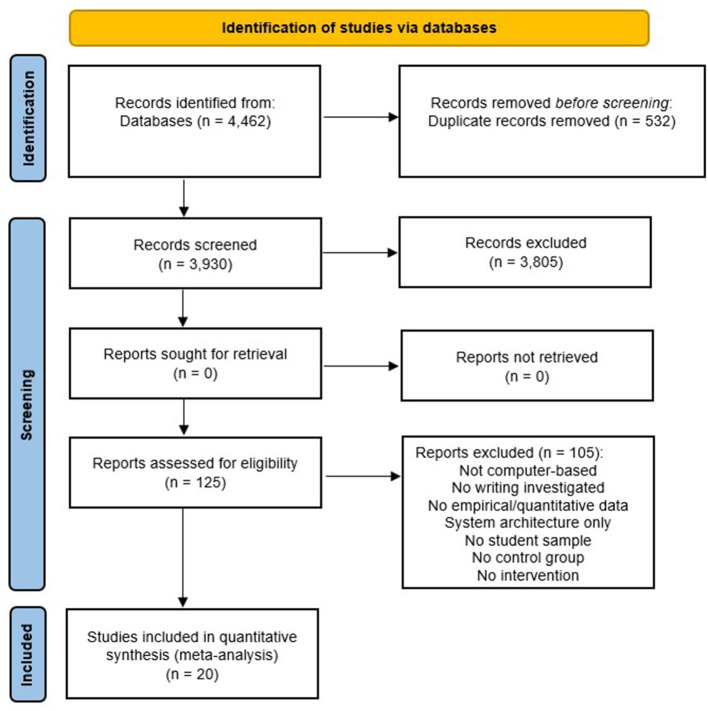
Introduction: Adaptive learning opportunities and individualized, timely feedback are considered to be effective support measures for students' writing in educational contexts. However, the extensive time and expertise required to analyze numerous drafts of student writing pose a barrier to teaching. Automated writing evaluation (AWE) tools can be used for individual feedback based on advances in Artificial Intelligence (AI) technology. A number of primary (quasi-)experimental studies have investigated the effect of AWE feedback on students' writing performance. Methods: This paper provides a meta-analysis of the effectiveness of AWE feedback tools. The literature search yielded 4,462 entries, of which 20 studies ( k = 84; N = 2, 828) met the pre-specified inclusion criteria. A moderator analysis investigated the impact of the characteristics of the learner, the intervention, and the outcome measures. Results: Overall, results based on a three-level model with random effects show a medium effect ( g = 0.55) of automated feedback on students' writing performance. However, the significant heterogeneity in the data indicates that the use of automated feedback tools cannot be understood as a single consistent form of intervention. Even though for some of the moderators we found substantial differences in effect sizes, none of the subgroup comparisons were statistically significant. Discussion: We discuss these findings in light of automated feedback use in educational practice and give recommendations for future research.
Overview
The claims and statistics of this paper haven’t been checked yet.
Free: it reads the open-access text and checks the first 5 claims that cite a source we can check. Create a free account to check every claim.
Integrity signals
Registry
Cites
Statistics
Figures
Verification
Claims the paper makes
The claims and statistics of this paper haven’t been checked yet.
Free: it reads the open-access text and checks the first 5 claims that cite a source we can check. Create a free account to check every claim.
Claims other papers make about this one
Each is checked against this paper’s own text: does it say what the citing paper says it does?
The source backs part of the claim, not all of it — or backs it for a different population, condition or comparison.
In the citing paper
“More recent research into the effectiveness of LLM-based generative AI in enhancing student performance on revised assignments has produced mixed results.”
From Generative AI and Essay Writing: Impacts of Automated Feedback on Revision Performance and Engagement (2024) · cites this paper as Fleckenstein et al., 2023
Experimental — accuracy not yet measured
Self-check
Percentages, sums and reported differences re-computed from the paper’s own numbers.
The self-check needs the paper’s full text.
Citations
Cites
Preferred reporting items for systematic reviews and meta-analyses: the PRISMA Statement.
(2009) · PubMed Central · Cited by 44,859
Preferred reporting items for systematic reviews and meta-analyses: The PRISMA statement
Moher, D., Liberati, A., Tetzlaff, J., Altman, D. G., & the PRISMA Group* (2009) · Annals of Internal Medicine · doi:10.7326/0003-4819-151-4-200908180-00135 · Cited by 37,554
Quantifying heterogeneity in a meta‐analysis
Higgins, J. P. T., & Thompson, S. G. (2002) · Statistics in Medicine · doi:10.1002/sim.1186 · Cited by 36,763 · cited 1×
“In addition to the estimate of τ 2 , the Q -test for heterogeneity (Cochran, 1954) and the τ 2 statistic (Higgins and Thompson, 2002) are reported.”
MethodConducting Meta-Analyses in R with the metafor Package
Viechtbauer, W. (2010) · Journal of Statistical Software · doi:10.18637/jss.v036.i03 · Cited by 20,464 · cited 1×
“The analysis was carried out using R (version 4.1.2; R Core Team, 2021) and the metafor package (Viechtbauer, 2010) to perform the meta-analyses.”
MethodInfluentialHattie, J., & Timperley, H. (2007) · Review of Educational Research · doi:10.3102/003465430298487 · Cited by 12,905 · cited 1×
“…effect on learner performance when it is given in a timely manner when it clarifies the gap between current performance and learning goal, when it reduces cognitive load, and when it is task-related, specific, and detailed (Mory, 2004; Hattie and Timperley, 2007; Shute, 2008; Black and Wiliam, 2009).”
Background(2000) · Cited by 9,198
Zawacki-Richter, O., Marín, V. I., Bond, M., & Gouverneur, F. (2019) · International Journal of Educational Technology in Higher Education · doi:10.1186/s41239-019-0171-0 · Cited by 7,242
Distribution Theory for Glass's Estimator of Effect Size and Related Estimators
Hedges, L. V. (1981) · Journal of Educational Statistics · doi:10.2307/1164588 · Cited by 5,695 · cited 1×
“Therefore, all Cohen’s d values were converted into Hedges’ g , which is an unbiased estimator that takes into account the sample sizes (Hedges, 1981): To verbally classify the effect sizes, we used a heuristic derived from the distribution of effects in this research field.”
MethodThe combination of estimates from different experiments
Cochran, W. G. (1954) · Biometrics · doi:10.2307/3001666 · Cited by 5,380 · cited 2×
“In addition to the estimate of τ 2 , the Q -test for heterogeneity (Cochran, 1954) and the τ 2 statistic (Higgins and Thompson, 2002) are reported.”
MethodShute, V. J. (2008) · Review of Educational Research · doi:10.3102/0034654307313795 · Cited by 4,631 · cited 1×
“…effect on learner performance when it is given in a timely manner when it clarifies the gap between current performance and learning goal, when it reduces cognitive load, and when it is task-related, specific, and detailed (Mory, 2004; Hattie and Timperley, 2007; Shute, 2008; Black and Wiliam, 2009).”
Background
Research works printed but not linked: 2
- Hattie J. (2009). The black box of tertiary assessment: An impending revolution. Tertiary Assess. High. Educ. Stud. Outcomes 259, 275.
- * Lin M. P. C. Chang D. (2020). Enhancing post-secondary writers' writing skills with a chatbot. J. Educ. Technol. Soc. 23, 78– 92.
Cited by
Items 101–147 of 147
Huo, H., & Zhang, L. J. (2026) · Assessing Writing · doi:10.1016/j.asw.2026.101084 · Cited by 1
Cabitza, F., & Vicente, L. (2026) · International Journal of Human-Computer Studies · doi:10.1016/j.ijhcs.2026.103855 · Cited by 3
Who Decides in AI-Mediated Learning? The Agency Allocation Framework
Borchers, C., Viberg, O., & Kizilcec, R. F. (2026) · ACM Conference on Learning @ Scale (L@S) · doi:10.1145/3774398.3811627 · Cited by 5
Meyer, J., Steinbach, M., Schiller, R., Mertens, U., Schaller, N.-J., Horbach, A., Fleckenstein, J., Köller, O., Kizilcec, R. F., & Jansen, T. (2026) · ACM Conference on Learning @ Scale (L@S) · doi:10.1145/3774398.3811602 · Cited by 3
“…reflection on one’s own writing, feedback can modify the writer’s mental representation of the task and their approach to it, thereby supporting not only local text improvement in the revision of their initial draft but also the application of skills to future similar writing tasks [2, 18, 89].”
Self-citationPan, Y.-L., Yu, P.-F., Yin, X.-L., Hong-sheng, Y., Long, X., & Tong, Q. (2026) · Educational Technology Research and Development · doi:10.1007/s11423-026-10659-2 · Cited by 2
AI feedback vs. peer feedback in EFL writing: exploring Indonesian students’ perceptions
Dewi, U., Daulay, S. H., & Ismahani, S. (2026) · Asian-Pacific Journal of Second and Foreign Language Education · doi:10.1186/s40862-026-00424-6 · Cited by 4
“AI systems may still face challenges in interpreting contextual meaning and communicative intent in complex academic writing, as they often lack the discourse-level understanding necessary to fully grasp nuanced ideas (Fan, 2023; Fleckenstein et al., 2023; Yang et al., 2024).”
Carriger, M. D. (2026) · SSRN Electronic Journal · doi:10.2139/ssrn.7070974
Reporting Transparency for AI in Applied Linguistics: An L2 Writing Audit and Proposed StandardPreprint
Carlo, M. (2026) · SSRN Electronic Journal · doi:10.2139/ssrn.7079541
From Human Raters to AI: A Critical Review of Research on ChatGPT in Writing Assessment
Wang, Y.-M., Harmer, P., & Xue, C. (2026) · Futurity Education · doi:10.57125/fed.2026.06.12
“…for help in assessing student writing, driving the development and adoption of Automated Writing Evaluation (AWE) systems in educational settings (Chen & Cheng, 2008; Fleckenstein et al., 2023; Hussein et al., 2019; Ramesh & Sanampudi, 2022; Valenti et al., 2003; Wilson & Roscoe, 2019; Lee, 2020).”
The effect of artificial intelligence on students’ writing performance: a meta-analysis
Wu, J., Chen, Q., Jiang, H., & Bai, X. (2026) · Reading and Writing · doi:10.1007/s11145-026-10884-4 · Cited by 2
Ghajarieh, A., Sardabi, N., & Roostan, S. (2026) · GiST Education and Learning Research Journal · doi:10.26817/16925777.2132 · Cited by 1
“The tool may provide prompt and somewhat uniform feedback for the students in the classrooms; however, as noted in Fleckenstein et al. (2023), the feedback from the tool is too diverse to be categorized in any type of intervention.”
Aldamen, H. A. K., Aldamen, F., Almashour, M., & Jarrah, M. A. (2026) · Language Learning Journal · doi:10.1080/09571736.2026.2687431
Smajla, T. (2026) · PALIMPSEST/ ПАЛИМПСЕСТ · doi:10.46763/palim261121223s
Zhang, T. (2026) · Learning and Motivation · doi:10.1016/j.lmot.2026.102322 · Cited by 1
ERDucate: An AI-Powered ERD Assessment and Feedback Tool
Effendi, E. S. Z., Mustaffa, M. R., Abdullah, L. N., & Nasharuddin, N. A. (2026) · Communications in computer and information science · doi:10.1007/978-981-92-4302-0_25
Generative AI-Enabled Adaptive Learning Platforms with Multi-modal Inputs for STEM Subjects
Ip, W. Y., Ghita, B., Kuzminykh, I., & Xiao, H. (2026) · Studies in systems, decision and control · doi:10.1007/978-3-032-23499-5_2 · Cited by 1
Ma, X., Wang, D., & Chen, G. (2026) · The Journal of Educational Research · doi:10.1080/00220671.2026.2710208
Almutairy, G. F. (2026) · Advances in computational intelligence and robotics book series · doi:10.4018/979-8-3373-7837-4.ch007
From Feedback to Feedforward: AI and the Evolution of Formative Assessment in Language Education
Kızıl, V. (2026) · Advances in computational intelligence and robotics book series · doi:10.4018/979-8-3373-7225-9.ch009
Родиков, И. Е. (2026) · Management of Education · doi:10.25726/r5228-1845-5100-o
Safarova, Z. T. (2026) · EPJ Web of Conferences · doi:10.1051/epjconf/202638403005
“As regards the students’ actions and motivation, Fleckenstei n et al. [8] (20 studies; k = 84, N = 2,828) emphasized that metaanalysis shows medium-sized efficiency of writing feedback provided by automatic writing assessment, though one should take into consideration considerable variety of data…”
Wang, Y., & Zhong, M. (2026) · Research Square · doi:10.21203/rs.3.rs-10410268/v1
Feng, X., & Tan, Z. (2026) · International Conference on Computer Science and Technologies in Education (CSTE) · doi:10.1109/cste69562.2026.11649628
“Research on automated feedback indicates that while AI can enhance revision quality and learning efficiency, deep understanding and knowledge construction depend heavily on learners ’ interpretive engagement and teachers ’ feedback literacy [8-9].”
Leng, R., Gu, T., Qian, L., Wang, X., & Li, W. (2026) · International Conference on Computer Science and Technologies in Education (CSTE) · doi:10.1109/cste69562.2026.11649811
“Multiple interventions outperform single interventions, likely due to more comprehensive designs, cumulative learning effects, and students’ growing familiarity with using GAI effectively [47][48].”
Fang, Y., Tan, Y., Zuo, C., & Boubaker, A. (2026) · International Conference on Computer Science and Technologies in Education (CSTE) · doi:10.1109/cste69562.2026.11649771
“Based on our design and the broader literature on automated and AI-generated feedback ( [14], [15], [28]), we suggest the following guardrails for classroom use: • Rubric anchoring: Align AI prompts and feedback requests directly with the course rubric so outputs target the same criteria used for…”
InfluentialKhattak, Z. I., Mathew, B. P., Ghorbanpoor, M., Qureshi, M. B., & Zakwani, M. A. (2026) · International Journal of Learning Teaching and Educational Research · doi:10.26803/ijlter.25.8.9
Pervaiz, M., Hassan, M. U., Aziz, A. A., Shahid, M., & Batool, A. (2026) · Discover Education · doi:10.1007/s44217-026-01717-1
“Nevertheless, these studies cautioned that improvements in higher-order argumentative skills are smaller until automated writing evaluation is incorporated into an iterative, process-oriented instruction [7, 11, 25].”
Influential(2026) · Wiley eBooks · doi:10.1002/9781394452484.ref
Drury, P., Chan, A., Bowdler, S., Kinghorn, G., & Curtis, E. M. (2026) · Nurse Education Today · doi:10.1016/j.nedt.2026.107411
Basan, S. A. A., BATULANON, A. A., Enanoria, S. M., Gioca, A. K., Lemente, L. C., Niñal, M. F. E., Orillo, D. G. L., & Razonable, J. P. C. (2026) · International Journal of Research on Multidisciplinary Studies · doi:10.67903/ijroms0239
Learning-Science Grounded Design for Generative Artificial Intelligence in Education
Lin, J., & Hu, X. (2026) · Springer eBooks · doi:10.1007/978-3-032-24819-0_7
AI-assisted language assessment in the post-ChatGPT era: A systematic literature review
Kim, J., Nishizawa, H., & Kim, H. (2026) · Research Methods in Applied Linguistics · doi:10.1016/j.rmal.2026.100373
Mesenhöller, J., & Böhme, K. (2026) · Frontiers in Education · doi:10.3389/feduc.2026.1875856
Vu, Q. H., & Nguyen, K. P. (2026) · International journal of AI in language education. · doi:10.54855/ijaile.26324 · Cited by 1
“Systematic reviews also reported that automated writing feedback can provide constructive feedback, leading to significant improvements in students’ writing (Fleckenstein et al., 2023).”
Zhou, W., & Yang, Y. (2026) · Interactive Learning Environments · doi:10.1080/10494820.2026.2732233
Exploring the effects of AI-powered feedback in language learning: a meta-analysis
Chen, Z., Chen, S., & Chen, W. (2026) · Educational Psychology · doi:10.1080/01443410.2026.2735272 · Cited by 2
Santos, C., Viana, F., & Sánchez-Caballé, A. (2026) · Ensaio Avaliação e Políticas Públicas em Educação · doi:10.1590/s0104-40362026003405414 · Cited by 3
Huamanta, E. R. C., Pillco, D. V. A., Seijas-Díaz, J. G., Ruales, E. A. B., Manrique, J. I. T., & Patiño, Í. W. A. (2026) · Frontiers in Education · doi:10.3389/feduc.2026.1928575
Han, F., & Wang, Z. (2026) · Behavioral Sciences · doi:10.3390/bs16101837 · Cited by 1
“To help FL writers to improve their writing skills, an essential strategy is to provide high-quality feedback (Fleckenstein et al., 2023).”
Sai, K. T., Gnaneswar, R., Kushal, U. K., & Devi, B. S. (2026) · International Conference on Advancements in Smart, Secure and Intelligent Computing (ASSIC) · doi:10.1109/assic70037.2026.11717269
“…institution-level findings, and research have made it evident that students can strengthen writing capabilities with AI-informed, fine-grained, credible, and instruction-related tailored evaluations, although generalizability to other settings can be problematic Fleckenstein et al. [6],[7].”
Zhang, X., Tlili, A., Li, S., & Xue, X. (2026) · IEEE International Conference on Advanced Learning Technologies (ICALT) · doi:10.1109/icalt68022.2026.00076
“While Automated Writing Evaluation (AWE) systems have shown promise in enhancing practice and revision [3], recent advances have integrated generative AI capabilities into these platforms, extending feedback beyond grammar checking to assist with ideation, drafting, and formulation, potentially…”
Ribeiro, F. G. C., Rodrigues, L., da Costa, N. T., Xavier, C., Lobo, J., Cavalcanti, A. P., Gašević, D., Drachsler, H., & Mello, R. F. (2026) · Anais do Workshop de Informática na Escola · doi:10.5753/wie.2026.28044
“One of the most effective strategies for addressing these challenges is the provision of timely and constructive feed-back, which helps learners identify errors, understand writing conventions, and engage in iterative improvement [Graham et al. 2024, Fleckenstein et al. 2023].”
Novak, D. (2026) · CASALC Review · doi:10.5817/casalc2026-1-4
Liu, L. (2026) · International Conference on Intelligent Education and Computer Technology (IECT) · doi:10.1145/3845354.3845426
“Studies conducted using meta-analysis have revealed that automated feed-back has a positive effect on improving the writing skills of learners [2].”
Untitled work
Chan, C. K. Y., Lo, N., & Wong, G. (2024)
Metadata
- Authors
- Fleckenstein, J., Liebenow, L. W., & Meyer, J.
- Affiliations
- University of Hildesheim (DE)
- Leibniz Institute for Science and Mathematics Education (DE)
- Corresponding author
- Fleckenstein, Johanna
- Venue
- Frontiers in Artificial Intelligence
- Publisher
- Frontiers Media SA
- Published
- 2023-07-03
- Volume
- 6
- Pages
- 1162454-1162454
- ISSN
- 2624-8212 (ISSN-L)
- PMC
- PMC10351274
- OpenAlex
- W4382940101
- Semantic Scholar
- 40a369c40d4419ce2669223aae4baa8f6f128cd8
- Cited by
- 145
- References
- 102
- Citations by year
- 2026: 74 · 2025: 49 · 2024: 19 · 2023: 3
- FWCI
- 8.80
- Type
- journal article
- Language
- en
- Open access
- gold
- doi.org
- Licence
- Locations
- Frontiers in Artificial Intelligence (publishedVersion, cc-by)
- PubMed Central (publishedVersion, cc-by)
- PubMed (publishedVersion)
- DOAJ (DOAJ: Directory of Open Access Journals) (submittedVersion, cc-by-sa)
- Funders
- Bundesministerium für Bildung und Forschung
- Topics
- Social Sciences › Education › Student Assessment and Feedback
- Social Sciences › Education › Artificial Intelligence in Education
- Physical Sciences › Computer Science › Artificial Intelligence › Intelligent Tutoring Systems and Adaptive Learning
- Keywords
- automated writing evaluation, automated feedback, student writing performance, writing instruction, artificial intelligence in education, adaptive learning, personalized feedback, moderator analysis, effect size heterogeneity
About these checks
Registry, retraction, Cites and statistics results are computed, not judged, with one exception: a printed reference that no index lists is read once by a model before it counts as a citation error. Claims are extracted by a model and kept only when their quote appears verbatim in the text; each cited source is then checked, with a model’s help, for whether it says what the claim relies on. Those verdicts can be wrong — read the claim’s quote and the cited source before relying on one.
Statistics and arithmetic are recomputed, not judged.
Confidence bands are shown only for fields calibrated on our annotated test set. None is calibrated yet, so no band is shown.
What counts as a claim ›How we measure confidence ›How we check this ›
Are you an author, or do you see a problem with this page? Request a review
Data sources
Bibliographic data: Semantic Scholar, OpenAlex, Crossref.
Contains information from the Semantic Scholar Academic Graph Datasets, made available under the ODC Attribution License (ODC-BY 1.0).
Semantic Scholar’s data is described in: Kinney, R., et al. (2023). The Semantic Scholar Open Data Platform. arXiv:2301.10140.
