

The DOI matches its Crossref record; 55 of the 56 references it cites were found in a registry or an index.
A longitudinal study on artificial intelligence adoption: understanding the drivers of ChatGPT usage behavior change in higher education
Open accessAbstract
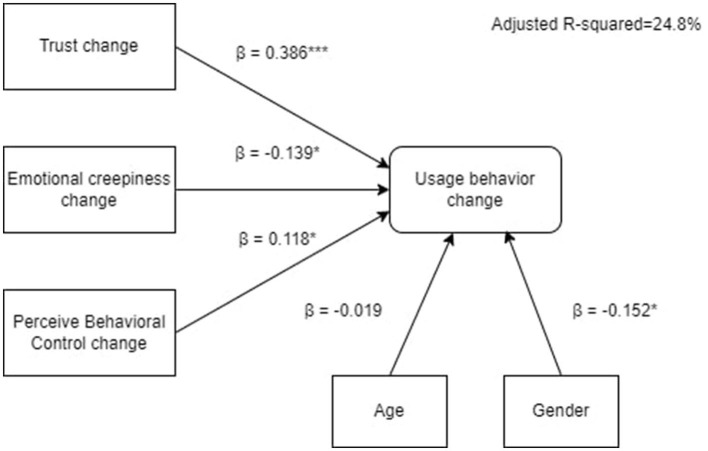
As the field of artificial intelligence (AI) continues to progress, the use of AI-powered chatbots, such as ChatGPT, in higher education settings has gained significant attention. This paper addresses a well-defined problem pertaining to the critical need for a comprehensive examination of students' ChatGPT adoption in higher education. To examine such adoption, it is imperative to focus on measuring actual user behavior. While measuring students' ChatGPT usage behavior at a specific point in time can be valuable, a more holistic approach is necessary to understand the temporal dynamics of AI adoption. To address this need, a longitudinal survey was conducted, examining how students' ChatGPT usage behavior changes over time among students, and unveiling the drivers of such behavior change. The empirical examination of 222 Dutch higher education students revealed a significant decline in students' ChatGPT usage behavior over an 8 month period. This period was defined by two distinct data collection phases: the initial phase (T1) and a follow-up phase conducted 8 months later (T2). Furthermore, the results demonstrate that changes in trust, emotional creepiness, and Perceived Behavioral Control significantly predicted the observed change in usage behavior. The findings of this research carry significant academic and managerial implications, as they advance our comprehension of the temporal aspects of AI adoption in higher education. The findings also provide actionable guidance for AI developers and educational institutions seeking to optimize student engagement with AI technologies.
Overview
The claims and statistics of this paper haven’t been checked yet.
Run the check — free, no account needed. It reads the open-access text and checks the sources it cites.
Integrity signals
Registry
Cites
Statistics
Figures
Verification
Claims the paper makes
The claims and statistics of this paper haven’t been checked yet.
Run the check — free, no account needed. It reads the open-access text and checks the sources it cites.
Claims other papers make about this one
Each is checked against this paper’s own text: does it say what the citing paper says it does?
The source backs part of the claim, not all of it — or backs it for a different population, condition or comparison.
In the citing paper
“Polyportis (2024) observes that as students grew more accustomed to ChatGPT, their feelings of emotional creepiness (i.e., the unsettling emotions or discomfort that individuals may encounter when interacting with AI systems that mimic human emotions or intentions) diminished, but their trust levels decreased, leading to decreased usage.”
From Fostering AI Literacy in Undergraduates: A ChatGPT Workshop Case Study (2025) · cites this paper as Polyportis (2024)
Experimental — accuracy not yet measured
Self-check
Percentages, sums and reported differences re-computed from the paper’s own numbers.
The self-check needs the paper’s full text.
Citations
Cites
The theory of planned behavior
Ajzen, I. (1991) · Organizational Behavior and Human Decision Processes · doi:10.1016/0749-5978(91)90020-t · Cited by 90,587
Perceived usefulness, perceived ease of use, and user acceptance of information technology
Davis, F. D. (1989) · MIS Quarterly · doi:10.2307/249008 · Cited by 68,483
User Acceptance of Information Technology: Toward A Unified View1
Venkatesh, V., Morris, M. G., Davis, G. B., & Davis, F. D. (2003) · MIS Quarterly · doi:10.2307/30036540 · Cited by 45,035
Self-efficacy: Toward a unifying theory of behavioral change
Bandura, A. (1977) · Psychological Review · doi:10.1037/0033-295x.84.2.191 · Cited by 43,925
A Theoretical Extension of the Technology Acceptance Model: Four Longitudinal Field Studies
Venkatesh, V., & Davis, F. D. (2000) · Management Science · doi:10.1287/mnsc.46.2.186.11926 · Cited by 23,066
Valente, T. W. (2003) · Genetics in Medicine · doi:10.1097/01.gim.0000061743.67794.c4 · Cited by 20,559
Venkatesh, V., Thong, J. Y. L., & Xu, X. (2012) · MIS Quarterly · doi:10.2307/41410412 · Cited by 15,756
Understanding information technology usage: a test of competing models
Taylor, S., & Todd, P. A. (1995) · Information Systems Research · doi:10.1287/isre.6.2.144 · Cited by 8,815
Perceived Behavioral Control, Self‐Efficacy, Locus of Control, and the Theory of Planned Behavior 1
Ajzen, I. (2002) · Journal of Applied Social Psychology · doi:10.1111/j.1559-1816.2002.tb00236.x · Cited by 7,629
Venkatesh, V. (2000) · Information Systems Research · doi:10.1287/isre.11.4.342.11872 · Cited by 6,664
Research works printed but not linked: 1
- Polyportis, Navigating the perils of artificial intelligence: a focused review on ChatGPT responsible research innovation, Hum. Soc. Sci. Commun.
Cited by
Sorted by citations
Does ChatGPT enhance student learning? A systematic review and meta-analysis of experimental studies
Deng, R., Jiang, M., Yu, X., Lu, Y., & Liu, S. (2025) · Computers & Education · doi:10.1016/j.compedu.2024.105224 · Cited by 531
Polyportis, A., & Pahos, N. (2024) · Behaviour and Information Technology · doi:10.1080/0144929x.2024.2317364 · Cited by 264
Self-citationYu, C., Yan, J., & Cai, N. (2024) · Frontiers in Education · doi:10.3389/feduc.2024.1354929 · Cited by 157
Cai, L., Msafiri, M. M., & Kangwa, D. (2025) · Education and Information Technologies · doi:10.1007/s10639-024-13112-0 · Cited by 104
Al-kfairy, M. (2024) · Applied System Innovation · doi:10.3390/asi7060110 · Cited by 123
Balaskas, S., Tsiantos, V., Chatzifotiou, S., & Rigou, M. (2025) · Information · doi:10.3390/info16020082 · Cited by 81
The Impact of AI on the Personal and Collaborative Learning Environments in Higher Education
Msambwa, M. M., Wen, Z., & Daniel, K. (2025) · European Journal of Education · doi:10.1111/ejed.12909 · Cited by 76
Kim, Y., Blazquez, V., & Oh, T. (2024) · Behavioral Sciences · doi:10.3390/bs14111035 · Cited by 103
Daniel, K., Msambwa, M. M., & Wen, Z. (2025) · European Journal of Education · doi:10.1111/ejed.70036 · Cited by 71
Ballesteros, M. A. A., Acosta-Enriquez, B. G., Farroñán, E. V. R., Juárez, H. D. G., Salinas, L. E. C., Sánchez, J. E. B., Castillo, J. C. A., Licapa-Redolfo, G. S., & Chilicaus, G. C. F. (2024) · Sustainability · doi:10.3390/su162310707 · Cited by 51
Sharma, S., & Singh, G. (2024) · International Journal of Systems Assurance Engineering and Management · doi:10.1007/s13198-024-02558-7 · Cited by 53
Abulail, R. N., Badran, O. N., Shkoukani, M., & Omeish, F. Y. (2025) · Computers · doi:10.3390/computers14060230 · Cited by 65
Uppal, K., & Hajian, S. (2024) · European Journal of Educational Research · doi:10.12973/eu-jer.14.1.199 · Cited by 36
Giri, F. S., & Chaparro, T. S. (2024) · Business Strategy & Development · doi:10.1002/bsd2.70038 · Cited by 36
Liu, N., Deng, W., & Ayub, A. F. M. (2025) · Education and Information Technologies · doi:10.1007/s10639-025-13349-3 · Cited by 36
The impact of generative AI on social media: an experimental study
Møller, A. G., Romero, D. M., Jurgens, D., & Aiello, L. M. (2026) · Scientific Reports · doi:10.1038/s41598-026-40110-8 · Cited by 56
One year in the classroom with ChatGPT: empirical insights and transformative impacts
Guo, F., Li, T., & Cunningham, C. J. L. (2025) · Frontiers in Education · doi:10.3389/feduc.2025.1574477 · Cited by 35
Milakis, E. D., Argyrakou, C. C., Melidis, A., & Vrettaros, J. (2025) · International Journal of Education and Information Technologies · doi:10.46300/9109.2025.19.11 · Cited by 28
Ruwe, T., & Kuklick, L. (2025) · British Journal of Educational Technology · doi:10.1111/bjet.70011 · Cited by 21
The use and usefulness of GenAI in higher education: Student experience and perspectives
Chung, J., Henderson, M., Slade, C., Liang, Y., Pepperell, N., Corbin, T., Walton, J., Yu, S., Bearman, M., Shum, S. B., et al. (2026) · Computers and Education Open · doi:10.1016/j.caeo.2026.100347 · Cited by 16
Rajan, S., & Niranjan, L. R. (2025) · International Journal of Educational Management · doi:10.1108/ijem-03-2024-0181 · Cited by 18
Nogueira, E., Lopes, J. M., & Gomes, S. (2025) · Management Review Quarterly · doi:10.1007/s11301-025-00531-7 · Cited by 28
Darmono, D., Setiawan, R. J., & Ma'ruf, K. (2025) · European Journal of Educational Research · doi:10.12973/eu-jer.14.3.805 · Cited by 18
Rizun, N., Bordean, O. N., Nikiforova, A., Beleiu, I. N., & Revina, A. (2026) · Computers and Education Open · doi:10.1016/j.caeo.2026.100336 · Cited by 26
Melanou, C., & Beege, M. (2026) · Education Sciences · doi:10.3390/educsci16040651 · Cited by 12
More-than-Human Storytelling: Designing Longitudinal Narrative Engagements with Generative AI
Fabre, É., Seaborn, K., Koiwai, S., Watanabe, M., & Riesch, P. (2025) · CHI Conference Extended Abstracts on Human Factors in Computing Systems (CHI EA) · doi:10.1145/3706599.3720135 · Cited by 15
Gupta, S., & Priyanka, P. (2025) · VINE Journal of Information and Knowledge Management Systems · doi:10.1108/vjikms-02-2024-0052 · Cited by 12
Razzouki, M., Hammou, S. B., & Izenzal, M. (2025) · Cogent Education · doi:10.1080/2331186x.2025.2553829 · Cited by 13
A Systematic Review on AI Technologies in English as a Foreign Language Education
Toscu, S. (2025) · Sakarya University Journal of Education · doi:10.19126/suje.1623401 · Cited by 12
Luna, D. S., Broer, I., Bilandzić, H., Taddicken, M., Schuller, B. W., & Bürger, M. (2025) · Public Understanding of Science · doi:10.1177/09636625251328854 · Cited by 15
The Practice of Enhancing Learning and Scientific Innovative Abilities Using LLM-Based AI Tools
Wang, B., Zhang, X., Li, S., & Wang, Y. (2024) · International Conference on Computer Science and Technologies in Education (CSTE) · doi:10.1109/cste62025.2024.00038 · Cited by 6
Fostering AI Literacy in Undergraduates: A ChatGPT Workshop Case Study
Archambault, S. G., Murph, N. L., & Ramachandran, S. (2025) · Library Trends · doi:10.1353/lib.2025.a968491 · Cited by 5
Transforming the self: Individual-level changes arising from collaboration with generative AI
Nandagopal, S. (2025) · Computers in Human Behavior Artificial Humans · doi:10.1016/j.chbah.2025.100232 · Cited by 9
With a little help from my artificial friend: Functional and parasocial value in ChatGPT use
Lasarov, W., Hoffmann, S., & Dwivedi, Y. K. (2026) · Technology in Society · doi:10.1016/j.techsoc.2026.103220 · Cited by 5
Polyportis, A. (2026) · Societal Impacts · doi:10.1016/j.socimp.2026.100176 · Cited by 5
Self-citationAl-Shamaileh, O., Mubin, O., & Nizamuddin, N. (2025) · International Journal of Human-Computer Interaction · doi:10.1080/10447318.2025.2532712 · Cited by 8
Qin, R. W. (2024) · Technology and Investment · doi:10.4236/ti.2024.153010 · Cited by 5
Organizational and External E-Readiness, AI Adoption in Hospitality Industry: Empirical Study
Hafeez, M. H., Kokash, H. A., Ahsan, M. N., Tariq, B., & Alam, S. S. (2026) · Journal of Quality Assurance in Hospitality & Tourism · doi:10.1080/1528008x.2025.2602779 · Cited by 4
Mao, K., Cui, R., & Wang, Z. (2026) · Frontiers in Psychology · doi:10.3389/fpsyg.2026.1773754 · Cited by 5
Mao, P., Cai, Z., Sun, X., Niu, G., Zhang, Y., & Liu, J. (2025) · Learning and Individual Differences · doi:10.1016/j.lindif.2025.102756 · Cited by 4
Salamzadeh, A., Ashkani, M., & Asgharifar, M. H. (2025) · Strategy and Leadership · doi:10.1108/sl-04-2025-0091 · Cited by 6
The implications of artificial intelligence usage on management students’ academic productivity
Idrissi, I. E., & Alami, Y. (2025) · Artificial Intelligence in Education · doi:10.1108/aiie-05-2025-0103 · Cited by 6
Quality, norms and privacy in AI chatbot adoption: a multigroup analysis
Yu, T., Teoh, A. P., Tu, Q., & Wang, C. (2026) · International Journal of Contemporary Hospitality Management · doi:10.1108/ijchm-08-2025-1167 · Cited by 3
Oguine, O. C., Garcia, A. A., Muller, M. J., & Badillo-Urquiola, K. A. (2026) · CHI Conference on Human Factors in Computing Systems · doi:10.1145/3772318.3791346 · Cited by 6
Palomares, S. M. B. (2024) · Advances in educational technologies and instructional design book series · doi:10.4018/979-8-3693-2591-9.ch007 · Cited by 3
Exploring faculty adoption of ChatGPT: a stimuli-organism-response approach
Cambra‐Fierro, J., García, O. C., Blasco, M. F., López-Pérez, M., Ruz-Mendoza, M. Á., & Trifu, A. (2025) · Interactive Learning Environments · doi:10.1080/10494820.2025.2483415 · Cited by 4
Development of a chatbot for mental health support using ai-intelligent
Dulloyeva, I. S., Рауфов, Ф. М., Bakhadirova, M., Nasirova, N., Pekhanova, Y., Mamarasulova, I., Pulatova, B. J., & Khakimova, M. (2024) · Health Leadership and Quality of Life · doi:10.56294/hl2024.178 · Cited by 2
Adawurah, M., & Buabeng-Andoh, C. (2025) · Education and Information Technologies · doi:10.1007/s10639-025-13706-2 · Cited by 2
Roman, S., & Bertolotti, F. (2025) · Frontiers Artif. Intell. · doi:10.3389/frai.2025.1671917 · Cited by 4
Garmpis, A., Garmpis, S., Panagiotarou, A., Antonopoulou, H., & Halkiopoulos, C. (2026) · Societies · doi:10.3390/soc16010024 · Cited by 7
Al-Shamaileh, O., Hammady, R., Abdelrahman, M., & Mubin, O. (2026) · Computers in Human Behavior Reports · doi:10.1016/j.chbr.2026.100980 · Cited by 6
Hooley, Z., Williams, S., & Hancock-Smith, B. (2026) · Studies in Higher Education · doi:10.1080/03075079.2026.2640092 · Cited by 2
Kumi, E. (2024) · African Journal Of Applied Research · doi:10.26437/ajar.v10i2.795 · Cited by 2
Teo, T. P., Scherer, R., Fung, A. S. K., & Fung, C. S. L. (2026) · Educational Research Review · doi:10.1016/j.edurev.2026.100804 · Cited by 3
Salazar, L. R., & Peeples, S. (2025) · Technology Knowledge and Learning · doi:10.1007/s10758-025-09865-3 · Cited by 6
What is the AIGC-assisted learning experience like? -- A study based on conceptual understanding
Lu, Y., Wang, D. Y., & Wu, J. (2024) · International Conference on Intelligent Education and Computer Technology (IECT) · doi:10.1145/3687311.3687403 · Cited by 1
Leveraging Generative AI for Automated Performance Optimization: A Technical Deep Dive
Chappidi, S. R. (2025) · International Journal of Scientific Research in Computer Science Engineering and Information Technology · doi:10.32628/cseit25111278 · Cited by 1
AI-Powered Professional Communication: Real-Time Multimodal Analysis Dashboard
Gullapalli, V. (2025) · European Modern Studies Journal · doi:10.59573/emsj.9(4).2025.69 · Cited by 1
Use Matters: How Different Ways of Using ChatGPT Drive AI Acceptance and Solutionism
Flaßhoff, F. G., Anicker, F., & Marcinkowski, F. (2025) · Human-Machine Communication · doi:10.30658/hmc.11.2 · Cited by 1
Designing Education for the AI Era: Principles for Integrating LLMs in Pedagogy
Biscalchin, A., Sarkheyli-Hägele, A., Eriksson, J., & Vogel, B. (2025) · International Conference on Software, Telecommunications and Computer Networks (SoftCOM) · doi:10.23919/softcom66362.2025.11197458 · Cited by 2
Ignjatović, A., Apostolovic, M. A., Stevanović, L., Radovanović, P., Sidharth, Topalović, M., & Filipović, T. (2025) · Journal of Medical Education and Curricular Development · doi:10.1177/23821205251409530 · Cited by 1
Götzfried, A., & Heitmayer, M. (2026) · Computers in Human Behavior Artificial Humans · doi:10.1016/j.chbah.2026.100255 · Cited by 5
Mehmood, S., Ghani, T., Naseer, L., & Mehmood, T. (2026) · Future Business Journal · doi:10.1186/s43093-026-00747-3 · Cited by 1
Ma, R., & Guo, M. (2026) · Behavioral Sciences · doi:10.3390/bs16040577 · Cited by 2
Muneer, S., Singh, A., Choudhary, M. H., & Anum, S. (2026) · Humanities and Social Sciences Communications · doi:10.1057/s41599-026-07532-1 · Cited by 1
Cheng, Y., Lee, J., Martin, F., & Rand, W. M. (2026) · PLoS ONE · doi:10.1371/journal.pone.0350661 · Cited by 1
Alzahrani, S., & Bhunia, A. K. (2026) · Frontiers in Education · doi:10.3389/feduc.2026.1803390 · Cited by 1
Araujo, T. (2026) · AI & Society · doi:10.1007/s00146-026-03279-0 · Cited by 2
Leveraging AI in Salesforce Partner Portal: A Technical Overview
Peri, A. S. (2024) · International Journal For Multidisciplinary Research · doi:10.36948/ijfmr.2024.v06i06.32727
Leveraging AI to Scale Product Development: Technical Approaches and Implementation Strategies
Golani, R. R. (2025) · International Journal of Scientific Research in Computer Science Engineering and Information Technology · doi:10.32628/cseit25112742
Bouwmans, M., Ongena, G., de Vaate, N. A. J. D. B., & Zhang, R. (2025) · SSRN Electronic Journal · doi:10.2139/ssrn.5363751
Khari, M. (2025) · IGI Global eBooks · doi:10.4018/979-8-3373-2670-2.ch015 · Cited by 2
Metaverse Farkındalık Ölçeği: Ölçek geliştirme ve doğrulama çalışması
Yıldız, İ., Terzi, R., & Evran, D. (2025) · Mehmet Akif Ersoy üniversitesi eğitim fakültesi dergisi. · doi:10.21764/maeuefd.1669036
Revisión bibliométrica sobre la adopción de inteligencia artificial en la educación superior
Jiménez, M. U., López-Mallama, O. M., & Espinosa, A. A. (2025) · Revista Guillermo de Ockham · doi:10.21500/22563202.7780
How Future Teachers Perceive Artificial Intelligence?
Kubiatko, M. (2025) · Signals and communication technology · doi:10.1007/978-3-031-96855-6_15
Adoption of Chatbots and Personalisation Engines in Digital Marketing
Moqaddem, O. (2026) · Lecture notes in networks and systems · doi:10.1007/978-3-032-14430-0_2
Polyportis, A. (2026) · Computers in Human Behavior Artificial Humans · doi:10.1016/j.chbah.2026.100266 · Cited by 4
Self-citationBisaso, S., & Fava, S. (2026) · Journal of Artificial Intelligence and Technological Development · doi:10.59324/jaitd.2026.2(2).07
Investigating Meta-Cognitive Processes in AI-mediated Academic Information SeekingPreprint
Quinlan, M., Hall, A., & Cho, Y. (2026) · SSRN Electronic Journal · doi:10.2139/ssrn.6412574
Sardar, H., Azam, A., Azam, M., & Ramzan, M. (2026) · The Electronic Library · doi:10.1108/el-10-2025-0435
Sutha, J. (2026) · SSRN Electronic Journal · doi:10.2139/ssrn.6555981
Yang, Y., Wang, Z., Ma, R., & Schaub, F. (2026) · CHI Conference on Human Factors in Computing Systems · doi:10.1145/3772318.3790881
Investigating Student Interaction with Competency-Based CS Education
Anzinger, M., Hecking-Veltman, A., Bichmann, M. H., & Krusche, S. (2026) · International Conference on Learning Analytics and Knowledge (LAK) · doi:10.1145/3785022.3785046 · Cited by 1
Tracing ChatGPT Use in Spain: Differences Among Population Groups in Adoption and Engagement
Ochoa, C., Fernandez-Melero, L., & Revilla, M. (2026) · Human Behavior and Emerging Technologies · doi:10.1155/hbe2/9703008
Profiling International Student Adaptability Needs via K-Means Clustering for Digital Empowerment
Li, W. (2026) · International Conference on Informatics Education and Computer Technology Applications (IECA) · doi:10.1145/3802133.3802177
Guo, J., Yi, D., Wang, C., Zhang, Z., & Guan, K. (2026) · Research Square · doi:10.21203/rs.3.rs-8651885/v1
Verma, C., & Kumar, D. (2026) · Computers and Education Artificial Intelligence · doi:10.1016/j.caeai.2026.100613 · Cited by 4
Only Time Will Tell: A Structured Survey of Longitudinal Studies on Social AI Companions
Pi, Y., & Hunter, R. (2026) · International Journal of Human-Computer Interaction · doi:10.1080/10447318.2026.2670529
From perception to adoption: A longitudinal study of trust and delegation in everyday AI use
Ehrhardt, N., Ivan, I. V., & Klein, S. H. (2026) · Computers in Human Behavior Artificial Humans · doi:10.1016/j.chbah.2026.100325
Integrating GPT in undergraduate management education and its impact on performance and perception
Damodaran, A., Aswani, R., & Sajith, S. (2026) · Discover Sustainability · doi:10.1007/s43621-026-03462-9
Wijaya, L., Wagle, S., Kadir, H. B. A., Vaish, A., Sustaningrum, R., Gunawan, R. A., Santosa, T. E. C., & Pradhani, R. A. (2026) · ASU International Conference in Emerging Technologies for Sustainability and Intelligent Systems (ICETSIS) · doi:10.1109/icetsis68266.2026.11548969
AI-Augmented Leadership and Digital Decision-Making Models
Roos, G. (2026) · Advances in computational intelligence and robotics book series · doi:10.4018/979-8-2600-2541-3.ch002
Students, AI, and the Future of Higher Education: A Scoping Review of Perceptions and Concerns
Farrokhnia, M., Salimi, G., & Ahmadshahi, A. (2026) · Lecture notes in computer science · doi:10.1007/978-3-032-29773-0_28
Hunt, D., & Miceli, M. D. (2026) · American Journal of STEM Education · doi:10.32674/tfptev94
An Ecological Systems Analysis of University Students' ChatGPT Use in Higher Education
Nazır, T. (2026) · Systems Research and Behavioral Science · doi:10.1002/sres.70108
Sundar, J., Sharma, N. K., Tripathi, R. K., Sumalatha, V., Ramya, R., & Sharma, P. (2026) · International Conference on AI, Data Science, Cyber Security and Smart Manufacturing for Sustainable Development (ICADCS) · doi:10.1109/icadcs70036.2026.11583454
Yang, J., Li, M. Y., Wang, S., Shi, Z., Fang, J., Zheng, P., & Wu, Z. (2026) · BMC Oral Health · doi:10.1186/s12903-026-09345-9
Vziatysheva, V. (2026) · Human Behavior and Emerging Technologies · doi:10.1155/hbe2/1733863
Wiryadinata, D. N., Hutagalung, G. M., Steven, & Zamasi, H. C. (2026) · International Conference on ICT for Smart Society (ICISS) · doi:10.1109/iciss71466.2026.11715061
Duan, H., Dawod, A. Y., & Wan, G. (2026) · Asia Pacific Journal of Marketing and Logistics · doi:10.1108/apjml-02-2026-0414
Metadata
- Authors
- Polyportis, A.
- Affiliations
- Delft University of Technology (NL)
- Corresponding author
- Polyportis, Athanasios
- Venue
- Frontiers in Artificial Intelligence
- Publisher
- Frontiers Media SA
- Published
- 2024-01-05
- Volume
- 6
- Pages
- 1324398-1324398
- ISSN
- 2624-8212 (ISSN-L)
- PMC
- PMC10797058
- OpenAlex
- W4390610074
- Cited by
- 111
- References
- 56
- Citations by year
- 2026: 58 · 2025: 36 · 2024: 17
- FWCI
- 41.74
- Type
- journal article
- Language
- en
- Open access
- gold
- doi.org
- Licence
- Locations
- Frontiers in Artificial Intelligence (publishedVersion, cc-by)
- PubMed Central (publishedVersion, cc-by)
- PubMed (publishedVersion)
- DOAJ (DOAJ: Directory of Open Access Journals) (submittedVersion, cc-by-sa)
- Research Repository (Delft University of Technology) (submittedVersion, cc-by)
- Topics
- Social Sciences › Education › Artificial Intelligence in Education
- Social Sciences › Decision Sciences › Information Systems and Management › Technology Adoption and User Behaviour
- Social Sciences › Business, Management and Accounting › Marketing › AI in Service Interactions
- Keywords
- ChatGPT, artificial intelligence adoption, university students, trust in AI, perceived behavioral control, student engagement with AI
About these checks
Registry, retraction, Cites and statistics results are computed, not judged, with one exception: a printed reference that no index lists is read once by a model before it counts as a citation error. Claims are extracted by a model and kept only when their quote appears verbatim in the text; each cited source is then checked, with a model’s help, for whether it says what the claim relies on. Those verdicts can be wrong — read the claim’s quote and the cited source before relying on one.
Statistics and arithmetic are recomputed, not judged.
Confidence bands are shown only for fields calibrated on our annotated test set. None is calibrated yet, so no band is shown.
What counts as a claim ›How we measure confidence ›How we check this ›
Are you an author, or do you see a problem with this page? Request a review
