

The DOI matches its Crossref record; 55 of the 56 references it cites were found in a registry or an index.
A longitudinal study on artificial intelligence adoption: understanding the drivers of ChatGPT usage behavior change in higher education
Open accessAbstract
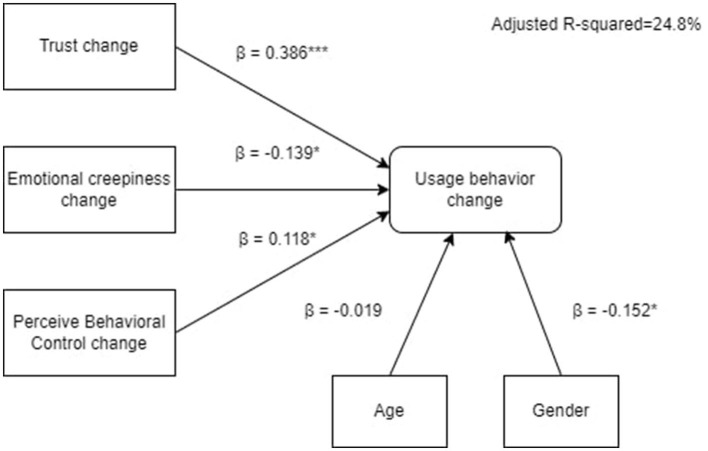
As the field of artificial intelligence (AI) continues to progress, the use of AI-powered chatbots, such as ChatGPT, in higher education settings has gained significant attention. This paper addresses a well-defined problem pertaining to the critical need for a comprehensive examination of students' ChatGPT adoption in higher education. To examine such adoption, it is imperative to focus on measuring actual user behavior. While measuring students' ChatGPT usage behavior at a specific point in time can be valuable, a more holistic approach is necessary to understand the temporal dynamics of AI adoption. To address this need, a longitudinal survey was conducted, examining how students' ChatGPT usage behavior changes over time among students, and unveiling the drivers of such behavior change. The empirical examination of 222 Dutch higher education students revealed a significant decline in students' ChatGPT usage behavior over an 8 month period. This period was defined by two distinct data collection phases: the initial phase (T1) and a follow-up phase conducted 8 months later (T2). Furthermore, the results demonstrate that changes in trust, emotional creepiness, and Perceived Behavioral Control significantly predicted the observed change in usage behavior. The findings of this research carry significant academic and managerial implications, as they advance our comprehension of the temporal aspects of AI adoption in higher education. The findings also provide actionable guidance for AI developers and educational institutions seeking to optimize student engagement with AI technologies.
Overview
The claims and statistics of this paper haven’t been checked yet.
Run the check — free, no account needed. It reads the open-access text and checks the sources it cites.
Integrity signals
Registry
Cites
Statistics
Figures
Verification
Claims the paper makes
The claims and statistics of this paper haven’t been checked yet.
Run the check — free, no account needed. It reads the open-access text and checks the sources it cites.
Claims other papers make about this one
Each is checked against this paper’s own text: does it say what the citing paper says it does?
The source backs part of the claim, not all of it — or backs it for a different population, condition or comparison.
In the citing paper
“Polyportis (2024) observes that as students grew more accustomed to ChatGPT, their feelings of emotional creepiness (i.e., the unsettling emotions or discomfort that individuals may encounter when interacting with AI systems that mimic human emotions or intentions) diminished, but their trust levels decreased, leading to decreased usage.”
From Fostering AI Literacy in Undergraduates: A ChatGPT Workshop Case Study (2025) · cites this paper as Polyportis (2024)
Experimental — accuracy not yet measured
Self-check
Percentages, sums and reported differences re-computed from the paper’s own numbers.
The self-check needs the paper’s full text.
Citations
Cites
The theory of planned behavior
Ajzen, I. (1991) · Organizational Behavior and Human Decision Processes · doi:10.1016/0749-5978(91)90020-t · Cited by 90,587
Perceived usefulness, perceived ease of use, and user acceptance of information technology
Davis, F. D. (1989) · MIS Quarterly · doi:10.2307/249008 · Cited by 68,483
User Acceptance of Information Technology: Toward A Unified View1
Venkatesh, V., Morris, M. G., Davis, G. B., & Davis, F. D. (2003) · MIS Quarterly · doi:10.2307/30036540 · Cited by 45,035
Self-efficacy: Toward a unifying theory of behavioral change
Bandura, A. (1977) · Psychological Review · doi:10.1037/0033-295x.84.2.191 · Cited by 43,925
A Theoretical Extension of the Technology Acceptance Model: Four Longitudinal Field Studies
Venkatesh, V., & Davis, F. D. (2000) · Management Science · doi:10.1287/mnsc.46.2.186.11926 · Cited by 23,066
Valente, T. W. (2003) · Genetics in Medicine · doi:10.1097/01.gim.0000061743.67794.c4 · Cited by 20,559
Venkatesh, V., Thong, J. Y. L., & Xu, X. (2012) · MIS Quarterly · doi:10.2307/41410412 · Cited by 15,756
Understanding information technology usage: a test of competing models
Taylor, S., & Todd, P. A. (1995) · Information Systems Research · doi:10.1287/isre.6.2.144 · Cited by 8,815
Perceived Behavioral Control, Self‐Efficacy, Locus of Control, and the Theory of Planned Behavior 1
Ajzen, I. (2002) · Journal of Applied Social Psychology · doi:10.1111/j.1559-1816.2002.tb00236.x · Cited by 7,629
Venkatesh, V. (2000) · Information Systems Research · doi:10.1287/isre.11.4.342.11872 · Cited by 6,664
Dwivedi, Y. K., Hughes, L., Ismagilova, E., Aarts, G., Coombs, C., Crick, T., Duan, Y., Dwivedi, R., Edwards, J., Eirug, A., et al. (2021) · International Journal of Information Management · doi:10.1016/j.ijinfomgt.2019.08.002 · Cited by 4,611
Dwivedi, Y. K., Kshetri, N., Hughes, L., Slade, E. L., Jeyaraj, A., Kar, A. K., Baabdullah, A. M., Koohang, A., Raghavan, V., Ahuja, M., et al. (2023) · International Journal of Information Management · doi:10.1016/j.ijinfomgt.2023.102642 · Cited by 4,584
Human trust in artificial intelligence: Review of empirical research
Glikson, E., & Woolley, A. W. (2020) · Academy of Management Annals · doi:10.5465/annals.2018.0057 · Cited by 2,921
Lerner, J. S., Li, Y., Valdesolo, P., & Kassam, K. S. (2015) · Annual Review of Psychology · doi:10.1146/annurev-psych-010213-115043 · Cited by 2,913
Venkatesh, V., & Morris, M. G. (2000) · MIS Quarterly · doi:10.2307/3250981 · Cited by 2,780
Harrison McKnight, D., Choudhury, V., & Kacmar, C. (2002) · The Journal of Strategic Information Systems · doi:10.1016/s0963-8687(02)00020-3 · Cited by 2,164
Dwivedi, Y. K., Rana, N. P., Jeyaraj, A., Clement, M., & Williams, M. D. (2019) · Information Systems Frontiers · doi:10.1007/s10796-017-9774-y · Cited by 2,137
What Is the Impact of ChatGPT on Education? A Rapid Review of the Literature
Lo, C. K. (2023) · Education Sciences · doi:10.3390/educsci13040410 · Cited by 2,024
ChatGPT: Bullshit spewer or the end of traditional assessments in higher education?
(2023) · Journal of Applied Learning & Teaching · doi:10.37074/jalt.2023.6.1.9 · Cited by 1,806 · cited 1×
“In this context, recent studies (Rudolph et al., 2023; Shoufan, 2023; Singh et al., 2023) have already provided initial findings on students’ perceptions, beliefs and functionalities of ChatGPT, offering foundational insights into its application in educational contexts.”
BackgroundActing with technology: Activity theory and interaction design
Kaptelinin, V., & Nardi, B. (2007) · First Monday · doi:10.5210/fm.v12i4.1772 · Cited by 1,647
What factors contribute to the acceptance of artificial intelligence? A systematic review
Kelly, S., Kaye, S.-A., & Oviedo-Trespalacios, Ó. (2022) · Telematics and Informatics · doi:10.1016/j.tele.2022.101925 · Cited by 1,340
Dave, T., Athaluri, S. A., & Singh, S. (2023) · Frontiers in Artificial Intelligence · doi:10.3389/frai.2023.1169595 · Cited by 1,204
Inexperience and experience with online stores: the importance of TAM and trust
Gefen, D., Karahanna, E., & Straub, D. W. (2003) · IEEE Transactions on Engineering Management · doi:10.1109/tem.2003.817277 · Cited by 965
Strzelecki, A. (2024) · Interactive Learning Environments · doi:10.1080/10494820.2023.2209881 · Cited by 807 · cited 1×
“Also, while facilitating conditions have been proposed to as a key construct in the established technology acceptance models, their effect on students’ desires to use ChatGPT was recently found to be non-significant (Strzelecki, 2023).”
BackgroundPatil, P. P., Tamilmani, K., Rana, N. P., & Raghavan, V. (2020) · International Journal of Information Management · doi:10.1016/j.ijinfomgt.2020.102144 · Cited by 783
Rapp, A., Curti, L., & Boldi, A. (2021) · International Journal of Human-Computer Studies · doi:10.1016/j.ijhcs.2021.102630 · Cited by 733
Chatbots in Education and Research: A Critical Examination of Ethical Implications and Solutions
Kooli, C. (2023) · Sustainability · doi:10.3390/su15075614 · Cited by 666 · cited 1×
“This involves addressing factors like policies, privacy concerns, and ethical considerations (Kooli, 2023).”
BackgroundIn AI We Trust: Ethics, Artificial Intelligence, and Reliability
Ryan, M. (2020) · Science and Engineering Ethics · doi:10.1007/s11948-020-00228-y · Cited by 600
Are We There Yet? - A Systematic Literature Review on Chatbots in Education
Wollny, S., Schneider, J., Di Mitri, D., Weidlich, J., Rittberger, M., & Drachsler, H. (2021) · Frontiers in Artificial Intelligence · doi:10.3389/frai.2021.654924 · Cited by 557
Exploring Students’ Perceptions of ChatGPT: Thematic Analysis and Follow-Up Survey
Shoufan, A. (2023) · IEEE Access · doi:10.1109/access.2023.3268224 · Cited by 499 · cited 1×
“In this context, recent studies (Rudolph et al., 2023; Shoufan, 2023; Singh et al., 2023) have already provided initial findings on students’ perceptions, beliefs and functionalities of ChatGPT, offering foundational insights into its application in educational contexts.”
BackgroundInvestigating the impact of user trust on the adoption and use of ChatGPT: Survey analysis
Choudhury, A., & Shamszare, H. (2023) · Journal of Medical Internet Research · doi:10.2196/47184 · Cited by 470
Kashdan, T. B., Barrett, L. F., & McKnight, P. E. (2015) · Current Directions in Psychological Science · doi:10.1177/0963721414550708 · Cited by 463
Online Trust: State of The Art, New Frontiers, and Research Potential
Urban, G. L., Amyx, C., & Lorenzon, A. (2009) · Journal of Interactive Marketing · doi:10.1016/j.intmar.2009.03.001 · Cited by 393
What Makes Users Trust a Chatbot for Customer Service? An Exploratory Interview Study
Følstad, A., Nordheim, C. B., & Bjørkli, C. A. (2018) · Lecture notes in computer science · doi:10.1007/978-3-030-01437-7_16 · Cited by 360
Croes, E. A. J., & Antheunis, M. L. (2021) · Journal of Social and Personal Relationships · doi:10.1177/0265407520959463 · Cited by 291
From computer to instrument system: a developmental perspective
Rabardel, P., & Bourmaud, G. (2003) · Interacting with Computers · doi:10.1016/s0953-5438(03)00058-4 · Cited by 257
A longitudinal study of human–chatbot relationships
Skjuve, M., Følstad, A., Fostervold, K. I., & Brandtzaeg, P. B. (2022) · International Journal of Human-Computer Studies · doi:10.1016/j.ijhcs.2022.102903 · Cited by 253 · cited 2×
“As demonstrated in previous research (Croes and Antheunis, 2021; Skjuve et al., 2022), the temporal dynamics of technology usage can reveal valuable insights into the evolving relationship between users and AI chatbots, especially within the nascent stages of AI innovation.”
BackgroundCreepiness: Its antecedents and impact on loyalty when interacting with a chatbot
Rajaobelina, L., Prom Tep, S., Arcand, M., & Ricard, L. (2021) · Psychology & Marketing · doi:10.1002/mar.21548 · Cited by 252
Raffaghelli, J. E., Rodríguez, M. E., Guerrero‐Roldán, A., & Bañeres, D. (2022) · Computers & Education · doi:10.1016/j.compedu.2022.104468 · Cited by 227
Understanding the evolution of consumer trust in mobile commerce: a longitudinal study
Lin, J., Wang, B., Wang, N., & Lu, Y. (2013) · Information Technology and Management · doi:10.1007/s10799-013-0172-y · Cited by 210
The role and challenges of education for responsible AI
Dignum, V. (2021) · London Review of Education · doi:10.14324/lre.19.1.01 · Cited by 197
Exploring the emotional antecedents and outcomes of technology acceptance
Lu, Y., Papagiannidis, S., & Alamanos, E. (2018) · Computers in Human Behavior · doi:10.1016/j.chb.2018.08.056 · Cited by 174
The intention–behaviour gap in technology usage: the moderating role of attitude strength
Bhattacherjee, A., & Sanford, C. (2009) · Behaviour and Information Technology · doi:10.1080/01449290802121230 · Cited by 158
Singh, H., Tayarani-Najaran, M.-H., & Yaqoob, M. (2023) · Education Sciences · doi:10.3390/educsci13090924 · Cited by 150
Skjuve, M. B., Haugstveit, I. M., Følstad, A., & Brandtzæg, P. B. (2019) · Human Technology · doi:10.17011/ht/urn.201902201607 · Cited by 143
Completing Design in Use: Closing the Appropriation Cycle
Carroll, J. M. (2004) · Journal of the Association for Information Systems · Cited by 137
Neumann, A. T., Arndt, T., Köbis, L., Meissner, R., Martin, A., de Lange, P., Pengel, N., Klamma, R., & Wollersheim, H.-W. (2021) · Frontiers in Artificial Intelligence · doi:10.3389/frai.2021.668220 · Cited by 121
Zolait, A. H. (2011) · Behaviour and Information Technology · doi:10.1080/0144929x.2011.630419 · Cited by 118
Youkui, W., Zhang, N., & Zhao, X. (2020) · Social Science Computer Review · doi:10.1177/0894439320980132 · Cited by 116
The Emotional State of Technology Acceptance
Saadé, R. G., & Kira, D. (2006) · Informing Science and IT Education Conference · doi:10.28945/2945 · Cited by 102
Introducing and Testing the Creepiness of Situation Scale (CRoSS)
Langer, M., & König, C. J. (2018) · Frontiers in Psychology · doi:10.3389/fpsyg.2018.02220 · Cited by 100
Talking to a bot or a wall? How chatbots vs. human agents affect anticipated communication quality
Zhou, Q., Li, B., Han, L., & Jou, M. (2023) · Computers in Human Behavior · doi:10.1016/j.chb.2023.107674 · Cited by 93
Effects of initial and ongoing trust in IT outsourcing: A bilateral perspective
Lee, J.-N., & Choi, B. (2011) · Information & Management · doi:10.1016/j.im.2011.02.001 · Cited by 92
How Far Can Conversational Agents Contribute to IBD Patient Health Care—A Review of the Literature
Pernencar, C. A. D. C., Saboia, I., & Dias, J. C. (2022) · Frontiers in Public Health · doi:10.3389/fpubh.2022.862432 · Cited by 16
Incidental Emotions and Hedonic Forecasting: The Role of (Un)certainty
Polyportis, A., Kokkinaki, F., Horváth, C., & Christopoulos, G. (2020) · Frontiers in Psychology · doi:10.3389/fpsyg.2020.536376 · Cited by 15
Self-citation
Research works printed but not linked: 1
- Polyportis, Navigating the perils of artificial intelligence: a focused review on ChatGPT responsible research innovation, Hum. Soc. Sci. Commun.
Cited by
Sorted by citations
Does ChatGPT enhance student learning? A systematic review and meta-analysis of experimental studies
Deng, R., Jiang, M., Yu, X., Lu, Y., & Liu, S. (2025) · Computers & Education · doi:10.1016/j.compedu.2024.105224 · Cited by 531
Polyportis, A., & Pahos, N. (2024) · Behaviour and Information Technology · doi:10.1080/0144929x.2024.2317364 · Cited by 264
Self-citationYu, C., Yan, J., & Cai, N. (2024) · Frontiers in Education · doi:10.3389/feduc.2024.1354929 · Cited by 157
Cai, L., Msafiri, M. M., & Kangwa, D. (2025) · Education and Information Technologies · doi:10.1007/s10639-024-13112-0 · Cited by 104
Al-kfairy, M. (2024) · Applied System Innovation · doi:10.3390/asi7060110 · Cited by 123
Metadata
- Authors
- Polyportis, A.
- Affiliations
- Delft University of Technology (NL)
- Corresponding author
- Polyportis, Athanasios
- Venue
- Frontiers in Artificial Intelligence
- Publisher
- Frontiers Media SA
- Published
- 2024-01-05
- Volume
- 6
- Pages
- 1324398-1324398
- ISSN
- 2624-8212 (ISSN-L)
- PMC
- PMC10797058
- OpenAlex
- W4390610074
- Cited by
- 111
- References
- 56
- Citations by year
- 2026: 58 · 2025: 36 · 2024: 17
- FWCI
- 41.74
- Type
- journal article
- Language
- en
- Open access
- gold
- doi.org
- Licence
- Locations
- Frontiers in Artificial Intelligence (publishedVersion, cc-by)
- PubMed Central (publishedVersion, cc-by)
- PubMed (publishedVersion)
- DOAJ (DOAJ: Directory of Open Access Journals) (submittedVersion, cc-by-sa)
- Research Repository (Delft University of Technology) (submittedVersion, cc-by)
- Topics
- Social Sciences › Education › Artificial Intelligence in Education
- Social Sciences › Decision Sciences › Information Systems and Management › Technology Adoption and User Behaviour
- Social Sciences › Business, Management and Accounting › Marketing › AI in Service Interactions
- Keywords
- ChatGPT, artificial intelligence adoption, university students, trust in AI, perceived behavioral control, student engagement with AI
About these checks
Registry, retraction, Cites and statistics results are computed, not judged, with one exception: a printed reference that no index lists is read once by a model before it counts as a citation error. Claims are extracted by a model and kept only when their quote appears verbatim in the text; each cited source is then checked, with a model’s help, for whether it says what the claim relies on. Those verdicts can be wrong — read the claim’s quote and the cited source before relying on one.
Statistics and arithmetic are recomputed, not judged.
Confidence bands are shown only for fields calibrated on our annotated test set. None is calibrated yet, so no band is shown.
What counts as a claim ›How we measure confidence ›How we check this ›
Are you an author, or do you see a problem with this page? Request a review
