

Multimodal data integration for oncology in the era of deep neural networks: a review
Open accessThe DOI matches its Crossref record; 212 of the 212 references it cites were found in a registry or an index.
Abstract
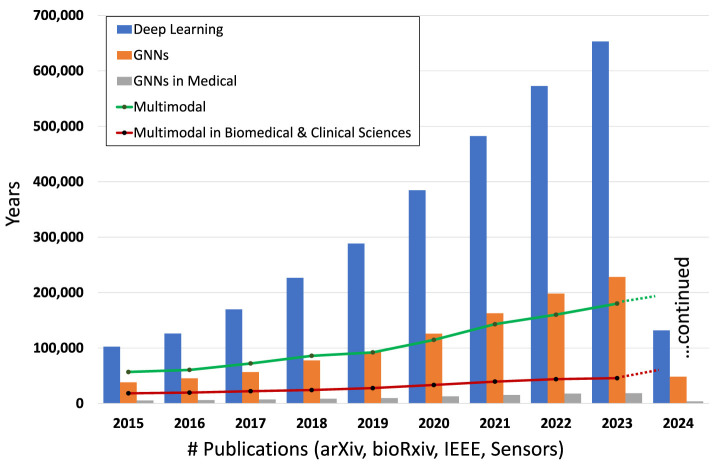
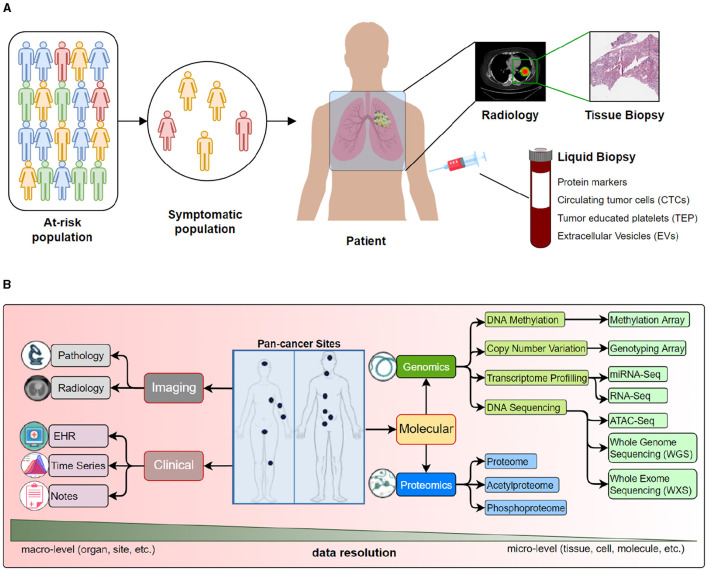
Cancer research encompasses data across various scales, modalities, and resolutions, from screening and diagnostic imaging to digitized histopathology slides to various types of molecular data and clinical records. The integration of these diverse data types for personalized cancer care and predictive modeling holds the promise of enhancing the accuracy and reliability of cancer screening, diagnosis, and treatment. Traditional analytical methods, which often focus on isolated or unimodal information, fall short of capturing the complex and heterogeneous nature of cancer data. The advent of deep neural networks has spurred the development of sophisticated multimodal data fusion techniques capable of extracting and synthesizing information from disparate sources. Among these, Graph Neural Networks (GNNs) and Transformers have emerged as powerful tools for multimodal learning, demonstrating significant success. This review presents the foundational principles of multimodal learning including oncology data modalities, taxonomy of multimodal learning, and fusion strategies. We delve into the recent advancements in GNNs and Transformers for the fusion of multimodal data in oncology, spotlighting key studies and their pivotal findings. We discuss the unique challenges of multimodal learning, such as data heterogeneity and integration complexities, alongside the opportunities it presents for a more nuanced and comprehensive understanding of cancer. Finally, we present some of the latest comprehensive multimodal pan-cancer data sources. By surveying the landscape of multimodal data integration in oncology, our goal is to underline the transformative potential of multimodal GNNs and Transformers. Through technological advancements and the methodological innovations presented in this review, we aim to chart a course for future research in this promising field. This review may be the first that highlights the current state of multimodal modeling applications in cancer using GNNs and transformers, presents comprehensive multimodal oncology data sources, and sets the stage for multimodal evolution, encouraging further exploration and development in personalized cancer care.
Overview
The claims and statistics of this paper haven’t been checked yet.
Free: it reads the open-access text and checks the first 5 claims that cite a source we can check. Create a free account to check every claim.
Integrity signals
Registry
Cites
Statistics
Figures
Verification
Claims the paper makes
The claims and statistics of this paper haven’t been checked yet.
Free: it reads the open-access text and checks the first 5 claims that cite a source we can check. Create a free account to check every claim.
Self-check
Percentages, sums and reported differences re-computed from the paper’s own numbers.
The self-check needs the paper’s full text.
Citations
Cites
Vaswani, A., Shazeer, N., Parmar, N., Uszkoreit, J., Jones, L., Gomez, A. N., Kaiser, L., & Polosukhin, I. (2017) · arXiv · doi:10.48550/arxiv.1706.03762 · Cited by 120,404 · cited 5×
“Recent advancements in MML, powered by Deep Neural Networks (DNNs), have shown remarkable capability in learning from diverse data sources, including computer vision (CV) and natural language processing (NLP) (Bommasani et al., 2022; Achiam et al., 2023).”
BackgroundInfluentialLeCun, Y., Bengio, Y., & Hinton, G. (2015) · Nature · doi:10.1038/nature14539 · Cited by 84,126
BERT: Pre-training of Deep Bidirectional Transformers for Language Understanding
Devlin, J., Chang, M.-W., Lee, K., & Toutanova, K. (2018) · arXiv · doi:10.48550/arxiv.1810.04805 · Cited by 73,173 · cited 3×
“Electronic Health Record ICD Code GNNs [131], ML models [132] -Omics GraphsK-mers GNNs [133] ML model [134] Clinical notes Word BERT [33], RoBERTa [34], BioBERT [135]”
BackgroundMethodAn Image is Worth 16x16 Words: Transformers for Image Recognition at Scale
Dosovitskiy, A., Beyer, L., Kolesnikov, A., Weissenborn, D., Zhai, X., Unterthiner, T., Dehghani, M., Minderer, M., Heigold, G., Gelly, S., et al. (2020) · arXiv · doi:10.48550/arxiv.2010.11929 · Cited by 47,472 · cited 3×
“Deep predictor of drug-drug interactions (DPDDI) predicted the drug-drug interactions using GCN followed by a 5-layer classical neural network (Feng et al., 2020).”
MethodExploring the Limits of Transfer Learning with a Unified Text-to-Text Transformer
Raffel, C., Shazeer, N., Roberts, A., Lee, K., Narang, S., Matena, M., Zhou, Y., Li, W., & Liu, P. J. (2019) · arXiv · doi:10.48550/arxiv.1910.10683 · Cited by 31,859 · cited 1×
“This has led to the development of powerful pre-trained models, such as BERT [48], GPT [165], RoBERTa [49], CLIP [5], T5 [166], BART [167], BLOOM [168], ALIGN [169], SimVLM [170], Florence [171], Flamingo [172], and CoCa [173] which have achieved impressive results on a wide range of NLP, CV, and multimodal tasks.”
MethodSemi-supervised classification with graph convolutional networks
Kipf, T. N., & Welling, M. (2016) · arXiv · doi:10.48550/arxiv.1609.02907 · Cited by 24,853 · cited 18×
“Decagon used a multimodal approach on GCNs using proteins and drug interactions to predict exact side effects as a multi-relational link prediction task (Zitnik et al., 2018).”
MethodInfluentialHigh-Resolution Image Synthesis with Latent Diffusion Models
Rombach, R., Blattmann, A., Lorenz, D., Esser, P., & Ommer, B. (2022) · 2022 IEEE/CVF Conference on Computer Vision and Pattern Recognition (CVPR) · doi:10.1109/cvpr52688.2022.01042 · Cited by 20,302 · cited 1×
“It can also capture complex interactions between the modalities that cannot be easily represented by simple concatenation [190].”
BackgroundSiegel, R. L., Miller, K. D., Wagle, N. S., & Jemal, A. (2023) · CA: A Cancer Journal for Clinicians · doi:10.3322/caac.21763 · Cited by 16,303 · cited 1×
“Cancer is the second most common reason for death in the US, and it is expected to cause 1,670 deaths per day in the US in 2023 [1].”
BackgroundA survey on deep learning in medical image analysis
Litjens, G., Kooi, T., Bejnordi, B. E., Setio, A. A. A., Ciompi, F., Ghafoorian, M., van der Laak, J. A. W. M., van Ginneken, B., & Sánchez, C. I. (2017) · Medical Image Analysis · doi:10.1016/j.media.2017.07.005 · Cited by 15,332 · cited 1×
“…analysis and ML methods to study cancer data use single data modalities [e.g., EHR (Miotto et al., 2016), radiology (Waqas et al., 2021), pathology (Litjens et al., 2017), or molecular, including genomics (Angermueller et al., 2017), transcriptomics (Yousefi et al., 2017), proteomics (Wang et al.,…”
MethodLearning Transferable Visual Models From Natural Language Supervision
Radford, A., Kim, J. W., Hallacy, C., Ramesh, A., Goh, G., Agarwal, S., Sastry, G., Askell, A., Mishkin, P., Clark, J., et al. (2021) · arXiv · doi:10.48550/arxiv.2103.00020 · Cited by 15,293 · cited 6×
“Prominent multimodal foundation models such as Contrastive Language-Image Pretraining (CLIP) and Generative Pretraining Transformer (GPT-4) by OpenAI have set new benchmarks in the field (Radford et al., 2021; Achiam et al., 2023).”
BackgroundMethodInfluential
Research works printed but not linked: 7
- Akter M. Moustafa N. Lynar T. (2022). “Edge intelligence-based privacy protection framework for iot-based smart healthcare systems,”? in IEEE INFOCOM 2022-IEEE Conference on Computer Communications Workshops (INFOCOM WKSHPS) (New York, NY: IEEE), 1– 8.
- Alayrac J.-B. Donahue J. Luc P. Miech A. Barr I. Hasson Y.. (2022). Flamingo: a visual language model for few-shot learning. Adv. Neural Inf. Process. Syst. 35, 23716– 23736. Available online at: https://proceedings.neurips.cc/paper_files/paper/2022/hash/960a172bc7fbf0177ccccbb411a7d800-Abstract-Conference.html
- Al-jabery K. K. Obafemi-Ajayi T. Olbricht G. R. Wunsch I. I. D. C. (2020). “Data preprocessing,”? in K. K. Al-jabery, T. Obafemi-Ajayi, G. R. Olbricht and D. C. Wunsch Computational Learning Approaches to Data Analytics in Biomedical Applications (Cambridge, MA: Academic Press), 7– 27.
- Defferrard M. Bresson X. Vandergheynst P. (2016). Convolutional neural networks on graphs with fast localized spectral filtering. Adv. Neural Inf. Process. Syst. 29, 3844– 3852. Available online at: https://proceedings.neurips.cc/paper_files/paper/2016/file/04df4d434d481c5bb723be1b6df1ee65-Paper.pdf
- Jaegle A. Borgeaud S. Alayrac J.-B. Doersch C. Ionescu C. Ding D.. (2021). Perceiver IO: A General Architecture for Structured Inputs &; Outputs (ICLR).
- Ma L. Yang Z. Miao Y. Xue J. Wu M. Zhou L.. (2019). “NeuGraph: parallel deep neural network computation on large graphs,” in USENIX Annual Technical Conference (USENIX), 443– 458.
- Remmer E. (2022). Explainability Methods for Transformer-based Artificial Neural Networks: a Comparative Analysis (PhD thesis).
Cited by
Transformers in Time-Series Analysis: A Tutorial
Ahmed, S., Nielsen, I. E., Tripathi, A., Siddiqui, S., Ramachandran, R. P., & Rasool, G. (2023) · Circuits, Systems, and Signal Processing · doi:10.1007/s00034-023-02454-8 · Cited by 305
“Apart from classical NLP tasks, examples from other areas include image classification [3], object detection and segmentation [4], image and language generation [5], sequential decision-making in reinforcement learning [6], multi-modal (text, speech, and image) data processing [7], and analysis of tabular and time-ser…”
BackgroundSelf-citationVision-language models for medical report generation and visual question answering: a review
Hartsock, I., & Rasool, G. (2024) · Frontiers in Artificial Intelligence · doi:10.3389/frai.2024.1430984 · Cited by 229
Self-citationDeep learning–driven multi-omics analysis: enhancing cancer diagnostics and therapeutics
Zhang, J., Che, Y., Liu, R., Wang, Z., & Liu, W. (2025) · Briefings in Bioinformatics · doi:10.1093/bib/bbaf440 · Cited by 112
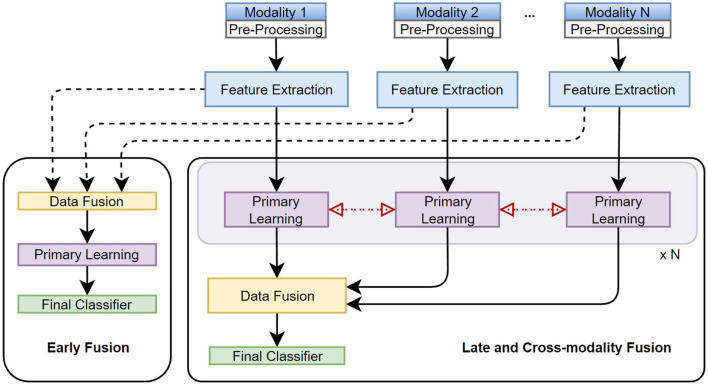
“Data integration strategies can be categorized into early, mid, and late integration [23].”
Artificial Intelligence in Head and Neck Cancer: Innovations, Applications, and Future Directions
Pham, T. D., Teh, M., Chatzopoulou, D., Holmes, S., & Coulthard, P. (2024) · Current Oncology · doi:10.3390/curroncol31090389 · Cited by 89
“The integration of multimodal data is an emerging trend that leverages AI to combine various types of data for a comprehensive understanding of HNC [38,106,246].”
BackgroundA Comprehensive Review of Multimodal Deep Learning for Enhanced Medical Diagnostics
Al‐Zoghby, A. M., Ebada, A. I., Saleh, A. S., Abdelhay, M., & Awad, W. A. (2025) · Computers, materials & continua/Computers, materials & continua (Print) · doi:10.32604/cmc.2025.065571 · Cited by 90
Metadata
- Authors
- Waqas, A., Tripathi, A., Ramachandran, R. P., Stewart, P. A., & Rasool, G.
- Affiliations
- Moffitt Cancer Center (US)
- Rowan University (US)
- Corresponding author
- Waqas, Asim
- Venue
- Frontiers in Artificial Intelligence
- Publisher
- Frontiers Media SA
- Published
- 2024-07-25
- Volume
- 7
- Pages
- 1408843-1408843
- ISSN
- 2624-8212 (ISSN-L)
- PMC
- PMC11308435
- OpenAlex
- W4400981456
- Cited by
- 165
- References
- 206
- Citations by year
- 2026: 81 · 2025: 70 · 2024: 12
- FWCI
- 5.72
- Type
- journal article
- Language
- en
- Open access
- gold
- doi.org
- Licence
- Locations
- Frontiers in Artificial Intelligence (publishedVersion, cc-by)
- PubMed Central (publishedVersion, cc-by)
- PubMed (publishedVersion)
- arXiv (Cornell University) (submittedVersion, cc-by)
- Rowan Digitals Works (Rowan University) (submittedVersion, cc-by)
- DOAJ (DOAJ: Directory of Open Access Journals) (submittedVersion, cc-by-sa)
- arXiv (Cornell University) (cc-by)
- Funders
- National Science Foundation (1903466, 2008690, 2234468, 2234836)
- Moffitt Cancer Center (P30CA076292, CA076292)
- National Cancer Institute (CA076292, P30CA076292)
- Division of Electrical, Communications and Cyber Systems (ECCS-1903466)
- Topics
- Physical Sciences › Computer Science › Computer Vision and Pattern Recognition › Multimodal Machine Learning Applications
- Physical Sciences › Computer Science › Artificial Intelligence › AI in cancer detection
- Health Sciences › Medicine › Radiology, Nuclear Medicine and Imaging › Radiomics and Machine Learning in Medical Imaging
- Keywords
- multimodal data integration, oncology, graph neural networks, transformer models, multimodal fusion, precision oncology, cancer diagnosis, cancer screening, histopathology, molecular data, data heterogeneity
About these checks
Registry, retraction, Cites and statistics results are computed, not judged, with one exception: a printed reference that no index lists is read once by a model before it counts as a citation error. Claims are extracted by a model and kept only when their quote appears verbatim in the text; each cited source is then checked, with a model’s help, for whether it says what the claim relies on. Those verdicts can be wrong — read the claim’s quote and the cited source before relying on one.
Statistics and arithmetic are recomputed, not judged.
Confidence bands are shown only for fields calibrated on our annotated test set. None is calibrated yet, so no band is shown.
What counts as a claim ›How we measure confidence ›How we check this ›
Are you an author, or do you see a problem with this page? Request a review
Data sources
Bibliographic data: Semantic Scholar, OpenAlex, Crossref.
Contains information from the Semantic Scholar Academic Graph Datasets, made available under the ODC Attribution License (ODC-BY 1.0).
Semantic Scholar’s data is described in: Kinney, R., et al. (2023). The Semantic Scholar Open Data Platform. arXiv:2301.10140.
