

Human-centered evaluation of explainable AI applications: a systematic review
Open accessThe DOI matches its Crossref record; 122 of the 122 references it cites were found in a registry or an index.
Abstract
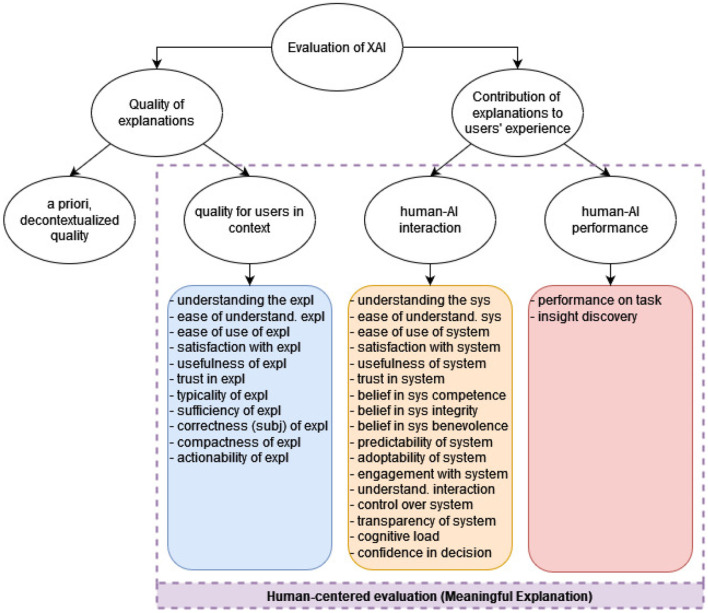
Explainable Artificial Intelligence (XAI) aims to provide insights into the inner workings and the outputs of AI systems. Recently, there's been growing recognition that explainability is inherently human-centric, tied to how people perceive explanations. Despite this, there is no consensus in the research community on whether user evaluation is crucial in XAI, and if so, what exactly needs to be evaluated and how. This systematic literature review addresses this gap by providing a detailed overview of the current state of affairs in human-centered XAI evaluation. We reviewed 73 papers across various domains where XAI was evaluated with users. These studies assessed what makes an explanation “good” from a user's perspective, i.e., what makes an explanation meaningful to a user of an AI system. We identified 30 components of meaningful explanations that were evaluated in the reviewed papers and categorized them into a taxonomy of human-centered XAI evaluation, based on: (a) the contextualized quality of the explanation, (b) the contribution of the explanation to human-AI interaction, and (c) the contribution of the explanation to human-AI performance. Our analysis also revealed a lack of standardization in the methodologies applied in XAI user studies, with only 19 of the 73 papers applying an evaluation framework used by at least one other study in the sample. These inconsistencies hinder cross-study comparisons and broader insights. Our findings contribute to understanding what makes explanations meaningful to users and how to measure this, guiding the XAI community toward a more unified approach in human-centered explainability.
Overview
The claims and statistics of this paper haven’t been checked yet.
Free: it reads the open-access text and checks the first 5 claims that cite a source we can check. Create a free account to check every claim.
Integrity signals
Registry
Cites
Statistics
Figures
Verification
Claims the paper makes
The claims and statistics of this paper haven’t been checked yet.
Free: it reads the open-access text and checks the first 5 claims that cite a source we can check. Create a free account to check every claim.
Claims other papers make about this one
Each is checked against this paper’s own text: does it say what the citing paper says it does?
The cited source says what the claim attributes to it.
In the citing paper
“Previous reviews of XAI have also reported that explainability is sensitive to contextual factors and future research should investigate different groups of end users [15,16].”
From Explainable AI in hospital clinical decision support systems: A scoping review of healthcare professionals’ perspectives (2026) · cites this paper as [16]
Self-check
Percentages, sums and reported differences re-computed from the paper’s own numbers.
The self-check needs the paper’s full text.
Citations
Cites
User Acceptance of Information Technology: Toward A Unified View1
Venkatesh, V., Morris, M. G., Davis, G. B., & Davis, F. D. (2003) · MIS Quarterly · doi:10.2307/30036540 · Cited by 45,035
Development of NASA-TLX (Task Load Index): Results of Empirical and Theoretical Research
(1988) · Advances in Psychology · doi:10.1016/s0166-4115(08)62386-9 · Cited by 15,003
SUS: A 'Quick and Dirty' Usability Scale
(1996) · Usability Evaluation In Industry · doi:10.1201/9781498710411-35 · Cited by 8,989
Technology Acceptance Model 3 and a Research Agenda on Interventions
Venkatesh, V., & Bala, H. (2008) · Decision Sciences · doi:10.1111/j.1540-5915.2008.00192.x · Cited by 8,159
Developing and validating trust measures for e-commerce: an integrative typology
McKnight, D. H., Choudhury, V., & Kacmar, C. (2002) · Information Systems Research · doi:10.1287/isre.13.3.334.81 · Cited by 5,550
Cacioppo, J. T., & Petty, R. E. (1982) · Journal of Personality and Social Psychology · doi:10.1037/0022-3514.42.1.116 · Cited by 5,359
Explanation in Artificial Intelligence: Insights from the Social Sciences
Miller, T. (2017) · arXiv · doi:10.48550/arxiv.1706.07269 · Cited by 5,338
Explanation in artificial intelligence: Insights from the social sciences
Miller, T. (2019) · Artificial Intelligence · doi:10.1016/j.artint.2018.07.007 · Cited by 5,302
Explainable AI: a review of machine learning interpretability methods
Linardatos, P., Papastefanopoulos, V., & Kotsiantis, S. (2020) · Entropy · doi:10.3390/e23010018 · Cited by 2,922 · cited 1×
“For more details about the dichotomies described above, the reader is referred to Linardatos et al. (2020).”
BackgroundInternational Conference on Artificial Neural Networks
(1990) · Neural Networks · doi:10.1016/0893-6080(90)90065-s · Cited by 2,088
Research works printed but not linked: 4
- Förster M. Hühn P. Klier M. Kluge K. (2021). “Capturing users' reality: a novel approach to generate coherent counterfactual explanations,” in Hawaii International Conference on System Sciences. Available at: https://api.semanticscholar.org/CorpusID:232412682
- Ibrahim L. Ghassemi M. M. Alhanai T. (2023). “Do explanations improve the quality of AI-assisted human decisions? An algorithm-in-the-loop analysis of factual and counterfactual explanations,” in Proceedings of the 2023 International Conference on Autonomous Agents and Multiagent Systems (London), 326– 334.
- Kim J. Maathuis H. van Montfort K. Sent D. (in press). “Identifying XAI user needs: gaps between literature use cases in the financial sector,” in Proceedings of the 2nd Workshop on Responsible Applied Artificial Intelligence (RAAIT), at HHAI 2024 (Malmö: CEUR Workshop Proceedings (CEUR-WS.org)). Accepted for publication.
- Schellingerhout R. Medentsiy V. Marx M. (2022). Explainable career path predictions using neural models.
Cited by
Items 101–154 of 154
Analysing Data Paradigms in K–12 Data Science Activities: A Systematic Literature Review
Whyte, R. O., Cheung, M., Childs, K., Waite, J., & Sentance, S. (2026) · Workshop in Primary and Secondary Computing Education · doi:10.1145/3801749.3801757 · Cited by 2
“Another challenge in working with opaque systems is the extent to which they can be explained [41].”
Mızrak, F., & Karakaya, T. (2026) · Data · doi:10.3390/data11090215
“Human-centered approaches therefore evaluate XAI according to user understanding, decision usefulness, and appropriate reliance [26,27].”
Gubitosa, J., Rizzi, V., Fini, P., & Cosma, P. (2026) · Progress in Materials Science · doi:10.1016/j.pmatsci.2026.101820
Explainable Artificial Intelligence Framework for Trustworthy Decision Support Systems
Ahmad, A. (2026) · Formosa Journal of Science and Technology · doi:10.55927/fjst.v5i8.143
Yuan, T., & Rau, P. P. (2026) · International Journal of Human-Computer Studies · doi:10.1016/j.ijhcs.2026.103939
Spagnolli, A., Capuozzo, E., Zaccaria, V., Casadei, O., Öztürk, S., Akyurt, I., Stropeni, A., & Susto, G. A. (2026) · European Conference on Cognitive Ergonomics · doi:10.1145/3822301.3822344
Qaisrani, S. N., Badri, S. K., Khattak, A. M., Alghazzawi, D., Alghamdi, M. Y., Alkhozae, M., Almakky, A., Alhazmi, R. M., & Asghar, M. Z. (2026) · Scientific Reports · doi:10.1038/s41598-026-63529-5
Lenard, D. B., & Kic-Drgas, J. (2026) · e-mentor · doi:10.15219/em114.1746
Maksom, Z., Mohd, C. K. N. C. K., & Shahbodin, F. B. (2026) · International Journal of Research and Innovation in Social Science · doi:10.47772/ijriss.2026.100800927
Park, G. H., & Kang, H. (2026) · Applied Sciences · doi:10.3390/app16199400
Enhancing Rule-Based Explanations via Cognitive Bias Towards Semantic Relevance
Mahya, P., & Fürnkranz, J. (2026) · Information · doi:10.3390/info17090919
What Remains of XAI in Practice? Comparing Literature-Based Methods and Operational Explainability
Geliev, A., Rieder, J. S. I., Aschenbrenner, D., & Gries, T. (2026) · IFIP advances in information and communication technology · doi:10.1007/978-3-032-38618-2_10
Cerezo-Narváez, A., Delgado, M. G., Ramírez-Peña, M., Sánchez-García, D., & Ramos, J. S. (2026) · Frontiers in Artificial Intelligence · doi:10.3389/frai.2026.1962132
“…support, procurement, implementation preparation, and planned operational feedback. is consistent with studies of human-centered digital twins and explain-able AI that treat user interaction and operational usefulness as components of system performance (Bäcklund et al., 2024; Kim et al., 2024).”
FractureSight-HCI: A Human-Centered Interactive System for AI-Assisted X-ray Fracture Visualization
Alhadi, A. M., & Hamhoum, F. A. (2026) · Al-Farooq Journal of Sciences · doi:10.65405/ke61pw60
“Human-centered ex-plainable AI Chen et al. [11], Kim et al. [12], Rong et al. [13] Supports the need for medical AI outputs that are understandable, user-centered, and useful for clinical decision-making.”
Sulaima, M. F., Jyotsna, A., Herout, L., Gálvez, I. P., Krejcar, O., & Namazi, H. (2026) · Energy Nexus · doi:10.1016/j.nexus.2026.100870 · Cited by 1
HUMAN-CENTERED EXPLAINABLE AI FOR CYBERSECURITY: A DESIGN SCIENCE RESEARCH APPROACH
(2026) · Issues in Information Systems · doi:10.48009/2_iis_2026_145
Role of Cognitive Computing in Next-Generation Human–Machine Interaction Systems
Sharma, S. (2026) · Edumania-An International Multidisciplinary Journal · doi:10.59231/edumania/9268
Li, M., Shu, J., Chang, F., Tao, P., Chen, X., 强五一, & Tao, T. (2026) · Scientific Reports · doi:10.1038/s41598-026-73748-5
Ganesh, P., & Namdeo, A. K. (2026) · Journal of Advances in Science and Technology · doi:10.29070/w0j61s95
Pandey, C., Rohilla, A., Kulshrestha, A., & Dangwal, G. (2026) · International Conference on Computer, Mechatronics, Robotics & Artificial Intelligence (ICCMRAI) · doi:10.1109/iccmrai67732.2026.11723772
A Study on a Margin-Based Adaptive UX Framework for Human–Agentic AI Collaboration
Ahn, S. (2026) · Journal of Broadcast Engineering · doi:10.5909/jbe.2026.31.5.948
Nazari, M. (2026) · ACM/IEEE Joint Conference on Digital Libraries · doi:10.1145/3805696.3847140
Adiluzzaman, A., Arif, A., Huq, S. N., & Munna, A. A. (2026) · Global Journal of Engineering and Technology Advances · doi:10.30574/gjeta.2026.29.1.0283 · Cited by 2
SmartInvest: Multi-view Enterprise Ranking and LLM-Assisted Investment Analysis
Zhang, J., Fang, J., Sun, X., Yuan, G., Peng, C., Wang, H., Lu, C., Wang, Z., Wang, Y., & 刘镇喜 (2026) · Lecture notes in computer science · doi:10.1007/978-981-92-6916-7_8
Halal Knowledge Integrity (HKI): A Proposed Governance Framework for AI-Mediated Islamic Knowledge
Ismail, S. A. (2026) · Journal of Halal Science and Management Research · doi:10.24191/jhsmr.v2i2.12815
“…highlights accountability, explainability, meaningful human evaluation, and traceable provenance as complementary conditions for justified trust (Kim et al., 2024; Novelli et al., 2024; Pan et al., 2023; Schneider, 2024), building on earlier trustworthy-AI literature (Thiebes et al., 2021;…”
URFALIOĞLU, M. (2026) · Özgür Yayınları eBooks · doi:10.58830/ozgur.pub1539.c6224
Yönetim Bilişim Sistemlerinde Güncel Yaklaşımlar
Sinap, V. (2026) · Özgür Yayınları eBooks · doi:10.58830/ozgur.pub1539
Design and User-Centred Evaluation of a Persuasive and Explainable AI App for Health Monitoring
Orji, F. A., Ataguba, G., Makwana, H., Bhavsar, D., Rudzicz, F., & Orji, R. (2026) · IEEE International Conference on Intelligent Systems · doi:10.1109/is71416.2026.11727343
“However, recent human-centred XAI research shows that explanations are not automatically beneficial; their impact depends on explanation quality, context, user needs, and how the explanation affects human-AI interaction [6].”
Sari, A. P., Sembiring, M. J., & Kodrat, D. S. (2026) · International Research Journal of Multidisciplinary Scope · doi:10.47857/irjms.2026.v07i04.012592
“Nevertheless, concerns regarding explainability, governance, fairness and ethical accountability remain prominent, particularly when evaluation outputs influence managerial decisions and employee appraisal outcomes (22, 43).”
Explainable AI for Mechanistic Toxicology and Regulatory-Grade Safety Assessment
Alzoubi, A. E., Wahed, M. K. Y. A., & Wahed, S. A. (2026) · Advances in computational intelligence and robotics book series · doi:10.4018/979-8-3373-8562-4.ch011
Urooj, B., Guruge, D. B., & Gyasi-Agyei, A. (2026) · Data and Information Management · doi:10.1016/j.dim.2026.100144
Rachmatsyah, A. D., Kodri, A. A. A., & Wijaya, B. (2026) · Jurnal Teknologi Informasi dan Komunikasi (TIKomSiN) · doi:10.30646/tikomsin.v14i1.1098
“Sejumlah penelitian menunjukkan bahwa SVM memiliki performa tinggi pada data berukuran menengah dengan jumlah fitur yang cukup besar, meskipun proses tuning parameter seperti C dan gamma perlu dilakukan dengan cermat [5], [10].”
InfluentialHuman-Centered Agentic AI Applications: Characteristics and Design Patterns
Zhou, M. X., Lu, J., Huahai, Y., & Chen, W. (2026) · ACM eBooks · doi:10.1145/3805739.3805748
(2026) · ACM eBooks · doi:10.1145/3805739.3805741
Zhou, M. X., Lu, J., Huahai, Y., & Chen, W. (2026) · ACM eBooks · doi:10.1145/3805739.3805753
Zhou, M. X., Lu, J., Huahai, Y., & Chen, W. (2026) · ACM eBooks · doi:10.1145/3805739.3805752
Zhou, M. X., Lu, J., Huahai, Y., & Chen, W. (2026) · ACM eBooks · doi:10.1145/3805739.3805747
Human-Centered Agentic AI Applications in Healthcare
Zhou, M. X., Lu, J., Huahai, Y., & Chen, W. (2026) · ACM eBooks · doi:10.1145/3805739.3805750
Zhou, M. X., Lu, J., Huahai, Y., & Chen, W. (2026) · ACM eBooks · doi:10.1145/3805739.3805744
(2026) · ACM eBooks · doi:10.1145/3805739.3805757
Zhou, M. X., Lu, J., Huahai, Y., & Chen, W. (2026) · ACM eBooks · doi:10.1145/3805739.3805746
(2026) · ACM eBooks · doi:10.1145/3805739.3805740
Agentic AI Solutions for Human Resource Management
Zhou, M. X., Lu, J., Huahai, Y., & Chen, W. (2026) · ACM eBooks · doi:10.1145/3805739.3805756
Agentic AI Solutions for Education
Zhou, M. X., Lu, J., Huahai, Y., & Chen, W. (2026) · ACM eBooks · doi:10.1145/3805739.3805754
Zhou, M. X., Lu, J., Huahai, Y., & Chen, W. (2026) · ACM eBooks · doi:10.1145/3805739.3805743
(2026) · ACM eBooks · doi:10.1145/3805739.3805758
Human-Centered Agentic AI Applications in Human Resource Management
Zhou, M. X., Lu, J., Huahai, Y., & Chen, W. (2026) · ACM eBooks · doi:10.1145/3805739.3805751
Human-Centered Agentic AI Applications in Education
Zhou, M. X., Lu, J., Huahai, Y., & Chen, W. (2026) · ACM eBooks · doi:10.1145/3805739.3805749
Agentic AI Solutions for Healthcare
Zhou, M. X., Lu, J., Huahai, Y., & Chen, W. (2026) · ACM eBooks · doi:10.1145/3805739.3805755
Zhou, M. X., Lu, J., Huahai, Y., & Chen, W. (2026) · ACM eBooks · doi:10.1145/3805739.3805745
Zhou, M. X., Lu, J., Huahai, Y., & Chen, W. (2026) · ACM eBooks · doi:10.1145/3805739
Zhou, M. X., Lu, J., Huahai, Y., & Chen, W. (2026) · ACM eBooks · doi:10.1145/3805739.3805742
Сравнительный анализ XAI-подходов для обнаружения синтетической речи
Ким, К. К. (2026) · Problems of Computational and Applied Mathematics · doi:10.71310/pcam.5_76.2026.06
Thivaios, S., Kostopoulos, G., Stefani, A., & Kotsiantis, S. B. (2026) · Entropy · doi:10.3390/e28111211
Metadata
- Authors
- Kim, J., Maathuis, H., & Sent, D.
- Affiliations
- University of Applied Sciences Utrecht (NL)
- Corresponding author
- Kim, Jenia
- Maathuis, Henry
- Venue
- Frontiers in Artificial Intelligence
- Publisher
- Frontiers Media SA
- Published
- 2024-10-17
- Volume
- 7
- Pages
- 1456486-1456486
- ISSN
- 2624-8212 (ISSN-L)
- PMC
- PMC11525002
- OpenAlex
- W4403501023
- Cited by
- 130
- References
- 118
- Citations by year
- 2026: 105 · 2025: 25
- FWCI
- 4.45
- Type
- journal article
- Language
- en
- Open access
- gold
- doi.org
- Licence
- Locations
- Frontiers in Artificial Intelligence (publishedVersion, cc-by)
- PubMed Central (publishedVersion, cc-by)
- PubMed (publishedVersion)
- DOAJ (DOAJ: Directory of Open Access Journals) (submittedVersion, cc-by-sa)
- Topics
- Physical Sciences › Computer Science › Artificial Intelligence › Explainable Artificial Intelligence (XAI)
- Physical Sciences › Computer Science › Human-Computer Interaction › Usability and User Interface Design
- Social Sciences › Human Factors and Ergonomics › Human-Automation Interaction and Safety
- Keywords
- explainable AI, human-centered evaluation, human-AI interaction
About these checks
Registry, retraction, Cites and statistics results are computed, not judged, with one exception: a printed reference that no index lists is read once by a model before it counts as a citation error. Claims are extracted by a model and kept only when their quote appears verbatim in the text; each cited source is then checked, with a model’s help, for whether it says what the claim relies on. Those verdicts can be wrong — read the claim’s quote and the cited source before relying on one.
Statistics and arithmetic are recomputed, not judged.
Confidence bands are shown only for fields calibrated on our annotated test set. None is calibrated yet, so no band is shown.
What counts as a claim ›How we measure confidence ›How we check this ›
Are you an author, or do you see a problem with this page? Request a review
Data sources
Bibliographic data: Semantic Scholar, OpenAlex, Crossref.
Contains information from the Semantic Scholar Academic Graph Datasets, made available under the ODC Attribution License (ODC-BY 1.0).
Semantic Scholar’s data is described in: Kinney, R., et al. (2023). The Semantic Scholar Open Data Platform. arXiv:2301.10140.
