

Delegated agency and moral responsibility in artificial intelligence
Open accessThe DOI matches its Crossref record; 24 of the 25 references it cites were found in a registry or an index, and 1 are not checked yet; 1 of the 23 sources its claims cite were checked for support.
Abstract
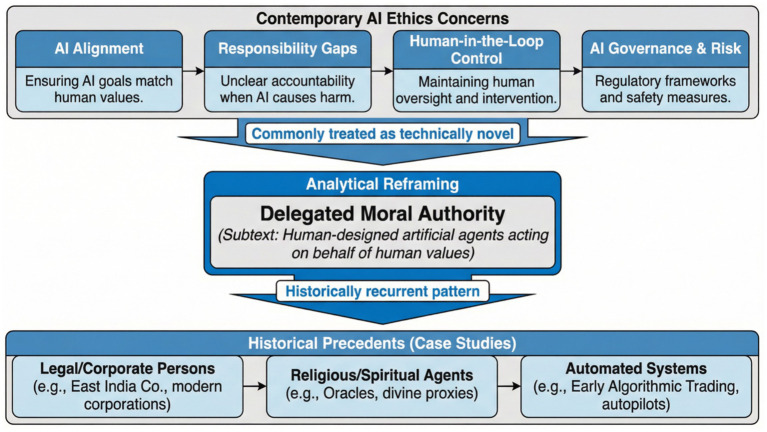
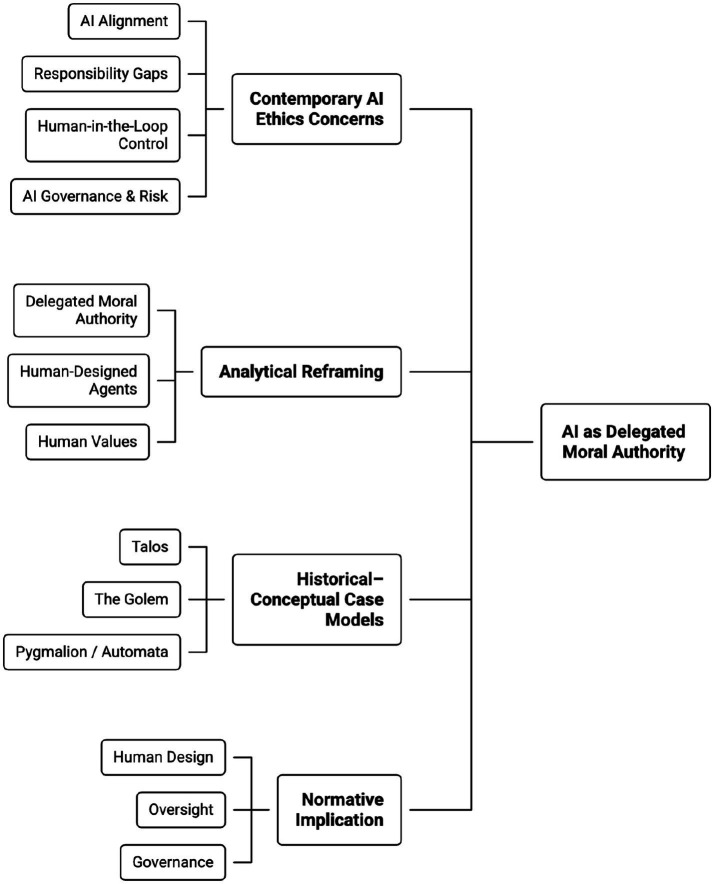
Introduction: Artificial intelligence ethics is often framed as a response to unprecedented technical autonomy, with risks attributed to recent advances in machine learning and scale. This framing overlooks a recurring ethical structure: the delegation of moral authority to artificial agents. Ethical failures associated with AI are best understood as governance failures rooted in human design choices and accountability arrangements, even where opacity and limited control complicate responsibility attribution. Methods: A qualitative, interdisciplinary approach integrates historical-thematic analysis, comparative interpretation of technological artifacts, and visual-conceptual synthesis. Mythological figures (Talos, the Golem, Pygmalion), early mechanical automata, and foundational computational systems are analyzed as conceptual models of delegated artificial agency rather than technological precursors. Results: Across historical contexts, artificial agents exhibit consistent structural features: bounded autonomy, delegated authority, explicit override mechanisms, and dependence on human oversight. These features directly correspond to contemporary AI ethics concerns, including alignment failures, responsibility gaps, human-in-the-loop control, and system interruptibility. Discussion: The analysis establishes that ethical risk in AI arises from the displacement of human responsibility rather than from machine autonomy. By situating AI within a longer history of artificial agency, the study provides a normative framework that locates moral responsibility unambiguously in human actors and institutions, with direct implications for AI governance and accountability.
Verified 2026-11-22 · 1 reference not checked yet
Overview
CoChat Summary
## TL;DR
The paper argues that AI ethics problems are best understood as governance failures caused by humans delegating moral authority to artificial systems, not as a new problem created by machine autonomy. Using mythological and historical cases like Talos, the Golem, automata, and Pygmalion, it claims responsibility must remain with human designers, deployers, and institutions.
## Key findings
- Across the cases analyzed, artificial agents repeatedly show the same structural features: bounded autonomy, delegated authority, explicit override mechanisms, and dependence on human oversight.
- The paper argues that alignment problems are governance problems before they are technical ones; misalignment comes from under-specified or conflicting human objectives, not emergent machine morality.
- It states that responsibility gaps arise from distributed human agency—engineers, deployers, executives, regulators, and users—when accountability pathways are unclear.
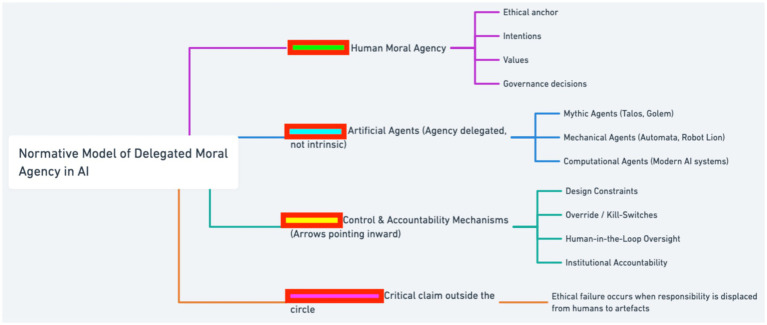
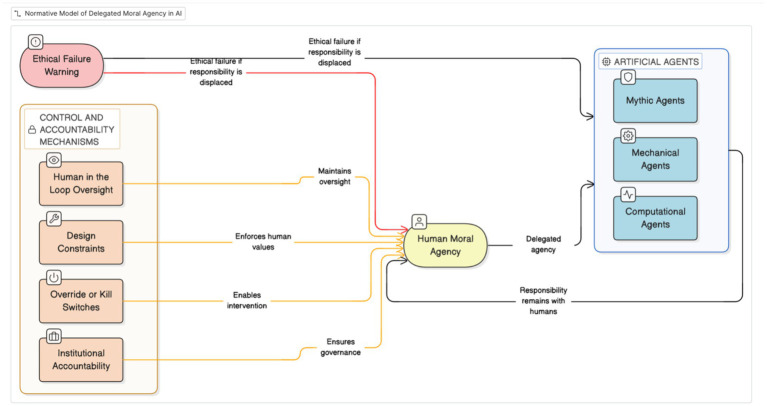
- The normative model specifies five criteria for proper delegation in frontier systems: auditability, interruptibility, reversibility, capability bounding, and compute monitoring/reporting.
## Methods
- The study uses a qualitative, interdisciplinary, historically grounded interpretive methodology combining historical-thematic analysis, comparative interpretation of technological artifacts, and visual/conceptual synthesis.
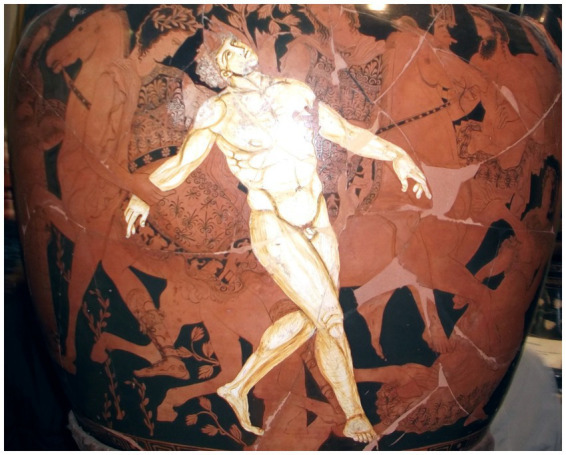
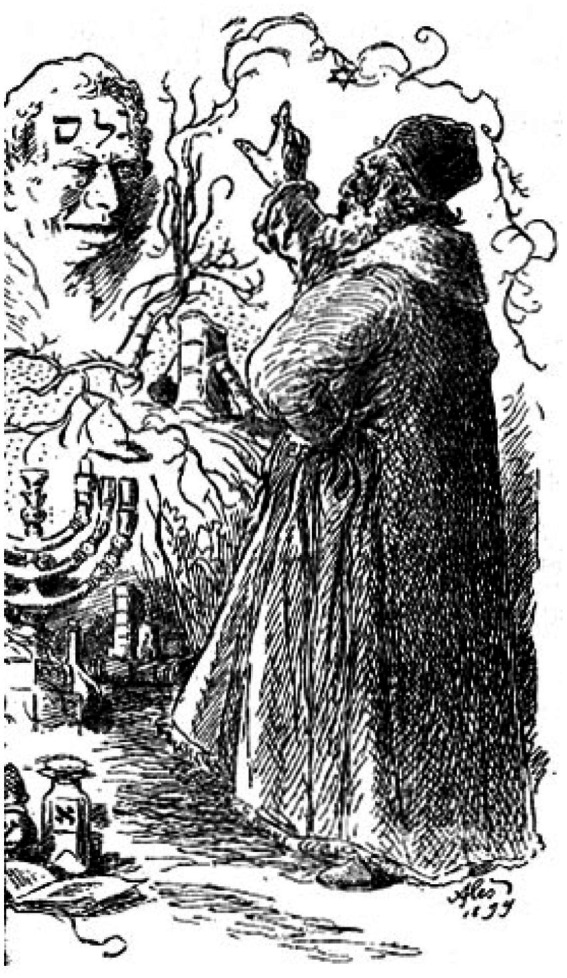
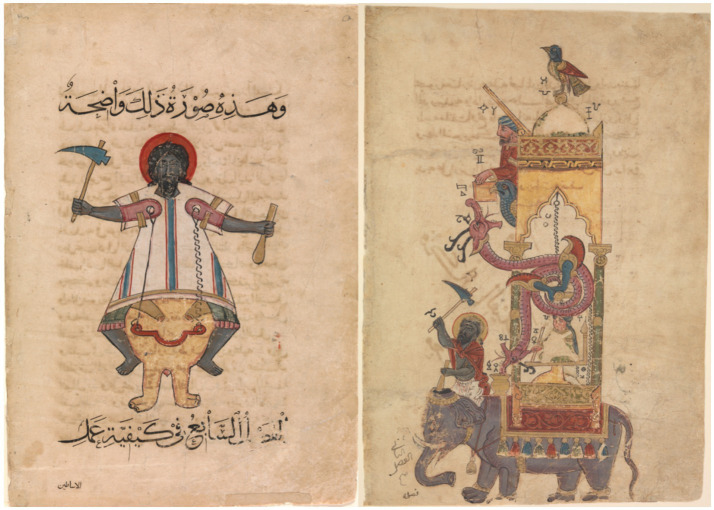
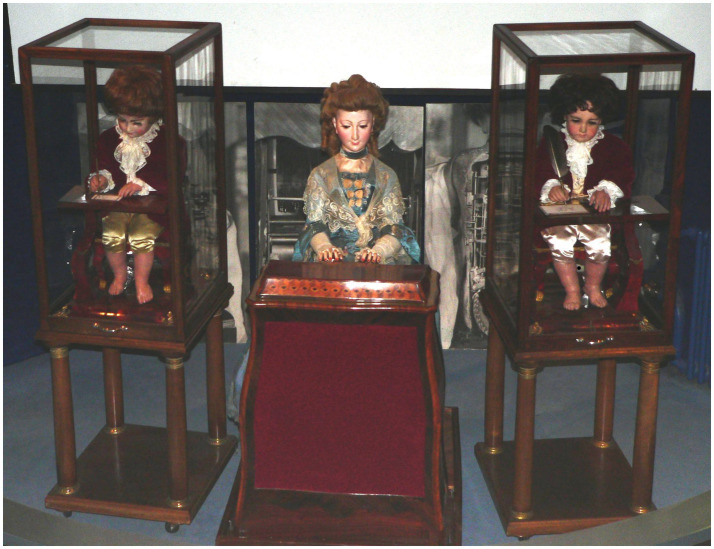
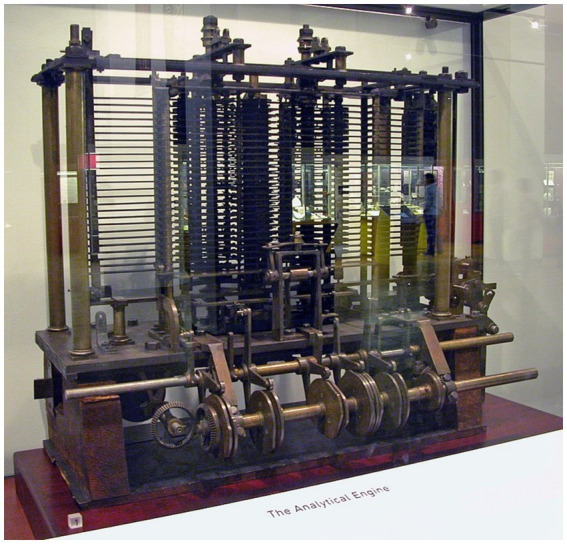
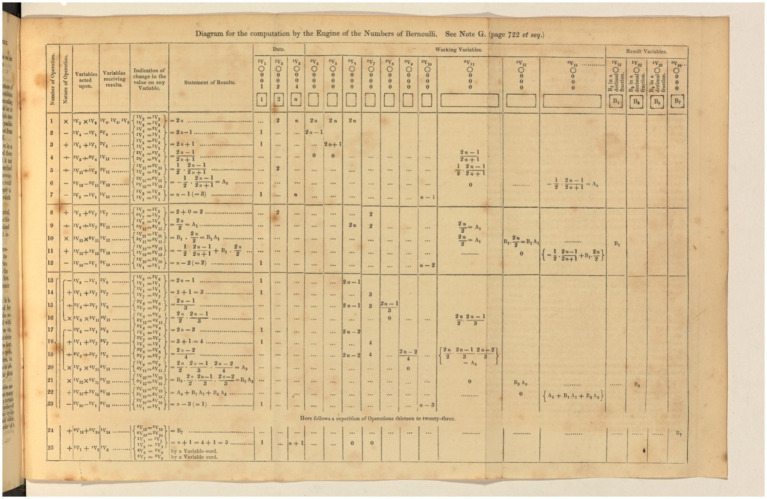
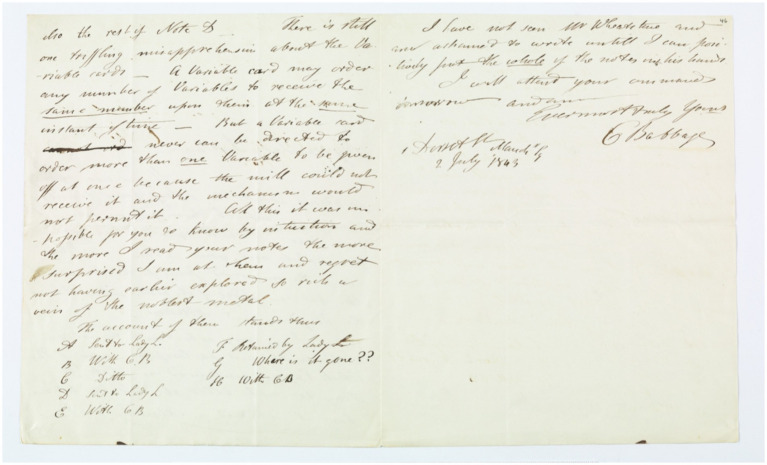
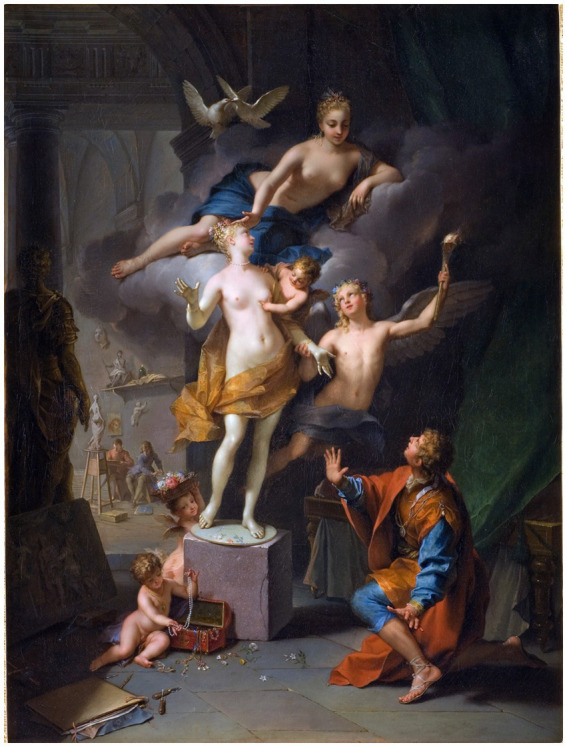
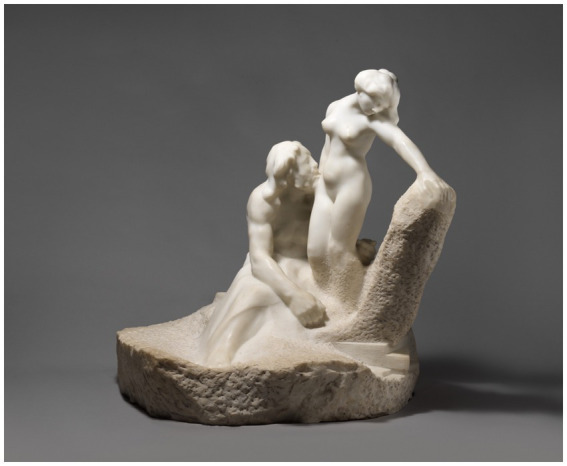
- The sample/cases are mythological figures (Talos, the Golem, Pygmalion), mechanical automata (including Al-Jazari and Jaquet-Droz), and early computational systems (Babbage and Lovelace).
- The main analysis compares cases using three criteria: mandate structure, control/override mechanisms, and failure mode, then applies those structural findings to contemporary AI ethics.
## Limitations
- The paper states that it is a normative and conceptual argument rather than a systematic literature review.
- It says the cases are not exhaustive representations of artificial beings in cultural history and were selected for structural clarity over chronological exhaustiveness.
- Evident from the text: the analysis is thematic rather than empirical, so it does not provide original experiments, datasets, or quantitative validation.
Model-written summary. Check it against the paper before relying on it.
Integrity signals
Registry
Cites
Statistics
Figures



Verification
Claims the paper makes
1 Valid · 14 Not valid · 16 Not checked · 153 Own results and interpretations
A conclusion the paper draws from its own results — it cites no other source for it, so there is none to check. The quote shows it is in the paper.
In the paper
“A historically informed and conceptually grounded approach clarifies that existing ethical principles, such as accountability, oversight, and alignment, do not fail due to conceptual insufficiency, but due to systematic displacement of responsibility.”
§ Delegated agency and moral responsibility in artificial intelligence > Introduction
boostedstates a cause- Asserted: passes — The authors put it forward as true.
- Checkable: passes — It can be checked against evidence.
- Load-bearing: passes — The paper’s conclusions depend on it.
- Based: unclear — It is unclear why the paper says it holds.
A conclusion the paper draws from its own results — it cites no other source for it, so there is none to check. The quote shows it is in the paper.
In the paper
“These features directly correspond to contemporary AI ethics concerns, including alignment failures, responsibility gaps, human-in-the-loop control, and system interruptibility.”
§ Delegated agency and moral responsibility in artificial intelligence > Abstract > Results
plainstates an association- Asserted: passes — The authors put it forward as true.
- Checkable: passes — It can be checked against evidence.
- Load-bearing: passes — The paper’s conclusions depend on it.
- Based: unclear — It is unclear why the paper says it holds.
A conclusion the paper draws from its own results — it cites no other source for it, so there is none to check. The quote shows it is in the paper.
In the paper
“Ethical failures associated with AI are best understood as governance failures rooted in human design choices and accountability arrangements, even where opacity and limited control complicate responsibility attribution.”
- Also stated in: § Introduction · plain
“Harmful outcomes attributed to AI are better explained by human design choices, institutional incentives, and governance failures than by machine autonomy itself.”
- Also stated in: § Scholarly contribution and argumentative positioning · plain
“the ethical risks associated with AI stem less from machine autonomy than from human design choices, governance failures, and moral outsourcing.”
§ Delegated agency and moral responsibility in artificial intelligence > Abstract > Introduction
plainstates a cause- Asserted: passes — The authors put it forward as true.
- Checkable: passes — It can be checked against evidence.
- Load-bearing: passes — The paper’s conclusions depend on it.
- Based: passes — The paper gives a reason why it holds.
- Also stated in: § Introduction · plain
A conclusion the paper draws from its own results — it cites no other source for it, so there is none to check. The quote shows it is in the paper.
In the paper
“The central ethical problem is therefore not whether AI systems possess moral agency, but how moral responsibility is allocated, constrained, and enforced when authority is delegated to artificial systems operating at speed, scale, and organizational distance.”
§ Delegated agency and moral responsibility in artificial intelligence > Introduction
plain- Asserted: passes — The authors put it forward as true.
- Checkable: unclear — It is unclear whether it could be checked against evidence.
- Load-bearing: passes — The paper’s conclusions depend on it.
- Based: passes — The paper gives a reason why it holds.
A conclusion the paper draws from its own results — it cites no other source for it, so there is none to check. The quote shows it is in the paper.
In the paper
“Delegated moral authority, when combined with scale and abstraction, renders human accountability opaque unless explicitly constrained by institutional mechanisms.”
§ Delegated agency and moral responsibility in artificial intelligence > Introduction
plainstates a cause- Asserted: passes — The authors put it forward as true.
- Checkable: passes — It can be checked against evidence.
- Load-bearing: passes — The paper’s conclusions depend on it.
- Based: unclear — It is unclear why the paper says it holds.
32 more claims
Create a free account to see all 184 claims and to verify the 1 reference still open.
- It may state two separate claims as one. 65
- Probably not a substantial claim. 126
Citations
Cites
Intriguing properties of neural networks
Szegedy, C., Zaremba, W., Sutskever, I., Bruna, J., Erhan, D., Goodfellow, I., & Fergus, R. (2013) · arXiv · doi:10.48550/arxiv.1312.6199 · Cited by 8,143 · cited 1×
“Talos’ vulnerability due to a single point of failure is similar to weaknesses in current security systems, such as inadequate encryption methods or susceptibility to attacks from adversaries (Szegedy et al., 2013).”
The global landscape of AI ethics guidelines
Jobin, A., Ienca, M., & Vayena, E. (2019) · Nature Machine Intelligence · doi:10.1038/s42256-019-0088-2 · Cited by 6,220 · cited 1×
“(Floridi et al., 2018; Bartoletti, 2019; Jobin et al., 2019; Milano et al., 2020; IEEE, 2023; Partnership on AI, 2023), the complexity of the ethical landscape and the potential for misuse continue to raise concerns (Mittelstadt, 2019; Roberts et al., 2021; Mökander et al., 2024).”
Floridi, L., Cowls, J., Beltrametti, M., Chatila, R., Chazerand, P., Dignum, V., Luetge, C., Madelin, R., Pagallo, U., Rossi, F., et al. (2018) · Minds and Machines · doi:10.1007/s11023-018-9482-5 · Cited by 4,774 · cited 3×
“Contemporary AI ethics scholarship has addressed alignment (Russell, 2022), responsibility gaps, governance frameworks (Tabassi, 2023a), and value pluralism (Floridi et al., 2018).”
Artificial Intelligence Risk Management Framework (AI RMF 1.0)
Tabassi, E. (2023) · doi:10.6028/nist.ai.100-1 · Cited by 2,951
Principles alone cannot guarantee ethical AI
Mittelstadt, B. (2019) · Nature Machine Intelligence · doi:10.1038/s42256-019-0114-4 · Cited by 1,886 · cited 1×
“(Floridi et al., 2018; Bartoletti, 2019; Jobin et al., 2019; Milano et al., 2020; IEEE, 2023; Partnership on AI, 2023), the complexity of the ethical landscape and the potential for misuse continue to raise concerns (Mittelstadt, 2019; Roberts et al., 2021; Mökander et al., 2024).”
Moralizing Technology: Understanding and Designing the Morality of Things
Verbeek, P.-P. (2011) · doi:10.7208/chicago/9780226852904.001.0001 · Cited by 923
Wallach, W., & Allen, C. (2009) · Oxford University Press · doi:10.1093/acprof:oso/9780195374049.001.0001 · Cited by 711 · cited 2×
“Other studies explore the possibility of “machine ethics” through computational implementation of moral decision procedures (Wallach and Allen, 2009).”
The Chinese approach to artificial intelligence: an analysis of policy, ethics, and regulation
Roberts, H., Cowls, J., Morley, J., Taddeo, M., Wang, V., & Floridi, L. (2021) · AI & SOCIETY · doi:10.1007/s00146-020-00992-2 · Cited by 573 · cited 1×
“(Floridi et al., 2018; Bartoletti, 2019; Jobin et al., 2019; Milano et al., 2020; IEEE, 2023; Partnership on AI, 2023), the complexity of the ethical landscape and the potential for misuse continue to raise concerns (Mittelstadt, 2019; Roberts et al., 2021; Mökander et al., 2024).”
Recommender systems and their ethical challenges
Milano, S., Taddeo, M., & Floridi, L. (2020) · AI & SOCIETY · doi:10.1007/s00146-020-00950-y · Cited by 556 · cited 1×
“(Floridi et al., 2018; Bartoletti, 2019; Jobin et al., 2019; Milano et al., 2020; IEEE, 2023; Partnership on AI, 2023), the complexity of the ethical landscape and the potential for misuse continue to raise concerns (Mittelstadt, 2019; Roberts et al., 2021; Mökander et al., 2024).”
Islamic Science and the Making of the European Renaissance
Saliba, G. (2007) · The MIT Press eBooks · doi:10.7551/mitpress/3981.001.0001 · Cited by 492
The Machine Question: Critical Perspectives on AI, Robots, and Ethics
Gunkel, D. J. (2012) · doi:10.7551/mitpress/8975.001.0001 · Cited by 449 · cited 2×
“…reflect a synthesis of positions in contemporary debates on moral agency and machine ethics (Wallach and Allen, 2009; Coeckelbergh, 2010, 2012; Gunkel, 2012; Parviainen and Coeckelbergh, 2021), while adopting a more restrictive criterion that ties moral agency to intentionality, normative…”
The Machine Question: Ethics, Alterity, and Technology
Gunkel, D. J. (2007) · Series in Philosophy/Communication · doi:10.5840/philcomm200745 · Cited by 440
Robot rights? Towards a social-relational justification of moral consideration
Coeckelbergh, M. (2010) · Ethics and Information Technology · doi:10.1007/s10676-010-9235-5 · Cited by 391 · cited 2×
“These definitions reflect a synthesis of positions in contemporary debates on moral agency and machine ethics (Wallach and Allen, 2009; Coeckelbergh, 2010, 2012; Gunkel, 2012; Parviainen and Coeckelbergh, 2021), while adopting a more restrictive criterion that ties moral agency to intentionality,…”
Auditing Large Language Models: A Three-Layered Approach
Mökander, J., Schuett, J., Kirk, H. R., & Floridi, L. (2023) · doi:10.2139/ssrn.4361607 · Cited by 292
Auditing large language models: a three-layered approach
Mökander, J., Schuett, J., Kirk, H. R., & Floridi, L. (2023) · arXiv · doi:10.48550/arxiv.2302.08500 · Cited by 292
Auditing large language models: a three-layered approach
Mökander, J., Schuett, J., Kirk, H. R., & Floridi, L. (2024) · AI and Ethics · doi:10.1007/s43681-023-00289-2 · Cited by 289
Coeckelbergh, M. (2012) · Palgrave Macmillan UK eBooks · doi:10.1057/9781137025968 · Cited by 171 · cited 2×
“These definitions reflect a synthesis of positions in contemporary debates on moral agency and machine ethics (Wallach and Allen, 2009; Coeckelbergh, 2010, 2012; Gunkel, 2012; Parviainen and Coeckelbergh, 2021), while adopting a more restrictive criterion that ties moral agency to intentionality,…”
Parviainen, J., & Coeckelbergh, M. (2021) · AI & SOCIETY · doi:10.1007/s00146-020-01104-w · Cited by 164
Gods and Robots: Myths, Machines, and Ancient Dreams of Technology
Mayor, A. (2018) · Princeton University Press eBooks · doi:10.2307/j.ctvc779xn · Cited by 164 · cited 1×
“Alongside other creations attributed to Daedalus, such as animated statues and mechanical constructs, Talos is part of a mythic lineage that envisions lifelike automata capable of independent movement and reaction (Mayor, 2018).”
Cybernetics, Automata Studies, and the Dartmouth Conference on Artificial Intelligence
Kline, R. (2011) · IEEE Annals of the History of Computing · doi:10.1109/mahc.2010.44 · Cited by 155 · cited 4×
“Islamic lands had already developed sophisticated mechanical devices, including automata in the form of animals and human figures (see Figure 13) long before the emergence of modern robotics (Al-Jazari, 1974; Hill, 1974; Saliba, 2007, 2022).”
InfluentialArtificial Intelligence and the Problem of Control
Russell, S. (2021) · Springer eBooks · doi:10.1007/978-3-030-86144-5_3 · Cited by 133
AI in Healthcare: Ethical and Privacy Challenges
Bartoletti, I. (2019) · Conference on Artificial Intelligence in Medicine in Europe · doi:10.1007/978-3-030-21642-9_2 · Cited by 95
Mayor, A. (2018) · Princeton University Press eBooks · doi:10.1515/9780691185446 · Cited by 74
Do ChatGPT and Other AI Chatbots Pose a Cybersecurity Risk?: An Exploratory Study
Sebastian, G. (2023) · International Journal of Security and Privacy in Pervasive Computing · doi:10.4018/ijsppc.320225 · Cited by 51
Robertson, M. (1977) · The Journal of Hellenic Studies · doi:10.2307/631029
Research works printed but not linked: 17
- Anderson M. (2006). Amazing Leonardo da Vinci Inventions: You Can Build Yourself. Christian St.White River Junction, VT: Nomad Press.
- Babbage C. (1833). Difference Engines, and Analytical Engines. Shoreline Blvd.Mountain View, CA. Computer History Museum.
- Bokser B. Z. (1954). From the World of the Cabbalah. New York, NY: Philosophical Library.
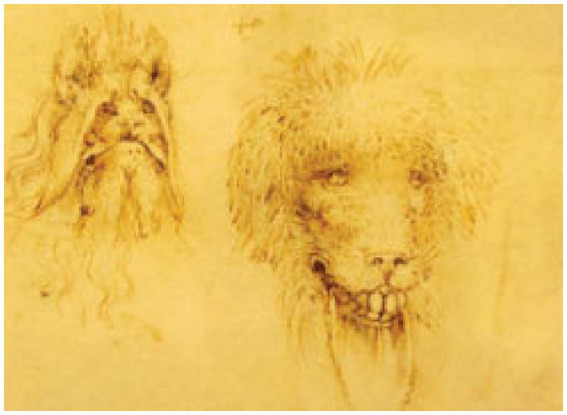
- Bruderer H. (2019). Leonardo da Vinci’s robot lion. Commun. ACM. Available online at: https://cacm.acm.org/blogcacm/leonardo-da-vincis-robot-lion/ (Accessed November 04, 2019).
- Dodge M. M. (2012). St. Nicholas: A Monthly Magazine for Boys and Girls. Charleston, SC: Nabu Press.
- Froelings L. (2018). How machine learning works and why it’s important. Payments J. Available online at: https://www.paymentsjournal.com/how-machine-learning-works-and-why-its-important/
- Ginsburg M. (1997). Clay Boy: Adapted from a Russian Folk Tale. New York, NY: Greenwillow Books.
- Hamilton E. (1953). Mythology. Calcutta: Tridibesh Basu.
- Hollings C. Martin U. Rice A. C. Adrian C. (2018b). Ada Lovelace: the making of a computer scientist. Oxford, UK: Bodleian Library Publishing.
- IEEE (2023). IEEE introduces new program for free access to AI ethics and governance standards. Piscataway, NJ: IEEE Standards Association.
- Ovid (2004). Metamorphoses. Translated by David Raeburn. London: Penguin Classics. Available online at: https://www.google.com/search?q=Ovid.+(2004).+Metamorphoses+(D.+Raeburn%2C+Trans.).+Penguin+Classics.+(Original+work+published+c.+8+CE)&oq=Ovid.+(2004).+Metamorphoses+(D.+Raeburn%2C+Trans.).+Penguin+Classics.+(Original+work+published+c.+8+CE)&gs_lcrp=EgZjaHJvbWUyBggAEEUYOdIBBzE2OGowajeoAgCwAgA&sourceid=chrome&ie=UTF-8 (Accessed March 21, 2026)
- Payes R. (2019). Leonardo da Vinci’s Lion Robot. Washington, DC: Edge of Yesterday.
- Rodin A. (1889) Pygmalion and Galatea. The Met Fifth Avenue in Gallery 800. New York, NY: The Metropolitan Museum of Art.
- Saliba G. (2022) Revisiting the Function of Mechanical Devices in Islamic Civilization. New York, NY: New York Academy of Sciences.
- Sparkes B. A. (1996). The red and the black: Studies in Greek Pottery. Routledge. Available online at: https://www.routledge.com/The-Red-and-the-Black-Studies-in-Greek-Pottery/Sparkes/p/book/9780415126618 (Accessed October 9, 2023)
- Time-Life Books (2014). Mysteries of the Unknown: Inside the World of the Strange and Unexplained. New York, NY: Time-Life.
- Yaghmour Y. (2019). Development of a Humanoid Robot for Educational Purposes. Lebanese International University. Available online at: https://www.researchgate.net/publication/353049334_Development_of_a_Humanoid_Robot_for_Educational_Purposes (Accessed January 21, 2025)
Metadata
- Authors
- Radanliev, P.
- Affiliations
- University of Oxford (GB)
- Corresponding author
- Radanliev, Petar
- ORCID
- Radanliev, Petar
- Venue
- Frontiers in Artificial Intelligence
- Publisher
- Frontiers Media SA
- Published
- 2026-04-15
- Volume
- 9
- Pages
- 1800302-1800302
- ISSN
- 2624-8212 (ISSN-L)
- PMC
- PMC13125054
- OpenAlex
- W7154531124
- Cited by
- 1
- References
- 15
- Citations by year
- 2026: 1
- FWCI
- 5.63
- Type
- journal article
- Language
- en
- Open access
- gold
- doi.org
- Licence
- Locations
- Frontiers in Artificial Intelligence (publishedVersion, cc-by)
- PubMed (publishedVersion)
- PubMed Central (publishedVersion, cc-by)
- DOAJ (DOAJ: Directory of Open Access Journals) (submittedVersion, cc-by-sa)
- Funders
- Bill and Melinda Gates Foundation (INV-057591)
- Engineering and Physical Sciences Research Council (EP/W020408/1, EP/S035362/1)
- Topics
- Physical Sciences › Computer Science › Artificial Intelligence › Ethics and Social Impacts of AI
- Social Sciences › Arts and Humanities › History and Philosophy of Science › Cybernetics and Technology in Society
- Social Sciences › Law › Literary and Philosophical Studies
- Keywords
- moral responsibility, AI ethics, AI governance, accountability, human oversight, human-in-the-loop control, machine autonomy, AI alignment, Talos, Golem, Pygmalion, mechanical automata, attribution of responsibility
About these checks
Registry, retraction, Cites and statistics results are computed, not judged, with one exception: a printed reference that no index lists is read once by a model before it counts as a citation error. Claims are extracted by a model and kept only when their quote appears verbatim in the text; each cited source is then checked, with a model’s help, for whether it says what the claim relies on. Those verdicts can be wrong — read the claim’s quote and the cited source before relying on one.
The claim verdicts this report counts are experimental: their accuracy is not yet measured.
A language model drew the claims from the paper on 2026-10-10, under version 3 of the claim definition (model deepseek-v4.1-flash, prompt extract-v3).
A second model labelled each claim on 2026-10-10 (model jev-1.13-20260917, definition revision gold-guideline-v0.2).
Statistics and arithmetic are recomputed, not judged.
Confidence bands are shown only for fields calibrated on our annotated test set. None is calibrated yet, so no band is shown.
What counts as a claim ›How we measure confidence ›How we check this ›
Are you an author, or do you see a problem with this page? Request a review
Data sources
Bibliographic data: Semantic Scholar, OpenAlex, Crossref.
Contains information from the Semantic Scholar Academic Graph Datasets, made available under the ODC Attribution License (ODC-BY 1.0).
Semantic Scholar’s data is described in: Kinney, R., et al. (2023). The Semantic Scholar Open Data Platform. arXiv:2301.10140.
