

From Local Product to Destination Identity: Leveraging Cave-Aged Cheese for Sustainable Rural Tourism Development
Open accessThe DOI matches its Crossref record; 79 of the 80 references it cites were found in a registry or an index, and 1 are not checked yet; none of the 23 sources its claims cite is checked for support yet.
Abstract
This study investigates how local gastronomic products with strong cultural and heritage value can contribute to destination identity and sustainable rural tourism development. Focusing on cave-aged cheeses, it emphasizes the case of Roquefort-sur-Soulzon (France), where traditional cheese-making and natural cave-aging have been successfully integrated into tourism experiences that reflect terroir, authenticity, and rural heritage. To explore tourist motivations, a survey of 416 visitors was conducted. Factor analysis and Structural Equation Modeling (SEM) were used to identify the main drivers behind cheese-related tourism. The analysis revealed three key motivational factors: Traditional Gastronomy, linked to interest in regional food practices; Cheese Experience, emphasizing the unique appeal of Roquefort cheese; and Heritage Tourism, reflecting a desire to connect with rural identity and sustainable traditions. These results support the hypothesis that culturally significant local food products can serve as central elements in shaping place identity and attracting visitors through immersive, heritage-based experiences. The study concludes that food heritage can be a powerful tool for rural development, offering economic, cultural, and experiential value. It also identifies similar opportunities in Serbian regions such as Pirot and Sokobanja, where traditional kačkavalj cheese and natural cave environments present strong potential for tourism growth rooted in local identity.
Checked 2026-11-24 · 1 reference not checked yet
Overview
CoChat Summary
TL;DR
This study uses a survey of 416 visitors to Roquefort-sur-Soulzon and factor analysis/SEM to show that cave-aged cheese heritage can shape destination identity and motivate sustainable rural tourism. It identifies Traditional Gastronomy, Cheese Experience, and Heritage Tourism as three motivational factors and proposes transfer to Serbian cave-aged kačkavalj contexts such as Pirot and Sokobanja.
Key findings
- EFA extracted three factors accounting for 84.781% of total variance: Traditional Gastronomy (Food Heritage 0.999, Local Tasting 0.952, Sustainable Traditions 0.707), Cheese Experience (Cheese Heritage 0.910, Authentic Tasting 0.807, Culinary Exploration 0.836, Cheese Indulgence 0.779), and Heritage Tourism (Cultural Immersion 0.987, Cultural Heritage 0.756, Rural Escape 0.779).
- KMO was 0.754; Bartlett’s test was χ² = 4152.815, df = 45, p < 0.001. SEM fit indicators were RMSEA 0.060, CFI 0.968, TLI 0.948, and GFI 0.930; all six sub-hypotheses were supported.
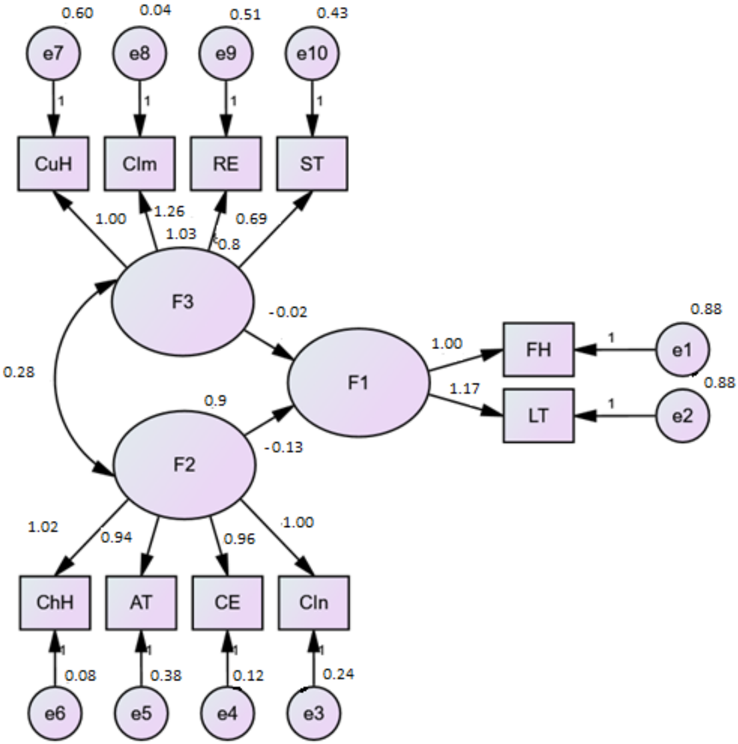
- Cheese Experience was a robust construct, but SEM showed a negative relationship between Cheese Experience and Traditional Gastronomy (reported as standardized weight −0.959; later described as β = −0.13), suggesting experiential specialization. Cheese Experience and Heritage Tourism were correlated (path coefficient 0.28).
- The sample included 416 valid respondents; 52.4% were international and 47.6% domestic French (n = 198). The largest age group was 45–54 (40.1%), and 66.3% had completed high school. Roquefort-sur-Soulzon attracts approximately 200,000 visitors annually.
Methods
- Quantitative, positivist, deductive design using a structured questionnaire with 35 items on a five-point Likert scale, based on previously validated constructs. Data were collected on-site in Roquefort-sur-Soulzon during summer 2024 via convenience sampling at Société Caves, cheese producers (Roquefort Gabriel Coulet and Papillon), and hiking trails of the Parc Naturel Régional des Grands Causses.
- The sample comprised 416 valid respondents; the paper states this is valid for a tourist population of about 200,000 at 95% confidence and 5% margin of error, with an optimal sample size of 384. Demographics: 52.2% male, 47.8% female; age mostly 45–54 (40.1%), 55–64 (28.8%), and 65+ (16.3%); education mostly high school (66.3%).
- Analysis used exploratory factor analysis (KMO, Bartlett’s test, eigenvalues > 1, rotation) and Structural Equation Modeling to test the overarching hypothesis and sub-hypotheses H1–H6.
Limitations
- The paper states the study was conducted in a single geographical location (Roquefort-sur-Soulzon), limiting generalizability; data collection occurred in a specific season, potentially introducing seasonal bias; and the demographic profile may have influenced results in ways not fully representative of the broader tourist population.
- The paper states future research should use longitudinal and comparative approaches across multiple regions and seasons, plus qualitative insights from local producers and tourists.
- Evident from the text: convenience sampling and cross-sectional summer-only data limit causal and generalizable claims; the reported SEM coefficient for Cheese Experience → Traditional Gastronomy appears inconsistent (−0.959 vs. −0.13), and some tables are not populated in the provided text.
Model-written summary. Check it against the paper before relying on it.
Integrity signals
Registry
Cites
Statistics
Figures
Verification
Claims the paper makes
0 Valid · 4 Not valid · 20 Not checked · 74 Own results and interpretations
In the paper
“The confirmation of authenticity as a catalyst for immersive experiences is also in line with Hsu et al. [77] though this study contributes by unpacking the emotional and psychological mechanisms underpinning such engagement.”
§ From Local Product to Destination Identity: Leveraging Cave-Aged Cheese for Sustainable Rural Tourism Development > 5.5. Interpretation of Findings in Light of Existing Literature
What the sources say
- Not checked yetcites Hsu et al. [77] Hsu, F.-C.; Agyeiwaah, E.; Chen, L.I-L. Examining food festival attendees' existential authenticity and experiential value on affective factors and loyalty: An application of stimulus-organism-response paradigm. J. Hosp. Tour. Manag. 2021, 48, 264-274. https://doi.org/10.1016/j.jhtm.2021.06.014. source
plainstates a cause- Asserted: passes — The authors put it forward as true.
- Checkable: passes — It can be checked against evidence.
- Load-bearing: unclear — It is unclear whether the paper’s conclusions depend on it.
- Based: passes — The paper gives a reason why it holds.
A result the paper reports from its own data — it cites no other source for it, so there is none to check. The quote shows it is in the paper.
In the paper
“The international segment was composed primarily of tourists from Germany (12.5%), followed by the United Kingdom (8.7%), Spain (8.7%), the Netherlands (7.7%), Belgium (6.7%), the United States (4.8%), and Japan (3.4%).”
§ From Local Product to Destination Identity: Leveraging Cave-Aged Cheese for Sustainable Rural Tourism Development > 3. Materials and Methods
plain- Asserted: passes — The authors put it forward as true.
- Checkable: passes — It can be checked against evidence.
- Load-bearing: unclear — It is unclear whether the paper’s conclusions depend on it.
- Based: passes — The paper gives a reason why it holds.
A result the paper reports from its own data — it cites no other source for it, so there is none to check. The quote shows it is in the paper.
In the paper
“High agreement scores on statements like “The opportunity to taste authentic, local cheese motivated me to visit Roquefort-sur-Soulzon” and “Learning about the history of Roquefort cheese was a major reason for my visit” confirm the centrality of cheese to the travel motivation.”
§ From Local Product to Destination Identity: Leveraging Cave-Aged Cheese for Sustainable Rural Tourism Development > 3. Materials and Methods
plainstates a cause- Asserted: passes — The authors put it forward as true.
- Checkable: passes — It can be checked against evidence.
- Load-bearing: passes — The paper’s conclusions depend on it.
- Based: passes — The paper gives a reason why it holds.
A result the paper reports from its own data — it cites no other source for it, so there is none to check. The quote shows it is in the paper.
In the paper
“However, the SEM results from Roquefort also suggest that traditional gastronomy (F1)-though thematically related-is not automatically activated by cheese-related motivations, as evidenced by its negative relationship with the core cheese experience factor.”
§ From Local Product to Destination Identity: Leveraging Cave-Aged Cheese for Sustainable Rural Tourism Development > 5.6. Practical Implications
hedgedstates an associationSingle case- Asserted: passes — The authors put it forward as true.
- Checkable: passes — It can be checked against evidence.
- Load-bearing: passes — The paper’s conclusions depend on it.
- Based: passes — The paper gives a reason why it holds.
A result the paper reports from its own data — it cites no other source for it, so there is none to check. The quote shows it is in the paper.
In the paper
“A key finding from the model is the strong and negative relationship between F2 (Cheese Experience) and F1 (Traditional Gastronomy), with a standardized regression weight of -0.959.”
§ From Local Product to Destination Identity: Leveraging Cave-Aged Cheese for Sustainable Rural Tourism Development > •
boostedstates an association- Asserted: passes — The authors put it forward as true.
- Checkable: passes — It can be checked against evidence.
- Load-bearing: passes — The paper’s conclusions depend on it.
- Based: passes — The paper gives a reason why it holds.
49 more claims
Create a free account to see all 98 claims and to verify the 21 references still open.
- Probably not a substantial claim. 21
- It may state two separate claims as one. 29
- The quote only partly states this claim. 1
Self-check
Percentages, sums and reported differences re-computed from the paper’s own numbers.
Each contradiction between two passages listed here was confirmed by an independent check.
Rated major: it would touch a result — a value a result rests on, reported and recomputed p-values on opposite sides of the significance level, two passages that conflict with no sign which is right, or a cited work retracted before this paper was published.
In the paper
§ From Local Product to Destination Identity: Leveraging Cave-Aged Cheese for Sustainable Rural Tourism Development > •
“the path from F3 (Heritage Tourism) to F1 (Traditional Gastronomy) is weak and negative (-0.112)”
§ From Local Product to Destination Identity: Leveraging Cave-Aged Cheese for Sustainable Rural Tourism Development > 5.4. Understanding Factor Interactions in Rural Cheese Tourism
“A weaker but notable connection exists between F3 and F1 (path coefficient = -0.02)”
Rated major: it would touch a result — a value a result rests on, reported and recomputed p-values on opposite sides of the significance level, two passages that conflict with no sign which is right, or a cited work retracted before this paper was published.
In the paper
§ From Local Product to Destination Identity: Leveraging Cave-Aged Cheese for Sustainable Rural Tourism Development > •
“The factor loadings for FH (1.00) and LT (1.17) indicate a strong alignment with the latent variable, confirming that traditional gastronomy is a key experiential component of the destination's identity.”
§ From Local Product to Destination Identity: Leveraging Cave-Aged Cheese for Sustainable Rural Tourism Development > •
“Factor F1: Traditional Gastronomy is defined by two observed variables: Food Heritage (0.136) and Local Tasting (0.159).These loadings are relatively low, indicating that this construct is not strongly defined in the current model.”
Rated major: it would touch a result — a value a result rests on, reported and recomputed p-values on opposite sides of the significance level, two passages that conflict with no sign which is right, or a cited work retracted before this paper was published.
In the paper
§ From Local Product to Destination Identity: Leveraging Cave-Aged Cheese for Sustainable Rural Tourism Development > •
“A key finding from the model is the strong and negative relationship between F2 (Cheese Experience) and F1 (Traditional Gastronomy), with a standardized regression weight of -0.959.”
§ From Local Product to Destination Identity: Leveraging Cave-Aged Cheese for Sustainable Rural Tourism Development > 5.4. Understanding Factor Interactions in Rural Cheese Tourism
“Firstly, the structural model reveals a negative regression path from Cheese Experience (F2) to Traditional Gastronomy (F1) (β = -0.13).”
Rated major: it would touch a result — a value a result rests on, reported and recomputed p-values on opposite sides of the significance level, two passages that conflict with no sign which is right, or a cited work retracted before this paper was published.
In the paper
§ From Local Product to Destination Identity: Leveraging Cave-Aged Cheese for Sustainable Rural Tourism Development > •
“High standardized loadings (ranging from 0.94 to 1.02) suggest that this factor effectively captures the depth of tourist interaction with cheese as a cultural, sensory, and learning experience.”
§ From Local Product to Destination Identity: Leveraging Cave-Aged Cheese for Sustainable Rural Tourism Development > •
“Factor F2: Cheese Experience, by contrast, emerges as a robust and highly coherent construct, with very high factor loadings: Cheese Indulgence (0.892), Culinary Exploration (0.936), Authentic Tasting (0.826) and Cheese Heritage (0.961).”
Rated minor: it would not touch a result — a value no result rests on, a p-value that stays on the same side of the significance level, or a conflict that is clerical, resolved elsewhere in the paper, or outside its own findings.
In the paper
§ From Local Product to Destination Identity: Leveraging Cave-Aged Cheese for Sustainable Rural Tourism Development > 3. Materials and Methods
“As stated by Ahmed [64], for a tourist population of 200,000, with a confidence level of 95% and a margin of error of 5%, the optimal sample size is determined to be 384 respondents.”
§ From Local Product to Destination Identity: Leveraging Cave-Aged Cheese for Sustainable Rural Tourism Development > References
“64. Bec, A.; Moyle, B.; Timms, K.; Schaffer, V.; Skavronskaya, L.; Little, C. Management of immersive heritage tourism experiences: A conceptual model. Tour. Manag. 2019, 72, 117-120.”
Citations
Cites
Food, place and authenticity: local food and the sustainable tourism experience
Sims, R. (2009) · Journal of Sustainable Tourism · doi:10.1080/09669580802359293 · Cited by 1,415
Tourism and Gastronomy: Gastronomy's Influence on How Tourists Experience a Destination
Kivela, J., & Crotts, J. C. (2006) · Journal of Hospitality & Tourism Research · doi:10.1177/1096348006286797 · Cited by 1,248
Developing the Travel Career Approach to Tourist Motivation
Pearce, P. L., & Lee, U.-I. (2005) · Journal of Travel Research · doi:10.1177/0047287504272020 · Cited by 1,054
Building a model of local food consumption on trips and holidays: A grounded theory approach
Kim, Y. G., Eves, A., & Scarles, C. (2009) · International Journal of Hospitality Management · doi:10.1016/j.ijhm.2008.11.005 · Cited by 851
Ahmed, S. K. (2024) · Oral Oncology Reports · doi:10.1016/j.oor.2024.100662 · Cited by 642
Swarbrooke, J., & Horner, S. (2007) · Routledge eBooks · doi:10.4324/9780080466958 · Cited by 502
Management of immersive heritage tourism experiences: A conceptual model
Bec, A., Moyle, B., Timms, K., Schaffer, V., Skavronskaya, L., & Little, C. (2019) · Tourism Management · doi:10.1016/j.tourman.2018.10.033 · Cited by 351
The Routledge Handbook of Cultural Tourism
Richards, G., Richards, G. W., & Smith, M. (2013) · Routledge eBooks · doi:10.4324/9780203120958 · Cited by 322
Exploring the multi-dimensionality of travellers' culinary-gastronomic experiences
Björk, P., & Kauppinen-Räisänen, H. (2016) · Current Issues in Tourism · doi:10.1080/13683500.2013.868412 · Cited by 231
Gastronomic tourism in Greece and beyond: A thorough review
Pavlidis, G., & Μαρκαντωνάτου, Σ. (2020) · International Journal of Gastronomy and Food Science · doi:10.1016/j.ijgfs.2020.100229 · Cited by 214
Research works printed but not linked: 1
- Martín, J.F.; Coton, M. Chapter 12-Blue Cheese: Microbiota and Fungal Metabolites. In Fermented Foods in Health and Disease Prevention;
Cited by
Knežević, M., Vujko, A., & Borovčanin, D. (2025) · Agriculture · doi:10.3390/agriculture15151613 · Cited by 33
Self-citationThe Future Is Community-Led: Rethinking Rural Tourism Sustainability Through the Bregenzerwald Model
Cvijanović, D., Karabašević, D., Vujko, A., Vukotić, S., Popović, G., & Mirčetić, V. (2025) · Sustainability · doi:10.3390/su17125450 · Cited by 30
Self-citationVujko, A., Mandić, D., Panić, A., Obradović, M., Obradović, A., Savić, I., & Brdar, I. (2025) · Agriculture · doi:10.3390/agriculture15151610 · Cited by 8
Self-citationArsić, M., Brdar, I., & Vujko, A. (2026) · World · doi:10.3390/world7020030 · Cited by 5
Self-citationAI Transparency and Climate-Adaptive Agritourism: Farm-Level Decision-Making and Rural Resilience
Vujko, A., Perović, N., Mirčetić, V., Radosavac, A., & Karabašević, D. (2026) · Agriculture · doi:10.3390/agriculture16040404 · Cited by 5
Self-citation
Metadata
- Authors
- Vujko, A., Arsić, M., & Bojović, R.
- Affiliations
- Singidunum University (RS)
- Independent Researcher, 11000 Belgrade, Serbia
- Corresponding author
- Vujko, Aleksandra
- Venue
- Agriculture
- Publisher
- MDPI AG
- Published
- 2025-05-24
- Volume
- 15
- Issue
- 11
- Pages
- 1137
- ISSN
- 2077-0472 (ISSN-L)
- OpenAlex
- W4410721773
- Semantic Scholar
- 35f94c27f88b378be16817efee20595c18eaff15
- Cited by
- 34
- References
- 74
- Citations by year
- 2026: 25 · 2025: 9
- FWCI
- 18.78
- Type
- journal article
- Language
- en
- Open access
- gold
- doi.org
- Licence
- Locations
- Agriculture (publishedVersion, cc-by)
- RePEc: Research Papers in Economics (submittedVersion)
- DOAJ (DOAJ: Directory of Open Access Journals) (submittedVersion)
- Topics
- Social Sciences › Business, Management and Accounting › Tourism, Leisure and Hospitality Management › Culinary Culture and Tourism
- Social Sciences › Business, Management and Accounting › Tourism, Leisure and Hospitality Management › Diverse Aspects of Tourism Research
- Social Sciences › Cultural Studies › Urbanism, Landscape, and Tourism Studies
- Keywords
- Roquefort cheese, destination identity, sustainable rural tourism, culinary heritage, tourist motivation, terroir, authenticity, rural heritage, traditional dishes, heritage tourism, Pirot, Sokobanja, rural development
About these checks
Registry, retraction, Cites and statistics results are computed, not judged, with one exception: a printed reference that no index lists is read once by a model before it counts as a citation error. Claims are extracted by a model and kept only when their quote appears verbatim in the text; each cited source is then checked, with a model’s help, for whether it says what the claim relies on. Those verdicts can be wrong — read the claim’s quote and the cited source before relying on one.
A language model drew the claims from the paper on 2026-11-24, under version 3 of the claim definition (model deepseek-v4.1-flash, prompt extract-v3).
A second model labelled each claim on 2026-11-24 (model jev-1.13-20260917, definition revision gold-guideline-v0.2).
Statistics and arithmetic are recomputed, not judged.
Confidence bands are shown only for fields calibrated on our annotated test set. None is calibrated yet, so no band is shown.
What counts as a claim ›How we measure confidence ›How we check this ›
Are you an author, or do you see a problem with this page? Request a review
How to cite
Cite CoChat for the checks on this page, and the paper for its own findings.
- This page
- CoChat. (2026). Citation check: From Local Product to Destination Identity: Leveraging Cave-Aged Cheese for Sustainable Rural Tourism Development. https://app.cochat.ai/papers/10.3390/agriculture15111137
- The paper
- Vujko, A., Arsić, M., & Bojović, R. (2025). From Local Product to Destination Identity: Leveraging Cave-Aged Cheese for Sustainable Rural Tourism Development. Agriculture. https://doi.org/10.3390/agriculture15111137
Data sources
Bibliographic data: Semantic Scholar, OpenAlex, Crossref.
Contains information from the Semantic Scholar Academic Graph Datasets, made available under the ODC Attribution License (ODC-BY 1.0).
Semantic Scholar’s data is described in: Kinney, R., et al. (2023). The Semantic Scholar Open Data Platform. arXiv:2301.10140.
