

Suitability of Black Soldier Fly Frass as Soil Amendment and Implication for Organic Waste Hygienization
Open accessThe DOI matches its Crossref record; 57 of the 57 references it cites were found in a registry or an index.
Abstract
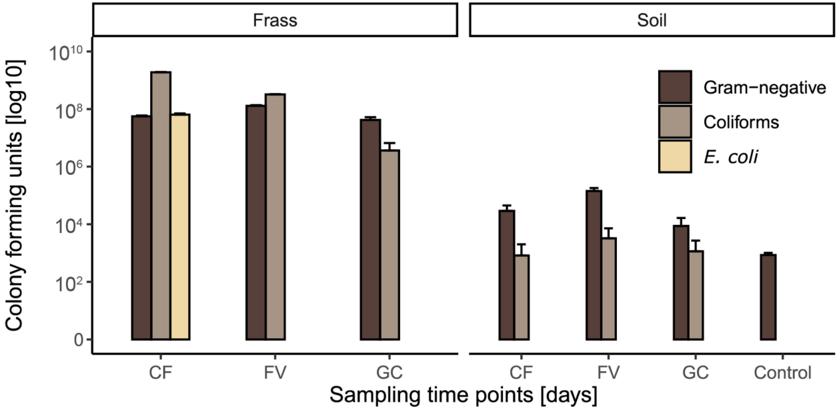
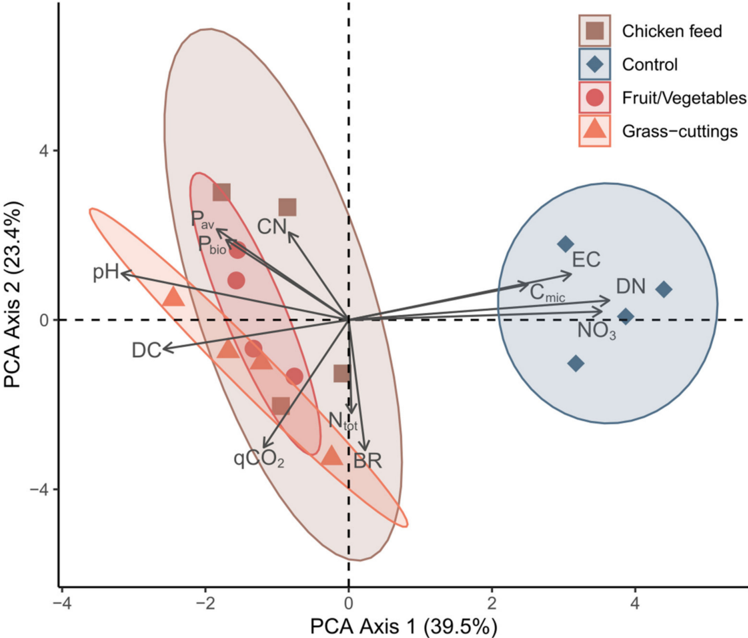
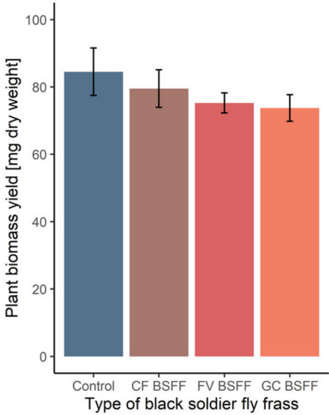
Because of its nutritious properties, the black soldier fly has emerged as one of the most popular species in advancing circular economy through the re-valorization of anthropogenic organic wastes to insect biomass. Black soldier fly frass accumulates as a major by-product in artificial rearing set-ups and harbors great potential to complement or replace commercial fertilizers. We applied frass from larvae raised on different diets in nitrogen-equivalent amounts as soil amendment, comparing it to NH4NO3 fertilizer as a control. While the soil properties did not reveal any difference between mineral fertilizer and frass, principal component analysis showed significant differences that are mainly attributed to nitrate and dissolved nitrogen contents. We did not find significant differences in the growth of perennial ryegrass between the treatments, indicating that frass serves as a rapidly acting fertilizer comparable to NH4NO3. While the abundance of coliform bacteria increased during frass maturation, after application to the soil, they were outcompeted by gram-negatives. We thus conclude that frass may serve as a valuable fertilizer and does not impair the hygienic properties of soils.
Overview
The claims and statistics of this paper haven’t been checked yet.
Free: it reads the open-access text and checks the first 5 claims that cite a source we can check. Create a free account to check every claim.
Integrity signals
Registry
Cites
Statistics
Figures
Verification
Claims the paper makes
The claims and statistics of this paper haven’t been checked yet.
Free: it reads the open-access text and checks the first 5 claims that cite a source we can check. Create a free account to check every claim.
Claims other papers make about this one
Each is checked against this paper’s own text: does it say what the citing paper says it does?
The source backs part of the claim, not all of it — or backs it for a different population, condition or comparison.
In the citing paper
“BSFL frass is harvested after 9–23 days of the experiment, depending on the substrate used in the composting process.”
From Potential Applications of Frass Derived from Black Soldier Fly Larvae Treatment of Food Waste: A Review (2022) · cites this paper as [23]
Experimental — accuracy not yet measuredThe source backs part of the claim, not all of it — or backs it for a different population, condition or comparison.
In the citing paper
“In addition, by enhancing nitrogen uptake, the high phosphorus concentration in the BSFL frass has aided in promoting nitrogen accumulation in plants since phosphorus is essential for energy transfer [23].”
From Potential Applications of Frass Derived from Black Soldier Fly Larvae Treatment of Food Waste: A Review (2022) · cites this paper as [23]
Experimental — accuracy not yet measuredThe source backs part of the claim, not all of it — or backs it for a different population, condition or comparison.
In the citing paper
“Post-processing by anaerobic digestion or composting could prevent soil nitrogen shortages or decreases in soil gas permeability as it increases the porosity and stability of wet BSFL frass [23].”
From Potential Applications of Frass Derived from Black Soldier Fly Larvae Treatment of Food Waste: A Review (2022) · cites this paper as [23]
Experimental — accuracy not yet measuredThe source backs part of the claim, not all of it — or backs it for a different population, condition or comparison.
In the citing paper
“The type of substrate determines the BSFL gut microbiome, and the BSFL excrement determines the microbiome in the BSFL frass [23].”
From Potential Applications of Frass Derived from Black Soldier Fly Larvae Treatment of Food Waste: A Review (2022) · cites this paper as [23]
Experimental — accuracy not yet measuredThe source backs part of the claim, not all of it — or backs it for a different population, condition or comparison.
In the citing paper
“The beneficial effect of BSFL frass with low moisture content is good for soil aeration and solubility; on the other hand, the BSFL frass with a high moisture content could have inadequate oxygen supply for the plant [23].”
From Potential Applications of Frass Derived from Black Soldier Fly Larvae Treatment of Food Waste: A Review (2022) · cites this paper as [23]
Experimental — accuracy not yet measured
3 more claims about this paper
Create a free account to see every claim other papers make about this one.
Self-check
Percentages, sums and reported differences re-computed from the paper’s own numbers.
The self-check needs the paper’s full text.
Citations
Cites
Wickham, H. (2016) · Use R! · doi:10.1007/978-3-319-24277-4_9 · Cited by 12,516
ANDERSON, T., & DOMSCH, K. (1993) · Soil Biology and Biochemistry · doi:10.1016/0038-0717(93)90140-7 · Cited by 1,389 · cited 1×
“The metabolic quotient (qCO2) was calculated from BR and Cmic according to Anderson and Domsch [40].”
MethodChitin — The Undisputed Biomolecule of Great Potential
Tharanathan, R. N., & Kittur, F. S. (2003) · Critical Reviews in Food Science and Nutrition · doi:10.1080/10408690390826455 · Cited by 996 · cited 1×
“Chitin, an N-acetylglucosamine-based polymer (C8H13O5N)n, may influence not only the C:N ratio, but its degradation product chitosan may also provide underrated benefits for plant health and pathogen resistance [53,54].”
Background(1996) · Springer eBooks · doi:10.1007/978-3-642-60966-4 · Cited by 949
Conversion of organic material by black soldier fly larvae: establishing optimal feeding rates
Diener, S., Zurbrügg, C., & Tockner, K. (2009) · Waste Management & Research: The Journal for a Sustainable Circular Economy · doi:10.1177/0734242x09103838 · Cited by 820 · cited 1×
“It is an inevitable side‐stream during the mass‐rearing of insects that can add up to 75% of the fed substrate [12] and is often merchandised as a fertilizing product.”
BackgroundNUTRIENT INTERACTIONS IN CROP PLANTS
Fageria, V. D. (2001) · Journal of Plant Nutrition · doi:10.1081/pln-100106981 · Cited by 721 · cited 1×
“Additionally, the higher P concentrations in the frass could facilitate N accumulation in plants by improving N uptake, as P plays an important role in energy transfer [62,63].”
BackgroundRhizosphere priming effects on soil carbon and nitrogen mineralization
Zhu, B., Gutknecht, J. L. M., Herman, D. J., Keck, D. C., Firestone, M. K., & Cheng, W. (2014) · Soil Biology and Biochemistry · doi:10.1016/j.soilbio.2014.04.033 · Cited by 440 · cited 1×
“A C:N-ratio > 20 bears the risk of soil N immobilization, which may favor plants with a more efficient N exploitation attributed to their rhizobiome [46,52].”
BackgroundRaaijmakers, J. M., & Mazzola, M. (2016) · Science · doi:10.1126/science.aaf3252 · Cited by 430
Sharp, R. (2013) · Agronomy · doi:10.3390/agronomy3040757 · Cited by 403 · cited 1×
“Chitin, an N-acetylglucosamine-based polymer (C8H13O5N)n, may influence not only the C:N ratio, but its degradation product chitosan may also provide underrated benefits for plant health and pathogen resistance [53,54].”
BackgroundThe Potential Role of Insects as Feed: A Multi-Perspective Review.
Sogari, G., Amato, M., Biasato, I., Chiesa, S., & Gasco, L. (2019) · Animals · doi:10.3390/ani9040119 · Cited by 395 · cited 1×
“The economic potential and meaningful reintroduction of otherwise wasted nutrients into the biosphere via a circular economy enticed researchers, investors, and the public to contribute to a more efficient recycling of organic wastes by exploiting the potential of insect larvae on a large scale [5,6].”
Background
Research works printed but not linked: 22
- 7. Choudhury, A.R.; Ashok, K.N.; Srinivas, K.; Arutchelvan, V.; Thota, K.R.; Ravi, S.N.; Sandeep, K.D.; Goutham, R.M. Black soldier fly larvae, a viable opportunity for entrepreneurship. Acta Sci. Agric. 2018, 2, 11-20.
- 19. Wang, H.; Rehman, K.; Liu, X.; Yang, Q.; Zheng, L.; Li, W.; Cai, M.; Li, Q.; Zhang, J.; Yu, Z. Insect biorefinery: A green approach for conversion of crop residues into biodiesel and protein. Biotechnol. Biofuels 2017, 10, 304. [CrossRef]
- 20. Erickson, M.C.; Islam, M.; Sheppard, C.; Liao, J.; Doyle, M.P. Reduction of Escherichia coli o157:h7 and Salmonella enterica serovar enteritidis in chicken manure by larvae of the black soldier fly. J. Food Prot. 2004, 67, 685-690. [CrossRef] [PubMed]
- 21. Lalander, C.; Diener, S.; Magri, M.E.; Zurbrugg, C.; Lindstrom, A.; Vinneras, B. Faecal sludge management with the larvae of the black soldier fly (Hermetia illucens)-From a hygiene aspect. Sci. Total Environ. 2013, 458-460, 312-318. [CrossRef] [PubMed]
- 22. Liu, Q.; Tomberlin, J.K.; Brady, J.A.; Sanford, M.R.; Yu, Z. Black soldier fly (Diptera: Stratiomyidae) larvae reduce Escherichia coli in dairy manure. Environ. Entomol. 2008, 37, 1525-1530. [CrossRef] [PubMed]
- 23. Vogel, H.; Müller, A.; Heckel, D.G.; Gutzeit, H.; Vilcinskas, A. Nutritional immunology: Diversification and diet-dependent expression of antimicrobial peptides in the black soldier fly Hermetia illucens. Dev. Comp. Immunol. 2018, 78, 141-148. [CrossRef]
- 24. Zhang, J.; Bisch-Knaden, S.; Fandino, R.A.; Yan, S.; Obiero, G.F.; Grosse-Wilde, E.; Hansson, B.S.; Knaden, M. The olfactory co-receptor IR8a governs larval-frass mediated competition avoidance in a hawkmoth. Proc. Natl. Acad. Sci. USA 2019, 116, 21828-21833. [CrossRef]
- 25. Zhang, X.G.; Li, X.; Gao, Y.L.; Liu, Y.; Dong, W.X.; Xiao, C. Oviposition deterrents in larval frass of potato tuberworm moth, Phthorimaea operculella (Lepidoptera: Gelechiidae). Neotrop. Entomol. 2019, 48, 496-502. [CrossRef] [PubMed]
- 26. Blomquist, G.J.; Figueroa-Teran, R.; Aw, M.; Song, M.; Gorzalski, A.; Abbott, N.L.; Chang, E.; Tittiger, C. Pheromone production in bark beetles. Insect Biochem. Mol. Biol. 2010, 40, 699-712. [CrossRef] [PubMed]
- 27. Lorenzana, L.R.J. Frass volatiles as attractant to the mango pulp weevil (Sternochetus frigidus (Fabr.) (Coleoptera: Curculionidae)). Philipp. Agric. Sci. 2014, 97, 385-390.
- 28. Mitchell, R.F.; Hanks, L.M. Insect frass as a pathway for transmission of bacterial wilt of cucurbits. Environ. Entomol. 2009, 38, 395-403. [CrossRef]
- 56. Kandeler, E. Ammonium. In Methods in Soil Biology; Schinner, F., Öhlinger, R., Kandeler, E., Margesin, R., Eds.; Springer: Berlin/Heidelberg, Germany, 1996; pp. 406-408, ISBN 978-3-642-60966-4. · DOI · Paper page
- 47. Kandeler, E. Ammonium. In Methods in Soil Biology; · DOI · Paper page
- 48. Schinner, F., Öhlinger, R., Kandeler, E., Margesin, R., Eds.; Springer: Berlin/Heidelberg, Germany, 1996; pp. 406-408; ISBN 978-3-642-60966-4. Death-affected Metrosideros polymorpha trees on Hawai'i Island. For. Pathol. 2019, 49, e12476. [CrossRef]
- 49. Khisti, U.V.; Kathade, S.A.; Aswani, M.A.; Anand, P.K.; Bipinraj, N.K. Isolation and identification of saccharomyces cerevisiae from caterpillar frass and their probiotic characterization. Biosci. Biotechnol. Res. Asia 2019, 16, 179-186. [CrossRef]
- 50. Frost, C.J.; Hunter, M.D. Recycling of nitrogen in herbivore feces: Plant recovery, herbivore assimilation, soil retention, and leaching losses. Oecologia 2007, 151, 42-53. [CrossRef]
- 51. Frost, C.J.; Hunter, M.D. Insect canopy herbivory and frass deposition affect soil nutrient dynamics and export in oak mesocosms. Ecology 2004, 85, 3335-3347. [CrossRef]
- 52. Yang, S.-S.; Chen, Y.; Kang, J.-H.; Xie, T.-R.; He, L.; Xing, D.-F.; Ren, N.-Q.; Ho, S.-H.; Wu, W.-M. Generation of high-efficient biochar for dye adsorption using frass of yellow mealworms (larvae of Tenebrio molitor Linnaeus) fed with wheat straw for insect biomass production. J. Clean. Prod. 2019, 227, 33-47. [CrossRef]
- 53. Schmitt, E.; de Vries, W. Potential benefits of using Hermetia illucens frass as a soil amendment on food production and for environmental impact reduction. Curr. Opin. Green Sustain. Chem. 2020. [CrossRef]
- 54. Goberna, M.; Podmirseg, S.M.; Waldhuber, S.; Knapp, B.A.; García, C.; Insam, H. Pathogenic bacteria and mineral N in soils following the land spreading of biogas digestates and fresh manure. Appl. Soil Ecol. 2011, 49, 18-25. [CrossRef]
- 55. Kandeler, E. Nitrate. In Methods in Soil Biology; Schinner, F., Öhlinger, R., Kandeler, E., Margesin, R., Eds.; Springer: Berlin/Heidelberg, Germany, 1996; pp. 408-410, ISBN 978-3-642-60966-4.
- 74. Dioha, I.; Ikeme, C.H.; Nafiu, T. Effect of carbon to nitrogen ratio on biogas production. Int. Res. J. Nat. Sci. 2013, 1, 1-10.
Cited by
Items 201–246 of 246
Transforming Martian Regolith with Black Soldier Flies, Hermetia illucens
Murphy, R. O., Shipman, W., Targonski, P., Livingston, C., Miranda, B., Kerl, M., Gandhi, H., Lloyd, G., Butler, J., Cortez, C. T., et al. (2024) · ASEAN Journal of Psychiatry · doi:10.54615/2231-7805.2024.13(10).369
Low-Cost Recycling of Agricultural Biomass into Compost Using Black Soldier Fly and Compost Worms
Elias, N. H., Zainalabidin, N., Kasim, K. F., & Ismail, K. S. K. (2025) · Springer eBooks · doi:10.1007/978-981-96-6279-1_7 · Cited by 1
INSECT FRASS: NATURE’S HIDDEN TREASURE FOR SOIL FERTILITY: A REVIEW
Geethanjali, L., Mohan, B. S., Bhushan, B. T., & Bidhan Chandra Krishi Vishwavidyalaya (BCKV), M. (2025) · PLANT ARCHIVES · doi:10.51470/plantarchives.2025.v25.no.2.351
食品廃棄物由来のアメリカミズアブ(Hermetia illucens, Diptera: Stratiomydae)堆肥が節足動物の個体数及び在来植物品種の生育に及ぼす影響
Yudistira, D. H. (2025) · Iwate University Repository (Iwate University) · doi:10.15113/0002000610
Additional file 1 of Fungal deterioration of the bagasse storage from the harvested sugarcane
Peng, N., Yao, Z., Wang, Z., Huang, J., Khan, M. T., Chen, B., & Zhang, M. (2021) · Figshare · doi:10.6084/m9.figshare.14903930
Food for thought: achieving sustainable food production with a circular model.
Doughty, K. (2023) · UWA Profiles and Research Repository (UWA) · doi:10.26182/f9s4-nv86
Nutrient sources for organic production: soil biological and agronomic responses
Mukungu, L. V. (2024) · Mspace (University of Manitoba) · Cited by 3
Looveren, N. V. (2024) · Lirias (KU Leuven)
Human urine and frass as fertilizers : nitrogen availability over time
Aronsson, E. (2024) · Epsilon Archive for Student Projects (Swedish University of Agricultural Sciences)
Lomonaco, G., Dolce, A., Scieuzo, C., & Falabella, P. (2025) · Elsevier eBooks · doi:10.1016/b978-0-443-29896-7.00008-1
Yepes, J. P. O., Trejo, J. F. G., Ceballos-Aguirre, N., & Salazar, A. H. (2025) · Revista Facultad de Ciencias Básicas · doi:10.18359/rfcb.7981
Mealworm frass fed on expanded polystyrene helps retention of chrysanthemum flower
Yun, J. Y., Lee, S. M., Joung, Y.-M., Jung, S. B., & Kim, D. S. (2026) · Scientific Reports · doi:10.1038/s41598-026-36020-4
Silva, R. M. D., Köhler, A., Costa, D., de Vargas, D. P., & Köhler, A. L. (2026) · Research Square · doi:10.21203/rs.3.rs-7509675/v1
The black soldier fly: A sustainable source of food
Amid, A. (2026) · Elsevier eBooks · doi:10.1016/b978-0-443-30058-5.00012-2
Sai, A., Khalfa, L., & Borgi, M. A. (2026) · Clean Technologies and Environmental Policy · doi:10.1007/s10098-026-03436-5
Rojas, J. B., & Mejía, C. D. R. (2025) · Universidad Industrial de Santander
Soo, T. H., Jalloh, M. B., Azman, E. A., Ismail, R., Tajidin, N. E., Mahmud, K., & Sakimin, S. Z. (2026) · Pertanika journal of tropical agricultural science · doi:10.47836/pjtas.49.1.24
Rehan, I. (2025) · Portuguese National Funding Agency for Science, Research and Technology (RCAAP Project by FCT)
Yudistira, D. H., Chofifah, I. A., WIRABUMI, B. A., & Sato, S. (2026) · Journal of Applied Entomology · doi:10.1111/jen.70096
“In acidic or low- organic-matter soils, frass alone may not fully meet nutrient requirements, and partial supplementation with chemical fertilisers could improve results (Houben et al. 2020; Klammsteiner et al. 2020).”
Santangelo, E., de Iudicibus, A., Arnone, S., Baldacchino, F., Santis, E. D., Carnevale, M., Mattei, P., Gallucci, F., Giudice, A. D., Assirelli, A., et al. (2026) · Agriculture · doi:10.3390/agriculture16070725
Giakoumatos, S. D. V., & Tsoulfas, G. Τ. (2026) · Waste and Biomass Valorization · doi:10.1007/s12649-026-03582-3
“In the literature, heat treatment of 70 °C for 60 min is presented as mandatory to meet the microbiological criteria beforeapplied on the soil as biofertilizer for soil conditioning [161, 162].”
Charberet, S. (2023) · theses.fr (ABES) · doi:10.70675/f2033a54zc353z416ez85aaz0b9fed0654f9
Fawzy, E., Hassanien, R. H. E., Mansour, G., & Suloma, A. (2026) · Journal of Insects as Food and Feed · doi:10.1163/23524588-bja10375
Volder, A. D., Frooninckx, L., Deruytter, D., Ceusters, J., & Vandeweyer, D. (2026) · Bioresources and Bioprocessing · doi:10.1186/s40643-026-01030-7
“As black soldier fly larvae are grown in a substrate consisting of vegetable waste streams, in a relatively humid and warm environment favoring microbial growth (Klammsteiner et al. 2020), a high microbial load of the residual frass is to be expected.”
Hodge, S., Ciobanu, L.-G., & Gormley, B. (2026) · Plants · doi:10.3390/plants15091388
“[5,20,31–36].”
We found a way to turn Canada goose poop into chicken feed and crop fertilizer
Khelifa, R., & López-Manzano, C. (2026) · The Conversation · doi:10.64628/aam.ur7gyxdh6
Starter and main diet impact on black soldier fly rearing: growth and chitin
Otake, R. (2025) · Cross Connect (Southern Cross University) · doi:10.25918/thesis.571
Schneider, L., Stoehr, N., Kisinga, B., Cord‐Landwehr, S., Weiss, C. K., Schulte‐Geldermann, E., Moerschbacher, B. M., Eder, K., Jha, R., & Dusel, G. (2026) · Journal of Insects as Food and Feed · doi:10.1163/23524588-bja10412
Khelifa, R., & López-Manzano, C. (2026) · The Conversation · doi:10.64628/aap.6mrqwqh53
Traoré, O., Zaato, P. A., Baidoo, J. K., Feleke, S., Manyong, V. M., Abdoulaye, T., Schreinemachers, P., Sæthre, M., Agbodzavu, M. K., & Ba, M. N. (2026) · Cleaner and Responsible Consumption · doi:10.1016/j.clrc.2026.100449
Ogabidu, A. O., Bernard, M., Abe, S. A., Jocthan, M. G., Onyeyirichi, E., Oshodin, O. J., Clement, Z. L., Elvanus, M. E., Yohanna, S. T., Joseph-Emmanuel, O. M., et al. (2026) · UMYU Journal of Microbiology Research (UJMR) · doi:10.47430/ujmr.26111.016
“One of the main factors driving the value of Black Soldier Fly Larvae (BSFL) frass as a sustainable soil amendment is its nutritional composition, as shown in Tables 1 and 2 (Meneguz et al., 2018; Klammsteiner et al., 2020; Gärttling & Schulz, 2022).”
InfluentialKreft, D., Safarpour, T., Hurka, S., Stift, M., Schillberg, S., Reimann, A., Röthig, T., Düring, R., Vilcinskas, A., & Tegtmeier, D. (2026) · Plant and Soil · doi:10.1007/s11104-026-08779-y
“While BSFL frass has been explored as a viable organic fertiliser (Beesigamukama et al. 2021; Kac-zor et al. 2025; Visvini et al. 2022; Klammsteiner et al. 2020; Salomon et al. 2025), few studies compare frass from different feeds or characterise its microbiota (Kreft et al. 2026; Tegtmeier et al.…”
Kalbasi, A., Behin, J., & Bassi, A. (2026) · Bioresource Technology Reports · doi:10.1016/j.biteb.2026.102940
Kullan, A. R. K., Neumann, E. G., Suresh, A., & Choi, H. L. (2026) · ENGINEERING Agriculture · doi:10.15302/j-fase-2027727 · Cited by 1
McKenzie, M. J., Liu, Z., Tran, A. K. N., Botero, J., Edmonds, R. L., Hermansen, C., Fabisik, F., Fletcher, K. M., & Najar‐Rodriguez, A. (2026) · Waste Management & Research The Journal for a Sustainable Circular Economy · doi:10.1177/0734242x261468120
Mufriah, D., Sabrina, T., & Lisdayani, L. (2026) · Agro Bali Agricultural Journal · doi:10.37637/ab.v9i2.2787
“Frass consists of insect feces or excretions, undigested substrate residues, and exoskeleton fragments (Klammsteiner et al., 2020).”
Ogabidu, A. O., Idowu, O. O., Samue, F. A., Tukki, O. H., Mohammed, J. A., Salihu, R., Nwangbo, F. O., Aputu, V., Stephen, L., Abdullahi, Z. T., et al. (2026) · Nigerian Journal of Biotechnology and Life Sciences · doi:10.67601/njbls.v3i2a.53
Plastics and associated chemical contaminants in black soldier fly larvae food waste bioconversion
Kolobaric, A., Hoffman, L. C., Chapman, J., & Cozzolino, D. (2026) · Critical Reviews in Environmental Science and Technology · doi:10.1080/10643389.2026.2730190
“…and physical impacts of frass on soil properties (Wang et al., 2021; Guo et al., 2021), as well as changes in soil and frass microbial communities, have been investigated (Klammsteiner et al., 2020; Watson et al., 2021; Fuhrmann et al., 2022; Van Looveren et al., 2021; Gebremikael et al., 2022).”
Kesumaningwati, R., Nugroho, R. A., Darma, S., Fahrunsyah, F., Candra, K. P., Hardi, E. H., & Idris, S. D. (2026) · Journal of Multidisciplinary Applied Natural Science · doi:10.47352/jmans.2774-3047.489
Siderophore-producing Pseudomonas spp.
Brämer, L. A. (2026) · Epsilon Archive for Student Projects (Swedish University of Agricultural Sciences)
INVESTIGASI POTENSI PEMANFAATAN MAGGOT KERING DAN KASGOT DARI PROSES BIOKONVERSI SAMPAH ORGANIK
Sari, G. L., Agustini, R. Y., & Nainggolan, A. M. (2024) · Jurnal Reka Lingkungan · doi:10.26760/rekalingkungan.v12i2.199-210
Dari Limbah Menjadi Berkah: Konversi Limbah Cair Pewarna Alam Ramah Lingkungan
Dekrita, Y. A., Lea, V. C., Meylano, N. H., Jelita, S., & Poling, F. C. (2025) · J-Dinamika Jurnal Pengabdian Masyarakat · doi:10.25047/j-dinamika.v10i3.6519
Trade-offs in insect-based waste valorization of a major organic waste streamPreprint
Zebsa, R., López-Manzano, C., Mahdjoub, H., Mellal, M. K., & Khelifa, R. (2026) · SSRN Electronic Journal · doi:10.2139/ssrn.7625273
AVALIAÇÃO DOS EFEITOS DO ACTFLY NO DESENVOLVIMENTO FISIOLÓGICO POR TS
Ignez, L. R., & Tonon, T. C. A. (2026) · Revista Ibero-Americana de Humanidades, Ciências e Educação · doi:10.51891/rease.v12i11.32157
Corsi, L., Pacella, M., Ruschioni, S., Trombetta, M. F., Pasquini, M., Isidoro, N., & Riolo, P. (2026) · Journal of Insects as Food and Feed · doi:10.1163/23524588-bja10497
Metadata
- Authors
- Klammsteiner, T., Turan, V., Fernández-Delgado Juárez, M., Oberegger, S., & Insam, H.
- Affiliations
- Universität Innsbruck (AT)
- Bingöl University (TR)
- Department of Microbiology, University of Innsbruck, Technikerstraße 25d, 6020 Innsbruck, Austria
- Corresponding author
- Klammsteiner, Thomas
- ORCID
- Venue
- Agronomy
- Publisher
- MDPI AG
- Published
- 2020-10-15
- Volume
- 10
- Issue
- 10
- Pages
- 1578
- ISSN
- 2073-4395 (ISSN-L)
- OpenAlex
- W3093147761
- Cited by
- 223
- References
- 57
- Citations by year
- 2026: 35 · 2025: 35 · 2024: 41 · 2023: 31 · 2022: 28 · 2021: 51 · 2020: 2
- FWCI
- 19.64
- Type
- journal article
- Language
- en
- Open access
- gold
- doi.org
- Licence
- Locations
- Agronomy (publishedVersion, cc-by)
- DOAJ (DOAJ: Directory of Open Access Journals) (submittedVersion, cc-by-sa)
- Funders
- Austrian Science Fund (P26444)
- Universität Innsbruck (Doktoratsstipendium aus der Nachwuchsforschung, 3. Tranche)
- Türkiye Bilimsel ve Teknolojik Araştirma Kurumu (1059B191601133)
- Topics
- Life Sciences › Agricultural and Biological Sciences › Insect Science › Insect Utilization and Effects
- Life Sciences › Agricultural and Biological Sciences › Soil Science › Composting and Vermicomposting Techniques
- Life Sciences › Agricultural and Biological Sciences › Plant Science › Agriculture, Plant Science, Crop Management
- Keywords
- Hermetia illucens, frass, soil amendment, insect biomass, ammonium nitrate, nitrate, dissolved nitrogen, perennial ryegrass, coliform bacteria, Gram-negative bacteria, circular economy, organic waste valorization
About these checks
Registry, retraction, Cites and statistics results are computed, not judged, with one exception: a printed reference that no index lists is read once by a model before it counts as a citation error. Claims are extracted by a model and kept only when their quote appears verbatim in the text; each cited source is then checked, with a model’s help, for whether it says what the claim relies on. Those verdicts can be wrong — read the claim’s quote and the cited source before relying on one.
Statistics and arithmetic are recomputed, not judged.
Confidence bands are shown only for fields calibrated on our annotated test set. None is calibrated yet, so no band is shown.
What counts as a claim ›How we measure confidence ›How we check this ›
Are you an author, or do you see a problem with this page? Request a review
Data sources
Bibliographic data: Semantic Scholar, OpenAlex, Crossref.
Contains information from the Semantic Scholar Academic Graph Datasets, made available under the ODC Attribution License (ODC-BY 1.0).
Semantic Scholar’s data is described in: Kinney, R., et al. (2023). The Semantic Scholar Open Data Platform. arXiv:2301.10140.
