

Crude Saponin from Platycodon grandiflorum Attenuates Aβ-Induced Neurotoxicity via Antioxidant, Anti-Inflammatory and Anti-Apoptotic Signaling Pathways
Open accessThe DOI matches its Crossref record; 70 of the 71 references it cites were found in a registry or an index.
Abstract
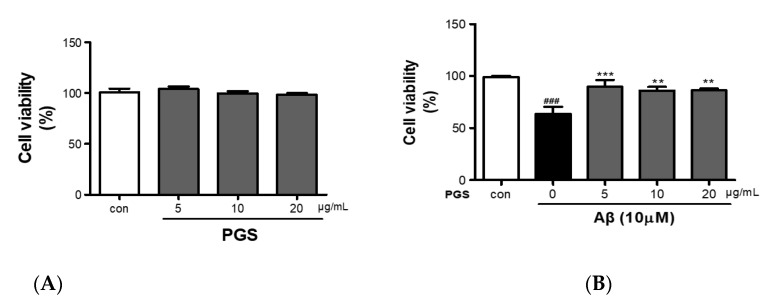
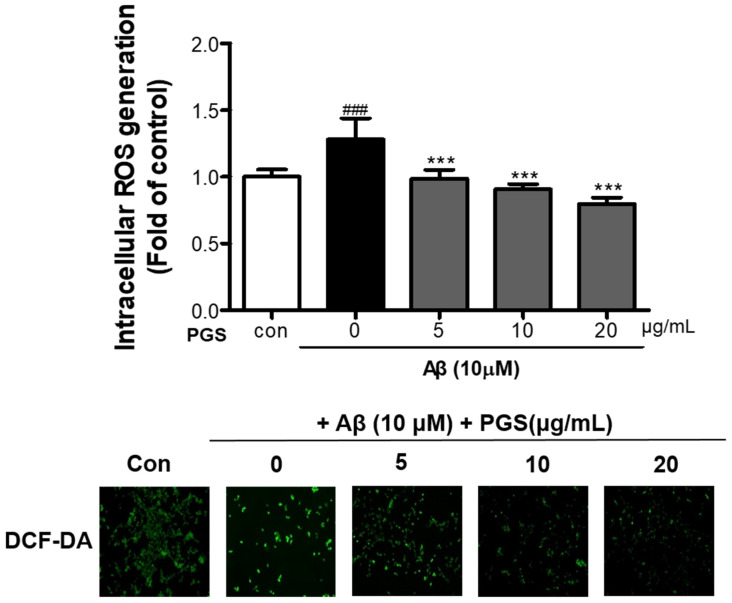
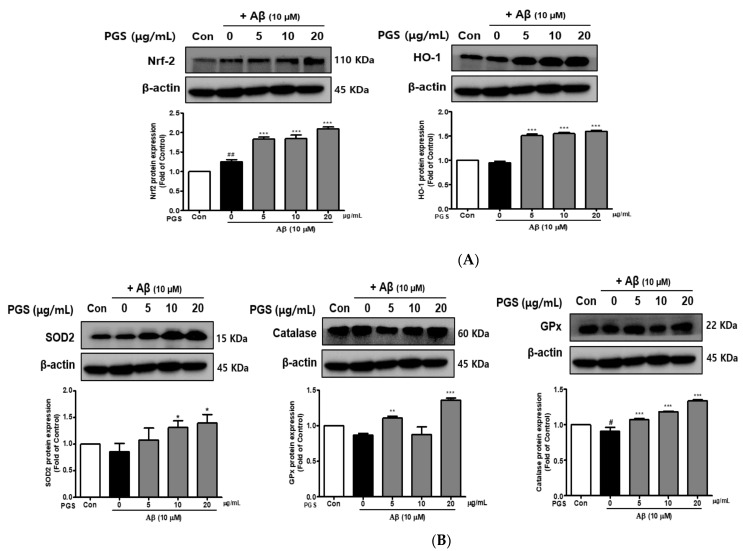
Although Platycodon grandiflorum saponins exhibit many beneficial biological effects in various diseases and conditions, how they protect nerve cells against neurodegenerative diseases and Alzheimer’s disease (AD) pathology is unknown. We investigated whether P. grandiflorum crude saponin (PGS) protects neurons from neurodegeneration caused by amyloid beta (Aβ)-induced oxidative stress. Hippocampal neuron HT-22 cells were used in the in vitro experiment, and AD mice (5XFAD mice) were used as the in vivo model. Intracellular reactive oxygen species (ROS) was stained with DCF-DA and assessed using fluorescence microscopy. To elucidate the mechanism underlying neuroprotection, intracellular protein levels were assessed by western blotting. In 5XFAD mice, an animal model of AD, nerve damage recovery due to the induction of Aβ toxicity was evaluated by histological analysis. PGS attenuates Aβ-induced neurotoxicity by inhibiting Aβ-induced reactive oxygen species (ROS) production and apoptosis in HT-22 cells. Furthermore, PGS upregulated Nrf2-mediated antioxidant signaling and downregulated NF-κB-mediated inflammatory signaling. Additionally, PGS inhibited apoptosis by regulating the expression of apoptosis-associated proteins. In addition, PGS ameliorated Aβ-mediated pathologies, leading to AD-associated cognitive decline. Conclusions: Taken together, these findings suggest that PGS inhibits Aβ accumulation in the subiculum and cerebral cortex and attenuates Aβ toxicity-induced nerve damage in vitro and in vivo. Therefore, PGS is a resource for developing AD therapeutics.
Overview
The claims and statistics of this paper haven’t been checked yet.
Free: it reads the open-access text and checks the first 5 claims that cite a source we can check. Create a free account to check every claim.
Integrity signals
Registry
Cites
Statistics
Figures
Verification
Claims the paper makes
The claims and statistics of this paper haven’t been checked yet.
Free: it reads the open-access text and checks the first 5 claims that cite a source we can check. Create a free account to check every claim.
Claims other papers make about this one
Each is checked against this paper’s own text: does it say what the citing paper says it does?
In the citing paper
“TCM treatment such as morroniside, rutin, resveratrol, triptolide and berberine have already shown their beneficial effects for AD509–527 (Table 3).”
From Amyloid β-based therapy for Alzheimer’s disease: Challenges, successes and future (2023) · cites this paper as [518]
Self-check
Percentages, sums and reported differences re-computed from the paper’s own numbers.
The self-check needs the paper’s full text.
Citations
Cites
1 retracted
Saeed, K. M., Shah, S. A., Ullah, R., Alam, S. I., Park, J. S., Saleem, S., Jo, M. H., Kim, M. W., Hahm, J. R., & Kim, M. O. (2020) · Oxidative Medicine and Cellular Longevity · doi:10.1155/2020/9523758 · Cited by 24
RetractedMitochondrial Dysfunction and Oxidative Stress in Neurodegenerative Diseases
Lin, M. T., & Beal, M. F. (2006) · Nature · doi:10.1038/nature05292 · Cited by 6,455
Neuropathological alterations in Alzheimer disease
Serrano-Pozo, A., Frosch, M. P., Masliah, E., & Hyman, B. T. (2011) · Cold Spring Harbor Perspectives in Medicine · doi:10.1101/cshperspect.a006189 · Cited by 3,345
Bloom (2014) · doi:10.1001/jamaneurol.2013.5847 · Cited by 2,194
BCL-2 FAMILY: Regulators of Cell Death
Chao, D. T., & Korsmeyer, S. J. (1998) · Annual Review of Immunology · doi:10.1146/annurev.immunol.16.1.395 · Cited by 1,685
Oxidative stress and Alzheimer disease
Christen, Y. (2000) · The American Journal of Clinical Nutrition · doi:10.1093/ajcn/71.2.621s · Cited by 1,158
Saponins: Properties, Applications and Processing
Güçlü-Üstündağ, Ö., & Mazza, G. (2007) · Critical Reviews in Food Science and Nutrition · doi:10.1080/10408390600698197 · Cited by 1,043
Oxidative stress and inflammation, a link between chronic kidney disease and cardiovascular disease
Cachofeiro, V., Goicochea, M., de Vinuesa, S. G., Oubiña, P., Lahera, V., & Luño, J. (2008) · Kidney International · doi:10.1038/ki.2008.516 · Cited by 662
Kobayashi, M., Li, L., Iwamoto, N., Nakajima-Takagi, Y., Kaneko, H., Nakayama, Y., Eguchi, M., Wada, Y., Kumagai, Y., & Yamamoto, M. (2009) · Molecular and Cellular Biology · doi:10.1128/mcb.01080-08 · Cited by 638 · cited 1×
“The nuclear factor erythroid-2-related factor 2 (Nrf2) pathway, a critical signaling pathway for ROS detoxification in the brain, constitutes an important cellular defense mechanism against oxidative stress injury [53].”
BackgroundMicroglia, neuroinflammation, and beta-amyloid protein in Alzheimer’s disease
Cai, Z., Hussain, M. D., & Yan, L.-J. (2014) · International Journal of Neuroscience · doi:10.3109/00207454.2013.833510 · Cited by 583
Verdile, G., Keane, K. N., Cruzat, V. F., Medic, S., Sabale, M., Rowles, J., Wijesekara, N., Martins, R. N., Fraser, P. E., & Newsholme, P. (2015) · Mediators of Inflammation · doi:10.1155/2015/105828 · Cited by 495
Oxidative stress in Alzheimer disease
Gella, A., & Durany, N. (2009) · Cell Adhesion & Migration · doi:10.4161/cam.3.1.7402 · Cited by 459
Blasko, I., Stampfer‐Kountchev, M., Robatscher, P., Veerhuis, R., Eikelenboom, P., & Grubeck‐Loebenstein, B. (2004) · Aging Cell · doi:10.1111/j.1474-9728.2004.00101.x · Cited by 374
Different Mechanisms of Oxidative Stress and Neurotoxicity for Alzheimer‘s Aβ(1−42) and Aβ(25−35)
Varadarajan, S., Kanski, J., Aksenova, M., Lauderback, C., & Butterfield, D. A. (2001) · Journal of the American Chemical Society · doi:10.1021/ja010452r · Cited by 346
Manon, S., Chaudhuri, B., & Guérin, M. (1997) · FEBS Letters · doi:10.1016/s0014-5793(97)01087-9 · Cited by 296 · cited 1×
“Cytochrome c release into the cytoplasm activates the cysteine proteases caspase-9 and -3, resulting in neuronal cell death [58,59].”
BackgroundGlial activation and inflammation along the Alzheimer’s disease continuum
Nordengen, K., Kirsebom, B.-E., Henjum, K., Selnes, P., Gísladóttir, B., Wettergreen, M., Torsetnes, S. B., Grøntvedt, G. R., Waterloo, K. K., Aarsland, D., et al. (2019) · Journal of Neuroinflammation · doi:10.1186/s12974-019-1399-2 · Cited by 274
Phytochemicals as inhibitors of NF-κB for treatment of Alzheimer’s disease
Seo, E.-J., Fischer, N., & Efferth, T. (2018) · Pharmacological Research · doi:10.1016/j.phrs.2017.11.030 · Cited by 265
Molecular and Cellular Basis of Neurodegeneration in Alzheimer’s Disease
Jeong, S. (2017) · Molecules and Cells · doi:10.14348/molcells.2017.0096 · Cited by 233
Lee, J.-Y., Hwang, W.-I., & Lim, S.-T. (2004) · Journal of Ethnopharmacology · doi:10.1016/j.jep.2004.04.017 · Cited by 228
Bhatia, V., & Sharma, S. (2021) · Journal of the Neurological Sciences · doi:10.1016/j.jns.2020.117253 · Cited by 222
Zhang, L., Yu, H., Zhao, X., Lin, X., Tan, C., Cao, G., & Wang, Z. (2010) · Neurochemistry International · doi:10.1016/j.neuint.2010.06.021 · Cited by 217
Haake, A., Nguyen, K., Friedman, L., Chakkamparambil, B., & Grossberg, G. T. (2020) · Expert Opinion on Drug Safety · doi:10.1080/14740338.2020.1721456 · Cited by 181
NF-κB as a Key Mediator of Brain Inflammation in Alzheimer’s Disease
Ju Hwang, C., Choi, D.-Y., Park, M. H., & Hong, J. T. (2019) · CNS & Neurological Disorders - Drug Targets · doi:10.2174/1871527316666170807130011 · Cited by 178
JNK activation is associated with intracellular β-amyloid accumulation
Shoji, M., Iwakami, N., Takeuchi, S., Waragai, M., Suzuki, M., Kanazawa, I., Lippa, C. F., Ono, S., & Okazawa, H. (2000) · Molecular Brain Research · doi:10.1016/s0169-328x(00)00245-x · Cited by 166 · cited 1×
“In addition, MAPKs induce apoptosis [67,68].”
The Role and Regulation of COX-2 during Viral Infection
Steer, S. A., & Corbett, J. A. (2003) · Viral Immunology · doi:10.1089/088282403771926283 · Cited by 152
Rodrigues, C. M. P., Solá, S., Silva, R., & Brites, D. (2000) · Molecular Medicine · doi:10.1007/bf03401828 · Cited by 131
Sakthivel, K. M., & Guruvayoorappan, C. (2013) · International Immunopharmacology · doi:10.1016/j.intimp.2013.09.022 · Cited by 124
Anti-inflammatory function of arctiin by inhibiting COX-2 expression via NF-κB pathways
Lee, S., Shin, S., Kim, H., Han, S., Kim, K., Kwon, J., Kwak, J.-H., Lee, C.-K., Ha, N.-J., Yim, D., et al. (2011) · Journal of Inflammation · doi:10.1186/1476-9255-8-16 · Cited by 123
Self-citationKyoung-Souk, K. I. M., Ezaki, O., Ikemoto, S., & Itakura, H. (1995) · Journal of Nutritional Science and Vitaminology · doi:10.3177/jnsv.41.485 · Cited by 104
Boridy, S., Takahashi, H., Akiyoshi, K., & Maysinger, D. (2009) · Biomaterials · doi:10.1016/j.biomaterials.2009.06.010 · Cited by 103
Inhibitory Effect of Lycopene on Amyloid-β-Induced Apoptosis in Neuronal Cells
Hwang, S., Lim, J., & Kim, H. (2017) · Nutrients · doi:10.3390/nu9080883 · Cited by 91
Self-citationZhao, H. L., Harding, S., Marinangeli, C. P. F., Kim, Y. S., & Jones, P. J. H. (2008) · Journal of Food Science · doi:10.1111/j.1750-3841.2008.00915.x · Cited by 86
Uddin, M. S., Al Mamun, A., Kabir, M. T., Ashraf, G. M., Bin-Jumah, M. N., & Abdel-Daim, M. M. (2021) · Molecular Neurobiology · doi:10.1007/s12035-020-02116-9 · Cited by 86
Aguirre-Rueda, D., Guerra-Ojeda, S., Aldasoro, M., Iradi, A., Obrador, E., Ortega, A., Mauricio, M. D., Vila, J. M., & Valles, S. L. (2015) · International Journal of Medical Sciences · doi:10.7150/ijms.10035 · Cited by 84
Shao, J., Li, Y., Wang, Z., Xiao, M., Yin, P., Lü, Y., Qian, X. H., Xu, Y. F., & Liu, J. (2013) · International Immunopharmacology · doi:10.1016/j.intimp.2013.06.008 · Cited by 81
Foyet, H. S., Abaïssou, H. H. N., Wado, E. K., Asongalem, E. A., & Ciobica, A. S. (2015) · BMC Complementary and Alternative Medicine · doi:10.1186/s12906-015-0864-4 · Cited by 78
Guo, R., Meng, Q., Wang, B., & Li, F. (2021) · International Immunopharmacology · doi:10.1016/j.intimp.2021.107474 · Cited by 76
Pan, X., Chen, X., Zhu, Y., Chen, L., Zhang, J., Huang, T., Ye, Q., & Huang, H. (2009) · Glia · doi:10.1002/glia.20844 · Cited by 70
Carter, R. S., Geyer, B. C., Xie, M., Acevedo-Suárez, C. A., & Ballard, D. W. (2001) · Journal of Biological Chemistry · doi:10.1074/jbc.c000777200 · Cited by 65
Chung, J. W., Noh, E. J., Zhao, H. L., Sim, J.-S., Ha, Y. W., Shin, E. M., Lee, E. B., Cheong, C. S., & Kim, Y. S. (2008) · Biological and Pharmaceutical Bulletin · doi:10.1248/bpb.31.2114 · Cited by 65
Yang, R., Liu, S., Zhou, J., Bu, S., & Zhang, J. (2017) · Immunopharmacology and Immunotoxicology · doi:10.1080/08923973.2017.1344989 · Cited by 65
Zhang, W., Hou, J., Yan, X., Leng, J., Li, R., Zhang, J., Xing, J., Chen, C., Wang, Z., & Li, W. (2018) · Nutrients · doi:10.3390/nu10091328 · Cited by 62
Jain, S., Sangma, T., Shukla, S. K., & Mediratta, P. K. (2015) · Nutritional Neuroscience · doi:10.1179/1476830514y.0000000113 · Cited by 60
Fu, Y., Xin, Z., Liu, B., Wang, J., Wang, J., Zhang, X., Wang, Y., & Li, F. (2018) · Frontiers in Immunology · doi:10.3389/fimmu.2017.01929 · Cited by 58
Song, J. H., Lee, H., & Kang, K. S. (2019) · International Journal of Molecular Sciences · doi:10.3390/ijms20010142 · Cited by 57
Zheng, J., Ji-guo, H., Ji, B., Li, Y., & Zhang, X. (2007) · Plant Foods for Human Nutrition · doi:10.1007/s11130-006-0034-4 · Cited by 55
Bresciani, A., Missineo, A., Gallo, M. L., Cerretani, M., Fezzardi, P., Tomei, L., Cicero, D. O., Altamura, S., Santoprete, A., Ingenito, R., et al. (2017) · Archives of Biochemistry and Biophysics · doi:10.1016/j.abb.2017.08.003 · Cited by 52
Qian, Y., Yin, J., Hong, J., Li, G., Zhang, B., Liu, C., Wan, Q., & Chen, L. (2016) · Journal of Neuroinflammation · doi:10.1186/s12974-016-0598-3 · Cited by 48
Dong, Y.-T., Cao, K., Tan, L.-C., Wang, X.-L., Qi, X.-L., Xiao, Y., & Guan, Z.-Z. (2018) · Journal of Alzheimer's Disease · doi:10.3233/jad-171020 · Cited by 48
Lee, A. Y., Lee, M. H., Lee, S., & Cho, E. J. (2018) · Journal of Agricultural and Food Chemistry · doi:10.1021/acs.jafc.8b00836 · Cited by 45
Kumar, S., Maheshwari, K. K., & Singh, V. (2010) · African Journal of Traditional Complementary and Alternative Medicines · doi:10.4314/ajtcam.v6i1.57073 · Cited by 43
Choi, J. H., Yoo, K., Park, O. K., Lee, C. H., Won, M., Hwang, I. K., Ryu, S. Y., Kim, Y. S., Yi, J., Bae, Y., et al. (2009) · Brain Research · doi:10.1016/j.brainres.2009.05.005 · Cited by 43
Son, I. H., Park, Y. H., Lee, S. I., Yang, H. D., & Moon, H. (2007) · Molecules · doi:10.3390/12051147 · Cited by 43
Ouyang, Y., Chen, Z., Tan, M., Liu, A., Chen, M., Liu, J., Pi, R., & Fang, J. (2013) · Biochemical and Biophysical Research Communications · doi:10.1016/j.bbrc.2013.10.160 · Cited by 37
Liu, Y., Sun, W., Li, B., Shang, N., Wang, Y., Lv, W., Li, D., & Wang, L. (2021) · Food Chemistry · doi:10.1016/j.foodchem.2021.130354 · Cited by 36
On the Common Journey of Neural Cells through Ischemic Brain Injury and Alzheimer’s Disease
Kriška, J., Heřmanová, Z., Knotek, T., Turečková, J., & Anděrová, M. (2021) · International Journal of Molecular Sciences · doi:10.3390/ijms22189689 · Cited by 35
Fu, X., Liu, H., Wang, P., & Guan, H. (2009) · The American Journal of Chinese Medicine · doi:10.1142/s0192415x09007375 · Cited by 34 · cited 1×
“Studies on obesity [19], cancer cell proliferation [20] and antioxidant effects [21,22] have been reported.”
BackgroundHwang, K., Hwang, Y.-J., Im, P., Hwang, H.-J., Song, J., & Kim, Y. J. (2019) · Journal of Medicinal Food · doi:10.1089/jmf.2018.4370 · Cited by 34
Noh, J., Kim, Y., Gang, G., Hwang, J., Kim, S. K., Ryu, S., Kim, Y.-S., Lee, H.-S., & Lee, C. (2011) · Annals of Nutrition and Metabolism · doi:10.1159/000330117 · Cited by 30
Self-citationPlatycoside N: A New Oleanane-Type Triterpenoid Saponin from the Roots of Platycodon grandiflorum
Li, W., Zhang, W., Xiang, L., Wang, Z., Zheng, Y., Wang, Y., Zhang, J., & Chen, L. (2010) · Molecules · doi:10.3390/molecules15128702 · Cited by 28
Physicochemical Properties of Black Doraji (Platycodon grandiflorum)
Lee, S., Shin, S.-R., & Yoon, K. Y. (2013) · Korean Journal of Food Science and Technology · doi:10.9721/kjfst.2013.45.4.422 · Cited by 27 · cited 1×
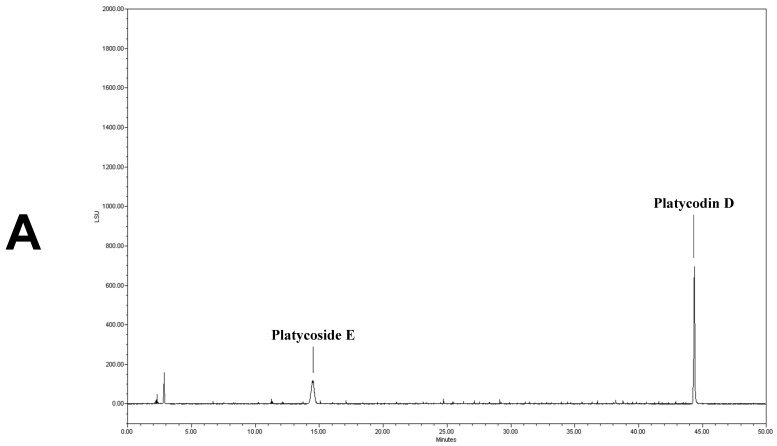
“These include 17 saponins [45,46], among which platycodin D, deapi-platycodin D, platycoside E, polygalacin D2 and polygalacin D are important.”
BackgroundThe Protective Effects of Crocetin on Aβ1-42-Induced Toxicity in Ht22 Cells
Kong, Y., Kong, L., Luo, T., Li, G.-W., Jiang, W. M., Li, S., Zhou, Y., & Wang, H. (2014) · CNS & Neurological Disorders - Drug Targets · doi:10.2174/1871527313666140806125410 · Cited by 27
Wang, G., Guo, H., & Wang, X. (2019) · Journal of Cellular Biochemistry · doi:10.1002/jcb.28677 · Cited by 27
Kim, J.-I., Jeon, S. G., Kim, K., Kim, J.-J., Song, E., Jeon, Y., Kim, E., Lee, K., Kwak, J. H., & Moon, M. (2017) · Nutrients · doi:10.3390/nu9070794 · Cited by 24
Self-citationKonish, Y., Denda, A., Inui, S., Takahashi, S., Ueda, N., & Namiki, M. (1978) · Cancer Letters · doi:10.1016/s0304-3835(78)94732-8 · Cited by 18 · cited 1×
“The active ingredients of PG are about 20 saponins, including platycodin D [23,24].”
BackgroundEvaluation of Antioxidant Activity of Platycodon grandiflorum
Kim, C. H., Jung, B.-Y., Jung, S. K., Lee, C. H., Lee, H. S., Kim, B.-H., & Kim, S. K. (1986) · Environmental Health and Toxicology · Cited by 15
Self-citationKumar, S., Maheshwari, K. K., & Singh, V. (2009) · TSpace (University of Toronto) · Cited by 15
Nam, Y., Shin, S. J., Park, Y. H., Kim, M., Jeon, S. G., Lee, H., Choi, Y., Kim, T., Shin, S. M., Kim, J.-J., et al. (2021) · Antioxidants · doi:10.3390/antiox10020207 · Cited by 14
Self-citationTotal Phenolics of Dried Platycodon grandiflorum and Its Effect on Growth of Human Cancer Cell Lines
Hwang, S. Y., Choi, H. M., & Lim, S. (2013) · Korean Journal of Food Science and Technology · doi:10.9721/kjfst.2013.45.1.84 · Cited by 7 · cited 1×
“Studies on obesity [19], cancer cell proliferation [20] and antioxidant effects [21,22] have been reported.”
BackgroundLee, K.-S., Seong, B.-J., Kim, S. I., Jee, M. G., Park, S. B., PARK, M., Park, S.-Y., & Kim, H. H. (2016) · Journal of the Korean Society of Food Science and Nutrition · doi:10.3746/jkfn.2016.45.7.1017 · Cited by 3
Self-citation
Research works printed but not linked: 1
- Yan Y. Xue J. Wu J. Yoo D. Lee S. Kim Y. Uddin M. Park S. Variation of triterpenoid saponin content in Platycodon grandiflorum (Jacq.) ADC Asian J. Chem. 2012 24 1268 1270
Cited by
Amyloid β-based therapy for Alzheimer’s disease: Challenges, successes and future
Zhang, Y., Chen, H., Li, R., Sterling, K., & Song, W. (2023) · Signal Transduction and Targeted Therapy · doi:10.1038/s41392-023-01484-7 · Cited by 988
Zhang, S., Chai, X., Hou, G., Zhao, F., & Meng, Q. (2022) · Phytomedicine · doi:10.1016/j.phymed.2022.154422 · Cited by 104
Anchimowicz, J., Zielonka, P., & Jakieła, S. (2025) · International Journal of Molecular Sciences · doi:10.3390/ijms26010380 · Cited by 45
Therapeutic Candidates for Alzheimer’s Disease: Saponins
Zhang, R., Zeng, M., Zhang, X., Zheng, Y., Lv, N., Wang, L., Gan, J., Li, Y., Jiang, X., & Yang, L. (2023) · International Journal of Molecular Sciences · doi:10.3390/ijms241310505 · Cited by 37
Isoimperatorin therapeutic effect against aluminum induced neurotoxicity in albino mice
Rajendran, P., Althumairy, D., Ismail, M. B., Bekhet, G. M., & Ahmed, E. A. (2023) · Frontiers in Pharmacology · doi:10.3389/fphar.2023.1103940 · Cited by 29
“Inflammatory mediators are also regulated by mitogen-activated protein kinases (MAPKs), including c-Jun NH2terminal kinase (JNK), extracellular signal-regulated kinase (ERK), and p38 in mammals (Zhou et al., 2018; Ji et al., 2021; Zong et al., 2021; Mehrbeheshti et al., 2022).”
Background
Metadata
- Authors
- Ji, Y.-J., Kim, S., Kim, J.-J., Jang, G. Y., Moon, M., & Kim, H. D.
- Affiliations
- Rural Development Administration (KR)
- Konyang University (KR)
- Chungnam National University (KR)
- Chungbuk National University (KR)
- Corresponding author
- Moon, Minho
- Kim, Hyung Don
- Venue
- Antioxidants
- Publisher
- MDPI AG
- Published
- 2021-12-09
- Volume
- 10
- Issue
- 12
- Pages
- 1968
- ISSN
- 2076-3921 (ISSN-L)
- PMC
- PMC8750977
- OpenAlex
- W4200430485
- Cited by
- 20
- References
- 71
- Citations by year
- 2026: 6 · 2025: 3 · 2024: 4 · 2023: 4 · 2022: 3
- FWCI
- 1.73
- Type
- journal article
- Language
- en
- Open access
- gold
- doi.org
- Licence
- Locations
- Antioxidants (publishedVersion, cc-by)
- PubMed Central (publishedVersion, cc-by)
- PubMed (publishedVersion)
- DOAJ (DOAJ: Directory of Open Access Journals) (submittedVersion, cc-by-sa)
- Funders
- Rural Development Administration (PJ01428601)
- Topics
- Life Sciences › Neuroscience › Cellular and Molecular Neuroscience › Alzheimer's disease research and treatments
- Health Sciences › Medicine › Complementary and alternative medicine › Medicinal Plants and Neuroprotection
- Life Sciences › Neuroscience › Neurology › Neuroinflammation and Neurodegeneration Mechanisms
- Keywords
- Platycodon grandiflorum, crude saponin, amyloid-beta, Alzheimer's disease, neuroprotection, oxidative stress, reactive oxygen species, Nrf2, NF-κB, inflammation, apoptosis, HT22 cells, 5xFAD mice, cognitive decline, neurodegeneration
About these checks
Registry, retraction, Cites and statistics results are computed, not judged, with one exception: a printed reference that no index lists is read once by a model before it counts as a citation error. Claims are extracted by a model and kept only when their quote appears verbatim in the text; each cited source is then checked, with a model’s help, for whether it says what the claim relies on. Those verdicts can be wrong — read the claim’s quote and the cited source before relying on one.
Statistics and arithmetic are recomputed, not judged.
Confidence bands are shown only for fields calibrated on our annotated test set. None is calibrated yet, so no band is shown.
What counts as a claim ›How we measure confidence ›How we check this ›
Are you an author, or do you see a problem with this page? Request a review
Data sources
Bibliographic data: Semantic Scholar, OpenAlex, Crossref.
Contains information from the Semantic Scholar Academic Graph Datasets, made available under the ODC Attribution License (ODC-BY 1.0).
Semantic Scholar’s data is described in: Kinney, R., et al. (2023). The Semantic Scholar Open Data Platform. arXiv:2301.10140.
