

The DOI matches its Crossref record; 142 of the 142 references it cites were found in a registry or an index.
Physiological Roles of Plant Methionine Sulfoxide Reductases in Redox Homeostasis and Signaling
Open accessAbstract
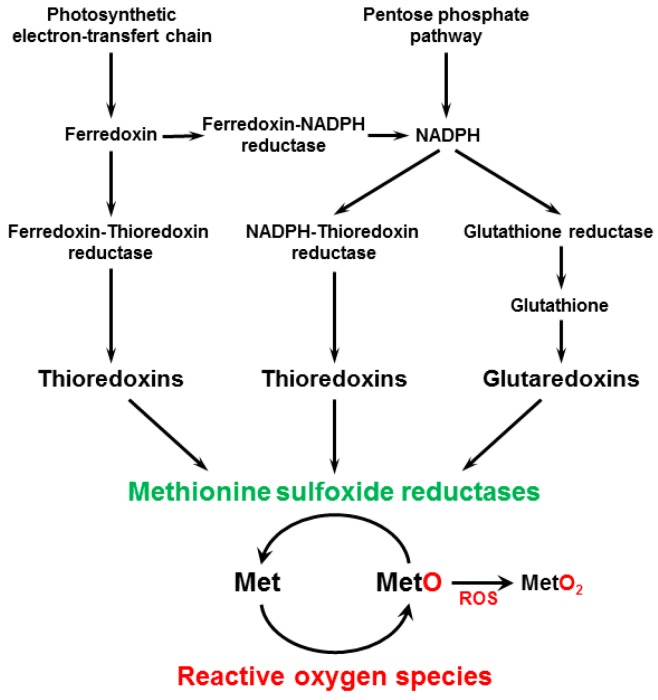
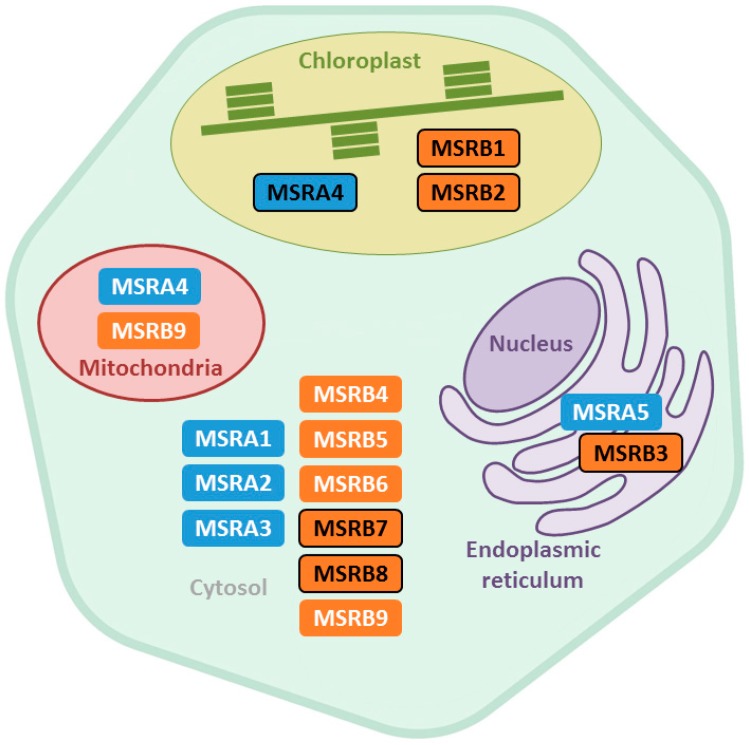
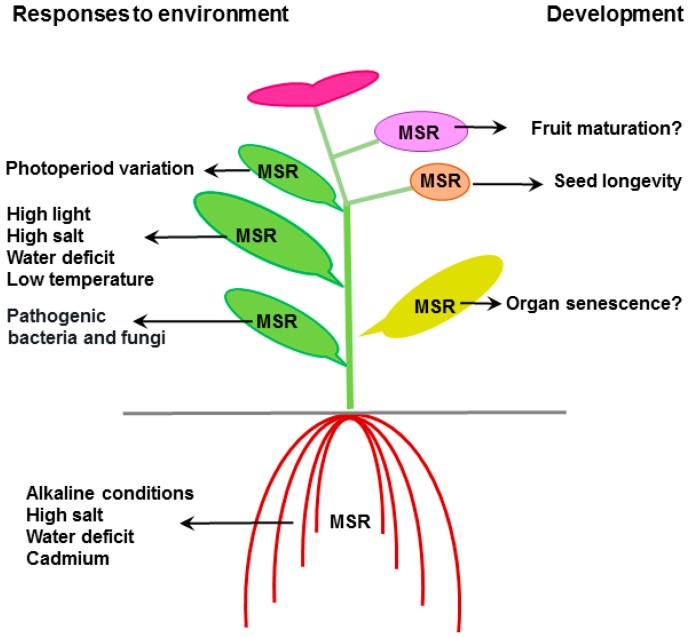
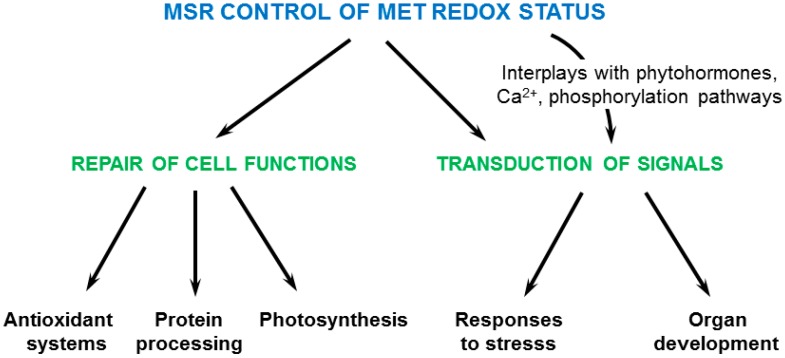
Oxidation of methionine (Met) leads to the formation of two S- and R-diastereoisomers of Met sulfoxide (MetO) that are reduced back to Met by methionine sulfoxide reductases (MSRs), A and B, respectively. Here, we review the current knowledge about the physiological functions of plant MSRs in relation with subcellular and tissue distribution, expression patterns, mutant phenotypes, and possible targets. The data gained from modified lines of plant models and crop species indicate that MSRs play protective roles upon abiotic and biotic environmental constraints. They also participate in the control of the ageing process, as shown in seeds subjected to adverse conditions. Significant advances were achieved towards understanding how MSRs could fulfil these functions via the identification of partners among Met-rich or MetO-containing proteins, notably by using redox proteomic approaches. In addition to a global protective role against oxidative damage in proteins, plant MSRs could specifically preserve the activity of stress responsive effectors such as glutathione-S-transferases and chaperones. Moreover, several lines of evidence indicate that MSRs fulfil key signaling roles via interplays with Ca2+- and phosphorylation-dependent cascades, thus transmitting ROS-related information in transduction pathways.
Overview
The claims and statistics of this paper haven’t been checked yet.
Run the check — free, no account needed. It reads the open-access text and checks the sources it cites.
Integrity signals
Registry
Cites
Statistics
Figures
Verification
Claims the paper makes
The claims and statistics of this paper haven’t been checked yet.
Run the check — free, no account needed. It reads the open-access text and checks the sources it cites.
Self-check
Percentages, sums and reported differences re-computed from the paper’s own numbers.
The self-check needs the paper’s full text.
Citations
Cites
S ALT AND D ROUGHT S TRESS S IGNAL T RANSDUCTION IN P LANTS
Zhu, J. (2002) · Annual Review of Plant Biology · doi:10.1146/annurev.arplant.53.091401.143329 · Cited by 5,808
ROS as signalling molecules: Mechanisms that generate specificity in ROS homeostasis
D'Autréaux, B., & Toledano, M. B. (2007) · Nature Reviews Molecular Cell Biology · doi:10.1038/nrm2256 · Cited by 3,642
Reactive oxygen species, abiotic stress and stress combination
Choudhury, F. K., Rivero, R. M., Blumwald, E., & Mittler, R. (2016) · The Plant Journal · doi:10.1111/tpj.13299 · Cited by 2,647
Wasternack, C., & Hause, B. (2013) · Annals of Botany · doi:10.1093/aob/mct067 · Cited by 2,629
Oxidative Modifications to Cellular Components in Plants
Møller, I. M., Jensen, P. E., & Hansson, A. (2007) · Annual Review of Plant Biology · doi:10.1146/annurev.arplant.58.032806.103946 · Cited by 1,994
The oxidative environment and protein damage
Davies, M. J. (2005) · Biochimica et Biophysica Acta (BBA) - Proteins and Proteomics · doi:10.1016/j.bbapap.2004.08.007 · Cited by 1,392
A Dynamic Pathway for Calcium-Independent Activation of CaMKII by Methionine Oxidation
Erickson, J. R., Joiner, M.-L. A., Guan, X., Kutschke, W., Yang, J., Oddis, C. V., Bartlett, R. K., Lowe, J. S., O'Donnell, S. E., Aykin-Burns, N., et al. (2008) · Cell · doi:10.1016/j.cell.2008.02.048 · Cited by 1,122
ROS-related redox regulation and signaling in plants
Noctor, G., Reichheld, J., & Foyer, C. H. (2017) · Seminars in Cell and Developmental Biology · doi:10.1016/j.semcdb.2017.07.013 · Cited by 914
How calmodulin binds its targets: sequence independent recognition of amphiphilic α-helices
O’Neil, K. T., & DeGrado, W. F. (1990) · Trends in Biochemical Sciences · doi:10.1016/0968-0004(90)90177-d · Cited by 841
Xia, X., Zhou, Y., Shi, K., Zhou, J., Foyer, C. H., & Yu, J. (2015) · Journal of Experimental Botany · doi:10.1093/jxb/erv089 · Cited by 721
Cited by
Sorted by citations
Items 101–106 of 106
Post-translational modification-regulating biomaterials for regeneration
Abudousu, A., Tang, Y., Liu, B., Xiang, L., Wang, Z., Li, Y., Zhao, D., & Cui, W. (2026) · Bioactive Materials · doi:10.1016/j.bioactmat.2026.07.020
The Nuclear Redox Code: Orchestrating Growth, Development, and Stress Resilience
Huang, F., Lv, H., & Wu, F.-H. (2026) · Plant Cell & Environment · doi:10.1111/pce.70818
Batel, A., Major, N., Anđelini, M., Išić, N., Kovačević, T. K., Ban, D., Pasković, I., & Ban, S. G. (2026) · Plants · doi:10.3390/plants15172652
Marok, M. A., Marok-Alim, D., Henri, P., & Rey, P. (2026) · Research Square · doi:10.21203/rs.3.rs-10010843/v1
Self-citationRedox regulation of plant hormone signaling transduction
Jing, P., Li, S., Chen, B.-H., Wu, J.-X., Li, L., Liao, C., Yang, H., Lu, K., Song, R., & Liu, W. (2026) · Journal of Plant Physiology · doi:10.1016/j.jplph.2026.154892
Kato, L. S., Fonseca, E. K. B., da Silva, V. H. C., de Andrade, D. C., Cruz, G. C. D. F., Pedrobom, J. H., & Arruda, M. A. Z. (2026) · Journal of Agricultural and Food Chemistry · doi:10.1021/acs.jafc.6c09256
Metadata
- Authors
- Rey, P., & Tarrago, L.
- Affiliations
- Centre National de la Recherche Scientifique (FR)
- Corresponding author
- Rey, Pascal
- Venue
- Antioxidants
- Publisher
- MDPI AG
- Published
- 2018-08-29
- Volume
- 7
- Issue
- 9
- Pages
- 114
- ISSN
- 2076-3921 (ISSN-L)
- PMC
- PMC6162775
- OpenAlex
- W2889182229
- Cited by
- 102
- References
- 142
- Citations by year
- 2026: 13 · 2025: 8 · 2024: 16 · 2023: 9 · 2022: 14 · 2021: 18 · 2020: 14 · 2019: 8 · 2018: 1
- FWCI
- 1.01
- Type
- journal article
- Language
- en
- Open access
- gold
- dx.doi.org
- Licence
- Locations
- Antioxidants (publishedVersion, cc-by)
- Europe PMC (PubMed Central) (publishedVersion, other-oa)
- PubMed Central (publishedVersion, cc-by)
- PubMed (publishedVersion)
- HAL (submittedVersion, cc-by)
- HAL Portal Artxiker (Hindustan Aeronautics Limited (India)) (submittedVersion)
- DOAJ (DOAJ: Directory of Open Access Journals) (submittedVersion)
- Topics
- Life Sciences › Biochemistry, Genetics and Molecular Biology › Molecular Biology › Redox biology and oxidative stress
- Life Sciences › Agricultural and Biological Sciences › Plant Science › Plant Stress Responses and Tolerance
- Life Sciences › Agricultural and Biological Sciences › Agronomy and Crop Science › Nitrogen and Sulfur Effects on Brassica
- Keywords
- methionine sulfoxide reductase, methionine sulfoxide, redox homeostasis, redox signaling, plant stress response, protein oxidation, seed deterioration, glutathione S-transferase, molecular chaperones, calcium signaling, phosphorylation, reactive oxygen species, redox proteomics, abiotic stress, biotic stress, plant mutants
About these checks
Registry, retraction, Cites and statistics results are computed, not judged, with one exception: a printed reference that no index lists is read once by a model before it counts as a citation error. Claims are extracted by a model and kept only when their quote appears verbatim in the text; each cited source is then checked, with a model’s help, for whether it says what the claim relies on. Those verdicts can be wrong — read the claim’s quote and the cited source before relying on one.
Statistics and arithmetic are recomputed, not judged.
Confidence bands are shown only for fields calibrated on our annotated test set. None is calibrated yet, so no band is shown.
What counts as a claim ›How we measure confidence ›How we check this ›
Are you an author, or do you see a problem with this page? Request a review
